Bob Schwartz

Category: Society

Fish and Assault Weapons

Fish Head Bullet Weights
Tomorrow, Barack Obama unveils a series of proposals to curb gun violence. Among them is likely to be a reintroduction of a federal ban on the sale of assault weapons, a ten-year prohibition that expired in 2004. Many are pessimistic, believing that such a measure might pass the Senate, but will certainly not make it through the House.

There is a fair amount of discussion about whether people hunt with assault weapons, and if they do, whether they should. It’s a good question, but not nearly as fascinating as the eccentric question of whether people fish with assault weapons.

The short answer is that up until a few years ago, two states did allow fishing with guns. New York State has since repealed its law, leaving Vermont as the only state where you can legally shoot fish (in a lake, but presumably still not in a barrel—except in the privacy of your own home).

Spring hunting for pike is in fact a Vermont tradition. Here is the law:

Vermont Statutes
Title 10: Conservation and Development
Chapter 111: FISH

§ 4606. Taking fish by unlawful means

(e) In Lake Champlain pickerel, northern pike, carp, garfish, bowfin, mullet, shad, suckers, bullhead, and other cull fish may be taken from March 25 to May 25 by shooting and spearing in other than spawning areas designated under section 4140 of this title. For the purposes of this subsection, Lake Champlain includes all connected waters at the same level.

Gun experts do not generally advise shooting in water at all, for the safety of bystanders. But if you do plan to set your sites on Lake Champlain fish, it is likely that assault weapons will still be legal this spring, so nothing other than a sense of fairness, or good sense in general, should be stopping you.

Metta New Year

Enso 1

The Metta Sutta—the Buddha’s Discourse on Loving Kindness

This is what should be accomplished by the one who is wise,
Who seeks the good, and has obtained peace.

Let one be strenuous, upright, and sincere,
Without pride, easily contented, and joyous.
Let one not be submerged by the things of the world.
Let one not take upon oneself the burden of riches.
Let one’s senses be controlled.
Let one be wise but not puffed up and
Let one not desire great possessions even for one’s family.
Let one do nothing that is mean or that the wise would reprove.

May all beings be happy.
May they be joyous and live in safety,
All living beings, whether weak or strong,
In high or middle or low realms of existence.
Small or great, visible or invisible,
Near or far, born or to be born,
May all beings be happy.

Let no one deceive another nor despise any being in any state.
Let none by anger or hatred wish harm to another.
Even as a mother at the risk of her life
Watches over and protects her only child,
So with a boundless mind should one cherish all living things.
Suffusing love over the entire world,
Above, below, and all around, without limit,
So let one cultivate an infinite good will toward the whole world.

Standing or walking, sitting or lying down,
During all one’s waking hours,
Let one practice the way with gratitude.

Not holding to fixed views,
Endowed with insight,
Freed from sense appetites,
One who achieves the way
Will be freed from the duality of birth and death.

The World Makes Sense Of America, One Front Page At A Time

COL_EC
The Newseum in Washington, D.C. is America’s news museum. It is a valuable resource that fortunately offers a lot of online content. One of its focuses is the still alive and kicking medium of print newspapers, and the Newsuem offers something that highlights one unique feature of these supposed media dinosaurs. Each day the Newsweum collects the front pages of hundreds of American and global papers and makes them available digitally.

For particular eventful days, like 9/11, the Newseum archives those front pages for posterity. The archive for Saturday, December 15, 2012, the day newspapers first reported about Sandy Hook, is particularly enlightening. Most nations had at least one front page featuring the story. American gun culture is so singular, even in places undergoing short-term or protracted states of war, that the stories mix perplexity with maybe some sense of “we’ve got plenty of problems, but this ain’t one.”

Even for those who love a well-crafted Web page or mobile screen, newspaper front pages remain an expressive art form, a story before and within the story. This is at its truest and most challenging in the face of big events.

The one above is from Medillin, Colombia. Medillin is the country’s second largest city and the infamous home of the Medillin drug cartel, which for about two decades terrorized the nation. Medillin is no stranger to brutality and guns.

The headline reads: “Golpe Al Alma de Estados Unidos”. Blow to the Soul of the United States.

Here are a few more:

Austria
Austria
Has America Learned from the Pain This Time?

PanamaPanama
Massacre
BelgiumBelgium
Bloodbath in Kindergarten
BrazilBrazil
Why?

God Does Not Like Guns

William Strutt - Peace
God does not like guns. God is also not crazy about nuclear weapons, and about all the easy to use and widely available tools of destruction in between.

This isn’t obvious. As scholars of religion and violence point out, the Old Testament is a compendium of both divine and divine-inspired and endorsed human mayhem. In the continuing battle against moral evil, which often has a religious component or context, the imperative to take up arms goes unquestioned among some, but not all. Finally, an entire eschatological theology is based on a battle that ends and transcends history as we know it, leading once and for all to the heaven on earth we have all been awaiting.

Let us pull back to the now and here, particularly last night in Newtown, Connecticut, where clergy of all faiths talked about God, if not for God.

The events in Newtown opened up a door to a new world. It was not Armageddon in an epic sense, but it was the end of the world for some, and everyone felt that. The door is a passage to the place where we leave the theology of the Second Amendment behind, where we stop listening to the priests of the National Rifle Association and their interpretations of what the founding gods meant.

This is the time to extend last night in Newtown to every congregation in America. There, leaders will explain to congregants whether God loves guns, and particularly whether God loves guns in such massive quantities and destructiveness.

The leaders can then cite Isaiah 11, and explain how “a child will lead them” is not merely some hermeneutic puzzle pointing to a messiah. Instead, it is reflected in the instruction by Jesus: “Let the little children come to me, and do not stop them; for it is to such as these that the kingdom of heaven belongs.”

The leaders will close by acknowledging that the faithful congregants will hear and themselves espouse practical arguments that stand in the way. Leaders will then patiently explain that all faith is ultimately impractical and heedless of impossibility. God does not like guns, but as his instruments, we are bound to do the worldly work of reducing their number and universal availability. If we claim to be faithful, that is more than just a good deed. It is a divine mission. God, it appears, will be more disappointed than ever if we fail.

If Not Now When: Today Is the Day to Talk About Guns

National Rifle Association - Newtown
In the immediate hours after the Newtown, Connecticut shootings, Presidential spokesman Jay Carney was asked whether this would move the President on the issue of gun control. “Today is not the day to talk about guns,” he replied. The focus, he said, should be on the victims and their families.

A few massacres ago, around the time of the Colorado movie theatre shootings, that sounded better. The boldness of those activists wanting to instantly seize the moment and make a point about gun control seemed insensitive. There would be time enough, soon, to talk about public policy.

“Today is not the day,” doesn’t sound so good or so responsible any more. Whether or not we go for years without another incident like this, or whether, as is more likely, it is a matter of a few weeks or months, the day to talk is today.

The National Rifle Association and the related Second Amendment groups are the most powerful and successful lobby in modern America. Grover Norquist is a pretender, thinking that his threats of losing elections have changed America. As much as Americans hate taxes, many love having their guns, and the NRA has helped those Americans get them, keep them and be allowed to use them.

The NRA’s biggest, though not only, problem is that they have constitutional paranoia. They perceive even the slightest hint of regulation as the first step on a slippery slope. That paranoia has mutated and spread to politicians of almost all types. Except that those politicians aren’t pathologically afraid of guns being taken away; they are pathologically afraid of losing their jobs.

Fortunately for him, the President just got his contract renewed for four years. Even if he has something to propose that won’t get the support of his own party, let alone Republicans, even if what he proposes will have trouble passing constitutional muster, that should not stop him, if he is the man of principle we believe him to be.

The dead can’t vote, and in the case of the children killed today at Sandy Hook Elementary School, they weren’t old enough anyway. So we have to speak for them and vote for them. Today is the day. President Obama, lead us and show us what to do.

Reductio Ad Scalia

Justice Antonin Scalia
Supreme Court Justice Antonin Scalia was asked yesterday why his writings compare homosexuality to bestiality and murder. Answering a Princeton freshman, Justice Scalia said:

“It’s a form of argument that I thought you would have known, which is called the ‘reduction to the absurd’. If we cannot have moral feelings against homosexuality, can we have it against murder? Can we have it against other things?”

(“I thought you would have known” seems a bit of a put down. This may have something to do with Justice Scalia having attended Georgetown undergrad, as opposed to Justices Samuel Alito, Sonia Sotomayor and Elena Kagan, all of whom attended Princeton.)

This is a common theme in the logical argument against cultural and moral relativism, particularly when it comes to homosexuality. And it is a provocative argument, as far as it goes. If we are to make no moral judgments about sexuality, then each and every type and instance of behavior is a matter of choice—polygamy, bestiality, you name it. Once we admit morality, we are broadly entitled to hold to it and the distinctions we make, even in the face of popular disagreement.

This is something worth thinking about as we make private and public policy, but it is far from dispositive. Some think we are at our best and doing our best when we hold strictly—including the “strict” construction of the Constitution, or for that matter of the Ten Commandments. But the real world has a funny way of demanding flexibility and fluidity from our philosophers, lawmakers, law interpreters and enforcers.

So Justice Scalia is not entirely wrong. He and all of us are, to avoid the absurd, allowed to attach particular values to homosexuality, bestiality, polygamy, divorce, whatever. There are probably still some out there who believe that slavery is moral; we know at least that it still thrives in the world. As for killing, morals differ for different circumstances; if not we would have outlawed killing entirely, or would admit that we don’t make a clear enough distinction when we seem to be legislating hypocritically.

But the story doesn’t end when we prove logically that different morals are legitimate. In the real world, people suffer at the hands of our “moral feelings” as Justice Scalia calls them. In some ways, it’s always about the suffering. In the face of “moral feelings” among some that there was nothing wrong with slavery, much of America agreed to its greatest national conflict to relieve an equally great suffering. Those who have legitimate “moral feelings” about homosexuality and marriage might want to be weighing their profound discomfort against the suffering of millions, not to mention against the arc of history.

The Story of the Generals: Prurience or Public Interest? Desperately Needed Break?


I see a little silhouetto of a man,
Scaramouche, Scaramouche, will you do the Fandango?
Thunderbolt and lightning, very, very frightening me.
Queen, Bohemian Rhapsody

Responsible media personalities have had to admit that they are hanging on every detail of the The Story of the Generals, even as they question whether private behavior, however crazy, however famous the players, rises above the level of celebrity gossip.

That’s a great and important question—in general. But in this particular case, something is happening. The details are growing exponentially, to the point that every story about it, even in this up-to-the-microsecond digital news age, is old the moment it is published. And practically all of the revelations have a public facet. It was tantalizing to learn that Jill Kelley had an identical twin sister who, among other things, was involved in a bitter child custody battle that ended with her losing custody and being branded “psychologically unstable” by the judge. It was another thing entirely to learn that both General Petraeus and General Allen had written letters to the court supporting her. And it was still another thing to learn that this sister’s ex-husband at one time worked for the Coalition Provisional Authority in Iraq.

On the public-private scale, stories all deserve the benefit of the doubt that leans toward privacy, and it’s better to err on that side. That’s what all of us would want for ourselves and our families. But this story sits at a previously unknown nexus of the strange personal and strange public. It is sui generis (and if it turns out not to be one of a kind, we are in serious terra incognita). We are stuck being unable to extricate prurience from public interest until we know it all, or at least much more. The evidence is compelling that there is something here we might deserve to care about as citizens, not just as voyeurs.

One of the other factors that plays into the fascination with this story is that we need a civic break. That is no comfort for the genuine pain that surrounds it, nor is it an acceptable excuse for prying. But it is a fact. We are supposed to immediately care about how we will resolve the looming fiscal crisis, about who is in leadership positions in Congress, about why Mitt Romney lost and Barack Obama won, about who will be running in the 2016 Presidential race, etc. Enough, for just this moment, is enough. Yesterday brought two horrific reports, one from Arizona about a Romney supporter who ran over and critically injured her husband in a parking lot because he had failed to vote, another from Florida about a man who committed suicide because Obama was re-elected.

That’s a reason we can’t get enough of this story, and miraculously, the story keeps growing to distract us in unimaginably original ways. And who knows? Maybe while we are so distracted, those who are elected to solve our problems—and a few who lost their jobs because they didn’t—will take the opportunity while we aren’t looking to start solving them in a cooperative way. That would be a much shinier and more substantial story to mesmerize us.

4th of July, Asbury Park (Sandy)

Who’s the boss?

The challenge of being a pop culture maven is that songs, movies and TV shows are regularly running around in your head, just waiting for a hook in the other real world. Then something happens and the connections light up, seemingly by themselves.

As soon as it was certain that the storm would hit the Jersey shore, Bruce Springsteen’s 4th of July, Asbury Park (Sandy) became the involuntary soundtrack. It is from his career-making second album, The Wild, The Innocent & The E Street Shuffle.

It is a sweet and melancholy song, more folk than rock. It seems to be about leaving a girl behind, but as Springsteen has explained, it is about leaving Asbury Park behind:

And me, I just got tired of hangin’ in them dusty arcades, bangin’ them pleasure machines
Chasin’ the factory girls underneath the boardwalk where they all promise to unsnap their jeans
And you know that tilt-a-whirl down on the south beach drag
I got on it last night and my shirt got caught
And they kept me spinning, babe, didn’t think I’d ever get off…

Did you hear the cops finally busted Madame Marie for tellin’ fortunes better than they do
For me this boardwalk life is through, babe
You ought to quit this scene too

All this (Sandy the storm, Sandy the girlfriend, the Jersey shore, Bruce Springsteen) prompted the question: Between events and people, who’s the boss?

The reflexive answer in the face of natural disasters like this is that events are in charge. As true as that may be, the parallel truth is that when people claim dominion, by building boardwalks and impossibly complex cities, people are in charge too.

Stewart Brand’s Whole Earth Catalog was one of the big inspirations in Steve Jobs’ life and career. In the 1969 issue of the Catalog, Brand stated the premise for his project to help people understand whole systems and master the tools to build and maintain them in an enlightened way. As we rebuild and reflect after Sandy, this is worth keeping in the mix:

We are as gods and might as well get good at it.

The Book On Lying


“Truthfulness can be required even where full truth is out of reach.”

In a season of seeming lies, there is only one book to read.

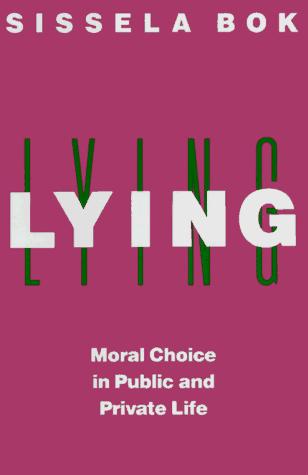
Sissela Bok’s classic Lying: Moral Choice in Public and Private Life (1978) is the essential work on the topic. At the time of its publication, no philosopher had tried to create such a brief, readable and accessible analysis. It has not been done better since.

This book was widely read and debated when it was published in 1978. That’s not surprising. Watergate was still a fresh presence in our public life. Before that crisis, people suspected—even expected—that some politicians were engaged in lying. Discovering the President and his inner circle all engaged in high-level big-scale deception confirmed the worst suspicions.

Bok begins with some fundamentals:

“I shall define as a lie any intentionally deceptive message that is stated….The moral question of whether you are lying or not is not settled by establishing the truth or falsity of what you say. In order to settle this question, we need to know whether you intend your statement to mislead.”

“As dupes we know what as liars we tend to blur—that information can be more or less adequate; that even where no clear lines are drawn, rules and distinction may, in fact, be made; and that truthfulness can be required even where full truth is out of reach.”

“When we undertake to deceive others intentionally, we communicate messages meant to mislead them, meant to make them believe what we ourselves do not believe.”

She analyzes some of the justifications that arise in special circumstances, as when we believe we are justified in lying to liars or lying to enemies:

“Enemies, through their own unfairness, their aggressive acts, or intentions, have forfeited the ordinary right of being dealt with fairly.”

“For the harm from lies to enemies is peculiarly likely to spread because of this very casual way in which enemy-hood is so often bestowed. Most claims that lies to enemies are justified would not then stand up in the face of reasonable scrutiny.”

Bok makes it clear that even when seemingly justified, all lies of all kinds have moral consequences:

“Because lines are so hard to draw, the indiscriminate use of such lies can lead to other deceptive practices. The aggregate harm from a large number of marginally harmful instances may, therefore, be highly undesirable in the end—for liars, those deceived, and honesty and trust more generally. One can’t dismiss lies merely by explaining that they don’t matter. More often than not they do matter, even when looked at in the simple terms of harm and benefit.”

The Day We Discovered the Gamers


It’s a cliché from a hundred movies: Right before the wedding, the father of the bride looks over at his daughter and discovers something: the little girl is all grown up. This isn’t the day she grew up; that has been going on all along, for years. This is just the day he learned that.

Sean Smith, the Libyan embassy officer killed yesterday along with Ambassador Chris Stevens and two others, was also a world-class online gamer. In the 400,000-member EV Online community, where his name was Vile Rat, he was known as perhaps the greatest of all space diplomats. Most did not know that was what he did in his other life.

The community responded immediately and in force. Members gave assurances that his family would be supported, including making sure that his children went to college. In the digital world, space stations were named in his honor.

Those two things may not make sense together to some, but it is fitting. There is an image, outdated if it was ever true, that digital gaming is filled with socially inept people, mostly men, suffering from some form of arrested development. To the contrary, just ask the digital gaming industry, which is reaping the rewards of one of the few truly healthy entertainment genres. Or ask the millions who are citizens of the communities, who are also grown-up, responsible men—and women—who live complete and complex non-digital lives.

Or ask the wife and young children of Sean Smith, who may or may not have understood the different way he was important as an online diplomat, esteemed member of that community, and friend to thousands who had never met him. As one member posted, it is a “stupid game” that stands in the shadow of Sean Smith’s real world contributions and passing. But the gaming itself and the community it fostered is not stupid.

This is the day we learned that.