Bob Schwartz

Category: Society

Online Gambling and Real Life Guns: It’s About The Children

sheldon-adelson-615cs013012
A team of highly-paid ex-politico lobbyists are out there arguing against proposed bills in Congress to allow Internet gambling. Under one of these bills, a 12% tax would be shared between the federal and state governments, 4% and 8% respectively. That would be a lot of revenue in these hard times.

Gambling is an American and ancient tradition. Lotteries helped fund the American Revolution, which makes them practically sacred. In this case, the main opponents of digital gaming for money are the wealthy owners of real-world casinos and establishments, most visibly billionaire Sheldon Adelson, who helped bankroll Mitt Romney’s quest for the Presidency. No surprise there. The practice of online gaming, which already goes on with offshore sites, would expand dramatically, leaving bricks, mortar and showgirl spots with a severely reduced market.

Some of the arguments against the bills are, on their own terms, not entirely unpersuasive. Gambling does support hospitality and tourism, and if the already declining dollars drop further, there are going to be folks who lose their jobs in this challenged economy. It’s not clear that the entrepreneurs getting rich off this have the will and creativity to come up with substitute businesses that would replace those jobs. Gambling is also already a social problem, damaging lives and families, and what is bad gets worse with increased volume. The final big argument is, naturally, about “the children.” No matter what we try to do, the online environment is notoriously freewheeling, and there is no question that underage players would find a way to play, just as they get cigarettes and alcohol.

On the tourism question, cultural and social trends have always left some forms of entertainment and diversion behind while other new or more appealing ones prospered. Either you believe overall in the free market or not. People who say that government shouldn’t be picking winners and losers shouldn’t be telling the government to pick winners and losers.

Out of control gambling can be pernicious, no doubt about it. But the argument, one actually made, that the poorest in society would be unfairly burdened by the attraction of online gambling is under current realities absurd. First, because it is not clear that all the opponents of online gambling care so very much for the lower tiers of American society. Second, because government already endorses, promotes and profits from easy-access gambling that does weigh on the most vulnerable—the lotteries. With all the strains on government budgets, it is unimaginable what state some states would be in without those gaming dollars.

Then there is the ultimate trump card: the children. That score is easy to answer. On the scale of things kids shouldn’t be allowed to do, alcohol is number 2, tobacco is a close number 3, and then comes gambling. Number 1 is easy. Children should not have guns, should not live in an environment where guns are widely available and acceptable, and where guns are regularly used to shoot, injure and kill innocent people—including children.

So if you happen to see or hear any of those lobbyists shilling for Sheldon Adelson and his ilk, talking about how it is about “the children” and how we must protect them from the evils of playing online poker or placing a digital bet on an NFL game, ask them if guns aren’t a tad more dangerous, and ask them what they’ve done to seriously reduce the ubiquity of those guns and to eliminate the personal and social costs that those guns have inflicted on all of us.

There likely won’t be a good answer, at least not one that isn’t laced with equivocation, hypocrisy and protests of irrelevancy. It is relevant. Ask them to put the two side by side, the harm to children from online gambling and from guns, and tell them that the billionaires are free to make billions more on their casinos—just as soon as the guns get put away.

Reviving Emerson

Ralph Waldo Emerson
It is time to bring Emerson back from the dead and ignored.

Up until the late 20th century, at least one of Ralph Waldo Emerson’s essays—usually the one titled Self-Reliance—was a staple of many high school curricula. So was the work of his fellow 19th century Transcendentalist Henry David Thoreau—though it was mostly Thoreau’s nature paean Walden, rather than On the Duty of Civil Disobedience. Maybe they are still there, but with our changing definition of what constitutes an American liberal arts education—if we consider that worthwhile at all—they have likely disappeared.

In the middle of the 19th century, the philosophical/political/religious/social/literary movement known as Transcendentalism gave birth to new ways of thinking and acting in America. Among the many intellectuals and activists associated with it, such as Thoreau and Margaret Fuller, none was more famous or prolific than Emerson. Transcendentalism gave new legitimacy to questioning the authority of convention and history. In the 1960s we would call this counterculture, and it is no coincidence that Thoreau became a guiding light to many in that generation.

Books and essays by the hundreds are devoted to Transcendentalism (see this entry from the Stanford Encyclopedia of Philosophy). They agree that pinning down exactly what Transcendentalism was and what it became over the years is a challenge. The same is said about Emerson, who unapologetically might contradict himself or change particular views over time.

With all that fluidity and vagueness, a few points of it are clear. According to Transcendentalism, we are driven to improve and grow, to aspire and rise higher. What drives us there is spiritual, but not in any conventional, narrow or simplistic sense. What we do is as important as what we believe and say. We must act, believe and speak as individuals, but knowing the nature of our particular individuality requires work and solitude. This life, this world, this existence are all-encompassing processes and not things—a concept that would later be refined as  a core of modern philosophy, but that had its origins in the most ancient roots.

All of the work of the Transcendentalists is in the public domain and widely available free online. Though more people are familiar with Thoreau, or at least some of his concepts, Emerson is a good place to start. In his Essays (First Series) you will find Self-Reliance. In it you will find what we might consider a libertarian distrust of the crowd and of the government, something shared with Thoreau. But this is an enlightened sort of selfness, different than modern mutations, because it makes no distinction between the one and the all, that is, if I do what is good for me but is not good for all, it is by definition no good at all. Figuring out how that exactly works is the mission of the Buddha, of Jesus, of just about every philosopher who urges us to find our unique self and act in the benevolent context of community, country and cosmos. Emerson was one of the first to say this in American, as an American, in America. Maybe he got lost in the rush to the shiny and new, but he’s still there, just waiting to be discovered.

Which Comes First: Evolution or Revolution?

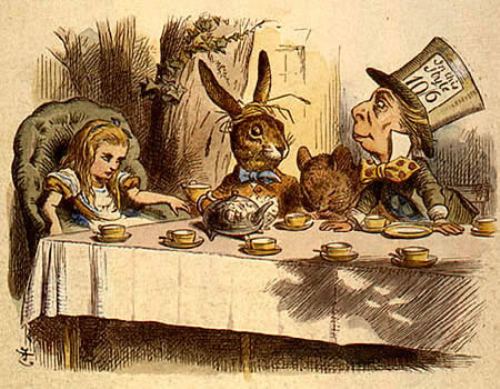
Tea Party
The 20th century gave us two world wars and an atomic bomb, but the most interesting of the Big Events of the century may be the Russian Revolution. An inequitable and unbalanced way of life gave bloody way to abstract enlightened visions of a better world. The particular inequities ended, Russia moved into modern times, but competition for the “right” vision and ineradicable baser human natures seeking power and control led to decades of national and global troubles. “Meet the new boss, same as the old boss,” the Who said.

The Russian Revolution was grounded in a Marxist vision, which was in turn a Christian vision: a community on earth as it is in heaven, a brotherhood of people in which suffering and want would be softened, if not alleviated, by those who have a surplus of comfort and resource. It was Lennon, not Marx, who said, “You can say I’m a dreamer, but I’m not the only one. I hope someday you’ll join us, and the world will live as one.”

What went wrong?

What almost always goes wrong is that evolution and revolution are out of sync. It is easy to say that people and society should first evolve for a while, and then at some critical moment, all that’s needed is that next faster-than-evolution event to take it to the next level.

That turns out rarely to be the case.

Evolution is slow, erratic, and always engenders resistance and reaction. The cliché is that people and society fear change, but that is too easy. They fear the unknown. The expression “better the devil you know than the one you don’t” sums it up. It takes a substantial leap—you might say a leap of faith—the walk into a vision rather than remain in a lesser but familiar reality.

Revolution is both an attempt to make evolution more real and to create conditions where that evolution can continue more broadly and forcefully. But, as pointed out with the Russian experience, it doesn’t always work that way. Revolution is conflict, and conflict creates its own set of conditions sometimes antithetical to evolution. “Fighting for peace” is oxymoronic (some would say just plain moronic), but we have had to live through that. (Note the moment in Stanley Kubrick’s brilliant film Dr. Strangelove where the President scolds his arguing advisers, “Stop it. There’s no fighting in the War Room.”)

One of the exceptional examples of evolution and revolution working together is the American Revolution. It is one of the reasons it worked so well. The founders may have been the fathers of our country, but they were the children of the Enlightenment. That multi-faceted evolution—philosophical, political, economic, spiritual—had gone as far as it could go when it hit a wall. They believed that if they could break through, which did mean war, they could establish an enlightened nation. And, to an extent greater or lesser than some might like or expect, they did.

Evolution, or lack of it, is at the heart of some current American problems.

America is heir to two great evolutions, sometimes unrecognized, often distorted. Some of those obstructionists who fight today hark back to the patriots who were mad as hell and wouldn’t take it any more, and so upended a cargo of British tea. Others who claim this is a Christian nation have the idea that if alive today, Jesus would certainly choose to be an American.

Every American in these dynamic times is free to pick the evolution they aspire to. There are plenty to choose from. We do have two very big ones on the menu. If a rabid revolutionary patriot, you might choose to follow the path of a 21st century version of Enlightenment; you might even study the work of those founding Enlightenists—Jefferson, Madison, Monroe, et al.—for guidance. If a committed Christian it’s even easier. No slogging through the Federalist Papers, or even the whole Bible. Just read and read again the words of Jesus—the ones in red type—and consider just how much evolution he was asking for and expecting. Then again, maybe it’s not evolution he was talking about at all.

The Marijuana Dilemma: It’s About Age

Marijuana
This was going to be a note about the Gallup poll showing that 58% of Americans think that the use of marijuana should be legal, and that 38% have tried it. It would include arguments about how pot stands in relation to other legal intoxicants—alcohol, tobacco, firearms (sorry, that’s the federal law enforcement agency)—and about how our justice system is distorted and how lives are ruined by reflexive, thoughtless, moralistic public policy.

But no. This is about a simple solution. It won’t make everybody happy, particularly those hypocritical it’s-all-bad-for-you-and-society Puritans who apparently missed the Sunday School class where Jesus mentioned getting the log out of your own eye before criticizing someone else’s splinter. But this might work.

Add marijuana to the list of acceptable American intoxicants. Then take the three biggies—alcohol, tobacco and marijuana—and make their distribution to children, particularly younger children, an even bigger deal than it is, so that the jail cells currently filled with marijuana-guilty adults could then be filled by real bad guys. Draconian punishment. Because while adult use of these intoxicants may be equivocal, childhood use of them is not.

We did not need American alcohol prohibition to learn that nothing will stop people using intoxicants. (Another hint: sex, at least if you’re doing it right, is also an intoxicant, the world’s most popular and, yes, one that the Puritans have also tried to circumscribe.) In another missed Sunday School lesson, Jesus did not smash the jars at the wedding at Cana, as he did the moneylender tables at the Temple; he actually made more wine for the celebrants. The poor we have with us always; so too the wine drinkers.

It is widely agreed that none of the three intoxicants are perfect: all of them are abused, all of them have real potential for ruining life and health. (America’s other big intoxicant, coffee, is excepted from this discussion, in part because any regulation of coffee would start a national revolt that really would prompt a new party, the Coffee Party, and in part because it is coffee that makes posts like this possible.) But as much as adolescents want to indulge, and as much as they already find a way to do it, if there’s a beneficial bargain to be made, this may be it. Let the grownups smoke/drink/smoke, let them explain to their kids why it isn’t a good idea for the younger set.

If you are currently a pre-teen or teenager yourself, or you once were, and you indulge in weed or once did, this may seem silly, arbitrary and unworkable. Here’s the news: all social policy is ultimately unworkable, or at least challenging and perplexing. The truth is that marijuana abuse by adolescents, just like alcohol and tobacco abuse by them, really is a bad thing, and really can cause irreversible damage. Adults should be free to get blissed out or ruin their lives (with minimal harm to others); kids shouldn’t be. If we are going to have some sort of marijuana policy, it ought to be a lot more sensible than the one we have now, even if the solution isn’t perfect.
10:39 AM 10/23/2013

A Chilly Breeze of Hate, a Hungarian Conductor and the Prospects for American Anti-Semitism

Ivan Fischer
Those of us who grew up Jewish in late 20th century America had a pretty good experience of tolerance, certainly compared to even our parents’ generation. The Holocaust had an immunizing effect, not so much because people saw where such ugly expressions of hatred might lead, but because it was harder to hold those views—at least publicly. There was not an immediate spillover effect, so common prejudices against blacks, women, gays, and other intolerance “classics” continued, while new groups such as Muslims were added all the time. Hate takes no holiday.

The news was not without stories of anti-Semitism. And if we lived in certain parts of the country, we might be more likely to feel like a stranger, and even to hear somebody we liked talk about bargaining as “Jewing” someone down. Oh well, that was ignorance talking, and overall those folks often had a good heart. Maybe the greatest deterrent to taking it too seriously was the Jewish cohort who daily found an anti-Semite around every corner. It wasn’t that there weren’t and aren’t anti-Semites everywhere, including some positions of high profile and power, it’s just that the progress Jews have made in acceptance and mainstreaming made these anomalies. There were other groups still having a much tougher time.

A story from this weekend’s New York Times prodded that complacency, just a little. It comes not from America at all. It is from Hungary. There, anti-Semitism and nationalism are on the rise, to the point where the country’s most celebrated conductor, Ivan Fischer, has written and staged an opera about it. Called The Red Heifer, it is about a 19th century incident in which Jews were blamed for the murder of a peasant girl. But contemporary elements make clear that this is not a story about historical artifacts. The whole world context of the opera is not just Hungary; much of Europe, particularly but not entirely those in the former Soviet empire, are trying to establish new identities in these trying times. That insurgent identity frequently involves a broad menu of nationalistic intolerance. See, for example, the treatment of gays in Russia and the rise of neo-Francoism in Spain. And where there’s a list, Jews are on it. That doesn’t make sense, but not making sense is precisely the hallmark of all this.

It is no secret that certain kinds of intolerance are a little more obviously a part of American life today. There can, for example, be argument about whether the unprecedented disrespect and vitriol for the President is purely political. It isn’t, and most know, or should, that race is near the heart of the hate. Americans too are having hard times that may continue for a while. Even if the current crop of demagogues seems penny-ante compared to “real” American demagogues of the 20th century—the Huey Longs, the Father Coughlins, the Joe McCarthys, the George Wallaces—demagoguery it is. And if we hope and do transcend history, it may be that some things don’t or can’t change: where there’s a list, Jews are on it.

One of the saddest phenomena of recent years is the ultra-ironic sight of a Jewish vigilance about anti-Semitism bizarrely combining with near-paranoid anti-Islamism. E-mails have circulated praising Dutch nationalist politician Geert Wilders, who advocates keeping Muslims out of the Netherlands and out of all (supposedly) white and Western Europe, lest those white and Western values be despoiled, or worse. Why this appeals to some Jews may not be a mystery, but it is moral madness.

And yet. These are stressful times around the world; outside of war, the most stressful in generations. Distrust and fear of “the other” is bred in the human bone. We must work to rise above and to mutate it out. If you have any sense of history—and all of us should study to be amateur historians—you may at certain moments get a little instinct, a buzz, a foreboding that you hope is way off, one that might be as much about you as about the state of things, and thus should be shaken off. On the other hand, there is the cliché: just because you’re paranoid doesn’t mean that somebody isn’t out to get you.

Two truths co-exist in America. Public anti-Semitism has never been at a lower ebb, and will not return to earlier levels. Privately, the truth is that the vast majority of Americans have never met a Jew, and know little about Judaism except the occasional news story or that it is the primitive religious precursor to Christianity. That unknowing is not pernicious, even if it’s not ideal. But seeing what is going on in the rest of the world is a reminder that vacuums can be filled by suspicion, perplexing troubles need someone to blame, and this “other” or that “other” is just too convenient not to accuse.

For American Jews, it is overstatement to call this a chilly breeze. There is not much in the air at the moment. But intolerance is a funny thing. It has a life of its own, and it doesn’t always take the same course. Over-vigilance and paranoia can be counter-constructive and debilitating. This doesn’t mean that closing your eyes works either. What’s happening thousands of miles away is not happening here. But who’s to say who’s next, once the dogs of hate are let loose.

There are never enough occasions to repeat the famous words of Martin Niemöller, the Protestant pastor who was a public foe of Adolf Hitler and who spent years in concentration camps. In a sense it is his translation of Christian (and Buddhist) non-judgmentalism and non-dualism. If you think you are not different but/or are “the right kind” of different, you are mistaken.

First they came for the Socialists, and I did not speak out—
Because I was not a Socialist.

Then they came for the Trade Unionists, and I did not speak out—
Because I was not a Trade Unionist.

Then they came for the Jews, and I did not speak out—
Because I was not a Jew.

Then they came for me—and there was no one left to speak for me.

Bandon by the Sea and Living Forever

Continuum Center
This is about a beach town and the possibility of living forever.

Bandon is a small beach town (about 3,000 people) on the southern coast of Oregon. It is special because of its beauty and spirit, including extraordinary rock outcroppings and stacks of bleached drift logs that hover in the sun and occasional fog. It is also special because few know about it. It is far enough from anywhere—248 miles south of Portland, 465 north of San Francisco—that there are other tourist stops better known and, to some, more exciting.

Bandon 4

The New Age is an ignored topic that deserves more than this brief discussion. In the 1970s, the movement toward a new consciousness coalesced around the concept of a New Age, a new era of human enlightenment and evolution that would move us forward, leaving some of the darkest aspects of our sometimes-sorry history behind. This included not only spirituality and religion, but psychology, art, music, mythology, earth, food, sex—anything that could help transform us and the way we live. By name, “New Age” has fallen into disuse; but as a matter of fact, many of the ideas and expressions are now part of our cultural fabric.

In 1979, philanthropist Hugh Harrison visited the Continuum Exhibit at JFK University in California. The exhibit showcased the Immortality Principle, the possibility of consciousness continuing after death. He was impressed and put the exhibit on tour, and also established a home for it in Bandon, in a building on Main Street called the Continuum Center. It was a splendid multimedia exhibit, state of the art for its time.

Continuum Book
One of faces of the New Age movement that is powerful though sometimes mocked is its music. New Age music was once a common category, though it has fallen into disuse. No good cultural development goes untortured. New Age music at its start and at its best is an attempt to coax, drag, push, pull and otherwise move your consciousness by the ear. In less talented hands it has been oversimplified and underpowered, but no different than with any other musical genre.

When I walked into the Continuum Center in Bandon years ago, I saw the oversized graphics and read about a vision of consciousness. But the very first thing I noticed was the music playing. It was, it turned out, the sublime Angel’s Flight by Shadowfax, and it was the first New Age music I had ever heard. The pictures and text of that visit are a little indistinct in memory, but that song isn’t, maybe because I’ve listened to it a few hundred times since.

A recent visit to Bandon, for the first time in a long time, revealed that not much had changed, a good thing. Maybe it was not a surprise that the Continuum Center as an exhibit is gone. But the building is still there, transformed into a small shopping plaza, but as you’ll see above, the name remains. Spirit abides.

So if any of this is interesting, here’s what to do. Listen to Angel’ Flight and other transportive music by Shadowfax and other worthy New Age artists. Learn a little more about the possibilities of consciousness and change, if you aren’t already doing so. Does consciousness survive death? Who knows, but what a beautiful question.

Last but not least, if your travels take you to the Pacific coast, visit Bandon. Unlike the Continuum Center exhibit, which lasted a few years, the beach and rocks and waves go on and on and on, waiting for you. They will wait forever.

Relying on Ourselves and Not Rolling Stone

Rolling Stone - Tsarnaev

This is what upsets us? This magazine cover is our biggest problem?

As of today, some retailers—of those retailers who actually sell paper magazines any more—are refusing to the carry the new issue of Rolling Stone with a cover showing a youthful and attractive photo of Boston bomber Dzhokhar Tsarnaev. They, along with maybe millions in the socialsphere, are making a statement.

But what exactly is that statement, and why are they making it?

If it’s about not giving any more publicity to him, along with any coverage of the Boston bombing and the upcoming trial, you can make a case that that might be healthy for all of us. But since there’s been no call for less coverage, that can’t be it.

If it’s about continuing the coverage, but making sure the coverage only reflects one particular approach, what approach would that be, exactly? And if it’s about not “glamorizing” him, where is the directorate that is going to make sure that all photos, cover and otherwise, of the most despicable people look suitably evil and ugly?

We have reached a point, not unique in history but maybe more now than ever, where reaction to everything is often overtaking thought about everything. The theory of “the wisdom of crowds”—that individuals can be wrongheaded, but heads put together are self-correcting and frequently right—needs to be reconsidered, if not thrown out the window.

If this Rolling Stone cover is a threat to anything, we have a problem. If we think that this cover makes mass murder look “cool” and is a contributor to our social difficulties, we really don’t know what those difficulties are. If we think that we shouldn’t have magazine covers with social and political miscreants, the Magazine Cover Authority will have to make a much broader review of all publications, before they pass them on to the Magazine Content Authority.

We have to start relying on our own thoughts, and when that careful thinking leads to conclusions, on our own abilities to directly address what we find. If a Rolling Stone cover with Tsarnaev is emblematic of anything, it is that Tsarnaev is here, he did what he did, and we should be working on that, and not on choices that magazines make.

For more on self-reliance, you might read Ralph Waldo Emerson’s classic essay of the same name. There was a time when Emerson’s essays were widely taught in schools—back in the Stone Age, before America got so smart and well-connected, before we realized that science and technology were the key to the future, and that the musty, fusty words of some old fart from Boston really had nothing to offer us.

Whoso would be a man must be a nonconformist. He who would gather immortal palms must not be hindered by the name of goodness, but must explore if it be goodness. Nothing is at last sacred but the integrity of your own mind. Absolve you to yourself, and you shall have the suffrage of the world.
Ralph Waldo Emerson
Self-Reliance (1841)

George Zimmerman: Not Guilty. Responsible? Sorry?

George Zimmerman
It’s easy to see how we’ve come to confuse the legal and the moral. Here and everywhere, laws are put in place that offend a general or specific sense of what is right, so we tend to connect the two. We’re also so used to seeing the legal system in media that it occupies a lot of our thinking. Even though those movies and shows try to include moral dilemmas for lawyers and clients, it’s the law that intrigues and entertains us. We have not yet had a hit television show featuring a team of super-attractive philosophers hammering out the fine points of moral right and wrong.

George Zimmerman is not guilty, at least of the crimes charged in Florida. We are awaiting possible federal civil rights charges or a wrongful death civil lawsuit. But we have no official moral court, and so we can consider where he might stand before that bench.

Every minute, people around the world, people you know, maybe even you, cross some pretty bright moral lines, and we don’t put them in jail. Not that they don’t deserve to somehow be punished, but the legal system doesn’t fit the deed, and anyway, our prison overcrowding would be exponentially more critical.

There are lots of killings we allow or sanction, including self-defense, war and capital punishment. (It would be disingenuous and dishonest not to include abortion—not because it is or isn’t killing, but because from the moral perspective of some, it is killing that we legally allow, and we can’t have the already underserved moral discussion without at least mentioning it.)

George Zimmerman killed Trayvon Martin. It is an unrefuted, admitted fact. The legal system, in its first but maybe not last swipe at the situation, has found him not guilty of a particular crime. For the record, for those who think the justice system failed, be aware that it was never enough for the jury to believe that Zimmerman was a liar and that his version of the scenario made no sense at all. The jury could only convict on the basis of another, more damning scenario—a scenario many of us could easily imagine, but a scenario the prosecution could never paint from the evidence they had to work with. The jury is allowed to draw inferences but can’t just use their imagination the way we can.

George Zimmerman killed Trayvon Martin, and many of us have come to the reasonable, non-legal conclusion about how it happened. People who reach that conclusion want him to be punished, not just for retribution, but to prevent something like this every happening again. Even if further legal proceedings don’t end up punishing him, many have the clear sense that he crossed a moral line and he was very wrong. That’s something that gets lost in all the fascinating legal discussion. You don’t have to be guilty to be wrong. And ever if there isn’t some sort of moral jail, that is still a big deal.

Which brings us to the apology. Even giving credit to the Zimmerman account, the killing happened, he did it, and all the legal exoneration can’t take it back or make it better. Apologies have gotten an increasingly bad name; just look at how the Republicans used it as pejorative in describing President Obama’s early “apology tour” of the world. (It does make you wonder what home life is like for some of those politicians, who in the face of expected apology refuse, not wanting to seem weak or ineffectual. Marriage counseling alert.)

George Zimmerman should apologize to Trayvon Martin’s family. Fully and sincerely. In legal terms, he can’t, of course, since there are still proceedings possible or likely. In moral terms, though, experts say that the need to confess is the best friend of police and prosecutors, because truth is a heavy weight that needs lifting. He is actually half-way to a confession anyway, since we know he shot Trayvon Martin. He doesn’t even have to detail the circumstances in any way different than he has, even if it’s not true.

All he has to say is this: I shot him I killed him. Whatever the law says, I was wrong. I’m sorry.

Notes for a George Zimmerman Sermon

Pulpit
This is Sunday, the day after the night before when the George Zimmerman verdict was reached and announced.

There will be countless sermons preached in churches today about the meaning of the crime, the trial and the verdict. The quick take of the media has focused on black churches for obvious reasons. In a case easily seen as having a racial component, the anger and frustration has been color-blind, but members of the black communities have reason to have special interest, if not to take it personally.

That still leaves a large number of churches that are not predominantly black. or more broadly, not non-white, or more plainly, white churches. This isn’t a monolith, nor is this an easy case and verdict to digest. There will be pastors who openly question how well justice was done, others who distance themselves from judgment, and maybe others who find a vindication of something in the verdict. Many more will not touch it at all, either because it has nothing to do with what goes on in church or because even if it does, the right words aren’t yet found to be spoken.

Whatever the identity of those in the pulpits or the pews, here are a few points that might belong in a George Zimmerman sermon.

The laws written by people and the higher laws (whether you call them the laws of God or something else) are two different things. Human imperfection extends to our inability to do perfect justice. Not only is it impossible to do perfectly, it is impossible for people to conceive of how it would be done perfectly in some other “better” realm. If there is a heaven or heaven/hell combination, exactly what are those trials like and what do the statures and rules of evidence look like? Whether you picture the 10 laws, or the 613 laws, or however many laws and interpretive regulations being litigated against you or those you love or despise, how does that case go?

There are some suggested solutions that are widely preached but, let’s say, inconstantly practiced. If we admit we don’t know everything, can’t build everything, can’t “correctly” judge everything, then we might be stuck with just some one-size-fits-all answer: forgive. This doesn’t mean, in the case of George Zimmerman, giving up on changing the laws, or not pursuing further legal tactics such as a federal civil rights suit or a civil wrongful death suit, or being friendly to George Zimmerman if you see him on your street or on your tv screen. Those are the worldly things we should feel free to pursue if that is what’s in our hearts. But in our hearts, where those higher laws are supposed to find a home, we are better off working on the compassion and forgiveness stuff. Especially with a tragic death, when we are the living, still capable of making things better.

Imperfection. Compassion. Forgiveness. Especially in light of this case. Oh God, that is so hard to take.

What Sorts of Weapons Might George Zimmerman Now Carry?

Bandolier
Robert Zimmerman says that his brother George will now be “looking over his shoulder.” There has been plenty of angry and overheated rhetoric aimed at George Zimmerman in the wake of the not guilty verdict in the case of his killing Trayvon Martin. Whether or not he needs to be in fear of his safety and life, that is something he is going to have to reasonably decide—a decision he has experience with.

In case he does decide he needs extra protection, Florida statute gives him lots of options:

Title XLVI, Chapter 790
WEAPONS AND FIREARMS

790.06 License to carry concealed weapon or firearm.—
(1) The Department of Agriculture and Consumer Services is authorized to issue licenses to carry concealed weapons or concealed firearms to persons qualified as provided in this section. Each such license must bear a color photograph of the licensee. For the purposes of this section, concealed weapons or concealed firearms are defined as a handgun, electronic weapon or device, tear gas gun, knife, or billie, but the term does not include a machine gun as defined in s. 790.001(9). (emphasis added)

So now that George has gotten his handgun back, he doesn’t have to stop there. He is free to add a bigger handgun, a Taser, a tear gas gun, a knife or billie club—or all of them. This is Florida, right on the edge of the subtropics, so it is almost literally a jungle out there. If he chooses not to stay in Florida, which he might deem a good idea, he may feel more comfortable out West, where there are states with conceal carry laws even more accepting of the Zimmerman philosophy, and where standing your ground while armed to the teeth is historically a way of life on the frontier. He might begin a new career writing cowboy fiction, where phrases like “you got me!” would not be out of place.

That was the 19th century, of course, and this is the 21st, but unfortunately for the sometimes glacial advance of civilization, some things never seem to change. If anything, they can look like they are moving backward.