Bob Schwartz

Category: Religion

The Eight Ways of Hanukkah

happy-hanukkah

Hanukkah, which begins at sunset with the lighting of the first candle, may be the most interesting, confusing, and confused of Jewish holidays. Let me count the ways.

1. It is the most historic of the traditional Jewish holidays. The historicity of more important holidays is somewhat shrouded in antiquity, bible stories, and faith. We have a pretty good chronicle of the events commemorated by Hanukkah: the Jewish rebellion of around 163 BCE led by the Maccabee family against the Seleucid/Syrian occupiers of Israel.

2. The best chronicle of Hanukkah is found in the Books of Maccabees. Maccabees is found in the bible, but because of textual happenstance, not in the Jewish Bible. Books of Maccabees are part of the Roman Catholic and Eastern Orthodox bibles, and are apocryphal books of the Protestant bible. But the Jewish biblical canon (the books officially included) was closed before these books were available. So if Jews want to read this particular biblical story, they have to turn to Christian bibles. Not that there’s anything wrong with that.

3. Hanukkah is probably not just about the Maccabees. As with other holidays, including Christmas, it is likely a melding of other seasonal celebrations at that time of year.

4. Because Hanukkah is extra-biblical, it did not achieve the stature of other holidays. You will often see it referred to as a “minor” holiday. In baseball terms, though, Hanukkah is at least AAA minor league, that is, completely ready to play in the majors. Which, as it turned out, it kind of does.

5. How Hanukkah became a much more important holiday than ever is covered by the wonderful book Hanukkah in America. For one thing, the original story of the Maccabees is about fighting not just the occupiers but the tendency of Jews in that situation toward assimilation and Hellenization. This obviously resonated in America, where secular culture and particularly Christmas became a juggernaut.

6. The candelabra used on Hanukkah for the eight nights of lights is usually referred to, by Jews and non-Jews alike, as a menorah. This is not exactly right. A menorah is a lamp, more particularly the seven-armed lamp that is an abiding symbol of Judaism and Israel. The lamp lit at Hanukkah is more properly called a hanukkiah. But hardly ever is.

7. The spelling of the word Hanukkah in English remains an unsettled mess. “Hanukkah” is now prevalent, but there is still plenty of the older “Chanukah” or, less likely, “Chanukkah” or other variations. The problem stems from trying to transliterate a Hebrew word into English—especially a word that has the guttural “ch” sound not heard in English (that is, not “ch” as in China). But as the saying goes: You can spell it Hanukkah or Chanukah, just don’t call me late for latkes. (No, that’s not an actual saying.)

8. This is from a little book that is a century old. The Hanukkah Festival: Outline of Lessons for Teachers (1914) was published by The Teachers’ Institute of the Hebrew Union College in Cincinnati and written by Rabbi Louis Grossmann, its principal. One of the benedictions for lighting the candles goes well beyond Judaism, history, or faith. It should work for just about anyone, tonight and every night.

Eight days long the Lights burned in the homes of our Fathers, and eight days long they rejoiced. One little flask of sacred oil was enough to illumine the Temple and to keep it bright. So each one of us may gladden those with whom we are, and the Light within our heart may make bright all who are about us.

Happy Hanukkah.
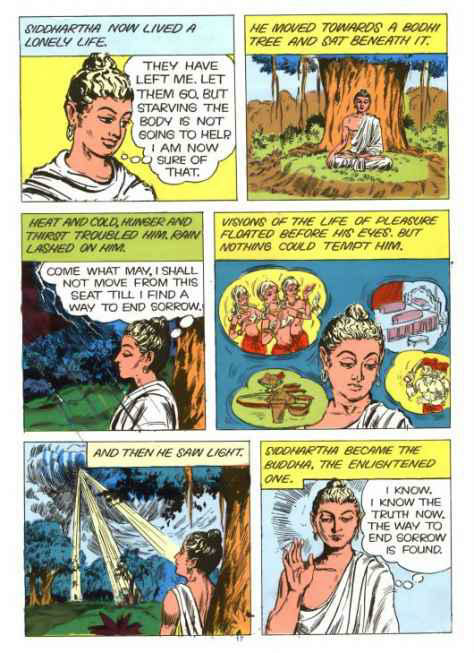
The Day the Buddha Woke Up

Buddha Comic Bodhi

December 8 is Bodhi Day, the day on which the Buddha’s enlightenment is traditionally celebrated.

The English word “enlightenment” is so packed with meaning that it might be better to just go back to what the Buddha is reported to have said: I am awake.

This is useful because it leads to the two questions: woke up from what and woke up to what?

The Buddha, sitting there under the Bodhi tree, woke up from a journey. Born a royal son, he had fled a life of accidental privilege to answer ultimate questions about suffering and death—the very same questions that consume religious lives of all kinds. He believed that if he tried a, b, and c (such as extreme asceticism), he would discover some secret x, y, and z. There was some kind of magic formula, and all he had to do was learn it. That sort of magic is still at the heart of much of our religion.

He woke up to discover that there was no magic, not in such an instrumental sense. Nothing was different. Suffering and death would not go away, no matter what efforts we make. The best and worst aspects of life would go on, with and without us. Great fortunes would be made and lost. Great structures would be built and then destroyed, by cataclysms natural and human. Love would be here and gone.

But this: He could see something in all of that that made sense of all of that. There is no big plan in which we are players, active or passive, though we could and do make and execute our own little plans. There are just things, relationships between those things, and change, and of all those of a singular piece. We can and do overlay that with all of our very complicated details and distinctions, which is after all a definition of the life we live. But if we discover that underlying existence, we just might choose to live differently. And in that living differently, make change and wake others up. And on and on.

None of that eliminated suffering and death for the Buddha, as it won’t for anyone. He grew old and tired and, legend has it, died from being given spoiled food. He had told his followers what he had discovered, none of which involved magic. It was all about the infinite depth of the ordinary. For him, there was no more a kingdom in the clouds than the kingdom he had left behind when he started his journey. There was just what is. Strive on with diligence, he told those followers at the last.

Thanksgiving: Simple Gifts

Shaker Sewing Table

The Shaker dance song Simple Gifts (Joseph Brackett, 1848) is the ultimate Thanksgiving song. It is also the ultimate American song, provided we recognize that in America, the most religious and richest nation on earth, simplicity and humility are ideals worth aspiring to and striving for.

Ken Burns writes this about his documentary The Shakers:

They called themselves the United Society of Believers in Christ’s Second Appearing, but because of their ecstatic dancing, the world called them Shakers. Though they were celibate, they are the most enduring religious experiment in American history. They believed in pacifism, natural health and hygiene, and for more than 200 years insisted that their followers should strive for simplicity and perfection in everything they did.

Shaker design, including furniture and baskets, may be familiar to you. So may the melody of Simple Gifts. It is frequently used in pop culture, and is most famous musically in Aaron Copland’s orchestral masterpiece, Appalachian Spring. And while the tune is often heard, the lyrics are not as frequently sung. Here is an appropriately unadorned version by Judy Collins.

Even if you can’t read music, you can look at the musical score and see how very simple this song is:

SimpleGifts

Here are the lyrics. Happy Thanksgiving.

‘Tis the gift to be simple, ’tis the gift to be free
‘Tis the gift to come down where we ought to be,
And when we find ourselves in the place just right,
‘Twill be in the valley of love and delight.

When true simplicity is gain’d,
To bow and to bend we shan’t be asham’d,
To turn, turn will be our delight,
Till by turning, turning we come ’round right.

Interstellar: Not thinking is the best way to travel

Soul Nebula

The new movie Interstellar takes on big questions and concepts. About the nature of everything. It is more like an invitation than a text, more like an appetizer than a feast. How much of that can you pack into a movie anyway?

Whether or not you’ve seen it, or liked it, or tried to understand it, here is something to consider.

What available paths are there to addressing these issues?

Being one of the travelers who journeys to the far reaches of time, space, and the other numberless dimensions.

Being a scientist who theorizes about that.

Being a director who makes a movie about that.

Being a viewer who watches a movie about that.

Being someone who thinks about that.

Being someone who stops thinking about that and journeys to those far reaches.

The list isn’t comprehensive, none of these is exclusive of the others, none of these may be best. But if you did see Interstellar, or have seen the dozens of movies that address this, or read any of the thousands of texts that address this, or are just curious, do investigate that last possibility. You may discover that the place beyond thinking looks like all the wonders of Interstellar. With fewer movie stars and special effects. But much more real.

Notes on Interstellar

Interstellar

1

Christopher Nolan’s movie Interstellar is more interesting than it is imperfect. See it if you like space movies, sci-fi movies, intellectually curious movies, spectacular movies, etc.

It is filled with wonders. It is like the car trunk stuffed with luggage for a vacation, so much colorful and significant luggage creatively crammed in that when you open it on arrival you say: Wow, I wonder how we ever got all that stuff in there?

No spoilers here, but a couple of things.

Look for all the tiny (and not so tiny) echoes of space and sci-fi movies past. Star Wars, Close Encounters, etc., but most of all 2001. Why not? Right now, “they” are probably having a good 5th dimensional laugh watching Stanley Kubrick’s proto-human apes tossing that bone.

Interstellar has the most subtly cool robots ever. TARS doesn’t sing like HAL, but he has moves like Jagger and is great with the snappy patter.

2

The movie is much about cosmology—the origin and nature of existence. Cosmology is the domain of all kinds of people, including religionists and philosophers. But in greater part, we have handed over many of those considerations, as in this movie, to theoretical physicists—Einstein, Hawking, etc. I am a big fan of cosmology.

It is not a spoiler to mention that plenty of people, including some in this movie, believe that the Apollo 11 moon landing was faked. Which raises this way-out-there question: What if the moon landing was real but all the cosmological theoretical physics is faked? Going back before Einstein, theoretical physics spends much of its time (as we understand it) looking for physical proof of those theories. What if all the theory is so utterly astounding and enlightening that when the evidence failed to support it, all the scientists engaged in the study conspired to make it seem as if those theories are supported?

Faking the moon landing mission has never been put entirely to rest because, in fact, only three people experienced it first-hand. Everyone else was second-hand or more distanced from the actuality. But the basic elements of it are well within our understanding: astronauts, rocket, spaceship, lunar lander, moon, television pictures. The cosmological speculation and supporting discoveries are so far beyond anything that most of us can fully—or slightly—grasp that we could easily be fooled into taking it for “reality.”

By the way, for those wondering about the earnestness of all that, be assured that I am just playing. Or am I?

3

We don’t have to be space pilots to experience cosmology, or be theoretical physicists or movie directors to think about it. Cosmology is ordinary. Interstellar and other movies and thousands of works of art and literature point to this. Everybody is a cosmologist, like it or not.

Cosmology is an excellent topic that does not necessarily require specialized knowledge. You may not know a worm hole from a black hole. But you already know a ton about time, space, being, and gravity. You just have to know how to know and that you know.

This is from an essay almost 800 years old. No more or less spectacular than Interstellar, it is no more or less a non-theoretical description:

Do not think that time merely flies away. Do not see flying away as the only function of time. If time merely flies away, you would be separated from time. The reason you do not clearly understand the time being is that you think of time only as passing.

In essence, all things in the entire world are linked with one another as moments. Because all moments are the time being, they are your time being….

You may suppose that time is only passing away, and not understand that time never arrives. Although understanding itself is time, understanding does not depend on its own arrival.

People only see time’s coming and going, and do not thoroughly understand that the time being abides in each moment. Then, when can they penetrate the barrier? Even if people recognized the time being in each moment, who could give expression to this recognition? Even if they could give expression to this recognition for a long time, who could stop looking for the realization of the original face? According to an ordinary person’s view of the time being, even enlightenment and nirvana as the time being would be merely aspects of coming and going….

Mountains are time. Oceans are time. If they were not time, there would be no mountains or oceans. Do not think that mountains and oceans here and now are not time. If time is annihilated, mountains and oceans are annihilated. As time is not annihilated, mountains and oceans are not annihilated.

Dogen
The Time Being (1240)
Treasury of the True Dharma Eye

Homeless Kodo on Religion

Kodo Sawaki

A short while ago I wrote about a new book, The Zen Teaching of Homeless Kodo. I thought it was the last I would say about it.

It is a book best read in bites. I’ve had to resist the temptation after each bite to say, “you’ve gotta taste this” and “you’ve gotta taste this.” This isn’t a blog about Zen (or about anything else in particular, for that matter). And by the time I got through pointing to all the chapters worthy of attention, I would have quoted practically the whole book.

I’ve written before about how religion is both essential in some form and so badly misused and abused. Others have said it much better. Here, Kodo Sawaki, in literary “conversation” with his student Kosho Uchiyama and with Uchiyama’s student Shohaku Okumura, talks about the value of religion, properly defined and understood.


Religion Is Life

KODO SAWAKI:

How we live our everyday lives has to be the main concern of religion.

KOSHO UCHIYAMA:

On television, it’s permissible to show scenes of explicit sex and crimes, including murder. Big posters of nude women can be posted on the street. Although kids see these TV shows and posters, not many people worry about this. At the same time, it’s illegal to teach religion in public school. To me this is one of the mysteries of twentieth-century Japan.

Maybe people think that “religion” means established sects, superstition, or fanaticism. It’s certainly true that if an innocent child is influenced by one-sided, fixed doctrines, this will lead to great problems. So one might say it’s understandable that the government bans religious education in public schools. On the other hand, if religion means teachings about the most important matter of our lives—how we should live—then we should worry about the next generation, growing up in a society without any religious education, yet constantly confronted with images of sex and violence. If things continue like this, we’ll find young people becoming more and more destructive.

I hope the time will come for religion to be taught in school without indoctrination, but as a lesson about the most important question of life: how to live.

KODO SAWAKI:

“Religion” is to live out the ever fresh self, which is not deceived by anything.

Religion must not be a system of dogma. Religion is life. Religion has to function as life. Worshiping sutras is not enough. Religion must manifest itself freely and inexhaustibly in all activities of life, everywhere and always.

SHOHAKU OKUMURA:

When the government supported religious institutions and forced people to adopt them, this caused terrible problems. An example is the State Shinto from the Meiji era to the end of World War II. When political power and religious authority are combined, there can be no freedom. I don’t think that’s what Uchiyama Roshi is recommending.

As I mentioned in chapter 2, the Japanese equivalent of the word “religion” is shukyo. This word originally referred to Buddhism: the teaching, or kyo, about fundamental reality, or shu. Sawaki Roshi and Uchiyama Roshi used the word “religion” to mean awakening to reality, rather than a system of belief and worship within a particular tradition.

Uchiyama Roshi thought the most important questions of our life should be taught in schools as the subject “Human Life.” He even wrote a textbook as an example. In that book he remarked:

When the time comes to teach “Human Life” in schools, I think the word “religion” should be eliminated. When we use the word in its traditional meaning . . . a strange atmosphere is created. This is because traditional religions always set up some authority beyond our understanding and force people to believe certain myths and doctrines. And yet in our life as the self that is born and dies naked, fundamentally no such authority and belief are necessary. We just need to straightforwardly see the reality of life as the self and teach how to live based on that reality.

Uchiyama Roshi’s searching, studying, and practicing were ways to study the “self.” He wasn’t interested in becoming a believer of a traditional religion. In his search for truth, he found some people in the Buddhist tradition who had the same attitude. One was the Buddha, who said, “The self is the only foundation of the self.” Another was Dogen, who said, “To study the Buddha way is to study the self.” Sawaki Roshi emphasized zazen practice as “the self selfing the self.” Throughout his life, Uchiyama Roshi continued to read the Bible as one of the ways to study the self. In his final days, he said, “I am neither a Buddhist nor a Christian. I am just who I am.

The Zen Teaching of Homeless Kodo
Wisdom Publications

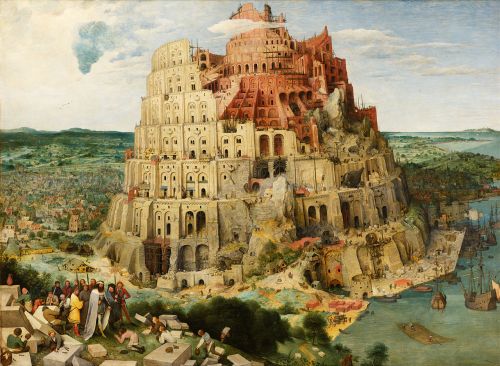
The Tower of Babel and Technological Humility

Tower of Babel - Bruegel the Elder

This week’s Torah reading, Genesis 6:9-11:32, includes two very different STEM achievements.

The first is the story of Noah, with a boat big enough to hold representatives of everything that lives (but does not swim). The ark’s purpose is to save all life in the face of an ultimate disaster. It works.

The other story is the Tower of Babel, with an immensely tall structure that has no obvious or express practical purpose. It is an early and elegant literary example of “because we can” philosophy. Think of it as a giant cosmic finger by some very arrogant builders.

Giving the finger is always rude and dangerous. Here, though, there is no violent retribution and no smiting by flood or fire. Instead, the result of that technological arrogance is eternal confusion and failure to communicate.

The Hebrew Bible has lots to say about human behavior, psychology, and spirituality. But no story may have more to tell us about life today than the Tower of Babel, especially when read in conjunction with Noah.

If we think we can build a boat big enough to save us from a particular catastrophe, maybe we can. But even then, as the rest of the post-Noah biblical stories and the rest of world history demonstrate, staying dry in the flood is just the beginning of our problems.

And if we think we can just show how smart we are by concocting a bunch of oversized technological wonders, monuments of pride, we may find ourselves, as the saying goes, too clever by half.

Consequences are inevitable. Purposes are necessary. Really big towers are awesomely cool. Just be sure you know, more or less, what you’re doing and why.


And all the earth was one language, oe set of words. And it happened as they journeyed from the east that they found a valley in the land of Shinar and settled there. And they said to each other, “Come, let us bake bricks and burn them hard.” And the brick served them as stone, and bitumen served them as mortar. And they said, “Come, let us build us a city and a tower with its top in the heavens, that we may make us a name, lest we be scattered over all the earth.” And the LORD came down to see the city and the tower that the human creatures had built. And the LORD said, “As one people with one language for all, if this is what they have begun to do, now nothing they plot to do will elude them. Come, let us go down and baffle their language there so that they will not understand each other’s language.” And the LORD scattered them from there over all the earth and they left off building the city. Therefore it is called Babel, for there the LORD made the language of all the earth babble. And from there the LORD scattered them over all the earth.

Genesis 11:1-9
The Five Books of Moses: A Translation with Commentary
Robert Alter

Coming Out: How Cosmetic Surgery Is Like Being Gay

South Park - Tom Cruise

In case you haven’t noticed, the noise surrounding Renee Zellweger’s about face sounds just like the conversations we have about celebrities being gay: did she or didn’t she, is he or isn’t he?

There are three kinds of cosmetic surgery: the public kind that can be explained as the result of exercise and nutrition (body shaping and toning), the public kind that is hard to explain that way (obviously enhanced breasts), and the private kind that is (sort of) meant to be private (vagina rejuvenation, penis enhancement).

Questions about the public kinds can be met with a variety of replies, all of them valid:

Yes.
No.
No comment.
It’s none of your business.

This remarkably parallels the situation of those who are “suspected” of being gay. Sometimes it is made public, sometimes it is kept private, sometimes it is treated matter-of-factly: it is what it is, it’s my life, take it or leave it, so what?

Admitting to plastic surgery is in many contexts (including and especially entertainment) as delicate as admitting to being gay—even if the fact is relatively obvious. One of the many reasons the late Joan Rivers was so beloved, why what was obnoxious in others was endearing in her, is that the fact of her many plastic surgeries was a prime subject of her own bits. As with other topics, she just gave you the finger, laughed, and had you laughing too.

In the scheme of all but the tiniest matters, Renee Zellweger’s face is inconsequential. But as with all the tongue wagging about the sexual preferences of some celebrity, it exposes unanswered and mostly unspoken questions about how people feel about certain things. Many people still don’t know exactly what they think about major or minor voluntary body mod, any more than they may have totally resolved their deepest puzzlement about homosexuality, no matter how genuinely progressive and tolerant they are.

For better or worse, we are actually seeing a bit of that in the Renee Zellweger situation: along with an avalanche of typically mindless chatter, there has been some useful discussion about the nature of celebrity, privacy, aging, feminism, and health. It is unfortunate that this has to fall on a single individual’s shoulders, with so much collateral and gratuitous hurt. But if we are careful, we might just learn something, mostly about ourselves. How rare and valuable an opportunity is that?

Illustration: The obvious illustration for this post would be yet another photo of Renee Zellweger, which neither the world nor she need. Instead, above is a frame from South Park, the 2005 episode called Trapped in the Closet. It is widely considered the show’s most controversial episode, which is saying something. In it, the fearless and brilliant and culturally incorrect Parker and Stone managed to skewer (eviscerate?) both Scientology and the rumored homosexuality of Hollywood stars. In this scene, Tom Cruise won’t come out of the closet (where he will ultimately be joined by John Travolta). Nicole Kidman, his then-wife, is trying to talk him out. As I said, culturally incorrect, and probably intolerant and spiteful in light of all that’s written above. But it is funny, and not surprisingly, it is the equally fearless and funny Joan Rivers who also took on the very same subject. Laughing and thinking. What a combo.

The Zen Teaching of Homeless Kodo

Zen Teachings of Homeless Kodo

Even if you are not interested in Zen or Buddhism, this is your invitation to discover one of the most fascinating and overlooked figures in 20th century religion.

If you are a student of Zen, and think you have a broad overview of Zen in the last century, you may wonder why you’ve never heard of Kodo Sawaki Roshi (1880-1965), let alone read any of his work. Up to now, circumstances worked against that. But that has changed with the just-published The Zen Teaching of Homeless Kodo from Wisdom Publications. You owe it to yourself to fill that gap.

Lineage is an essential element of Zen, a tracing of the conceptual DNA that reaches back to Bodhidharma, who in the 5th or 6th century BCE legendarily brought Buddhism from India to China. Thus begins the story of Chinese Ch’an (later Japanese Zen) Buddhism.

In the modern Western incarnations of Zen, some lineages are well-known. Arguably the most popular of all teachers in the West is Shunryu Suzuki Roshi, who founded the San Francisco Zen Center. The first collection of his teachings, Zen Mind, Beginner’s Mind, remains the bestselling introduction to Zen practice in English. It is clear and captivating, and it captured many, including me years ago.

Maybe not as well-known, but equally important, is the work of Kosho Uchiyama Roshi. Published at about the same time as Zen Mind, Uchiyama Roshi’s Approach to Zen lacked the design and print sophistication of Suzuki’s book. Instead of Zen Mind’s colorful cover, calligraphy, and fine typesetting, Approach to Zen is plain brown, with simple illustrations hand-drawn by Uchiyama Roshi.

Approach to Zen

Proving that you can’t judge a book by its cover or color, Approach to Zen is an excellent primer on practice and philosophy. It was later expanded into the even more valuable Opening the Hand of Thought: Foundations of Zen Buddhist Practice (where happily a few of the original drawings are kept). If you are Zen-curious, you could do no better than starting with the pair of Zen Mind and Opening the Hand of Thought.

Opening the Hand of Thought

Sawaki Roshi was Uchiyama Roshi’s teacher. Uchiyama Roshi’s best-known student is Shohaku Okumura, whose practice includes being one of the premier translators of Zen texts—now including the work of Sawaki Roshi. In this new book, these three teachers, three points on an extraordinary line, come together.

Zen masters often have complex lives, but more than most, Sawaki Roshi’s story defies quick summary. The emblematic thing to know about his life and teaching is that he was an iconoclast. It is conventional for great teachers to take over a temple, so that they can effectively (and perhaps comfortably) transmit their teachings. Sawaki refused that possibility; he was, as a teacher for decades, without a home.

People call me Homeless Kodo, but I don’t think they particularly intend to disparage me. They say “homeless” probably because I never had a temple or owned a house. Anyway, all human beings without exception are in reality homeless. It’s a mistake to think we have a solid home.

Zen is renowned for straight talk, even when that talk seems to be crooked, wandering around so that the undeniable point remains out of easy reach or reason. In these excerpts, Kodo Sawaki employs the straightest of straight talk—no less philosophically deep than the most puzzling of messages, but as punishing and sometimes sarcastic as a punch in the face.

When people are alone, they’re not so bad. However, when a group forms, paralysis occurs; people become totally foolish and cannot distinguish good from bad. Their minds are numbed by the group. Because of their desire to belong and even to lose themselves, some pay membership fees. Others work on advertising to attract people and intoxicate them for some political, spiritual, or commercial purpose.

I keep some distance from society, not to escape it but to avoid this kind of paralysis. To practice zazen is to become free of this group stupidity.


Some opinions have passed their prime and lost relevance. For instance, when grownups lecture children, they often simply repeat ready-made opinions. They merely say, “Good is good; bad is bad.” When greens go to seed, they become hard and fibrous. They aren’t edible anymore. We should always see things with fresh eyes!

Often people say, “This is valuable!” But what’s really valuable? Nothing. When you die, you have to leave everything behind. Even the national treasures in Kyoto and Nara will sooner or later perish. It’s not a problem even if they all burn down.

Equal to the value of these teachings is the layering of commentary on Sawaki Roshi by his student Uchiyama Roshi and by Uchiyama Roshi’s student Shohaku Okumura. Layered commentary is common not only to Zen, but to many religious and philosophical traditions. Yet this is remarkable for combining erudite exposition about the teachings and Zen with what can only be described as filial respect and affection—that is, love. Though two of the three participants have died, you feel as if you are present for an enlightened three-way conversation among grandfather, father, and son.

You will wish that it would never end. In a sense, it never does or has to. You can take the treasures you find here and incorporate them into your life, your thinking, and, if you are inclined that way, into your practice.

A horse and a cat once discussed the question, “What is happiness?” They couldn’t reach any agreement.

In the Beginning, Again

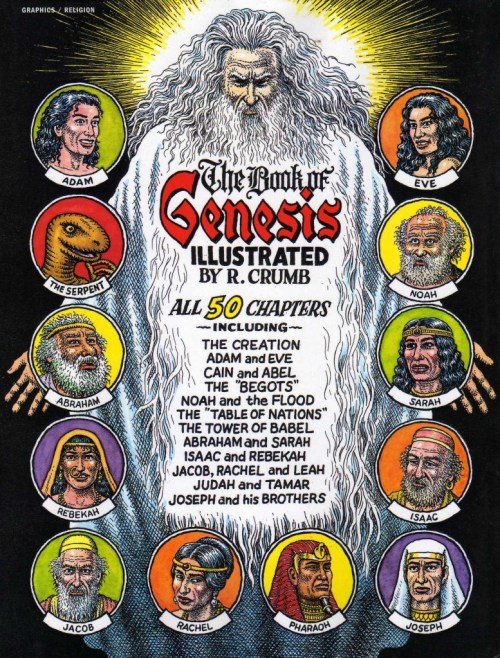
Genesis Illustrated Cover

This Sabbath, the annual cycle of Torah readings starts all over again. Again. Back to the beginning. Genesis (Breisheit), Chapter 1.

In the beginning….Well, you probably know how it goes. But don’t be jaded by familiarity. And don’t avoid it or be put off by belief that this and all the Genesis stories that follow are neither history nor science. So what? These are big stories and we need big stories. Not to be used as clubs to beat us up (though there is that), but as invitations and portals to bigger things. If not, then why are so many watching Hunger Games or Downtown Abbey?

Instead of learned discourse, here is something much more fun. R. Crumb, one of the great comic artists (beginning with his classic underground comics in the 1960s—Mr. Natural, etc.), published his Book of Genesis Illustrated in 2010.

Genesis Illustrated Back Cover

(If you don’t like pictures or Crumb’s illustrations, you might just try the excellent translation of Genesis that Crumb used, by Robert Alter)

Take a moment, whatever your inclinations, and allow yourself to be awed. Whatever you think is awesome, the sudden appearance of everything is more awesome than that, however you explain it. And for those who are waiting to see the Big Guy with the long beard–you know you’ve just gotta have it–here it is.

Genesis Illustrated Page 1