Bob Schwartz

Category: Religion

The Revival of Enlightened and Transformative Politics

Talking about the revival of enlightened and transformative politics is bound to be imprecise.

That concept has never actually been dead. Looking at Christianity, a recent post about Jim Wallis and Sojourners highlights just one instance. A bigger and much more famous current example is Pope Francis. And it is nothing new. The Social Gospel movement, which is still represented (though not always appreciated), aimed to see the realization of the highest Christian principles in everyday practical society.

Keeping with the Christian theme, this is not about what Jesus would say about abortion or gay marriage or prayer in schools or any of these specific arguments—though all have a certain significance. It is about politics as a tool of overall transformation, beyond sectarian concerns.

This is not limited to Christianity. Every one of the traditions has a core of enlightenment and large scale transformation. But each of those traditions has found a way to occasionally devolve that mission into movements and policies and tactics that diverge and even contradict the higher principles and aspirations. It isn’t necessary to point out the wrong turns that, for example, Judaism and Islam have taken along the way to supposedly establish heaven on earth.

In the era of what was affectionately, or for some derisively, known as the New Age movement, this concept of politics as a transformative tool was central. There was the idea that if we kept our eyes on the prize—not just a country but a world elevated above our baser selves—we could together create something better. Politics was one of the tools that would serve that end, instead of enabling smaller personal ambitions and selfish, possibly pernicious, goals.

So here we are. Enlightened and transformative politics is not dead. But it may be missing in action. Each political choice we make—each donation, each tweet, each vote and, yes, each post—might help us find it. Or kill it. It’s up to us.

How to Change Your Mind

Floral Chair

The phrase “how to change your mind” is, as are many English expressions, simple and complex:

“How to” as in which method.
“How to” as in which direction.
“Change your mind” as in making a different decision.
“Change your mind” as in transforming it.

Sorting through all that begins with an example.

There is a big colorful overstuffed chair. The fancy fabric is maybe striped or covered with big flowers or designs.

You look at it and think it is beautiful or ugly. You sit in it and think it is comfortable or uncomfortable.

Someone else looks at it and thinks it is beautiful or ugly. Sits in it and thinks it comfortable or uncomfortable.

You two discuss the chair, your thoughts and feelings about it. One may try and explain to the other why one view or experience is better or worse, right or wrong. You might talk about the construction and style relative to the current market for chairs or the historic evolution of chairs.

Yet there it just is. An object with four legs, to keep you sitting up from the floor. There it just is.

You might change your mind about the chair by engaging in the discussion about it, or by sitting in it a few more times.

Or you might realize that it is just that chair. About which your mind is fundamentally changed. Whether the chair is plain wood or elaborately upholstered. Whether you think about it or look at it or sit in it or not.

That is one way to change your mind.

MIND is the forerunner of all actions.
All deeds are led by mind, created by mind.
If one speaks or acts with a corrupt mind, suffering follows,
As the wheel follows the hoof of an ox pulling a cart.

Mind is the forerunner of all actions.
All deeds are led by mind, created by mind.
If one speaks or acts with a serene mind,
Happiness follows,
As surely as one’s shadow.

“He abused me, mistreated me, defeated me, robbed me.”
Harboring such thoughts keeps hatred alive.
“He abused me, mistreated me, defeated me, robbed me.”
Releasing such thoughts banishes hatred for all time.

From the Dhammapada, translated by Ananda Maitreya.

Jim Wallis: Evangelical Voters Have Some Explaining To Do

Embarrasing to Be an Evangelical

Jim Wallis says that some Evangelical voters should be embarrassed.

Wallis is President and Founder of the Christian social justice organization Sojourners. It is impossible in short form to explain what treasures Jim Wallis and Sojourners are. So please visit the links to read the descriptions.

Wallis is a stubborn reminder of what he believes Jesus would expect from American Christians, in the face of some of their shortcomings, hypocrisy and grandstanding. No matter what your own faith preference, he is admirable as a brave and insistent conscience for America.

Please read today’s piece, “It’s Embarrassing to Be an Evangelical This Election:
The So-Called ‘Evangelical Vote’ Has Some Explaining to Do.

What Is So Wonderful About Climbing Mount Everest?

Hotel Mount Everest

Climbing Mount Everest is special. Unless you’re from Tibet:

Human beings are capable of so much endeavor, even in small matters. People spend their lives trying to measure the height of mountains or the depth of the sea. These provide useful information, but they may not prove significant in the long run. For example, we Tibetans could never understand why people climbed mountains for no reason. The mountaineers would say, “I am doing an expedition on Mount Everest,” as if it were the most important thing in the world. They would spend so much time and money; they would even risk, and sometimes lose, their lives. We would wonder if they were mad, and ask, “What do you get when you reach the top?” They replied, “Oh, it is just wonderful!” We would say, “What is so wonderful in that cold wind?” The answer was, “Oh, it is so exciting!” It might seem wonderful, but it will only last a short time, and it is only wonderful if you consider it wonderful. Someone else might think that the most wonderful thing is being curled up, warm and snug, in a cozy bed. To me, for instance, that is much more wonderful.

Ringu Tulku Rinpoche in Radical Compassion: Shambhala Publications Authors on the Path of Boundless Love. Available free.

Hasidic Tales of the Holocaust

Hasidic Tales of the Holocaust

For International Holocaust Remembrance Day, this story from Hasidic Tales of the Holocaust by Yaffa Eliach.


Good Morning, Herr Müller

Near the city of Danzig lived a well-to-do Hasidic rabbi, scion of prominent Hasidic dynasties. Dressed in a tailored black suit, wearing a top hat, and carrying a silver walking cane, the rabbi would take his daily morning stroll, accompanied by his tall, handsome son-in-law. During his morning walk it was the rabbi’s custom to greet every man, woman, and child whom he met on his way with a warm smile and a cordial “Good morning.” Over the years the rabbi became acquainted with many of his fellow townspeople this way and would always greet them by their proper title and name.

Near the outskirts of town, in the fields, he would exchange greetings with Herr Müller, a Polish Volksdeutsche (ethnic German). “Good morning, Herr Müller!” the rabbi would hasten to greet the man who worked in the fields. “Good morning, Herr Rabbiner!” would come the response with a good-natured smile.

Then the war began. The rabbi’s strolls stopped abruptly. Herr Müller donned an S.S. uniform and disappeared from the fields. The fate of the rabbi was like that of much of the rest of Polish Jewry. He lost his family in the death camp of Treblinka and, after great suffering, was deported to Auschwitz.

One day, during a selection at Auschwitz, the rabbi stood on line with hundreds of other Jews awaiting the moment when their fates would be decided, for life or death. Dressed in a striped camp uniform, head and beard shaven and eyes feverish from starvation and disease, the rabbi looked like a walking skeleton. “Right! Left, left, left!” The voice in the distance drew nearer. Suddenly the rabbi had a great urge to see the face of the man with the snow-white gloves, small baton, and steely voice who played God and decided who should live and who should die. He lifted his eyes and heard his own voice speaking:

“Good morning, Herr Müller!”

“Good morning, Herr Rabbiner!” responded a human voice beneath the S.S. cap adorned with skull and bones. “What are you doing here?” A faint smile appeared on the rabbi’s lips. The baton moved to the right—to life. The following day, the rabbi was transferred to a safer camp.

The rabbi, now in his eighties, told me in his gentle voice, “This is the power of a good-morning greeting. A man must always greet his fellow man.”

Based on my conversation with an elderly Hasidic personality.


In the literature of the Holocaust, Hassidic Tales of the Holocaust stands alone. As the publisher describes it, “Derived by the author from interviews and oral histories, these eighty-nine original Hasidic tales about the Holocaust provide unprecedented witness, in a traditional idiom, to the victims’ inner experience of “unspeakable” suffering. This volume constitutes the first collection of original Hasidic tales to be published in a century.”

As the author writes in her Foreword:

The Hasidic tale of the Holocaust is rooted in the Auschwitz reality, yet it soars to heaven and higher. It can carry the faithful above pits filled with bodies. Despite Auschwitz, the tale still expresses belief that man is good and capable of improvement; it can restore order to a chaotic world and offer unlimited freedom to the creative mind attempting to come to terms with the Holocaust. Its rich Jewish heritage and European tradition make it a unique genre of modern literature. The tales in this collection completed a full cycle from documentation to art to documentation and back to art. For in the beginning there was a tale.

There are many other books that will tell you about the history of the Holocaust. There are few other books that so deeply and creatively offer its soul.

Hermitage

Thomas Merton hermitage

Four Walls

Four walls
Three doors
One window
One ceiling
One floor.
How simple
How deep.
Walls layered
And filled.
Behind two doors
Filled too.
One door
Is different.
Goes out
Comes in.
Out there
The same.
In here
The same.
But not.

Hermitage has been in and on my mind. While not exactly a hermitage, the poem above describes the room in which I write.

When I first started reading Thomas Merton, I learned about his building a hermitage on the grounds of the Kentucky abbey where he lived. Merton was a sublime conundrum, who committed himself to relative silence and disciplined orthodoxy as a monk, yet whose spirit (the Spirit) would not allow him to be quiet and stop exploring. So he wrote and discovered. Thank goodness for us.

Sandokai is a famous poem by the Chinese Ch’an (Zen) Master Shitou Xiqian (700-790), who is known in Japanese as Sekito Kisen. I have long been reading and studying this, as have many Zen students. Of all the essential texts available, there are few more concisely powerful than Sandokai.

There is another poem by Sekito that is a little less known, but equally compelling. It is a description of his hermitage, a grass hut. There, he tells us, is nothing and everything.

Song of the Grass Roof Hermitage
by Shitou Xiqian

I’ve built a grass hut where there’s nothing of value.
After eating, I relax and enjoy a nap.
When it was completed, fresh weeds appeared.
Now it’s been lived in – covered by weeds.

The person in the hut lives here calmly,
Not stuck to inside, outside, or in between.
Places worldly people live, he doesn’t live.
Realms worldly people love, he doesn’t love.

Though the hut is small, it includes the entire world.
In ten square feet, an old man illumines forms and their nature.
A Great Vehicle bodhisattva trusts without doubt.
The middling or lowly can’t help wondering;
Will this hut perish or not?

Perishable or not, the original master is present,
not dwelling south or north, east or west.
Firmly based on steadiness, it can’t be surpassed.
A shining window below the green pines –
Jade palaces or vermilion towers can’t compare with it.

Just sitting with head covered, all things are at rest.
Thus, this mountain monk doesn’t understand at all.
Living here he no longer works to get free.
Who would proudly arrange seats, trying to entice guests?

Turn around the light to shine within, then just return.
The vast inconceivable source can’t be faced or turned away from.
Meet the ancestral teachers, be familiar with their instruction,
Bind grasses to build a hut, and don’t give up.

Let go of hundreds of years and relax completely.
Open your hands and walk, innocent.
Thousands of words, myriad interpretations,
Are only to free you from obstructions.
If you want to know the undying person in the hut,
Don’t separate from this skin bag here and now.

(from Taigen Daniel Leighton, Cultivating the Empty Field)

Donald Trump Wants to Make the Bible Great Again!

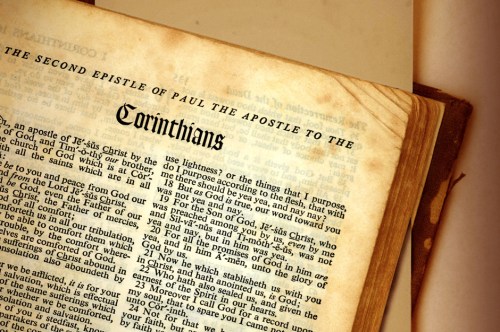
2 Corinthians

Donald Trump spoke to an assembly of students at Liberty University, one of the best-known evangelical colleges in the country. He quoted a Bible passage to show his depth of Christian faith and knowledge.

In doing that, he mispronounced the name of the New Testament book “2 Corinthians” as “Two Corinthians.” It is in fact universally called “Second Corinthians.” Anyone who has glancing familiarity with the Bible knows that, including five-year-olds in Sunday School. Every time there is a numbered series of books (such as 1 Kings and 2 Kings in the Old Testament, etc.), they are called by the ordinal number (First, Second).

Does this prove that Trump has little familiarity with the Bible? Yes. Does this prove that he is willing to cynically use faith as a tool to “close the deal” on the Republican nomination? Yes. Will this affect his support among evangelical Christians, Christians in general, or people of faith? Who knows?

Here’s the thing. It was no mistake.

Trump may not know much about the Bible or about the Presbyterian Church he identifies himself as belonging to. But he knows a “not great” situation when he sees it. Calling these books “First” or “Second” makes no sense. Plus, it’s a waste of time and breath. Everyone knows that Trump is all about making sense and not wasting breath.

And so, this is part of his strategy to make everything terrific. He wants to change the way people have been referring to the Bible for centuries.

He wants to make the Bible great again! Who can blame him? Thank you, Donald.

Bernie Sanders as John the Baptist

John the Baptist

The Democratic Party is in trouble. Politically, philosophically, spiritually, demographically. Bernie Sanders won’t save the party or win the presidency. But he is setting the scene for the party’s reform and renewal.

John the Baptist was a terrible candidate to lead a religious revolution. He was a wild-eyed radical who seemed to be crazy. His people skills needed work. But his cause found a much better spokesman and leader, who took it to the next level. And then some.

When you think carefully about the party and its recent Presidents and leaders, you look hard for real radical inspiration. Bill Clinton was affable and politically adept, but his was the politics of radical compromise, to the point of digging a rut in the middle of the road that invited neo-conservative disaster and greed. Barack Obama was genuinely inspirational, and has helped the cause of humane Americanism as much as politics would allow. But circumstances and inclination led him to solid pragmatism.

One problem with pragmatism is that it makes a terrible anthem and cause. Another is that it allows all sorts of accommodations that look to the would-be believer like nothing but surrender.

That’s where Bernie Sanders and John the Baptist come together. When the stakes are high, and the troubles are deep, that’s when you have to invoke big visions. That’s what gets people who have fallen into both practical and spiritual malaise to answer the call and start working for real change.

There are few in the Democratic Party willing or able to do this. Whether or not Hillary Clinton wins the nomination or the election, it is not her. If she wins the nomination but loses the election, the party will do some typical superficial soul searching. If she wins both, she may consolidate her power, and the power of the establishment, but the Congress will be even less effective than it is now.

Either way, it is possible that Bernie Sanders is unleashing something bigger than the Clintons or any tepid self-inquiry the party may pretend to engage in. He may not be heir to the spirit of Bobby Kennedy, but he might as well be saying this:

“There are those that look at things the way they are, and ask why? I dream of things that never were, and ask why not?”

When Bernie Sanders is done with this election, another Democratic reformer and revolutionary will come along, and another. At that point, if we are lucky, millions of previously unengaged and disappointed people may come to the party dreaming and asking “why not?” And Bernie, like John the Baptist, will have prevailed.

One God Two God

One Fish Two Fish

One God
Two God
Red God
Blue God
(apologies to Dr. Seuss)

A professor at Wheaton College may be dismissed for saying that Christian and Muslims worship the same God.

There is so much that could be said about this.

About the history of American evangelicalism, of which Wheaton is a part. How it began as an open and activist socially liberal Christian movement and has ended up in some instances a radically conservative and strictly exclusivist movement.

About theology as complex as any machine ever built, and just as incomprehensible to those who are not religion mechanics and engineers. How even though the God of the Jews was absolutely the God of Jesus, and the God of the Jews and Jesus was absolutely the God of Muhammed, that isn’t so according to people who may think themselves smarter and more important than Jesus or Muhammed.

The concept of one God was a revolution in civilization. The earlier belief in an entourage of gods, greater and lesser, has been mostly replaced by the one. (Whether that one might be three-in-one goes back to the theology complexities mentioned above, so let’s leave that for now.)

It is no wonder that after thousands of years with religion as a standard way of life, more people are rejecting it than ever. Because if there is a God, and if religions have sprung up on his behalf (with or without his blessing), that God and those religions can look spectacularly ridiculous in the eyes of good people who want nothing but good for people. And because if God really cares about all this very human nonsense, a growing number of people want nothing to do with him or his religions. And who can blame them?

God and the H-Bomb

God and the H-Bomb

The Hydrogen Bomb is in the news, thanks to North Korea’s questionable claim that they have one and have tested it.

In the years following World War 2, the H-Bomb was big news. Big, just like The Bomb. The world had seen the destructive power of the A-Bomb used at Hiroshima and Nagasaki. The H-Bomb made the A-Bomb look like a stick of dynamite. Where once there was the power to destroy cities, we could now destroy the world. And ourselves. We were as gods, at least in our punishing might.

In 1961, a book called God and the H-Bomb was published. It’s not in print, but you might find a copy used or in a library, as I did a few years ago. The cover carries this question: “What counsel do our spiritual leaders offer in response to mankind’s greatest challenge?”

The roster of contributors is an impressive list of thinkers, some of whom are still recognized names, some less familiar. Paul Tillich, Martin Buber, Pope Pius XII, and so on.

We don’t see many—any—religious and spiritual leaders interviewed about the North Korean test, about the Iran deal, or about any Bomb related stories. Except for those religious and spiritual leaders with political strategy in mind or a political axe to grind.

That’s not what this 55-year-old book is about. It is about the moral and spiritual dimensions of the H-Bomb. That is reflected in the titles of the pieces. The power of self-destruction. War and Christian conscience. Fifteen years in hell is enough. Thy neighbor as thyself. The road of sanity.

The foreword is by Steve Allen, who is a little remembered as a significant television personality, but less as one of the most entertaining and brilliant public intellectuals of the middle twentieth century. Here’s what he writes:

That our nation is in the throes of moral collapse of serious dimensions is, apparently, no longer a debatable conclusion. Liberal and conservative spokesmen vie to see who shall express the conviction most vigorously. Churchmen and secularists, too, agree that we have fallen upon evil days. These various groups naturally differ as to the reasons for the situation, but that it exists no one seems to doubt….

Will our nation be guided in this dread hour by the moral code it professes to honor?

Will it?