Bob Schwartz

Category: Politics

Trump v. Moses: Grievances Win Over Vision

People can be complainers. Grievances can be powerful. Just ask Trump. Or Moses.

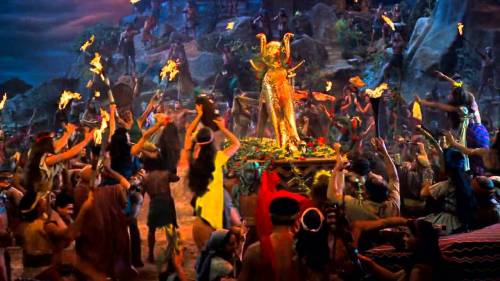
Prior freedom and miracles were not enough for the Jews at Mount Sinai. While Moses goes up the mountain, for what turns out to be a monumental visionary moment, the people head in an entirely different direction. They are still chronically unhappy and complaining about their lives and the way things have been going, and so engage in all sorts of crazy behavior. In that story, the vision does end up prevailing, but only after lots more tzuris (troubles) and mishegas (craziness).

The only chance for vision to prevail over grievance is for there to be an actual coherent and enlightened vision, and for there to be widespread confidence among people in that actual vision. Otherwise people, who are just human, will complain—sometimes selfishly and shortsightedly, sometimes justifiably. And they will channel those complaints into strange behaviors and choices.

In America, there are a lot of people with grievances. And there is a vision vacuum, at least among those whose supposed structural mission is to be practical visionaries (for example, Democrats and religious institutions). Even with miracles behind him, Moses had a tough time. Without miracles or vision, in elections and at other times, we may be seeing a lot more golden calves.


On Tyranny. Again.

I don’t know the words or the enticements to move people to read the book On Tyranny: Twenty Lessons from the Twentieth Century. I wrote about it when it was released two months ago. I would write it about it every day. Because American democracy, and the values that support and enable American democracy, are under daily siege—from the highest levels of the republic itself. Using the vast history of tyrannical regimes—tyranny that exists elsewhere right now—we should learn how to respond and act constructively. Rather than running around as if our national hair was on fire or, worse, just giving up and giving in.

1. The book is cheap. Really cheap. $3.99 for the ebook. $6.39 for the paperback.

2. The book is short. Really short. 128 pages.

3. The book is great and essential. Some sample reviews:

“We are rapidly ripening for fascism. This American writer leaves us with no illusions about ourselves.” —Svetlana Alexievich, Winner of the Nobel Prize in Literature

“Timothy Snyder reasons with unparalleled clarity, throwing the past and future into sharp relief. He has written the rare kind of book that can be read in one sitting but will keep you coming back to help regain your bearings. Put a copy in your pocket and one on your bedside table, and it will help you keep going for the next four years or however long it takes.” —Masha Gessen

“Please read this book. So smart, so timely.” —George Saunders

“Easily the most compelling volume among the early resistance literature. . . . A slim book that fits alongside your pocket Constitution and feels only slightly less vital. . . . Clarifying and unnerving. . . . A memorable work that is grounded in history yet imbued with the fierce urgency of what now.” —Carlos Lozada, The Washington Post

“Snyder knows this subject cold. . . . It is impossible to read aphorisms like ‘post-truth is pre-fascism’ and not feel a small chill about the current state of the Republic. . . . Approach this short book the same you would a medical pamphlet warning about an infectious disease. Read it carefully and be on the lookout for symptoms.” —Daniel W. Drezner, The New York Times Book Review

“As Timothy Snyder explains in his fine and frightening On Tyranny, a minority party now has near-total power and is therefore understandably frightened of awakening the actual will of the people.” —Adam Gopnik, The New Yorker

“Snyder is superbly positioned to bring historical thinking to bear on the current political scene. . . . These unpretentious words remind us that political resistance isn’t a matter of action-movie heroics, but starts from a willingness to break from social expectations.” —Jeet Heer, The New Republic

“The perfect clear-eyed antidote to Trump’s deliberate philistinism. . . . These 128 pages are a brief primer in every important thing we might have learned from the history of the last century, and all that we appear to have forgotten.” —Tim Adams, The Guardian

“On Tyranny demands to be read.” —The Forward

“The manifesto we need. . . . Snyder detects dangerous trends in American politics that may be less visible to most citizens who cannot believe that our country, with its system of checks and balances, could succumb to illiberalism or authoritarianism.” —Darryl Holter, Los Angeles Review of Books

“Bracing. . . . On Tyranny is a call to action. . . . A brisk read packed with lucid prose.” —Vox

4. The book is popular:

#2 in Kindle Store > Kindle eBooks > Nonfiction > Politics & Social Sciences > Politics & Government > Specific Topics > Civics
#3 in Kindle Store > Kindle eBooks > Nonfiction > Politics & Social Sciences > Politics & Government > Ideologies & Doctrines > Democracy
#7 in Kindle Store > Kindle eBooks > History > Modern (16th-21st Centuries) > 20th Century
#5 in Books > Politics & Social Sciences > Politics & Government > Specific Topics > Civics & Citizenship
#6 in Books > Politics & Social Sciences > Politics & Government > Ideologies & Doctrines > Democracy

The chapters in On Tyranny:

  1. Do not obey in advance.
  2. Defend institutions.
  3. Beware the one-party state.
  4. Take responsibility for the face of the world.
  5. Remember professional ethics.
  6. Be wary of paramilitaries.
  7. Be reflective if you must be armed.
  8. Stand out.
  9. Be kind to our language.
  10. Believe in truth.
  11. Investigate.
  12. Make eye contact and small talk.
  13. Practice corporeal politics.
  14. Establish a private life.
  15. Contribute to good causes.
  16. Learn from peers in other countries.
  17. Listen for dangerous words.
  18. Be calm when the unthinkable arrives.
  19. Be a patriot.
  20. Be as courageous as you can.

Finally, “it can’t happen here” are infamous last words. And as the epigraph to the book says:

In politics, being deceived is no excuse.
—Leszek Kołakowski

“This is the business we’ve chosen.”

I watched a news panel discussing reports that Michael Cohen is distraught for his family and realizes that his business and professional life is over—not to mention the possibility of years in prison.

Some panelists expressed compassion for someone in his position. But another was less sympathetic, saying that this was the life he had chosen.

I can’t be sure, but this may have been meant to echo one of the many famous lines from the Godfather movies. In Godfather II, the dying Hyman Roth explains his attitude towards the killing of Moe Green, the man who invented modern Las Vegas. Roth knows that the Corleone family executed Green, but Roth explains to Michael Corleone why he set that fact aside:

HYMAN ROTH: There was this kid I grew up with; he was younger than me. Sorta looked up to me, you know. We did our first work together, worked our way out of the street. Things were good, we made the most of it. During Prohibition, we ran molasses into Canada… made a fortune, your father, too. As much as anyone, I loved him and trusted him. Later on he had an idea to build a city out of a desert stop-over for GI’s on the way to the West Coast. That kid’s name was Moe Greene, and the city he invented was Las Vegas. This was a great man, a man of vision and guts. And there isn’t even a plaque, or a signpost or a statue of him in that town! Someone put a bullet through his eye. No one knows who gave the order. When I heard it, I wasn’t angry; I knew Moe, I knew he was head-strong, talking loud, saying stupid things. So when he turned up dead, I let it go. And I said to myself, this is the business we’ve chosen; I didn’t ask who gave the order, because it had nothing to do with business!

Trump: King Midas in Reverse Works His Magic on Kanye

He’s King Midas with a curse.
He’s King Midas in reverse.
He’s not the man to hold your trust,
Everything he touches turns to dust in his hands.
King Midas in Reverse, The Hollies

From The Hill:

President Trump on Friday thanked Kanye West during his speech at the National Rifle Association’s (NRA) annual convention, giving the artist credit for his rising popularity in the polls among African Americans.

“And by the way, Kanye West must have some power, because you probably saw, I doubled my African-American support numbers,” the president told those gathered in Dallas, Texas. “I went from 11 to 22 in one week.”

“Thank you Kanye, thank you,” he added….

West has sparked outrage and intense debate among the hip-hop and African-American communities in recent days with tweets in support of Trump, with some celebrities expressing support for West while others, including many of his fans, have expressed disappointment.

“We are both dragon energy. He is my brother,” West tweeted in one of his pro-Trump messages starting April 25….

Trump has previously thanked West for the support on Twitter, tweeting that it was “very cool!”

Kanye is only the latest in a long series of those who have seen their careers or lives turn to “dirt” (to be polite) simply by having anything to do with Trump. Sometimes it happens relatively quickly, as in the case of Dr. Ronny Jackson. Sometimes it happens after years and years, as in the case of Michael Cohen. Besides being an exceptional artist—which he has been—Kanye seems to have a bunch of other problems, not totally related to his Trump thing. But he seems to have been able to overcome some of those difficulties—until this. Being thanked by Trump at the NRA Convention is almost certainly the coup de grace.

The moral of the story: If you think it necessary or advantageous to get in bed with a pathological narcissist, know that you will wake up alone and covered in dirt. Possibly under a bus. Which is never very cool.

Trump After Two Terms as President

Imagine it is 2024. Trump is finishing out his second term as president. Eight years.

In a detailed and complex way, we may wonder what the lives of people in America and the world have been like during those years, day after day, thanks to his presidency. Wondering what we might do, what we might have done, to enjoy a different outcome.

But there is simple wondering too. Even at this point in 2018, it is hard to avoid seeing his face every day. Which led me to wonder: what face will we be looking at every day in 2024?

It turns out that a graphic designer at the Express newspaper in the UK has already helped us imagine that: “The intriguing image [see above] has been meticulously constructed by a professional graphic design artist, who specialises in biometric techniques to age the human face.”

Trump’s Shtarkers

There is news that the offices of Trump’s long-time New York doctor were raided in February 2017 by Trump associates. A great Yiddish word comes immediately to mind: shtarker.

The Hill reports:

President Trump’s longtime personal doctor in New York said a trio of Trump associates raided his office in February 2017, seizing the president’s medical records.

Dr. Harold Bornstein told NBC News that Trump’s bodyguard, Keith Schiller, a lawyer with the Trump Organization and a third man came to his office the morning of Feb. 3, 2017. They took lab reports and Trump’s medical charts, he said.

“They must have been here for 25 minutes or 30 minutes. It created a lot of chaos,” Bornstein said, adding that he felt “raped, frightened and sad.”

Stark in Yiddish means strong, and so one of the usages of shtarker is to mean “strong man” or “tough guy.” But it acquired another, more sinister meaning in the lexicon of crime. A shtarker is a strong-arm man, an enforcer, a thug.

It is a word definitely well-known to the Russian and Eastern European Jews who surrounded Michael Cohen in his family and business (see A Brief History of Michael Cohen’s Criminal Ties . It is a word that may not be known to all of Trump’s people,  but it is a concept that some of them understand, endorse and are not afraid to use.

The Next Trap for Trump: Facts Can’t Be Defamed But People Can

Stormy Daniels released a sketch of the man who threatened her in 2011 to keep her from talking about Trump. In a tweet, Trump called this threat and sketch a “con job.” She has now sued Trump for defamation, claiming he accused her of the crime of making a false accusation of committing a crime against another.

This may seem like grasping at straws, but it isn’t. If Trump had ever said one word directly refuting her account of their relationship—which he hasn’t—he would find himself in a bigger defamation action. But even this smaller one is a harbinger of what may become a new trend.

Defamation is a perfect action to bring in the case of chronic and pathological liars. The essential defense to defamation is the truth of the matter asserted. If the reputation-damaging statement was undeniably made, but the speaker/writer will not or cannot prove that it is true, proof of damage is enough for the plaintiff to prevail. In every instance where Trump is the defamer, and an action is brought, he would be obliged to prove that the damaging words he says or tweets about someone are true. Which in all cases, he either won’t do or can’t do.

It is a shame that all the facts that Trump has brutally attacked don’t have standing to sue (two thousand lies and counting, just as president). But people do have that standing. Stormy Daniels, who has one of the smartest, most creative, most articulate, most media-savvy lawyers of the Trump era, is taking advantage of this vulnerability. Do not be surprised to see more of these defamation actions from all sorts of people who have been publicly maligned by Trump.

Explosive New Book: Trump/Russia: A Definitive History

“Kenneth McCallion, a former prosecutor who tracked the flows of Russian criminal money into Trump’s properties, told me, “Trump’s genius – or evil genius – was, instead of Russian criminal money being passive, incidental income, it became a central part of his business plan.””
Trump/Russia: A Definitive History

It was during the Moscow trip that Sater used his Kremlin connections to impress Trump’s daughter. Sater would later boast: “I arranged for Ivanka to sit in Putin’s private chair at his desk and office in the Kremlin.”
Trump/Russia: A Definitive History

Next week, the book Trump/Russia: A Definitive History will be released—and it will be explosive.

Written by Seth Hettena, an award-winning journalist who was a long-time investigative reporter for the Associated Press, it “chronicles the many years Trump has spent wooing Russian money and power. From the collapse of his casino empire—which left Trump desperate for cash—and his first contacts with Russian deal-makers and financiers, on up to the White House.”

The only excerpt available so far was published in Rolling Stone, A Brief History of Michael Cohen’s Criminal Ties. That brief excerpt paints one corner of a bigger picture that we will finally be able to see once the Mueller investigation is complete.


From Trump/Russia: A Definitive History:

Michael Cohen’s bare-knuckled tactics earned him the nickname of “Tom,” a reference to Tom Hagen, the consigliore to Mafia Don Vito Corleone in The Godfather. He grew up on Long Island, the son of a physician who survived the Holocaust in Poland, and like Tom Hagen spent a childhood around organized crime, specifically the Russian Mafiya. Cohen’s uncle, Morton Levine, was a wealthy Brooklyn doctor who owned the El Caribe Country Club, a Brooklyn catering hall and event space that was a well-known hangout for Russian gangsters. Cohen and his siblings all had ownership stakes in the club, which rented for years to the first Mafiya boss of Brighton Beach, Evsei Agron, along with his successors, Marat Balagula and Boris Nayfeld. (Cohen’s uncle said his nephew gave up his stake in the club after Trump’s election.)

I spoke to two former federal investigators who told me Cohen was introduced to Donald Trump by his father-in-law, Fima Shusterman, a naturalized U.S. citizen from Ukraine who arrived in the U.S. in 1975. Shusterman was in the garment business and owned a fleet of taxicabs with his partners, Shalva Botier and Edward Zubok – all three men were convicted of a money-laundering related offense in 1993….

Shusterman, who owned at least four New York taxi companies, also set his son-in-law up in the yellow cab business. Cohen once ran 260 yellow cabs with his Ukrainian-born partner, the “taxi king” Simon V. Garber, until their partnership ended acrimoniously in 2012…

Cohen was able to purchase a $1 million condo at Trump World Tower in 2001, persuading his parents, his Ukrainian in-laws and Garber to do the same in other Trump buildings. Cohen’s in-laws Fima and Ania Shusterman bought three units in Trump World Tower worth a combined $7.66 million. Cohen later purchased a nearly $5 million unit in Trump Park Avenue. In a five-year period, he and people connected to him would purchase Trump properties worth $17.3 million….

A year after Trump World Tower opened in 2002, Trump had agreed to let Miami father-and-son developers Gil and Michael Dezer use his name on what ultimately became six Sunny Isles Beach condominium towers, which drew in new moneyed Russians all too eager to pay millions. “Russians love the Trump brand,” said Gil Dezer, who added that Russians and Russian-Americans bought some 200 of the 2,000 or so units in Trump buildings he built. A seventh Trump-branded hotel tower built up Sunny Isles into what ostensibly has become a South Florida Brighton Beach.

An investigation by Reuters found that at least 63 individuals with Russian passports or addresses have bought at least $98.4 million worth of property in the seven Trump-branded luxury towers. And that was a conservative estimate. At least 703 – or about one-third – of the 2044 units were owned by limited liability companies, or LLCs, which could conceal the property’s true owner. Executives from Gazprom and other Russian natural resource giants also owned units in Trump’s Sunny Isles towers. In an observation that several people I spoke with echoed, Kenneth McCallion, a former prosecutor who tracked the flows of Russian criminal money into Trump’s properties, told me, “Trump’s genius – or evil genius – was, instead of Russian criminal money being passive, incidental income, it became a central part of his business plan.” McCallion continued, “It’s not called ‘Little Moscow’ for nothing. The street signs are in Russian. But his towers there were built specifically for the Russian middle-class criminal.”

Cohen joined the Trump Organization around the time that the second Sunny Isles tower was being built. A few years earlier, he had invested $1.5 million in a short-lived Miami-based casino boat venture run by his two Ukrainian business partners, Arkady Vaygensberg and Leonid Tatarchuk. Only three months after its maiden voyage, it would become the subject of a large fraud investigation. But Cohen was saved from his bad investment by none other than Trump himself, who hired Cohen as an attorney just before his casino ship sank. A source who investigated Cohen’s connections to Russia told me, “Say you want to get money into the country and maybe you’re a bit suspect. The Trump organization used lawyers to allow people to get money into the country.”…

Michael Cohen’s in-laws, the Shustermans, also bought real estate in Sunny Isles. The development was paying off. Trump’s oldest son, Don Jr., would later note, “We see a lot of money pouring in from Russia.” There is no question Trump owed his comeback in large part to wealthy Russian expatriates.

Cohen and Felix Sater have known each other for nearly 30 years. They met in Brighton Beach when Cohen started dating his future wife, Shusterman’s daughter, Laura, who Sater says he knew from the neighborhood. When Cohen joined the Trump organization, Sater had become a fixture in the office. Sater was developing Trump SoHo, a hotel-condo in lower Manhattan that later would be consumed by scandal, and had earned Trump’s trust. Trump asked him to look after his children, Ivanka and Don Jr., on a 2006 visit to Moscow. (It was during the Moscow trip that Sater used his Kremlin connections to impress Trump’s daughter. Sater would later boast: “I arranged for Ivanka to sit in Putin’s private chair at his desk and office in the Kremlin.”) When Sater’s criminal past was exposed in The New York Times, Trump suddenly looked and acted like a man with something to hide. Despite laying claim to “one of the great memories of all time,” he seemed to be having trouble recollecting who Sater was. “Felix Sater, boy, I have to even think about it,” Trump told The Associated Press in 2015. “I’m not that familiar with him.”
 

Politely Ask Trump to Resign

The majority of Americans think that Trump is a threat to civility, to honesty, to American values, democracy and institutions, and to American and global peace and progress. As one new and untried tactic, we should simply, politely and plainly ask him to resign.

This is not a replacement for any of the other ongoing approaches, including investigation of his wrongdoing, ridicule, humor, and calls for impeachment or action under the 25th amendment. And of course, voting.

It is, however, a civilized way of doing something it is increasingly hard to do: be a better and more civilized person than Trump himself. It is hard not to fall into the sinkhole of being as terrible as our worst nemesis—that is an ancient theme. The pragmatic fact is that it is sometimes unavoidable, if the better is to triumph over the lesser. But when that happens, we are in danger of being just as bad, and our remaining upright and our job of healing and recovering is made that much more difficult.

So let us ask Trump to resign, politely explaining the many reasons it is best for America and Americans, and for the world. Of course he will not do it or consider it, and will mock it, since in his mind any show of decency and quiet reason is a show of weakness. Instead, though, it is a small demonstration that we still believe that decency is a show of strength. Which is something we are understandably starting to forget.

Note:

As is my practice, I asked the I Ching about this proposal. It is appropriate to do that for two reasons. The I Ching itself is in part a philosophical response to centuries of national political changes in China, cataclysms that make a few years of Trump look like a picnic. Second, China itself in 2018 still uses the I Ching for guidance. So why shouldn’t we?

The I Ching says (Alfred Huang translation):

59
Huan • Dispersing

NAME AND STRUCTURE

Originally Huan meant ice breaks, melts, and vanishes. Later on, it came to mean to separate and scatter.

Sequence of the Gua: After happiness and joyfulness, there comes dispersing. Thus, after Joyful, Dispersing follows.

The ideograph of Huan expresses its original meaning. The image on the left represents water. It resembles the primary gua for Water, turned vertically. On the top right is a knife, and on the bottom are two hands with fingers and arms. In the middle are two pieces of ice. Taken as a whole, this ideograph pictures a knife used to break up the ice, with two hands separating the pieces of ice. The ice melts and becomes water, at last dispersing and vanishing. The structure of the gua is Wind   above, Water   below. The wind blows over the water and disperses the waves. The inner gua is Water; its attribute is danger. It symbolizes one’s vital energy blocked within. The outer gua is Wind; its attribute is penetration. Penetrating and breaking the blockage leads to dispersion.

Decision

Dispersing.
Prosperous and smooth.
The king arrives at the temple.
Favorable to cross great rivers.
Favorable to be steadfast and upright.

Commentary on the Decision

Dispersing.
Prosperous and smooth.
The firm comes without hindrance.
The yielding is at the proper place.
It goes out to meet its similarity above.
The king arrives at the temple.
He is in the central place.
Favorable to cross great rivers.
The merit comes from mounting on the wood.

Commentary on the Symbol

The wind moves over the water.
An image of Dispersing.
In correspondence with this,
The ancient king offers sacrifice to the Lord of Heaven
And establishes temples.

SIGNIFICANCE

The gua takes the image of the wind moving over the water to demonstrate the act of dispersing people’s resentment. During the time of dispersing, having a leader with wisdom and foresight is crucial. The king approaching his temple gives us an image of his connection with the spiritual world. Crossing great rivers signifies the hardship and difficulty of the work. Steadfastness and uprightness should be the virtue of a great leader. He has self-confidence, so he is able to live and work in peace. The host of the gua is the solid line at the fifth place. This line represents the king who approaches his temple to connect himself with the Lord of Heaven. During the time of dispersing he is the only one who, in the honored place, is able to establish order throughout his nation. The fourth line represents the king’s minister, while the second line is his officer. They faithfully assist the king to unite the people in the time of dispersing.

During King Wen’s sitting in stillness he meditated upon joyfulness and dispersion. After people had been joyful, their energy dispersed, and their focus was scattered. At such a time, a leader with wisdom and foresight was needed. He arrived at his temple and communicated with the deity. His sincerity and trustworthiness encouraged people to work in full cooperation and with unity of purpose. The Duke of Zhou narrates that to be of help at such a time, one should have the speed of a strong horse. Dispersing self-serving groups led to a union as solid as a mound.

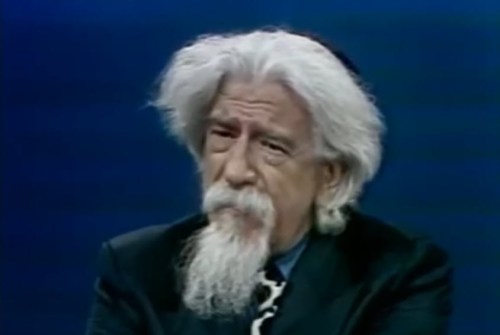
Heschel on Politicians

“I consider the heart of the problem of human existence is to fight against mendacity, against lying. I would like to use a word which may be too often used, but it’s still the most important word—and that is “honesty,” or “sincerity,” or “trust.””

“I am against the word “politician.” I have great respect for the word “statesman.” It’s very interesting, the word “statesman” is not used. “Politician” is used. “Statesman” is a great word….The task of a statesman is to be a leader, to be an educator, and not to cater to what people desire almost against their own interests. To be a leader.”

From an interview with Abraham Joshua Heschel at the University of Notre Dame in 1967, published in Moral Grandeur and Spiritual Audacity, essays by Heschel.

Q: Your esteem for religious colleagues is greater than your esteem for politicians. I think you once said that the most depressing word in the English language is “politician.” Politicians are necessary, aren’t they? Why disparage them?

A: No, I’m not against politicians in their vocation. I’m against politicians in their tactics. Against the very meaning, the semantic meaning of the word “politician.”

Now let me elaborate. It may take me two minutes to explain it to you. I consider the heart of the problem of human existence is to fight against mendacity, against lying. I would like to use a word which may be too often used, but it’s still the most important word—and that is “honesty,” or “sincerity,” or “trust.”

The tragedy of our time is, we don’t trust each other. The Golden Rule today is not “Love thy neighbor as thyself” but “Suspect thy neighbor as thyself.” We suspect all politicians because we know in advance they don’t mean what they say and they don’t say what they mean.

Q: Is that justified? That suspicion?

A: Ask the people in the country. You’re asking me? I’m only one citizen. I have only one vote.

If you go to the country and ask them, “What do you think of politicians?,” they’ll say a politician is a synonym for a person who is not necessarily truthful. Right? Do you mind my elegant way of speaking?

We have a type of politician today—I suppose we’ve always had, and I don’t want to identify anyone—who tells us that he is doing what the peoples want. And, in fact, that may be so. Of course, that doesn’t reach to the question of leadership. Should our leaders give us what we want, or is there some other role?

I think there is another role. By the way, I am against the word “politician.” I have great respect for the word “statesman.” It’s very interesting, the word “statesman” is not used. “Politician” is used. “Statesman” is a great word.

Now, about doing what the people want—I’ll tell you what the people want. One of the major inclinations in every human being is a desire to be deceived. Self-deception is a major disease.

Q: To be told what one wants to hear?

A: Yes. You want to be deceived.

The task of a statesman is to be a leader, to be an educator, and not to cater to what people desire almost against their own interests. To be a leader.

The great question of today is mendacity. We live in a world full of lies. And the tragedy that our young people—or maybe it’s good—the young people have discovered how many lies are uttered daily and every moment. They can’t stand it. If there’s anything they despise, it’s someone who is phony, false rhetoric. We call it “credibility gap”—what we mean really is lying.