Pete Rose And The Healthcare Decision
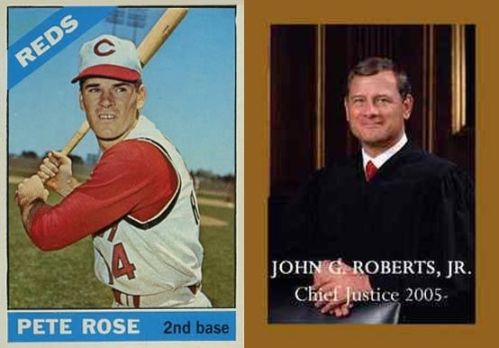
It looks as if the Supreme Court will issue its decision on the Affordable Care Act (aka Heritagecare) this week. An unreported story is the relationship of this to baseball legend Pete Rose.
There has probably been more betting on the outcome of this legal question than any before, at venues such as Intrade. Presumably the bettors include some number of lawyers; with more than a million lawyers in the U.S., what are the odds of that?
Major League Baseball has so far banned Pete Rose from the Hall of Fame because he bet on games. Not games he or his team were involved in, just games. Ever since the Black Sox scandal almost a century ago, baseball has had a zero tolerance rule on gambling by anyone in the sport.
The courts and the bar associations that regulate the practice of law have well developed and strict rules of conduct for lawyers. Obviously illegal gambling is just that— illegal—and clearly out of bounds. Gambling addictions that affect practice have also taken a prominent place in the rules of professional responsibility.
But it doesn’t appear that reasonable and prudent legal gambling of any kind is an ethical problem for lawyers. Unless, that is, there is some kind of Pete Rose issue about it. Specifically: Can lawyers responsibly and ethically bet on court decisions with which they have absolutely no relationship? The answer awaits investigation, and maybe some law review articles.
As for the case itself, they say that only fools predict difficult Supreme Court decisions. So a fool rushes in:
1. The Court will have the law stand or fall as a whole and not pick and choose. There is no severability clause. The court can appropriately say that with such an integrated and complex piece of legislation, if Congress got it wrong constitutionally, it is up to Congress to get it right.
2. If it falls on the basis of the mandate, as widely expected, the reasoning of the majority is going to be a sight to behold and study. A principle of jurisprudence at every level is to decide legal issues as narrowly as possible, unless there is an intention to make a bold legal statement. When the Supreme Court speaks, the bolder the statement, the more far-reaching the impact. In a three-branch democracy, any statement about the limits of powers is very loud and long-echoing.
3. We may not have nine opinions, but we may have an almost complete set of concurring and dissenting opinions. For those who have never read dissents in Supreme Court opinions, be aware that in difficult and controversial cases, it is not unheard of or inappropriate for dissenting Justices to politely but clearly state that the majority is in all respects wrong (see the four dissents in Bush v. Gore).
And now, the bottom line. Intrade traders have placed their bets, and they say the chances of “The US Supreme Court to rule individual mandate unconstitutional before midnight ET 31 Dec 2012” are 76.5%. Judging by the comments on the site, the bettors are some combination of knowledgeable thinkers and anti-Obama ideologues. Intrade and those analysts willing to go out on a limb are right. The mandate will be found wanting, with strenuous disagreement among the Justices. And on the basis of non-severability, so will the entire Affordable Care Act.
Or, then again, maybe not.