Bob Schwartz

Category: Politics

Performers in Chief

Every President, every aspirant, every high-profile politician is a performer. They are the epitome of T.S. Eliot’s “prepare a face to meet the faces that you meet” (or that may vote for you).

There is no moral measure in this, any more than there is for fish swimming or birds flying. The measure instead is the roles they choose to play, how well they play them, how suited they are to play them, and ultimately how the performance plays with the audiences.

Even playing yourself is a form of performance, sometimes the most challenging. Washington, Lincoln, FDR, all were who they seemed to be, just in a public way that channeled, focused, and amplified that actuality. It was only partly Reagan’s policies that got him overwhelmingly elected and keeps him in the national consciousness; it’s that he created and played an unforgettable Presidential role that even his skeptics admit was masterful. On the other end, we have many moments of miscasting, as in Michael Dukasis’s misbegotten moment playing a warrior in a tank.

President Obama was on the Jimmy Fallon show last night. We may have had other performers in the office who were as affable, funny, and smooth, but in the young twenty-first century, there are none who can hit the perfect note at the nexus of presidential gravity and free-spirited playfulness. The President slow jammed the news, working in his message about attempts to double the interest rate on Stafford college loans.

Older viewers, who may fondly remember candidate Richard Nixon’s few seconds on Rowan & Martin’s Laugh-In in 1968 (“Sock it to ME?”), might think that Obama goes too far—in this and his many “cool” appearances. But Nixon’s performance was more than forty years ago, and audiences and sensibilities have changed. We may not want a President who is one of us, but we may want a President who chooses to act in a way that demonstrates he knows what time it is and who we are—and one who can pull it off naturally.

Up to this point, Mitt Romney seems to be one of the most reluctant and least effective performers we’ve had running for President. This doesn’t mean there won’t be improvement, but it will have to come from him or his handlers recognizing the basics: choose the roles appropriate for yourself and your intended audiences, and then play the roles effectively. One of Romney’s challenges is sometimes called flip-flopping or more recently etch-a-sketching. But the real challenge is that Romney has not chosen any roles to play, and he is struggling to even play the default role—himself—effectively. Romney has little experience as a performer, since many business positions don’t require it. It’s time for him to learn.

Until Romney decides to pick some appropriate roles and learn how to perform them, it will be an uphill race for him. Likeability has become the shorthand index for predicting electoral success. But it is something more, less subject to measure, but still very clear. The best performers often win the Presidency. In a campaign, and in office, you don’t just be the President, you play the President.
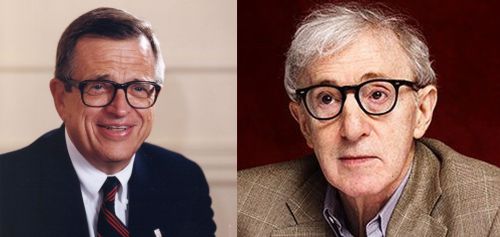
Chuck Colson: Teshuvah and Woody Allen


Chuck Colson (1931-2012) died this past weekend. His ruthless loyalty to Richard Nixon led to his central role in the Watergate scandal and to time in prison. That experience in turn led to his rebirth as an Evangelical Christian and to a lifetime of writing books (23 of them) and of helping the least among us—prisoners and others—to achieve fuller and better lives, at least by Colson’s religious lights.

If many were turned off by Colson’s politics before his conversion, it was not always easier after. Some questioned his sincerity. Others wondered whether any amount of transformation, however sincere, could balance his responsibility for helping to bring our democracy to its knees. Others saw the politics of his Christianity to be as socially destructive as the politics of his pre-Christian ruthlessness.

Two notes about Chuck Colson.

His first book Born Again (1976) is distinguished from all other books by participants in Watergate, from Nixon down through all his men. Most readers with particular political or religious inclinations didn’t read the book then, and even fewer do now. It is a compelling, candid, sincere confession of malfeasance and faith. Whether Colson’s work of the past forty years is to your liking or loathing, if you believe in the possibility of turning—in Hebrew, teshuvah—then you should believe in this. Personal transformation is not limited to those we approve of.

The second note is that Chuck Colson was a big Woody Allen fan. This was revealed last fall in an article  by Washington Post religion writer Michele Boorstein. Theories of humor and religion aside, this really isn’t hard to understand. Funny and smart is funny and smart, and this is probably something Colson appreciated. There’s no evidence that Colson and Allen ever met (though Boorstein did uncover a tape of Allen interviewing Billy Graham!). If they had, maybe they would have shared their experiences and views about the power of turning and confession for everyone, including artists and political operatives.

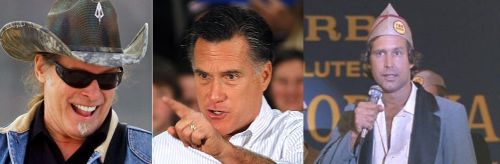
Mitt Romney, Ted Nugent and Chevy Chase

The recent silliness regarding Ted Nugent’s endorsement of Mitt Romney, followed by Nugent’s seeming threats to kill the current President, brought to mind a classic movie moment involving Ted Nugent and another rich guy.

It wasn’t actually Ted Nugent. It was Chevy Chase in Fletch. In the movie, Fletch/Chevy Chase is a smart-mouthed investigative reporter who regularly cracks wise by using ridiculous names. In this scene, Fletch is disguised as a beach bum, and businessman Alan Stanwyk (played by Tim Matheson) offers him a deal:

Stanwyk: Excuse me. I have something I’d like to discuss with you.

Fletch: What’s that?

Stanwyk: We can’t talk about it here.

Fletch: Why not?

Stanwyk: Because we can’t.

Fletch: You on a scavenger hunt, or did I forget to pay my dinner check?

Stanwyk: Come to my house to talk.

Fletch: Wrong gal, fella.

Stanwyk: I’ll give you cash.

Fletch: What?

Stanwyk: Come to my house and listen to the proposition. If you reject the proposition, you keep the thousand…and your mouth shut.

Fletch: Does this entail my dressing up as Little Bo Peep?

Stanwyk: It’s nothing of a sexual nature.

Fletch: Yeah.

Stanwyk: One thousand just to listen? How can you pass that up, Mister…

Nugent. Ted Nugent.

Stanwyk: Alan Stanwyk.

Fletch: Alan, charmed. For an extra grand, I’ll let you take me out to dinner.

There’s no reason to believe that the one conversation between Mitt Romney and Ted Nugent went anything like this. Mitt Romney is much richer than the fictional Alan Stanwyk, and the fictional Fletch/real Chevy Chase is much funnier than Ted Nugent. But it is fascinating to speculate how that endorsement conversation really did go, and if it might have been as surreal as this.

Thinking about Fletch can’t help but bring to mind the scene where Fletch disrupts an American Legion meeting by singing an earnestly terrible version of our national anthem. And thinking about Chevy Chase can’t help but bring to mind National Lampoon’s Vacation and a dog being tied to the bumper of a station wagon. Idle thoughts, none of which have anything to do with Ted Nugent.

But if we were thinking about singing, Mitt Romney, and Ted Nugent, we might idly wonder which song—either Nugent or Amboy Dukes—Romney might choose the next time he sings or recites a song on the campaign trail (though it’s doubtful he ever will again).

Journey to the Center of the Mind (1968) was the biggest Amboy Dukes hit, but maybe the most interesting song on an album that combined blues and psychedelia was Why Is A Carrot More Orange Than An Orange?.  Mitt Romney will not sing or recite it, of course, but it would be a memorable and humanizing moment:

First the world,
Then boy then girl,
Six days it took in all.
In His image he designed us
With no thought of flaw.

Now the question of perfection
Lingers in my mind.
Why is a carrot more orange than an orange?
Why are you greener than green?
Why do we sometimes believe
In things we’ve never seen?
Never doubt what it’s about
And you’ll get along fine.
But thy seeing the true meaning
Proves you’ve got a mind.
My suggestion is inspection of humanity.

I see why the ground is lower than the sky
And why sound can penetrate your mind.
But why is a carrot oranger than an orange?
Oranger than an orange?

Thank you, Ted Nugent.

Could We Have Survived a Great Depression?

The Great Recession did not turn into a(nother) Great Depression, and the prospects of continuing towards prosperity, or at least less economic insecurity, seem good. The big question that we now have a limited luxury to ask is this: Could we have survived a Great Depression? The study of that question may be the most valuable we can make.

The Great Depression has spawned an industry for scholars, historians, and thinkers of all stripes, and that has been a good thing. Systems and people are seen truest at their moments of greatest stress, and hardly anything before or since qualifies

Looking at how we managed to survive the last Great Depression – whether it was leadership and action, the normal cycle correcting a horrific anomaly, the fortunate unfortunate impact of a global war, or all/none of the above – tells us something about how we might handle the next. A couple of small starting points:

Creativity matters. Dismissing creative civic solutions out of hand and out of political pique is something we can never afford, and in the worst times something we should never tolerate. Love him or hate him, FDR got boldly creative, pushing the bounds of constitutionality, convention, and common sense. But when things fall apart as they did, common sense is cold comfort. Herbert Hoover, who was in fact a man of civic accomplishment, lacked the boldness and sense of adventure needed for the unprecedented times.

The question is: At that moment in 2008, if things had gone from bad to worse, would there have been the will to be creative and to try things, even if that meant setting aside ideology and political advantage. The answer is that nothing at the time, and nothing today, tells us that there would have been.

Optimism matters. One of the latest political ads from Rick Santorum depicts a cautionary apocalyptic vision of Obama America, something straight out of the Book of Revelation. During the Great Depression, there was no need for a fanciful version of the Apocalypse; it was already there. Books, songs, and movies painted an accurate vision of hardship, but they also tried for uplift and hope. The best and smartest politicians realized that when the spirit of America was already broken, the last thing people needed was a reminder that things could and might yet get worse. Happy days might not have been there again, as the song said, but there was no point in saying that they never would.

So as with the dismissal of creative solutions, the question is, in the face of a 21st century Great Depression, whether today’s politicians could find a way to set aside the darkness and pessimism for a brighter vision of good times ahead, even if it meant faking optimism, even if it meant losing political advantage. There is little evidence of that.

Heritagecare

In 1989, Stuart Butler and others at the conservative Heritage Foundation laid the groundwork for Obamacare/Romneycare in the publication A National Health System for America. Chapter 2 by Butler, A Framework for Reform, outlines and explains “the key elements of a consumer-oriented, market-based, comprehensive health system for America.” Element #1 is “Every resident of the U.S. must, by law, be enrolled in an adequate health care plan to cover major health care costs.” (page 51):

The requirement to obtain basic insurance would have to be enforced. The easiest way to monitor compliance might be for households to furnish proof of insurance when they file their tax returns. If a family were to cancel its insurance, the insurer would be required to notify the government. If the family did not enroll in another plan before the first insurance lapsed and did not provide evidence of financial problems, a fine might be imposed.

In other words, a mandate.

Agree or disagree with the Heritage Foundation or this proposal, Butler deserves credit for putting together a cogent, well-written primer on health care history, a report on the shortcomings of the current system, and a set of well-reasoned and creative proposals.

But no good or at least well-intentioned deed goes unpunished. In the time since, and especially in the past year, Butler and others have taken pains to explain how this Heritage Foundation proposal isn’t Obamacare and, in any case, how the proposal has been misunderstood and misapplied. The document itself can still be found on the Heritage Foundation website, though it is not shown and linked as one of Stuart Butler’s documents.

No matter what is argued to the Supreme Court today, no matter what the Justices ultimately decide about the constitutionality of mandates, and no matter how the complicated political dance involving Obama, Romney, Obamacare, and Romneycare turns out, Heritagecare was there first. It is essential reading.

Microsoft and the Mobile OS Nomination

To spin a political metaphor, in the race for dominance in mobile OS, Microsoft is the candidate with the resources and the organization who can’t seem to close the deal.

It’s not that consumers don’t like Microsoft, although many don’t. It’s a complex of factors with this outcome: the race is down to two candidates – iOS and Android – and it is likely the two will dominate and coexist for a long time.

The field began with so many candidates now gone or barely hanging on, including WebOS, Symbian, and others. Microsoft remains confident it will be a major player. In so many of the other competitions, their sheer presence and heft has assured their victory. Windows has had to share a bit of the personal computing world with slicker, sexier Apple, not to mention the third-party Linux, the Ron Paul of OS. Along with that PC dominance came a near-monopoly on office productivity; for as many times as Microsoft remakes Office, each time more over-complex and confusing, it is still the standard. Even in browsers, where it appeared that IE would end up relegated to minority status, Microsoft could afford to hang in there and claw its way back. It has won more than it has lost, and believes it is entitled to stay in any race.

It may, therefore, be too early to completely count Microsoft out of the mobile OS race. It is partnering with Nokia, arguably the coolest phone maker on the planet (yes, maybe cooler than Apple), which is abandoning its long use of Symbian OS in favor of Windows. But as much as Microsoft puts into the effort, as many good reviews and fans as the Windows mobile OS wins over, it is too little too late.

Maybe in this case there is a “rule of two” for mobile app development and consumer adoption, rather than the usual rule of three. Developers have been willing to port their iOS apps to Android, though it remains a work in progress, as the differences between the OS continue to present challenges. Developers are already balking at adding a third version to the mix, given that Windows is also different and hasn’t yet demonstrated market share, if it ever will.

Two things we know about politics: the best candidate doesn’t always win, and money and organization may or may not be able to buy an election. Over the years, Microsoft has managed to push aside some very capable and innovative software. But that’s how it goes: the technology business isn’t “beanbag.” Maybe Microsoft has something really special to offer with Windows mobile OS. But millions of consumers may not care, and will never get the chance to find out.

Etch A Sketch – the Original Digital Tablet – Goes Political and Mobile

Etch A Sketch is the original digital tablet, if digital means using your fingers to twirl some knobs. The Ohio Art toy company is thrilled that its Etch A Sketch has become a new prop in the public and political conversation.

But as much as we continue to hear about Mitt Romney’s positions in the primary being drawn on an Etch A Sketch – here now, shaken and redrawn in an instant – not many people are going to go out and buy one, let alone carry one around.

The good news is that just last month, digital game company Freeze Tag released an Android version of the official Etch A Sketch mobile app.

It’s a very simple app, permissions-light for the privacy conscious, fun and free, and it works just like the real thing, only much tinier (more advanced features like color and saving sketches are available with the 99-cent paid app). Even if you’re not an Etcher, those of a particular partisan persuasion might find it a handy way to signal your leanings.

Political Fairness and Context

All is fair in love, war, and politics. Most don’t actually believe that unconditionally, but when push comes to shove, principles of fairness have a way of bending in the furtherance of some higher causes and outcomes.

As a politician, Mitt Romney appears to be more than rhetorically challenged. He seems to have some kind of disability when it comes to expressing himself spontaneously in a politically positive way. Examples are by now too many to list, though if he does become the Republican Presidential candidate, every last one of the verbal blunders made and yet to be made are sure to be front and center.

In a radio interview this week, Romney was asked about federal spending he would cut as President, and among other programs, he said he would “get rid of” Planned Parenthood. It is obvious that what he meant was that he would cut federal support for Planned Parenthood. But since everything that any politician says can be taken and used in different ways, there are a number of possibilities:

He meant just what he said, inartfully as usual, that he would cut federal spending for the organization, and that no tax money would be spent there.

He meant that he would cut federal spending for the organization, which in turn would “get rid of” Planned Parenthood. Romney presumably knows better and knows that Planned Parenthood has other funding sources, though it would be no doubt be hurt by such a cut.

He meant to send a message to some conservative voters that he disdains Planned Parenthood as much as they do, and while he would only be able to propose cuts in federal support, if he had the power to directly control the fate of the organization (which he wouldn’t), he would love to get rid of it.

A number of vocal and visible Democratic proponents believe and have seized on the last interpretation. But to make that point, and to avoid getting into long-form exegetical nuance, they simply quote Romney saying that he wants to get rid of Planned Parenthood. The problem is that in context, that isn’t what he said, even if he meant or was signaling something bigger and more significant.

Democrats regularly complain, justifiably, when they and President Obama are the targets of out of context quotes and multimedia moments. As with all kinds of questionable tactics, from love to war, it comes down to a choice between adopting the inglorious approach, fire-with-fire, or recognizing and reaching for higher ground. The point of fairness is that if it isn’t universally applied, it becomes an expedient tool to be used or left in the toolbox as the situation demands.

If truth is the first casualty of war, maybe fairness is the first casualty of politics. But it shouldn’t be, because we are better than that. Or at least we think we are.

Romney’s Away Down South Game

Mitt Romney is downplaying expectations for his performance in the Mississippi and Alabama primaries, saying the elections are an “away game” for him.

Even though home field advantage is usually a topic when one candidate can claim native or adoptive connection (Michigan, Massachusetts, Pennsylvania, Georgia, etc.), there are no natives or adoptees in this race at this moment. The fact is that when you’re running for President, even at the party nomination level, the U.S. is your home field. This isn’t regional beanbag, to paraphrase Romney, this is national politics. You may one day be President of all the people, and none of those people live in a foreign country.

Speaking of Mississippi, Romney also said that through a relationship with local politicians he had become an “unofficial” Southerner, parotting “y’all” and liking grits. Three things Mitt Romney has to learn:

You can move to Mississippi and other places in the South, live there, love it there, but you will not be a Southerner, unofficial or otherwise. Don’t even think about it.

“Y’all” and “All y’all” are some of the most useful linguistic creations in the English language, not just quaint phrases in a guidebook. Respect them.

What can you say about grits that hasn’t already been said? You don’t like grits, you love grits. It is the ultimate breakfast synthesizer, turning a disconnected group of eggs, toast, and meat (or meat substitute) into the best and most important meal of the day.

Trans v. Intra

A tiny lexical commentary about the proposed trans-vaginal ultrasound procedure proposed and now withdrawn in Virginia, without opinions offered otherwise:

1. The legislator who sponsored the bill could not bring himself to say the V word, instead referring to it as “trans-V.”

2. “Trans” is itself misdescriptive. It should correctly have been called “intra-vaginal,” but for reasons too politically obvious, that was softened.

3. Notice in the context of this controversy the similarity between “Virginia” and “vagina.” Will “trans-Virginia” or “intra-Virginia” soon enter our vocabulary too? Will some begin to refer to the state as “V”?

4. Virginia is for lovers.