Bob Schwartz

Category: Politics

There Is No MAD In Politics


The Supreme Court decision in American Tradition Partnership, Inc. v. Bullock confirms that states like Montana must follow the rule of Citizens United and allow corporations the same political speech rights as individuals, including speaking money in elections.

War Games (1983) is a charming movie with a serious message. The charming comes from a young Matthew Broderick, playing a computer geek whose gaming nearly starts a global thermonuclear war. He is able to avert it, and the serious message for everyone is spoken by the computer: “The only winning move is not to play.”

When nuclear weapons were used for the first and only time in 1945, and it was obvious that portions of the world could be destroyed in an instant, responses followed.  There were moves to keep them out of the hands of “bad guys”, there were demonstrations to “ban the bomb” from everyone, there were attempts to limit and reduce the weapons that everyone eventually got.

And then there was the idea of Mutually Assured Destruction (MAD). It was simple: If anyone with those weapons could as easily be destroyed as they could destroy, it would be “madness” for them to strike. And as much as our deepest humanity wants to deny it, MAD is the reigning paradigm that has prevented nuclear weapons from being used even once in the almost seventy years since Hiroshima and Nagasaki.

In post-Citizens United politics, there is no MAD. There is worthwhile talk of disclosure, transparency and constitutional amendments to at least moderate the influence of corporate money in elections. But there is also a realpolitik sense that in the meantime those with the biggest weapons may well win. And the prospective winners have no worries about being destroyed by any opposing arsenal. That is why, understandably, the Obama campaign very quickly pivoted on the issue of Super Pacs. It was a matter of political survival.

MAD has saved us from blowing ourselves up. It is not available to save the politics of democracy. It is time for the most creative minds to figure out something beyond the virtuously obvious but ineffective. Whatever that might be.

Pete Rose And The Healthcare Decision

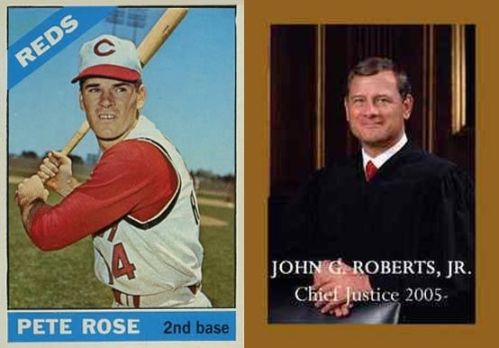
It looks as if the Supreme Court will issue its decision on the Affordable Care Act (aka Heritagecare) this week. An unreported story is the relationship of this to baseball legend Pete Rose.

There has probably been more betting on the outcome of this legal question than any before, at venues such as Intrade. Presumably the bettors include some number of lawyers; with more than a million lawyers in the U.S., what are the odds of that?

Major League Baseball has so far banned Pete Rose from the Hall of Fame because he bet on games. Not games he or his team were involved in, just games. Ever since the Black Sox scandal almost a century ago, baseball has had a zero tolerance rule on gambling by anyone in the sport.

The courts and the bar associations that regulate the practice of law have well developed and strict rules of conduct for lawyers. Obviously illegal gambling is just that— illegal—and clearly out of bounds. Gambling addictions that affect practice have also taken a prominent place in the rules of professional responsibility.

But it doesn’t appear that reasonable and prudent legal gambling of any kind is an ethical problem for lawyers. Unless, that is, there is some kind of Pete Rose issue about it. Specifically: Can lawyers responsibly and ethically bet on court decisions with which they have absolutely no relationship? The answer awaits investigation, and maybe some law review articles.

As for the case itself, they say that only fools predict difficult Supreme Court decisions. So a fool rushes in:

1. The Court will have the law stand or fall as a whole and not pick and choose. There is no severability clause. The court can appropriately say that with such an integrated and complex piece of legislation, if Congress got it wrong constitutionally, it is up to Congress to get it right.

2. If it falls on the basis of the mandate, as widely expected, the reasoning of the majority is going to be a sight to behold and study. A principle of jurisprudence at every level is to decide legal issues as narrowly as possible, unless there is an intention to make a bold legal statement. When the Supreme Court speaks, the bolder the statement, the more far-reaching the impact. In a three-branch democracy, any statement about the limits of powers is very loud and long-echoing.

3. We may not have nine opinions, but we may have an almost complete set of concurring and dissenting opinions. For those who have never read dissents in Supreme Court opinions, be aware that in difficult and controversial cases, it is not unheard of or inappropriate for dissenting Justices to politely but clearly state that the majority is in all respects wrong (see the four dissents in Bush v. Gore).

And now, the bottom line. Intrade traders have placed their bets, and they say the chances of “The US Supreme Court to rule individual mandate unconstitutional before midnight ET 31 Dec 2012” are 76.5%. Judging by the comments on the site, the bettors are some combination of knowledgeable thinkers and anti-Obama ideologues. Intrade and those analysts willing to go out on a limb are right. The mandate will be found wanting, with strenuous disagreement among the Justices. And on the basis of non-severability, so will the entire Affordable Care Act.

Or, then again, maybe not.

Elizabeth Warren And Native American Lending

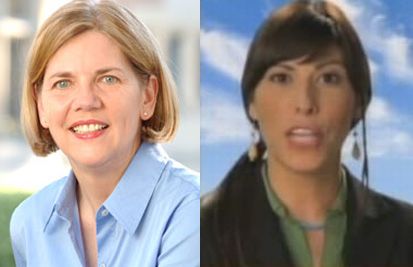
Elizabeth Warren is a figure of considerable talent and successful public service. On the heels of a controversy that has been dogging her, though, an irony has cropped up that is worth a note in passing.

Even in a political season where the bizarre has become the everyday, Elizabeth Warren’s run for a U.S. Senate seat from Massachusetts has taken some strange turns. While her claim to Native American heritage is entirely legitimate, her handling of the politics surrounding it has been less than smooth. And now there is an unremarked upon twist to it.

You’ve probably seen television ads for the Internet lender Western Sky Financial. A pretty woman in braids looks you straight in the eye and offers you a personal loan. “Yes, the money is expensive,” she admits, “but it is a lot cheaper than a payday advance.” All the while, the Western Sky three-tipi logo is emblazoned onscreen, as a drum beats softly in the background.

The Western Sky site explains:

Western Sky Financial is owned wholly by an individual Tribal Member of the Cheyenne River Sioux Tribe and is not owned or operated by the Cheyenne River Sioux Tribe or any of its political subdivisions. Western Sky Financial is a Native American business operating within the exterior boundaries of the Cheyenne River Sioux Reservation, a sovereign nation located within the United States of America.

In an earnest section on Responsible Lending, Western Sky outlines its philosophy:

Fair Dealing among people is a Lakota Tradition, and a concept that is fully embraced by Western Sky. Fair Dealing requires parties to be open and honest and to treat others with respect. Western Sky believes Fair Dealing to be an important aspect of being a responsible Lender.

Western Sky seeks to employ the concept of Fair Dealing at all levels of customer relations, from the application process to the details of loan repayment. This page outlines our approach and what we ask you in return. If you have any questions regarding our commitment to Fair Dealing or our expectations of you, please feel free to ask.

Here are some of the loan rates:

Loan Product Borrower Proceeds Loan Fee  APR   Number of Payments Payment Amount
$10,000 Loan      $9,925          $75   89.68%        84              $743.49
$5,075 Loan       $5,000          $75   116.73%       84              $486.58
$2,600 Loan       $2,525          $75   139.22%       47              $294.46
$1,500 Loan       $1,000          $500  234.25%       24              $198.19
$850 Loan         $500            $350  342.86%       12              $150.72

Demand for easy but high-interest loans has skyrocketed in these hard times. In response to possible overreaching, a number of states that had previously kept their legislative hands off have jumped in to try and set some limits.

It appears that hundreds of Native American-related lending companies, including Western Sky, have cropped up to meet consumer demand. Despite state efforts to weigh in on this development, tribal sovereignty in the face of state laws has prevailed. In 2011 the Native American Lending Alliance  was formed to establish best practices and to make sure that sovereignty in this area remains intact and unassaied.

The only entity empowered to take on any question of tribal-related lending is the federal government. In recent years the federal government did generally take on consumer lending and related  issues with the establishment of the Consumer Financial Protection Bureau. But Native American lending is a legally complex and sensitive matter, and neither the federal government nor the CFPB is currently addressing it as frontline cause.

And that’s where the irony comes in. The CFPB is to a great extent the creation of Elizabeth Warren. She conceived it and helped build it. So at a time when Native American interests are operating just outside the purview and the spirit of the CFPB, Elizabeth Warren’s own Native American heritage has become a bit of a campaign issue.

The two have no direct connection, and all we know tells us that Elizabeth Warren always stands squarely on the side of consumers. But it is ironic: not a big irony, but certainly a curious twist in an endlessly curious and twisted political season.

Bobby Kennedy: To Strive and Not To Yield


June 6th is the anniversary of the assassination of Robert F. Kennedy in 1968. The assassination of his brother John F. Kennedy is a milestone, a marker between eras. The assassination of Bobby Kennedy is a touchstone, a regular reminder that bright possibilities exist for a while, but things get in the way. Life goes on, just not the way you imagined or dreamed.

It seems useless to add to the volume of words about Bobby Kennedy. Not as many words as those devoted to his brother, who was, after all, President. After all, Bobby Kennedy was not President, and maybe would never have been. Maybe destiny planned all along to serve us up Richard Nixon. Maybe that Kennedy presidency could never live up to expectations or aspirations. We have learned that he was not a personal or political saint, but that was not a surprise. Saints belong in churches, not politics. We want and need heroes, which often means tragic ones. Bobby Kennedy was that and more.

For those unfamiliar with his life and career, here is the condensed version, courtesy of Congress:

KENNEDY, Robert Francis,  (brother of John Fitzgerald Kennedy and Edward Moore Kennedy, grandson of John Francis Fitzgerald, uncle of Patrick J. Kennedy, and father of Joseph Patrick Kennedy II), a Senator from New York; born in Boston, Suffolk County, Mass., November 20, 1925; graduated from Milton (Mass.) Academy; served in the United States Navy Reserve 1944-1946; graduated from Harvard University in 1948 and from the University of Virginia Law School in 1951; admitted to the Massachusetts bar in 1951; attorney, Criminal Division, Department of Justice 1951-1952; campaign manager for John F. Kennedy’s election to the United States Senate in 1952; assistant counsel, Senate Permanent Subcommittee on Investigations 1953; assistant counsel, Hoover Commission 1953; chief counsel to the minority, Senate Permanent Subcommittee on Investigations 1954, and chief counsel and staff director 1955; chief counsel of Senate Select Committee on Improper Activities in the Labor or Management Field 1957-1960; campaign manager for John F. Kennedy’s election to the Presidency in 1960; Attorney General of the United States from January 1961, until his resignation September 3, 1964, to be a candidate for the United States Senate; elected as a Democrat from New York to the United States Senate and served from January 3, 1965, until his death; died from the effects of an assassin’s bullet at Los Angeles, Calif., June 6, 1968, while campaigning for the Democratic presidential nomination; interment in Arlington National Cemetery, Arlington, Va.

Bobby Kennedy was a lover of literature and poetry. He frequently quoted the poem Ulysses by Alfred, Lord Tennyson. It is the tale of the old warrior Ulysses, who eschews comfort for mission. He has already sacrificed family life for duty, and he can’t help but set out one more time. It is not about glory, but about the dullness of a life of ease and about fiercely pursuing a dream until the end of days.

The poem closes with one of the great calls to action in the English language, both realistic and idealistic. “That which we are, we are,” Ulysses says. Bobby Kennedy was what he was.

…Come, my friends,
‘T is not too late to seek a newer world.
Push off, and sitting well in order smite
The sounding furrows; for my purpose holds
To sail beyond the sunset, and the baths
Of all the western stars, until I die.
It may be that the gulfs will wash us down:
It may be we shall touch the Happy Isles,
And see the great Achilles, whom we knew.
Tho’ much is taken, much abides; and tho’
We are not now that strength which in old days
Moved earth and heaven, that which we are, we are;
One equal temper of heroic hearts,
Made weak by time and fate, but strong in will
To strive, to seek, to find, and not to yield.

This is how it ends: Bobby Kennedy giving a victory speech after his winning the California Presidential primary. All these years later, the divisions he speaks about seem just as present and pressing as ever. Could he have healed them then? Could he heal them now? Not too late to seek a newer world:

I think we can end the divisions within the United States. What I think is quite clear is that we can work together in the last analysis. And that what has been going on with the United States over the period of that last three years, the divisions, the violence, the disenchantment with our society, the divisions—whether it’s between blacks and whites, between the poor and the more affluent, or between age groups, or in the war in Vietnam—that we can work together. We are a great country, an unselfish country and a compassionate country. And I intend to make that my basis for running.

Update: A check mid-day on June 6 shows that a Google News search for “Bobby Kennedy” results in 7 hits and a search for “Robert F. Kennedy” finds 24, and some of those concern gossip about his son Robert F. Kennedy, Jr. It might be that the 44th anniversary of any event is less important than the rounder numbers like 40 or 50. Besides, we aren’t obliged to pay attention to anything, present or past. There is some tendency, not only today but maybe always, to dismiss looking back at pivotal events as pointless nostalgia. But history is not nostalgia, a confusion related to the very current idea that trivia is news. This endless political season is filled with lots of lesser mortals on all sides, not indictable because they are flawed, but because their flaws so outweigh their nobility. The point of the post is to remind us that this doesn’t have to be true, and there was a time when it wasn’t, and might yet be again.

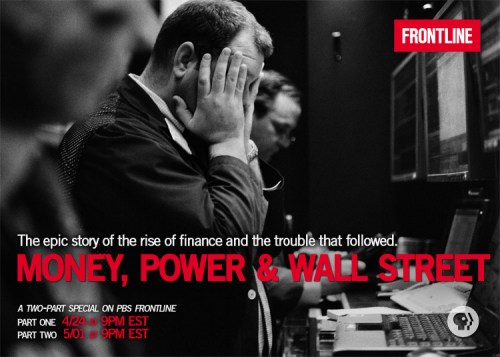
Money, Power & Wall Street: The Don’t-Miss Can’t-Watch Documentary

It is hard to recommend the four-part PBS Frontline documentary Money, Power & Wall Street and hard not to. Difficult as it is to watch the financial crisis unfolding, the film is superior even by Frontline’s high standard of excellence. As a history and prospectus, it is an insightful, even-handed and essential work of reporting. As a source of optimism, it is a complete failure, because the conclusion is that nothing has substantially changed, and that maybe nothing will.

It is as good as any disaster movie in pulling us in and moving us inexorably along. We see the scenes in detail, meet the cast of characters—lead and supporting actors—and have a growing sense of foreboding: this can’t end well.

It is different than most disaster movies in two ways. Most have some heroes, and with a few exceptions, there are no heroes here. And most disaster movies end with some movement toward rebuilding and reform, and with a sense of lessons learned: we will keep better watch for asteroids, we will build a system of asteroid warning and protection, we will come out this with a fundamentally better society. There is none of that here.

Yet Money Power & Wall Street has to be seen by every American. Those with political agendas will no doubt point to particular decisions or non-decisions, or particular actions or inactions, to prove a partisan point. But when they do, they will have missed the bigger point. In a world where financial forces become too big to understand or control, it is still our job as citizens and public servants to understand and control them. Because when it finally hits, ideologies and political badges are not really going to matter.

Smooth Newt and Newtsex Models


Sometimes posts don’t make it to the blog on time. The Republican Presidential primaries moved so fast that yesterday’s hot item becomes tomorrow’s “Who?” or “Who cares?” in a flash. Newt Gingrich is back in the news today, with the apparent collapse of his business mini-empire. This is in no way kicking a man when he’s done, since it is simply fascinating, not critical.

For those who think that “Smooth Newt” and “Newtsex Models” refer to something about a Presidential candidate, you are in for a shock. They are in fact references to four Newtsex models (known as Mark I, II, III and IV) that are part of a very sophisticated biological study of the courtship of the smooth newt (triturus vulgaris). The article How Long Will Newts Wait? explains:

The Newtsex model simulates the behavioural transition between two parts of newt courtship, Retreat Display and Creep, and models the interaction between four causal factors: the behaviour of the female, the male’s spermatophore supply, his need for oxygen, and feedback from the male’s own behaviour. The model predicts that, if feedback from the female is withheld at a critical point (Tail-touch), the male will revert from Creep to Retreat Display after an interval, the duration of which is proportional to his spermatophore supply. The results of an experiment in which the female’s behaviour was controlled support this prediction, but a high level of variance in the results suggests that respiratory constraints on male courtship behaviour require further investigation. (Behaviour, March 1991)

Newtsex. Tail-touch. Creep. Retreat Display. This is science. You cannot make this stuff up.

Barack and Mitt: The Most Unpopular Candidates in American History


This is an unprecedented Presidential campaign. Just ask the Social Security Administration.

The SSA keeps track of baby names, a database that goes back to 1879. It just released its list of the 1000 most popular male and female names for 2011—Jacob to Armani to Ethen (sic), Sophia to Francesca to Damaris. None of that necessarily matters for the Presidential race.

What does matter is this: Never in American history have both major party candidates for the Presidency had names that were not among the 1000 most popular—ever.

In 2008 it was easy to surmise that one name (not John) had never made it to the Top 1000, and Barack still hasn’t. But this year’s race includes two overwhelmingly unpopular names.

Romney’s real first name Willard has made appearances on the chart: the last time in 1989 when it was #966, and it reached its highest position in 1915 (#58). But that isn’t the name he has ever used. The name Mitt is nowhere to be found.

The Presidential names (including candidates) you think might not make the list do. Woodrow, last seen in 1983 (#954), went from #234 in 1911 to #44 in 1913, Wilson’s first year in office. Ike bounced around the middle to bottom of the pack from the 19th century on, but at least it is on the list, finally falling off the Top 1000 in 1957 (while Ike was still in office). Rutherford always struggled, giving up in 1905 at #910. Even Newt had its day (though not much of one), appearing near the bottom between 1880 and 1907.

But no Barack. And no Mitt.

Does this have any consequence? As for any correlation between electoral success and relative name popularity—at the time of election or at some significant life stage for voters—there is no consistent pattern, no seeming name advantage.

All we know is this: There has never been an election between two candidates with such unusual and unpopular names. Just one more element in an election unlike any other.

The First [Description Here] President

You’re every President
It’s all in you.
(apologies to Ashford & Simpson and Chaka Khan)

It all began when Maya Angelou dubbed Bill Clinton “the first black President.” This proved awkward when the real first black President, Barack Obama, took office. But when politics meets media, too much is never enough, and so the meme took hold.

This week Barack Obama was cover-featured in Newsweek as “The First Gay President.” That was followed today by Dana Milbank in the Washington Post suggesting that Obama may be, in a way, the first female President. Previous coverage had tagged Obama “The First Jewish President.”

To keep things actual, President Obama is not Jewish, or gay, or female. He has indeed been known to wear a kipa. He has not been known to wear a halo, rainbow or any other color.

Keeping it further factual, he is also the first biracial President, the first Hawaiian President, the first Grammy-winning President, and so on. If you’re positively inclined, you might also add that he may be the first 21st century President, if you relegate George W. Bush to a prior century’s worldview. If negatively inclined, there are plenty of choices: the first non-American President, the first Muslim President, the first Socialist/Communist President, etc.

Why stop there? Neither politics nor media is always that tethered to reality, so let your imagination run wild (i.e., make stuff up). Simply choose a descriptor and plug it in. Warning: No matter how whimsical and fantastic the results may seem, some of those who oppose Barack Obama will likely pick up on them and treat them as real. Please whimsicize responsibly.

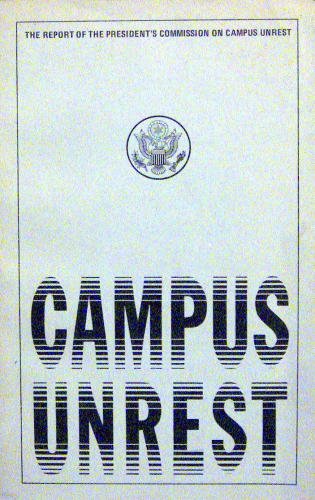
The President’s Commission on Campus Unrest: A 1970 Manifesto of Hope

These first weeks of May mark events in 1970 unlike any in American history. Along with the most tragic consequence, an almost forgotten document of that time offers an eloquent statement of hope—for then and for now.

On April 30, President Richard Nixon announced the U.S. bombing of Cambodia as an escalation of the Vietnam War. Student protests and strikes swept colleges across the country. On May 4, National Guard troops at Kent State University shot at students, killing four and wounding nine. Protests and demonstrations expanded, and within the week hundreds of campuses were affected or closed down. Then ten days after Kent State, on May14, black students and other demonstrators at Jackson State College in Mississippi engaged with city and state policemen. Two students were killed and at least twelve were wounded.

Only a few weeks later, President Nixon established the President’s Commission on Campus Unrest on June 13, 1970. The Commission was chaired by William Scranton, former Pennsylvania Governor, and issued its report in October 1970.

Defining events have a half-life. Time passes, people pass, and more immediate crises displace the old. There are round-number anniversaries, and these events did get a boost from the fortieth anniversary a couple of years ago. Even when they are remembered, the visceral actuality and meaning get lost. If the event is at all controversial, it may be better to avoid the reminders completely and not have to deal with still-unsettled topics and themes. An example of this was the virtual silence surrounding last year’s 150th anniversary of the start of the Civil War. That could have been a platform for discussing so many issues—race, state’s rights, etc.—but we were understandably too busy trying to fix a broken national and world economy.

Maybe it is not surprising then that the 1970 report on campus unrest is so little mentioned or sought and so hard to find, even in this age of digital archives. It is worth reading, and not just as an historical artifact. President Nixon and others in his circle believed that colleges had become the breeding ground not just for opposition to the Vietnam War but for virulent and violent un-Americanism/anti-Americanism.

He hoped that the Commission would support this view of America. He got some of that, with conclusions that there were a minority of strident academics and students who, well-meaning or not, had created an environment of intolerance where discord and violence were the inevitable outcomes.  This the report called a “Crisis of Violence.”

But the Commission also found what it called a “Crisis of Understanding.” This moderate and idealistic analysis was not what President Nixon had in mind. It is an unbearably eloquent statement of aspiration and progress that could be written today—not in spite of the specifics being so different, but in their being so much of the moment.

From the introduction:

The crisis on American campuses has no parallel in the history of the nation. This crisis has roots in divisions of American society as deep as any since the Civil War. The divisions are reflected in violent acts and harsh rhetoric, and in the enmity of those Americans who see themselves as occupying opposing camps. Campus unrest reflects and increases a more profound crisis in the nation as a whole. This crisis has two components: a crisis of violence and a crisis of understanding.…

Behind the student protest on these issues and the crisis of violence to which they have contributed lies the more basic crisis of understanding. Americans have never shared a single culture, a single philosophy, or a single religion. But in most periods of our history, we have shared many common values, common sympathies, and a common dedication to a system of government which protects our diversity. We are now in danger of losing what is common among us through growing intolerance of opposing views on issues and of diversity itself. A “new” culture is emerging primarily among students. Membership is often manifested by differences in dress and life style. Most of its members have high ideals and great fears. They stress the need for humanity, equality, and the sacredness of life. They fear that nuclear war will make them the last generation in history. They see their elders as entrapped by materialism and competition, and as prisoners of outdated social forms. They believe their own country has lost its sense of human purpose. They see the Indochina war as an onslaught by a technological giant upon the peasant people of a small, harmless, and backward nation. The war is seen as draining resources from the urgent needs of social and racial justice. They argue that we are the first nation with sufficient resources to create not only decent lives for some, but a decent society for all, and that we are failing to do so. They feel they must remake America in its own image….

At the same time, many Americans have reacted to this emerging culture with an intolerance of their own. They reject not only that which is impatient, unrestrained, and intolerant in the new culture of the young, but even that which is good. Worse, they reject the individual members of the student culture themselves. Distinctive dress alone is enough to draw insult and abuse. Increasing numbers of citizens believe that students who dissent or protest, even those who protest peacefully, deserve to be treated harshly. Some even say that when dissenters are killed, they have brought death upon themselves. A nation driven to use the weapons of war upon its youth is a nation on the edge of chaos. A nation that has lost the allegiance of part of its youth is a nation that has lost part of its future.

We urgently call for reconciliation. Tolerance and understanding on all sides must reemerge from the fundamental decency of Americans, from our shared aspirations as Americans, from our traditional tolerance of diversity, and from our common humanity. We must regain our compassion for one another and our mutual respect. There is a deep continuity between all Americans, young and old, a continuity that is being obscured in our growing polarization. Most dissenting youth are striving toward the ultimate values and dreams of their elders and their forefathers. In all Americans there has always been latent respect for the idealism of the young. The whole object of a free government is to allow the nation to redefine its purposes in the light of new needs without sacrificing the accumulated wisdom of its living traditions. We cannot do this without each other. Despite the differences among us, powerful values and sympathies unite us. The very motto of our nation calls for both unity and diversity: from many, one. Out of our divisions, we must now recreate understanding and respect for those different from ourselves. Violence must end. Understanding must be renewed. All Americans must come to see each other not as symbols or stereotypes but as human beings. Reconciliation must begin. We share the impatience of those who call for change. We believe there is still time and opportunity to achieve change. We believe we can still fulfill our shared national commitment to peace, justice, decency, equality, and the celebration of human life. We must start. All of us.

Likeability and Political Forgiveness


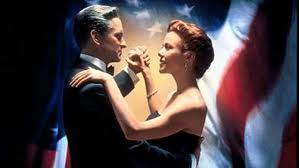
In the most charming of political romantic comedies, The American President, an incandescently beautiful lobbyist (Annette Bening) chastises the handsome and liberal President (Michael Douglas), though not to his face:

The President has critically misjudged reality. If he honestly thinks that the environmental community is going to whistle a happy tune while rallying support around this pitifully lame mockery of environmental leadership just because he’s a nice guy and he’s done better than his predecessors, then your boss is the Chief Executive of Fantasyland.

The President is a very nice guy. He overhears this tirade, which leads to their meeting cute, having sex in the White House, splitting up, getting back together, and living happily ever after, romantically and politically. All is forgiven.

Everyone agrees that likeability matters. There is an apparent likeability gap between President Obama and Mitt Romney. Under normal circumstances, relative likeability is a solid predictor of Presidential outcomes. But these are anything but normal times. There are plenty of world-class doctors who are personality challenged, and given the choice between the one you would have a beer with and the one who can keep you alive, there isn’t much choice.

Still, likeability provides something that other characteristics cannot: room for forgiveness. That is why likeability matters, in politics and elsewhere. Everyone screws up, and the willingness of others to get over or past that is essential. Without denying his substantial talents and achievements, Bill Clinton survived on his likeability more than once. In the much darker and non-romantic comedy Primary Colors, based on Joe Klein’s roman a clef about pre-Presidential Bill Clinton, the candidate’s close friend and no-bullshit confidant, played by Kathy Bates, sums up the Peck’s Bad Boy of politics:

Now what kind of shit is that, Jack? Oh, excuse me. I forgot. It’s the same old shit. The shit no one ever calls you on, ever. Because you are so completely fucking special! Because everyone was always so proud of you. Me, too. Me, the worst.

Likeability matters because it makes you special, at least long enough to get beyond the worst of it. As President Obama confessed early on, he is not a perfect man, and would not be a perfect President. He hasn’t been, but who can be? The judgment depends on just how badly imperfect you are and how much people will forgive. That’s the well we all go to, and likeability keeps the well filled—at least for a while. Mitt Romney is not a perfect man or a perfect candidate. At some point, he will likely have to go to the well of likeability and forgiveness. We wonder whether there will be anything there when he does.