Bob Schwartz

Category: Politics

Politics of Pessimism

Book of Job

It is one thing to say that things could be better in America. Another to say that things are terrible, horrible, very bad.

At the moment, that seems to be a Republican approach to “lifting up” the nation and winning the presidency. Make sure we realize just how dire things really are and then promise to swoop in as our rescuer. First we kill all hope.

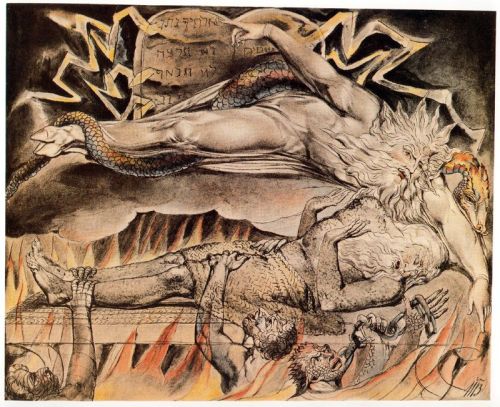
Hope isn’t dead. Crushing our current spirit for the sake of future dominance is a terrible, horrible, very bad idea. The more Bible-minded will recognize this as one of the tricks played by some legendary figures. See, for example, the Book of Job.

For a post-debate review of this, see The ‘Everything is Bad’ Party.

Biden and Colbert

Whatever your politics, it was TV history last night on The Late Show. Joe Biden and Stephen Colbert talking, just two great guys leaning in and getting real, while millions watched, and many teared up.

It starts with Colbert. The question has been whether and how he would progress from being a character on The Colbert Report to a different character that is more himself. There was that moment on the final Daily Show when Colbert exposed his most sincere and unironic thanks to Jon Stewart, the man who gave him his chance.

But last night’s Late Show interview skipped all the midpoints of developing a Colbert talk show persona to transcending any idea of what a late-night host might be. Beyond showing himself as a man of faith, Colbert served almost as a therapist and priest. He didn’t stay away from the pain. He compassionately went right for it, not for spectacle, but for the healing truth, and to reveal the depths of Biden’s quandary.

Reflecting their shared history of family tragedy, it was like a reunion of two old souls. On top of that, Colbert wore not only his faith but his politics on his sleeve, something that just isn’t done in his position. It was clear that he was urging Biden to run not because it was a good idea, but because Colbert and the Nation needed him.

It doesn’t take much to get Biden to speak from his soul. Hello will usually do. But Colbert brought out an extra dimension of that. Where certain candidates now running make us cringe, Biden made me and plenty of others cry. Where certain candidates make us want to run the other direction, listening to Joe just made me want to be a better person.

In the moment, it didn’t matter that Colbert was in only the third show of his widely-covered new TV venture. Or that Biden was in the final weeks of the will-he-or-won’t-he candidacy drama. It just was what it was, and what it was was good and human, so humbly and nobly human. Something we don’t see much on TV. Or in politics.

Bacon and Ribs Illegal in America When Jews and Muslims Take Over

When Orthodox Jews or Muslims are in charge, bacon, ribs, and all sorts of other things will be made illegal.

Of course, that will never happen. Not because Orthodox Jews or Muslims will never take control of American democracy (anything’s possible). But because the U.S. Constitution—that imperfectly perfect protector of individual rights—would not permit it.

In the secular sphere, there is no higher law than the Constitution. Beyond being the law of the land, it is the law of the law of the land. Those who study it in the context of world history and politics recognize that it is a one-of-a-kind, no-other-time-or-place achievement.

Those who say there is some kind of higher law than that in the civic arena are misinformed, or in some cases, such as Ted Cruz who should know better, strategically mistaken. The question those folks have to answer is this: If there is higher law than the Constitution, whose law is it? If it’s “God’s” law, recall that God talks to lots of people in lots of religious traditions, and apparently isn’t always heard to say the same thing to everyone. It will shock some Christians to learn that God has been speaking to Jews for thousands more years, and while there seemed to have been plenty of talk about a messiah, nothing to indicate that one actually arrived. Or asked county clerks in Kentucky to stop issuing marriage licenses. Or told presidential candidates who claim to believe in law and order to defy the law of the law of the land. In his name. Amen.

Why Would A Human Candidate Need to Be Humanized?

A dog does not need to be caninized. A cat does not need to be felinized. So why would a human candidate need to be humanized?

Joe Biden and the Kennedys: Profiles in Service and Tragedy

Joe Biden

Thinking about Joe Biden’s decision on whether to run for the Democratic presidential nomination, the Kennedys come to mind. All the brothers.

Like the Kennedys, Biden is Irish-American, with a fanatical sense of public service and family. Like the Kennedys, he is a pragmatic liberal, maybe a bit to the left of that dynasty, but deeply aware of the obligation of those who have much to those who have much less.

(Speaking of the haves, unlike the Kennedys, Biden may be the least wealthy politician ever to emerge from decades of high-profile public service.)

Most of all, like the each of the Kennedy brothers, he has had to struggle with multiple tragedies, each one a reason to choose a different path, each one instead a reason to keep going—because of rather than in spite of.

Not a single person, no matter the party, no matter who they support, would begrudge Biden a decision not to run this time. But—unlike the position taken by those who say running might tarnish his legacy—he would crown his career by demonstrating the idea that what does not kill us can make us stronger, and can make us give more, even when so much has been taken.

Hiroshima: The Year 70 AH and I Ching Heaven

Flag of Hiroshima City

How special is the atomic bomb? So special that many nations want one, many nations have more than one, and yet despite how crazy and desperate some nations have been in the past decades, only one nation has ever used one. A hoarded treasure so dark that it is displayed and demonstrated but not deployed.

So special that it should be the zero of a standard human calendar. Just as Jews measure time from the creation of the world, Christians from the birth of Jesus, Muslims from the hijra from Mecca to Medina, we might all measure time from August 6, 1945.

The U.S. did drop atomic bombs. Twice in three days (August 6 on Hiroshima, August 9 on Nagasaki). And divided history in half, before and after. Before, things might be brutal, tens of millions might be slaughtered, but it would take superhuman effort, and would be followed by an opportunity, however arduous, to rebuild and repopulate. After, in these times, our times, there is a theoretical prospect of erasing some, most, or all of the world and its people. Not easily, but not that hard either, leaving behind a wasteland the size of a city or country or continent.

Above is a picture of the Hiroshima municipal flag, adopted by the city in 1896, almost fifty years before the weapon that destroyed and damaged so many lives. Historians still debate the effect and necessity of the Bomb in hastening the end of the war with Japan, an argument heightened when talking about the second bomb.

On this 70th anniversary, 70 After Hiroshima, let us focus on the flag.

Brief research doesn’t reveal much about the flag’s design. But students of Asian culture might see in it one of the eight I Ching trigrams, since the Chinese oracle has been widely used across Asian nations for thousands of years.

This particular trigram, composed of three unbroken lines, is Qian. When doubled it forms Hexagram 1 of the I Ching, also known as Qian. Heaven. The Creative. Sublime success.

I Ching Hexagram 1

 
John Minford explains in his recent translation:

Heaven above Heaven. Pure Yang. This is the first of eight Hexagrams formed by doubling a Trigram of the same Name. The word chosen for the Trigram/Hexagram Name, Qian, whatever its original meaning may have been (and there are many understandings of this), came in later times to be used more and more as a shorthand for Heaven, emblem of Yang Energy and Creativity.

The classic Wilhelm/Baynes translation notes:

The first hexagram is made up of six unbroken lines. These unbroken lines stand for the primal power, which is lightgiving, active, strong, and of the spirit. The hexagram is consistently strong in character, and since it is without weakness, its essence is power or energy. Its image is heaven. Its energy is represented as unrestricted by any fixed conditions in space and is therefore conceived of as motion. Time is regarded as the basis of this motion. Thus the hexagram includes also the power of time and the power of persisting in time, that is, duration.

The power represented by the hexagram is to be interpreted in a dual sense—in terms of its action on the universe and of its action on the world of men. In relation to the universe, the hexagram expresses the strong, creative action of the Deity. In relation to the human world, it denotes the creative action of the holy man or sage, of the ruler or leader of men, who through his power awakens and develops their higher nature.

THE JUDGMENT

THE CREATIVE works sublime success,
Furthering through perseverance.

We have come a long way in 70 years, and whether or not that trajectory is to everyone’s liking, here we are. That we have managed not to drop any more nuclear bombs or fire any nuclear missiles might be a miracle, or might just be a sign of self-interest in survival coming before everything else.

That we did drop those bombs was a high price to pay for learning just how much damage the “good guys” were capable of and might feel compelled to perpetrate when dire circumstances seemed to call for it. It’s a lesson in self-awareness that we are still learning, more or less studiously. It’s a lesson that the traditions try to help us with. The devil, for example, is not an arm’s length third party who bargains and cajoles. The devil is in us, and handling it is one of our missions. The I Ching is clear on the fluid dynamics of our lives and the world, knowing that we and it flow this way and that, and heaven can be hell for a while, maybe deep and for a long while, but not forever.
Mandatory Campaign Esperanto and Poetry

The First Amendment forbids the government from controlling how political candidates campaign. Which seems a shame, since the abuse of language, logic, and truth that goes on often seems criminal, a form of citizen abuse.

But if we could make some changes, it might be fun and even enlightening. So instead of having to endure candidates pandering with their (sometimes questionable) fluency in Spanish, we could require all of them to campaign in Esperanto.

Jeb Bush might then have launched his campaign this way, almost certainly capturing the Esperanto vote:

En ajna lingvo, mia mesaĝo estos optimisma ĉar mi estas certa ke ni povos fari la jardekoj tuj antaŭ la plej granda tempo iam esti viva en tiu mondo.

Ke hazardo, ke espero postulas pli bona kiu estas en ni, kaj Mi gxin donos mian ĉiuj.

Mi kampanji kiel mi utilus, irante ĉie , parolante al ĉiuj, observante Miajn vorto, alfrontante la demandoj sen flinching, kaj restante fidela al kion mi kredas.

Mi prenos nenio kaj neniu por sentado. Mi kuras kun koro.

Mi kuras por gajni.

Ĝi komencas tie kaj nun.

Kaj mi petas vian voĉdonon.

Dankon. Dio benu vin.

In any language, my message will be an optimistic one because I am certain that we can make the decades just ahead the greatest time ever to be alive in this world.

That chance, that hope requires the best that is in us, and I will give it my all.

I will campaign as I would serve, going everywhere, speaking to everyone, keeping my word, facing the issues without flinching, and staying true to what I believe.

I will take nothing and no one for granted. I will run with heart.

I will run to win.

It begins here and now.

And I’m asking for your vote.

Thank you. God Bless You.

Even better, let us require all candidates to campaign in poetry, rather than in their often overextended, useless, uninspired, and uninspiring prose.

They could choose any genre or form that suited them and their message. Rhyming or free verse. Classic or experimental. Long or short. Of course, we would be thrilled if they would go with haiku or some other sort of micro poetry. Imagine a campaign speech only 17 syllables long. It would be blissfully over as quickly as it began. By the time they got through “God bless you and God bless the United States of America,” they would have exactly one syllable left. Which given the nonsense that we have to endure, may still be one syllable too many.

Why We Should Not Give Up on Global Nuclear Disarmament

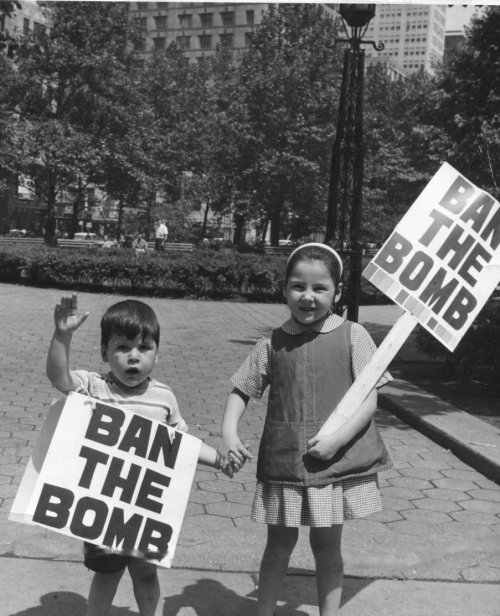
Ban the Bomb

It is picture as quaint as someone dialing a telephone: protestors in the 1950s and 1960s marching around with signs that say “Ban the Bomb.”

Quaint because so many countries now have nuclear weapons that getting rid of them all borders on the ridiculous. And it’s not just major powers; smaller nations who have developed nuclear weapons consider themselves “major” for having done so. (It sure beats the trouble of developing a sustainable, healthy economy and democracy.) Speaking of democracy, nuclear armament is all so complex that one of the bright lights of a hyperdangerous region refuses to acknowledge even having a nuclear stockpile, pretending to maintain the worst kept geopolitical secret in the world.

And yet: Blessed are the peacemakers. According to someone or other, they will be called children of God. This doesn’t mean that warmakers and hoarders of nuclear weapons aren’t children of God. It just means that the billions who live in the shadows of those bombs and missile warheads might not feel particularly blessed. That’s why we, and our children and our generations, shouldn’t give up on global nuclear disarmament, no matter how naïve or impossible it seems.

Joementum

Joe Biden

Let’s say you lined up all the presidential prospects from both parties. And just for the heck of it, let’s put Joe Biden in the lineup.

Now let’s rank them according to experience and knowledge in public service. Separate that from any partisan or ideological views—that is the wrong kind of experience and knowledge—Joe is going to stack up pretty well.

And now, let’s add the comments of Lindsey Graham a few days ago about Biden:

He’s the nicest person I’ve ever met in politics. He’s as good a man as God has ever created.

That’s Lindsey Graham, a seriously conservative Republican Senator and presidential candidate. And a longtime friend and Senate colleague of Biden’s.

Okay. So we now have an undeniably experienced person who one political opponent says is the nicest person in politics and the best man on earth.

And the problem with his being the Democratic candidate is exactly what?

The only thing that will stop the momentum for Joe running is his taking himself out of consideration. Which would be understandable in many ways. But which has not yet happened.

It would be clichéd to say that this is Hillary Clinton’s worst nightmare, but it is. Last time she was ambushed by a young pipsqueak upstart who just happened to be everything she was not, including black. So her major trump cards were neutralized. Now she has much more leadership experience under her belt, thanks to that upstart, and the field has mostly cleared itself away for her.

But along comes the exact opposite obstacle. A man even older than she is. A face even more familiar in American politics than hers, by decades. A man who has twice failed to win the Democratic nomination.

And yet, his experience and acumen in government and retail politics can’t be denied. Neither can his progressive views and his forthright uncalculated candor, giving rise to some unscripted moments, but also bolstering his authenticity and the affectionate concept of “Joe being Joe.”

Above all, there are no Republican politicos, and maybe not that many Democrats either, who, with all due respect, might be heard to describe Hillary Clinton thus:

She’s the nicest person I’ve ever met in politics. She’s as good a woman as God has ever created.

So if Joe wants to run, then he should run. Because the presidential race, not to mention the country, might need him more than we know.

Independence Day and STEM Democracy

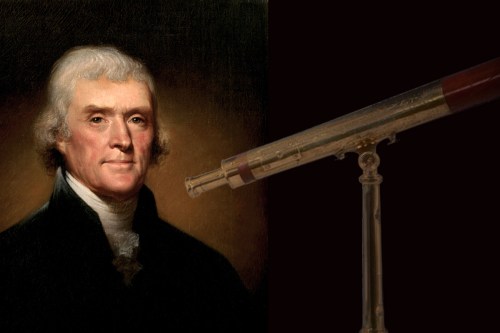
Thomas Jefferson with Telescope

Is the increasing hegemony of STEM education dangerous to the future of American democracy?

In Science and the Founding Fathers: Science in the Political Thought of Thomas Jefferson, Benjamin Franklin, John Adams, and James Madison, Professor I. Bernard Cohen might see it otherwise. As one of the most eminent historians of science, he makes the case that the familiarity of some Founding Fathers with science inspired the new nation, and that the shape of the new democracy was directly based on scientific principles.

One review notes about Professor Cohen’s theory:

The Declaration of Independence, which he [Jefferson] wrote, reverberates with echoes of Newtonian science, as when he invokes “self-evident” truths or “laws of nature.” Benjamin Franklin, far from being a mere tinkerer or inventor, pioneered the science of electricity. Franklin also developed a demographic theory that North America would become a population center of the British world; this led to the policy according to which the British annexed Canada rather than Guadeloupe as the spoils in the war against the French (1754-63). John Adams, who studied astronomy and physics at Harvard, was a founder of the American Academy of Arts and Sciences in Boston. And James Madison, a devoted amateur scientist, drew on scientific metaphors and analogies in his Federalist articles.

Maybe. But in fact, most of those in Philadelphia for the Continental Congress from which the Declaration of Independence emerged were not scientists or even science fans. And even those whose philosophy was shaped in part by science enjoyed a much broader education, one that gave complete dimension to their thinking, what we now call liberal arts. So that while the intriguing questions that Professor Cohen raises are significant, so is the parallel question: If the Continental Congress had been mostly or entirely filled with 18th century scientists, just what kind of Declaration would have been produced, and more broadly, what kind of nation would we be?

Nowhere can the nexus of Big Science and Big Political Philosophy be better seen than in Richard Rhodes’ magnificent book The Making of the Atomic Bomb. It is sort of a fun house mirror of what Cohen claims for the American founding. Rather than world-changing political thinkers with a scientific bent, we have equally historic scientists with a worldly and philosophical bent. They had been educated in the early 20th century, many in Europe, and the standard for education then and there was broad learning beyond the laboratory. In the end, their science was driven by the realities of World War II and Hitler, but that did not stop them from philosophical ponderings and quandaries about the work they were doing and its ultimate impact.

So, yes, it may be that science did help give us what by all measures is a remarkably robust and resilient democracy, starting with the rousing rhetoric of the Declaration of Independence. And we should educate scientists, to make progress and to advance the liberty, peace, and security we want. But we should also have many other thinkers, scientists or otherwise, who are capable of leading and having enlightening debates about exactly what we do need and want, and about the means we choose to get there, and about where it might lead. We do need scientists, technologists, engineers, and mathematicians. But it is never enough, not nearly enough, at least not in this democracy.