Bob Schwartz

Category: Politics

Roy Moore Blues: Good Morning Little Schoolgirl

Mississippi is on my mind, as it is always in my heart.

There is the controversy surrounding Trump’s visit to the wonderful new Mississippi Civil Rights Museum.

Then there is Alabama, the neighbor to the east, suffering through the unending untender political mercies of Roy Moore.

This led to my listening to the blues this morning, and the blues standard Good Morning Little Schoolgirl came on. As cosmically unbluesy as Roy Moore is, this is his song:

Good morning little schoolgirl
Can I come home
Can I come home with you
Tell your mama and your papa
I’m a little schoolboy too

Age of Folly: America Abandons Its Democracy

A frivolous society can acquire dramatic significance only through what its frivolity destroys.
—Edith Wharton

I am tempted to include the entire Preface to Lewis Lapham’s Age of Folly in this post. Instead, I include excerpts and then encourage you to buy the ebook for just $2.99. As with all lucid insights into the current situation, it will not make you happier, but it will provide enlightening perspective.

The book is a collection of Latham’s essays, “essays arranged in order of their composition and stepping off on a march of folly with America’s 1991 invasion of Iraq—a reality TV show armed with self-glorifying high explosives and a nonsensical casus belli—and ending with Donald Trump’s 2016 presidential campaign, a self-glorifying photo-op bursting star-spangled bombast in air.”


Preface

A frivolous society can acquire dramatic significance only through what its frivolity destroys.
—Edith Wharton

It’s been six months since Donald Trump moved into the White House with his Twitter account, but I’m still talking to people unable or unwilling to believe he is president of the United States. Eager to bring late-breaking reports of Trump’s uncivil and unconstitutional behavior, they come bearing gifts of high-minded outrage and condescending mockery soon followed by variations on the question, How can such things be?

The short answer is Edith Wharton’s. A longer answer is the one spread across the pages of this book, essays arranged in order of their composition and stepping off on a march of folly with America’s 1991 invasion of Iraq—a reality TV show armed with self-glorifying high explosives and a nonsensical casus belli—and ending with Donald Trump’s 2016 presidential campaign, a self-glorifying photo-op bursting star-spangled bombast in air. Over the course of the twenty-five years from point A to point B, a weakened but still operational democracy gives way to a stupefied and dysfunctional plutocracy.

To regard Trump as an amazement beyond belief is to give him credit where none is due. He is undoubtedly a menace, but he isn’t a surprise. Product and mirror of an age distinguished by its extravagant displays of vanity and greed, Trump’s positioning of government as trivial pursuit is the way things are and have been in Washington and Wall Street for the last quarter of a century….

The camera doesn’t do democracy. Democracy is the holding of one’s fellow citizens in respectful regard not because they are beautiful or rich or famous, but because they are one’s fellow citizens and therefore worth the knowing what they say and do. The work is difficult and slow; too many words with too little action doesn’t move the merchandise. The cameras on the road with the biggest name on earth weren’t covering a play of ideas; they were attracted to the splendor and flash of money, to the romance of crime and the sweet decaying smell of overripe celebrity.

Because the camera sees but doesn’t think, it makes no meaningful distinction between a bubble bath in Las Vegas staffed by pretty girls and a bloodbath in Palmyra staffed by headless corpses. The return on both investments is the bankable flow of wish and dream drawn from the bottomless wells of human ignorance and fear, from the always rushing river of mankind’s limitless desire. It didn’t matter what Trump said or didn’t say, whether he was cute and pink or headless.

Trump pitched his campaign on the storyline the movie-going American electorate loves beyond all others—the one about the knight errant up against the system and the odds, the lonesome-pine hero in the trail-weary saddle riding into town to gun down the degenerate sheriff and rescue the God-fearing settlers, to set the crooked straight, restore civic virtue, distribute a fair share of the loot to the schoolteacher, the shepherd, and the store-keep.

It didn’t matter that Trump was a prosperous fool. He sold newspapers, boosted television ratings. He was maybe short on sense and sensibility, but he was long on market share. The infotainment media in all of its factions and instrumentations (CNN and the New York Times as well as Fox News and Rush Limbaugh’s dittoheads) recognized Trump as a preposterous clown and transparent fraud but nevertheless framed him in the gilt-edged cliché of the underdog outlaw—up there in lights with robber barons Rockefeller and Vanderbilt, gunslingers Eastwood and Stallone, Mafia dons Corleone and Soprano. The unifying and all-purpose product placement won the election for Trump, rewarded the media with a Rumpelstiltskin spinning straw into gold. Already in the first months of the primary season the numbers moving up in the opinion poll leaderboards encouraged Leslie Moonves, chief executive officer of CBS, to assure the network’s bankers at JPMorgan Chase that “Trump’s candidacy may not be good for America, but it’s damn good for CBS.”…

In office as president of the United States, Trump presents himself as signature endorsement of concentrated wealth, a camera-ready product placement promoting money as the hero with a thousand faces, all of them the face of Trump. Trump at the top of every hour on the networks and cable channels, on page one in every morning’s newspaper. Trump overruling the rule of law, under investigation for obstructing justice, withdrawing from the Paris climate accords, firing FBI director James Comey, ordering fifty-seven cruise missiles into Syria, dropping the Mother Of All Bombs on Afghanistan, signing executive orders lifting regulation of the oil, gas, coal, and banking industries. Trump embodying the Time magazine sales promotion of America, dominant power in the world, more dominant than any since Rome, reshaping norms and creating new realities, saying and doing whatever it takes to discredit government by the people, of the people, and for the people—to nullify it in theory and dispose of it in practice.

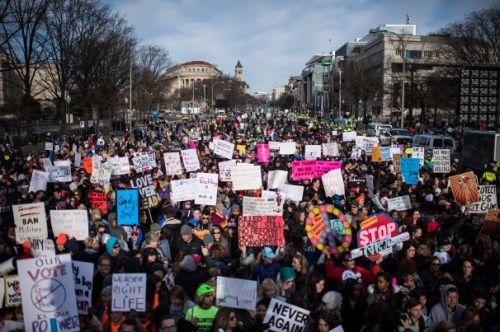
The self-glorifying opposition to Trump is as foolish as the man itself. The “Resistance” composed of outraged sensibilities unable or unwilling to believe that Trump is president of the United States—Hillary Clinton voters, Democratic Party nomenclatura and crowd-sourced Pussy Hats, NeverTrump reactionaries, Bernie or Bust revolutionaries, sit-down protesters and stand-up comics—devotes its efforts to the project of Trump’s impeachment. Impeachment will be sought on whatever grounds (yet to be discovered or manufactured) can be cultivated to yield political scandal and tabloid entertainment.

Meanwhile in the White House gilded cage the unscripted and overweight canary sings his ferocious songs of sixpence, and on all sides of every story the voices of objection and dissent rise to near hysteria. Trump accuses former President Barack Obama of tapping his telephones, denounces the news media as “the enemy of the people”; the news media liken Trump to the Devil, accuse him of treason, hear in his frivolous noise the sound of Nazi boots marching into Poland.

The consequence is the destruction of a credible political discourse without which democracy cannot exist. James Fenimore Cooper, author of The Last of the Mohicans, made the point in his 1838 political essay, The American Democrat. The vitality of America’s democracy, said Cooper, is the capacity of its citizens to tell the truth, speak and think without cant….

Age of Folly fills in at least some of the backstory behind President Donald Trump’s appearance as Time magazine’s 2016 “Man of the Year.” The essays in Part I proceed in the order of their composition as monthly columns in Harper’s Magazine; the essays in Part II, all but one written to introduce issues of Lapham’s Quarterly, construe history as means rather than end, a hedge against the despairing of the present and a weapon to defend the hope of the future against the inertia of the past. History doesn’t save the day or provide a PowerPoint presentation of a new and better world. It is the fund of energy and mind that makes possible the revolt against what G. K. Chesterton once called “the small and arrogant oligarchy of those who only happen to be walking about.” We have less reason to fear what might happen tomorrow than to beware what happened yesterday.

July 4, 2017

Is Trump Experiencing a Break With Reality?

“Trump suggested to a senator earlier this year that [the “Access Hollywood” tape] was not authentic, and repeated that claim to an adviser more recently.”

The New York Times reports:

But something deeper has been consuming Mr. Trump. He sees the calls for Mr. Moore to step aside as a version of the response to the now-famous “Access Hollywood” tape, in which he boasted about grabbing women’s genitalia, and the flood of groping accusations against him that followed soon after. He suggested to a senator earlier this year that it was not authentic, and repeated that claim to an adviser more recently. (In the hours after it was revealed in October 2016, Mr. Trump acknowledged that the voice was his, and he apologized.)

The least controversial interpretation is that Trump is doing what he frequently does: saying something untrue in the face of incontrovertible evidence to the contrary to escape an inconvenient situation. Or, as even Republicans admit, he lies.

But sometimes you wonder, as when candidate Trump said he saw people cheering the attacks on 9/11:

Republican presidential candidate Donald Trump says he saw people cheering the Sept. 11 attacks across the river in New Jersey — a claim officials strongly deny.

Trump first told the story Saturday at a rally in Birmingham, Alabama, as he pressed the need for greater surveillance, including monitoring certain mosques, in the wake of the Paris attacks.

“I watched when the World Trade Center came tumbling down. And I watched in Jersey City, New Jersey, where thousands and thousands of people were cheering as that building was coming down. Thousands of people were cheering,” Trump said Saturday at a rally in Birmingham, Alabama.

Trump repeated the assertion Sunday in an interview with George Stephanopoulos on ABC’s “This Week,” as Stephanopoulos explained to Trump that police had refuted any such rumors at the time.

“It did happen. I saw it,” said Trump. “It was on television. I saw it.”

It was simple to dismiss this as political prevarication. But the sincerity with which he said it might indicate he really did see it, or thought he did. In the current revision of history, he says he no longer believes that he spoke the words that appear to be coming out of his mouth—even though he previously acknowledged it.

So maybe Trump really does now believe he never said the words he is shown saying and admits saying. If that is the case, it is evidence that somehow he is experiencing a break with reality. There is no clinical definition of the term “mental breakdown”, but the clinical conditions related to this sort of break can be exacerbated or triggered by extreme stress. However Trump got himself into his current situation, and whether or not he was predisposed to mental problems before he took office, he is now in a situation that offers little opportunity for a clean escape. It would not be surprising if anyone under that kind of pressure might no longer know the difference between the real and unreal, the true and untrue. If the person is president, the stakes are immeasurably high.

Fake News and Enlightenment

An apple is also a banana.

Maybe all things Trump are good for us.

As with all indignities and suffering, we may want our difficulties to have meaning, meaning that is constructive and helpful. That can be hard and even impossible. Considering some current events as a blessing smacks of shaky rationalization.

In the Trump context, we know what fake news means. It means that reports from reliable sources are not to be believed, no matter how well investigated and substantiated. This can be maddening to intelligent and discerning people. It led to the current CNN campaign, showing that you can call an apple anything you want, including a banana, but it is still an apple. The apple is not fake news.

The Buddhist tradition doesn’t say it is not an apple. Of course it is. But beyond that, what we know is the thought of an apple, as is anything and everything the thought of anything and everything.

To put it another way, the apple is real news. And fake news. A conversation about how the apple is a banana sounds like a conversation you might find in a collection of Zen koans.

All is real news and fake news. Having the concept of fake news in our face can be a reminder of that. Even Trump is real news and fake news. Of course he is president and all that comes with it, some of it actually or potentially dire. But he and all that comes with it, including the dire, are thoughts. That doesn’t make the situation less real, but it may help moves us towards an enlightened perspective on things. Including all things Trump.

Do Justice. Love Kindness. Walk Humbly.

Whether you are faithful, less so, or not so at all, you probably recognize the value of a compass.

The Roy Moore situation seems one of the many these days where some people, for various reasons, seem to have lost their compass or even thrown it away.

For people of any faith or none, the words of Micah 6:8 can be one such compass. Nowhere in the Bible is there a more compact directional message. The Jewish Study Bible says, “This didactic saying is one of the most influential and often quoted sayings in prophetic literature. It was considered as a possible compendium of all the mitzvot.”

So for Roy Moore, the people of Alabama, the people of America, here it is:

He has told you, O mortal, what is good;
and what does the LORD require of you
but to do justice, and to love kindness,
and to walk humbly with your God?
Micah 6:8 (NRSV)

David and Donald: The Men Who Would Be King

For those who think that Donald Trump is on his way to becoming an authoritarian strongman, this is far from the first time in history that some citizens have begged for such a leader—against the best advice. We can go way back, biblically back, to the story of how Israel got a king, first Saul then David—against the biggest advice of all.

Here is a passage from Chapter 8 of 1 Samuel, translated by Robert Alter:

And it happened when Samuel grew old that he set his sons up as judges for Israel. And the name of his firstborn son was Joel and the name of his Secondborn was Abijah—judges in Beersheba. But his sons did not go in his ways and they were bent on gain and took bribes and twisted justice.

And all the elders of Israel assembled and came to Samuel at Ramah. And they said to him, “Look, you yourself have grown old and your sons have not gone in your ways. So now, set over us a king to rule us, like all the nations.” And the thing was evil in Samuel’s eyes when they said, “Give us a king to rule us.” And Samuel prayed to the LORD.

And the LORD said to Samuel, “Heed the voice of the people in all that they say to you, for it is not you they have cast aside but Me they have cast aside from reigning over them. Like all the deeds they have done from the day I brought them up from Egypt to this day, forsaking Me and serving other gods, even so they do as well to you. So now, heed their voice, though you must solemnly warn them and tell them the practice of the king that will reign over them.” And Samuel said all the words of the LORD to the people who were asking of him a king. And he said, “This will be the practice of the king who will reign over you: Your sons he will take and set for himself in his chariots and in his cavalry, and some will run before his chariots. He will set for himself captains of thousands and captains of fifties, to plow his ground and reap his harvest and to make his implements of war and the implements of his chariots. And your daughters he will take as confectioners and cooks and bakers. And your best fields and your vineyards and your olive trees he will take and give to his servants. And your seed crops and your vineyards he will tithe and give to his courtiers and to his servants. And your best male and female slaves and your cattle and your donkeys he will take and use for his tasks. Your flocks he will tithe, and as for you, you will become his slaves. And you will cry out on that day before your king whom you chose for yourselves and he will not answer you on that day.” And the people refused to heed Samuel’s voice and they said, “No! A king there will be over us! And we, too, shall be like all the nations and our king will rule us and go out before us and fight our battles.” And Samuel listened to all the words of the people and he spoke them in the LORD’S hearing.

And the LORD said to Samuel, “Heed their voice and make them a king.”

According to the elders of Israel, divine political direction is how they ended up in the swamp. The sons of Samuel were judges who “did not go in his [Samuel’s] ways and they were bent on gain and took bribes and twisted justice.”

Their proposed solution: drain the swamp by doing what other nations did—appointing and anointing a king.

God disagrees. First, because it reflects a lack of faith. Second, because kings are a bad idea, as listed in his parade of horribles:

This will be the practice of the king who will reign over you: Your sons he will take and set for himself in his chariots and in his cavalry, and some will run before his chariots. He will set for himself captains of thousands and captains of fifties, to plow his ground and reap his harvest and to make his implements of war and the implements of his chariots. And your daughters he will take as confectioners and cooks and bakers. And your best fields and your vineyards and your olive trees he will take and give to his servants. And your seed crops and your vineyards he will tithe and give to his courtiers and to his servants. And your best male and female slaves and your cattle and your donkeys he will take and use for his tasks. Your flocks he will tithe, and as for you, you will become his slaves. And you will cry out on that day before your king whom you chose for yourselves and he will not answer you on that day.

As is typical in Bible stories, God advises and then shrugs when nobody listens. You’re going to do what you want to do anyway, he says, just don’t blame me when it all goes wrong. And wrong it went, as the history of the monarchy demonstrates.

The take-way, which preceded the emergence of modern democracy, is that it may seem that kingship is a good idea, so long as you select the right kind of king rather than the wrong kind. But in the end, that is never the case. You have that on the highest authority.

Bobby Kennedy Abides

I’ve written before and frequently about Bobby Kennedy. I’m not the only one.

Last year saw the masterful biography, Bobby Kennedy: The Making of a Liberal Icon by Larry Tye, which is the current definitive work. This past June, The Revolution of Robert Kennedy: From Power to Protest After JFK by John R. Bohrer.

In just the past week, two more. Bobby Kennedy: A Raging Spirit by Chris Matthews. And while it is broader than just Bobby, Playing with Fire: The 1968 Election and the Transformation of American Politics by Lawrence O’Donnell  opens with a chapter about Bobby’s decision to run for President, a chapter called Seizing the Moment.

Why the abiding interest, and why now? In the face of an ever-challenging nation and world, politics was and can still be a rich and complicated weave of strength and weakness, resolve and resignation, pleasure and pain, ideals and pragmatism. Know that once and again soulfulness could and would stare down soullessness, however dark the times. And that it could and would be embodied in the life and work of complicated humane leaders who inspired us. No saints, just good people.

Rather than quote from these books, which should be read, here’s a portion of a poem that Bobby was partial to, and which I’ve recited before. It is the close of Alfred, Lord Tennyson’s Ulysses:

…Come, my friends,
‘T is not too late to seek a newer world.
Push off, and sitting well in order smite
The sounding furrows; for my purpose holds
To sail beyond the sunset, and the baths
Of all the western stars, until I die.
It may be that the gulfs will wash us down:
It may be we shall touch the Happy Isles,
And see the great Achilles, whom we knew.
Tho’ much is taken, much abides; and tho’
We are not now that strength which in old days
Moved earth and heaven, that which we are, we are;
One equal temper of heroic hearts,
Made weak by time and fate, but strong in will
To strive, to seek, to find, and not to yield.

Sophie Scholl: “Somebody, after all, had to make a start.”

Readers of Brigitte, the largest women’s magazine in Germany, voted Sophie
Scholl the most important woman of the 20th century.

You probably do not know Sophie Scholl. She was a founder of the White Rose movement, a tiny group of German students who distributed leaflets opposing the Nazi regime. In 1943 she and two others were arrested, tried and immediately executed for treason. At the trial she simply said, “Somebody, after all, had to make a start.”


From A Noble Treason: The Story of Sophie Scholl and the White Rose Revolt Against Hitler:

A young Munich barrister named Leo Samberger opened his mail one morning in February of 1943, and, as he said afterward, he couldn’t believe his eyes. That was a time when every new day seemed to bring some new event to unsettle the nerves or stun the senses. The war, in its fourth year, had made the unexpected routine and the startling commonplace.

Even so, Leo Samberger was shaken when he opened what he thought was a letter but turned out to be a leaflet. It was neatly typed, singlespaced, with no illustration or typographical flourish of any kind. It was a solid block of type that made no more concession to the reader than a page from a textbook. But Leo Samberger caught his breath as he ran his eye down the page. “The day of reckoning has come, the reckoning of German youth with the most detestable tyranny that our people has ever endured. . .”…

With an intensity that broke through every phrase, the leaflet denounced the “corporal of World War I” whose amateur strategy had just cost the German people three hundred thousand of their sons in the bloodbath at Stalingrad. Here the leaflet, in its bitterness, used sardonically the saying that the Ministry of Propaganda had popularized to hail the achievements of Adolf Hitler: “Führer, wir danken Dir!” (Leader, we thank you!).

Then, at the end, came an impassioned call for revolt: “The name of Germany will be disgraced forever unless the German youth rises up, in both atonement and vengeance, to crush its tormentors and to build a new and nobler Europe.”…

The story circulated that some students had been caught scattering leaflets along corridors on the stairway between floors, and in the central hall under its high, domed skylight. The leaflets had been swiftly gathered up and spirited away by custodians before they could spread their corruption among the students. Copies were being closely examined in the rector’s office, to which, again, the Gestapo had been summoned. The names of the perpetrators were not immediately made known, nor was their fate….

Now it became clear why the chief judge of the People’s Court had been hastily flown from Berlin to preside at this trial and why the courtroom was so liberally seeded with representatives of the armed power of the state. The charges that Freisler had read from the indictments were among the gravest that could be brought against a German by his government in wartime.

It appeared from the evidence that the infamous deeds cited by the prosecution had been perpetrated over a period of many months by an organization with the curiously incongruous name of “the White Rose”. Page after page told of the activities of this group that had secretly and subversively produced thousands of leaflets attacking the government and the war effort and circulated them in many different cities, thereby threatening the very survival of the Reich.

Freisler made no pretense of being judicial. He ranted. He bellowed. He encouraged the prosecution and ignored the defense. At his post in the doorway Leo Samberger turned his eyes from the flaming figure on the bench to the defendants. There were three of them. Though he didn’t know them, he recognized their faces from seeing them many times in the concert halls of Munich that he himself frequented. They were college students, young, educated, clean-cut—his own sort. It seemed hardly credible that they were sitting in the dock with a death penalty over their heads as a consequence of what had happened at the university only three days before….

All three maintained their self-possession in a way that won a grudging admiration even in that room, but Sophie made a particular impression. Not only did she stand out as the lone female caught up in these proceedings, but she had an indefinable quality of her own. She was twenty-two years old, dark, and with a curious aura of mingled girlishness and gravity. Now and then during the trial, her brow would crease into a quick, musing frown, which those who knew her would have recognized as characteristic. Even here, in the courtroom with her life at stake, the frown did not signify anxiety or dismay. It meant that she was turning over in her mind a point, an implication, or a shading and weighing it to get it right.

She was wearing a rumpled and rather mannish sort of coat that contributed little to her appearance. She had endured three days of nearly unbroken interrogation in a Gestapo prison, and she looked worn and tired. But her quiet appeal, hovering always between girl and woman, was unimpaired. It was overlaid, now, with a kind of subdued defiance apparent in the cast of her features and the set of her head. Once Roland Freisler, squirming with fury inside his scarlet robe, demanded to know how any German could possibly do what the indictment charged against the trio in the dock. It was Sophie who responded, clearly and coolly:

“Somebody, after all, had to make a start. What we wrote and said is also believed by many others. They just don’t dare to express themselves as we did.”

As the proceedings wore on, it became obvious that no defense worth the name would be offered. The court-appointed defense attorneys scarcely troubled to conceal their aversion to their task or to disguise their approval of the charges. The verdict itself was never in doubt. Berlin had not sent Roland Freisler winging down to Munich to preside over an acquittal.

Yet there was, as Leo Samberger noted, a pronounced tension in the courtroom as the words were about to be spoken that would, quite literally, cost three young people their heads. Such a thing had never happened before even in a Nazi courtroom. And the words came from the bench as expected: “. . . for the protection of the German people, and of the Reich, in this time of mortal struggle, the Court has only one just verdict open to it on the basis of the evidence: the death penalty. With this sentence the People’s Court demonstrates its solidarity with the fighting troops!”

Even before the auditorium was drained of its gray, black, and brown uniforms, the condemned trio was hurriedly surrounded by a cordon of police, put in manacles, and led away.

The three of them were taken directly from the court to the place of execution, to Stadelheim, on the outskirts of the city. There, that same afternoon, all three were beheaded, the girl, Sophie, going under the guillotine first. It was all done with a speed and brutality that signaled something like panic in high places.

A Courage, Conscience and Character Party

I have long said that a third (or fourth) party can’t work in America because of political structure, tradition and history. I may have been wrong.

America has a two-party system, one of the many ways we are “exceptional” compared to the rest of the democratic world, which mostly has some form of a multi-party parliamentary system. As much as our system more or less works, it is now apparent that it works only when it is filled, top to bottom, with people of courage, conscience and character. We know this because for the first time in more than two centuries, courage, conscience and character are in short supply, or at least buried under ambition, greed and who knows what other issues.

And so, I introduce a new kind of third party. The Courage, Conscience and Character Party (aka the People of Principle Party).

There is no policy or ideology litmus test for this party. Of course policy and ideology matter, sometimes a lot, in the particular way things get done. But I now see that in the big picture, these are secondary. Whether one is progressive, conservative, or in between, none of that matters if you are not driven by brave decency. Even if the policy or ideology is not to our liking, or completely anathema, we can at least be inspired by those who publicly demonstrate the qualities of courage, conscience and character.

It is true that wherever you stand politically there are preferred policies that appeal to you and for which you will fight. But it is just as important to be able to point to people—be able to point out those people to our children—and say: Their plans may be wrongheaded and ill-conceived, but I don’t question their honesty, sincerity, decency, empathy, courage, conscience or character. We seem to be taking a break from that possibility, and if it takes another party to get us there, we will be a better country and better people for it.

Rosanne Cash: Country Musicians, Stand Up to the N.R.A.

The wonderful and gifted musician Rosanne Cash, daughter of Johnny Cash, wrote an eloquent and stirring piece in the New York Times, Country Musicians, Stand Up to the N.R.A.  It is addressed to her fellow country artists. In part:

For the past few decades, the National Rifle Association has increasingly nurtured an alliance with country music artists and their fans. You can see it in “N.R.A. Country,” which promotes the artists who support the philosophical, if not economic, thrall of the N.R.A., with the pernicious tag line “Celebrate the Lifestyle.”

That wholesome public relations veneer masks something deeply sinister and profoundly destructive. There is no other way to say this: The N.R.A. funds domestic terrorism…

A shadow government exists in the world of gun sales, and the people who write gun regulations are the very people who profit from gun sales. The N.R.A. would like to keep it that way.

The stakes are too high to not disavow collusion with the N.R.A. Pull apart the threads of patriotism and lax gun laws that it has so subtly and maliciously intertwined. They are not the same.

I know you’ll be bullied for speaking out. This is how they operate. Not everyone will like you for taking a stand. Let it roll off your back. Some people may burn your records or ask for refunds for tickets to your concerts. Whatever. Find the strength of moral conviction, even if it comes with a price tag, which it will. Don’t let them bully you into silence. That’s where their power lies — in the silence of rational voices and in the apathy of those who can speak truth to power.

In case you don’t visit the NRA Country site, here are the citizens of NRA Country that Rosanne Cash is talking to.