Bob Schwartz

Category: Peace

Warriors Day

Battle of the Somme - 1916

Today is Warriors Day. We call it Veterans Day, which intentionally or inadvertently distances it from a harsher reality. It began in 1919 to commemorate the Armistice that ended World War I, the War to End All Wars.

Who is a warrior?

In broad terms, all of us are warriors of some sort, battling for causes and ideals ranging from the personal to the cosmic, and everything in between. We fight for ourselves, our families, our nation, our ideologies, our traditions.

But the warriors of Warriors Day are something very specific. These are the people we delegate to fight for us, for causes that we deem significant enough to sacrifice their safety, their bodies, their lives. Under threat, current or prospective, real or perceived, we sacrifice them and peace so that we might ultimately have peace.

What should we do?

After the fact of war, we should keep whatever promises we make to warriors—without adjustment, equivocation, or renegotiation. World War I provided one of the most egregious instances of this. World War I veterans were not to receive full payment of their service bonus until 1945. But the Depression left many of them destitute. Thousands of them marched on Washington in 1932, seeking an advance of this payment. The letter of the law dictated waiting; the spirit of their sacrifice and hardship demanded payment. The Bonus Marchers were violently dispersed, though in 1936 Congress met the demands—over FDR’s veto.

Before the fact of war, we should consider everything involved. Really consider, not just blow hard self-righteously and politically. This is easier for those who have actually been warriors, though that number is decreasing as a proportion of our population, especially among our politicians and policy makers. Those veterans may or may not be able to sort through and articulate all the issues of our most complex geopolitics ever, but they can do something home front folks can’t—relive the experience of being a warrior.

Demand truth. Truth is said to be the first casualty of war, including pre-war and post-war. Right now, for example, Obama’s talk about “advisers only” in Iraq is making some veterans, particularly those of Vietnam, shake their heads. Col. Jack Jacobs, an NBC commentator, observed this morning that his experience as an “adviser” in Vietnam inevitably involved combat.

What about peace?

Peace, the absence of conflict at all levels, may not be a possibility. But that doesn’t mean it shouldn’t be our default position, the one from which all other circumstances are an aberration. For whatever reasons, conflict seems to be the default position for some, including those in positions of power and influence. There are things worth fighting for, but before moving forward, we need to be much surer of what those things are, how we are going about the fight, and how honest we can be. Most of all, if it is someone else doing the fighting at our command, we must realize that we are totally answerable for the consequences, as uncomfortable and costly as that might turn out to be.

The News and the Wheel

The Wheel - Jerry Garcia

The wheel is turning
and you can’t slow down
You can’t let go
and you can’t hold on
You can’t go back
and you can’t stand still
If the thunder don’t get you
then the lightning will

The Wheel
Jerry Garcia

If you are still listening to, watching, or reading the news, oh boy. If the world seems out of balance, that’s not just the news talking. That’s the way it is.

Thousands of U.S. troops sent to fight Ebola. No troops but planes and bombs to fight thuggish madmen disguised as religious fanatics whose organizational name we can’t keep straight. Honored gladiators beating their wives and children. Police shooting the people they are sworn to protect. The most powerful legislature in the world doing nothing when something is called for, something when nothing is called for, and blabbering on when silence is golden. Rampant use of destructive drugs, demonizing of less destructive drugs. Speaking of drugs, powerful pharmaceuticals interrupting your entertainment with the news that they can cure you, but may also kill you, harshly and slowly. And that’s just for starters.

Every time that wheel turn round
bound to cover just a little more ground

Won’t you try just a little bit harder
Couldn’t you try just a little bit more?
Won’t you try just a little bit harder?
Couldn’t you try just a little bit more?

Breathe. If it seems like madness, that’s because it is. But it’s our madness and we just have to live with it. Being strong and smart will move us forward, but it’s never enough. Being strong and smart will not, for example, cure our madness, and like those very high-tech pharmaceutical drugs, can do more harm than good. Misplaced confidence in our strength and our brains is like putting a thumb on the scale. Which is no way to get in balance.

Ferguson and The Fire Next Time

James Baldwin - The Fire Next Time

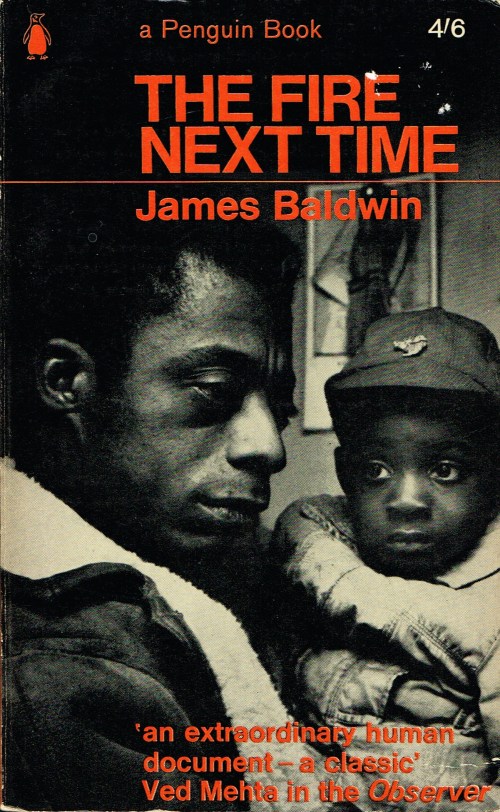
James Baldwin’s The Fire Next Time may be the best and most eloquent statement of relations between whites and blacks in America ever written. From the publisher:

The appearance of The Fire Next Time in 1963, just as the civil rights movement was exploding across the American South, galvanized the nation and continues to reverberate as perhaps the most prophetic and defining statement ever written of the continuing costs of Americans’ refusal to face their own history. It became a national bestseller, and Baldwin was featured on the cover of Time magazine. Critic Irving Howe said that The Fire Next Time achieved “heights of passionate exhortation unmatched in modern American writing.”

Baldwin was one of the great writers of his or any other American generation. He shouldered the burden of being a triple threat to America of the 1960s—a black man, a brilliant and outspoken intellectual, and gay. This he did with unequaled prose grace, and this work and others are required reading for anyone who wants or claims to be a writer.

The first of the two essays is My Dungeon Shook: Letter to My Nephew on the One Hundredth Anniversary of the Emancipation. Brief and unforgettable, it is a summary of how things are and why his teenage namesake cannot give up and in. It does no justice to this book to excerpt it; it stands as a whole that must be read—not the least of all because with the real progress we have made, we are foolish and destructive to over-measure how far we have come. But here is how the essay closes:

And if the word integration means anything, this is what it means: that we, with love, shall force our brothers to see themselves as they are, to cease fleeing from reality and begin to change it. For this is your home, my friend, do not be driven from it; great men have done great things here, and will again, and we can make America what America must become. It will be hard, James, but you come from sturdy, peasant stock, men who picked cotton and dammed rivers and built railroads, and, in the teeth of the most terrifying odds, achieved an unassailable and monumental dignity. You come from a long line of great poets, some of the greatest poets since Homer. One of them said, “The very time I thought I was lost, My dungeon shook and my chains fell off.”

You know, and I know, that the country is celebrating one hundred years of freedom one hundred years too soon. We cannot be free until they are free. God bless you, James, and Godspeed.

Your uncle,
James

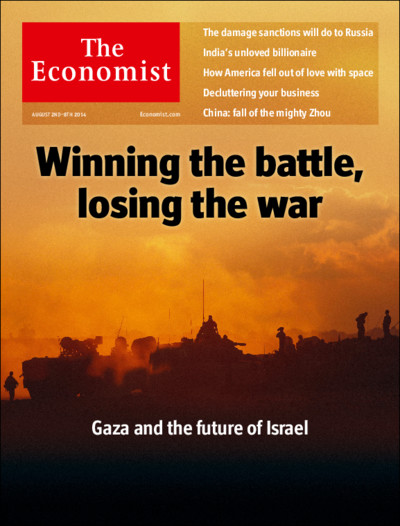
The Economist on Israel: Winning the Battle, Losing the War

Economist - Israel and Gaza

If you read the biblical chronicles instead of the newspapers, you know that the Jewish homelands have lived forever from crisis to crisis. In the history of modern Israel, none of that has changed.

When you live in constant crisis, the historical topography can be indistinct—it can be hard to tell which one is bigger than another. But in Israel’s history, Independence in 1948 and the Six Day War in 1967 are epochal. The current Israel-Gaza conflict is still ongoing, but the current crisis of 2014 may join that cohort.

Among the thousands of pieces and millions of words generated over the past few weeks, the new cover story from The Economist, Winning the battle, losing the war is one of best and most even-handed evaluations published about the aftermath of all this.

“Even-handed” and “fair-minded” are hard to find in such a brutal and polarized controversy, and some would say they don’t exist at all. The Economist, for those who don’t know, is one of the most astute and level-headed journals of public affairs in the world. This piece, like others about contested matters, is not without embedded value judgments or opinions. It is just a sharp, worthwhile, and informed point of view that should be heard—even if it is shouted down as somehow biased and mistaken:

For all the blood and misery in Gaza, Mr Netanyahu will soon have a chance to show he has heard the critics. Having won his battle, he could return to the negotiating table, this time with a genuine offer of peace. Every true friend of Israel should press him to do so.

Haftarah for War and Peace: Isaiah

Isaiah

The Jewish scriptural calendar has two parts: a weekly reading from the Torah (the Five Books of Moses) and a weekly reading from the prophets, known as a haftarah.

Today’s reading—Isaiah 1:1-27—is possibly the most special of these haftarot. Isaiah is the most famous and read of all biblical prophets, among Jews and Christians. And today’s reading is the very first chapter of Isaiah. It was written in, about, and for the Jewish kingdoms of the 8th century BCE, which were under threat from without and within.

Whole libraries have been written explaining and interpreting Isaiah. (For those who want a very brief, very readable introduction to these readings, there is no better start than W. Gunther Plaut’s The Haftarah Commentary.) One message is that the form of faith, no matter how punctilious and properly executed, is not enough, never enough. God says:

Trample my courts no more; bringing offerings is futile; incense is an abomination to me. New moon and sabbath and calling of convocation— I cannot endure solemn assemblies with iniquity. Your new moons and your appointed festivals my soul hates; they have become a burden to me, I am weary of bearing them. When you stretch out your hands, I will hide my eyes from you; even though you make many prayers, I will not listen; your hands are full of blood. (Isaiah 1:13-16)

The passage that follows this is one of the best known in the Bible:

Wash yourselves; make yourselves clean; remove the evil of your doings from before my eyes; cease to do evil, learn to do good; seek justice, rescue the oppressed, defend the orphan, plead for the widow. (Isaiah 1:16-17)


Isaiah 1:1-27

1The vision of Isaiah son of Amoz, which he saw concerning Judah and Jerusalem in the days of Uzziah, Jotham, Ahaz, and Hezekiah, kings of Judah.

2Hear, O heavens, and listen, O earth; for the Lord has spoken: I reared children and brought them up, but they have rebelled against me. 3The ox knows its owner, and the donkey its master’s crib; but Israel does not know, my people do not understand. 4Ah, sinful nation, people laden with iniquity, offspring who do evil, children who deal corruptly, who have forsaken the Lord, who have despised the Holy One of Israel, who are utterly estranged! 5Why do you seek further beatings? Why do you continue to rebel? The whole head is sick, and the whole heart faint. 6From the sole of the foot even to the head, there is no soundness in it, but bruises and sores and bleeding wounds; they have not been drained, or bound up, or softened with oil. 7Your country lies desolate, your cities are burned with fire; in your very presence aliens devour your land; it is desolate, as overthrown by foreigners. 8And daughter Zion is left like a booth in a vineyard, like a shelter in a cucumber field, like a besieged city. 9If the Lord of hosts had not left us a few survivors, we would have been like Sodom, and become like Gomorrah.

10Hear the word of the Lord, you rulers of Sodom! Listen to the teaching of our God, you people of Gomorrah! 11What to me is the multitude of your sacrifices? says the Lord; I have had enough of burnt offerings of rams and the fat of fed beasts; I do not delight in the blood of bulls, or of lambs, or of goats. 12When you come to appear before me, who asked this from your hand? Trample my courts no more; 13bringing offerings is futile; incense is an abomination to me. New moon and sabbath and calling of convocation— I cannot endure solemn assemblies with iniquity. 14Your new moons and your appointed festivals my soul hates; they have become a burden to me, I am weary of bearing them. 15When you stretch out your hands, I will hide my eyes from you; even though you make many prayers, I will not listen; your hands are full of blood.

16Wash yourselves; make yourselves clean; remove the evil of your doings from before my eyes; cease to do evil, 17learn to do good; seek justice, rescue the oppressed, defend the orphan, plead for the widow. 18Come now, let us argue it out, says the Lord: though your sins are like scarlet, they shall be like snow; though they are red like crimson, they shall become like wool. 19If you are willing and obedient, you shall eat the good of the land; 20but if you refuse and rebel, you shall be devoured by the sword; for the mouth of the Lord has spoken.

21How the faithful city has become a whore! She that was full of justice, righteousness lodged in her— but now murderers! 22Your silver has become dross, your wine is mixed with water. 23Your princes are rebels and companions of thieves. Everyone loves a bribe and runs after gifts. They do not defend the orphan, and the widow’s cause does not come before them. 24Therefore says the Sovereign, the Lord of hosts, the Mighty One of Israel: Ah, I will pour out my wrath on my enemies, and avenge myself on my foes! 25I will turn my hand against you; I will smelt away your dross as with lye and remove all your alloy. 26And I will restore your judges as at the first, and your counselors as at the beginning. Afterward you shall be called the city of righteousness, the faithful city. 27Zion shall be redeemed by justice, and those in her who repent, by righteousness.

Slaughterhouse-Five


Kurt Vonnegut

A friend in Israel has been corresponding with me about the current mess there. He is a proud and passionate American-Israeli. In the course of the conversation, he mentioned Dresden.

I, along with millions of others, can’t think of Dresden without thinking of Kurt Vonnegut. There is some chance, if you are of a certain age, that you don’t know Dresden or Vonnegut, so here is a summary.

In February 1945, just a few months before World War II ended, the Allies firebombed the city of Dresden, Germany. Much of the city was destroyed and tens of thousands lost their lives. At the same time, Allied prisoners of war were being held by Germany in Dresden.

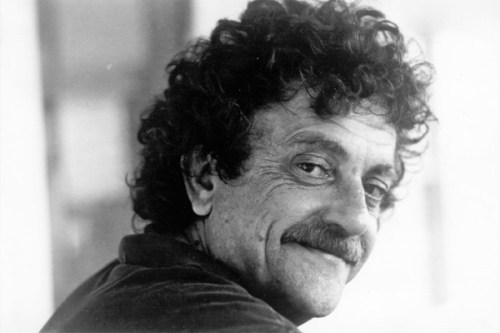
Kurt Vonnegut was one of the most interesting and original writers of the 20th century, and he influenced the cultural lives of readers throughout the 1960s and beyond. He was also one of those prisoners of war who was an eyewitness to the destruction in Dresden. He tried for more than twenty years to write about it, and finally in 1969 published his novel Slaughterhouse-Five, a title reference to the Dresden slaughterhouse in which he was held. It is a masterpiece, but not what anyone would expect a novel about the horrors of war to be like. It is, though, precisely what you might expect from Vonnegut.

The first chapter is his factual history of how he came to write this book. That chapter alone is worth reading, even if you think you don’t want or wouldn’t like the rest. In it, he recounts this conversation with a friend:

Over the years, people I’ve met have often asked me what I’m working on, and I’ve usually replied that the main thing was a book about Dresden.

I said that to Harrison Starr, the movie-maker, one time, and he raised his eyebrows and inquired, “Is it an anti-war book?”

“Yes,” I said. “I guess.”

“You know what I say to people when I hear they’re writing anti-war books?”

“No. What do you say, Harrison Starr?”

“I say, ‘Why don’t you write an anti-glacier book instead?’”

What he meant, of course, was that there would always be wars, that they were as easy to stop as glaciers. I believe that, too.

And even if wars didn’t keep coming like glaciers, there would still be plain old death.

Please read Slaughterhouse-Five (and more Vonnegut if you are so moved). You will be glad you did.

Suit and Tie: The Sad and Silly Syrian Election

Syrian President Assad Votes

It is reported that President Bashar al-Assad wore a dark suit and light blue tie for voting in today’s Syrian election. Good reporting. He looked good. So did his wife Asma.

Assad actually had opponents, the first time Syria has had a contested presidential election in fifty years. No one could think that this opposition meant anything. The other candidates could not think so. And yet there were supporters and voters at the polls, maybe out of fear, maybe out of hope, maybe just wanting to pretend things are normal. Some new normal, so that with one more term, a few more years added to his enlightened regime, there would be no more deaths after the 160,000, no more displaced and refugees after the millions.

Journalists and other nations are sworn by a sense of fairness and professionalism and diplomacy and sovereignty to pretend that this is an election, even if they have some quibbles. They might, if they had a better sense of irony or humor, treat it like Halloween or Mardi Gras. An occasion on which one dresses up to play the part of something you are not, say, a democratically elected leader in dark suit and light blue tie.

The U.S. also had an election during a civil war. Lincoln did have opposition and he did win. Whatever he wore when he voted, he certainly didn’t look as slick as Assad, nor was Mary Todd as socialite beautiful as Asma. By that point Lincoln was deeply tired and sick of the horrible conflict and would do anything he could to finally end it. The good news is that there would be only a few more months of war. The not so good news is that even with the good that came, it would take decades for the wounds to begin healing. The worst news, for Lincoln and the country, is that he would soon be assassinated.

Lincoln and the civil war were sad but never silly. Assad, in his dark suit and light blue tie, within this hollow semblance of an election, is sad and morbidly silly. Unlike Lincoln, he may be around for years, continuing to rack up votes and deaths. But looking real good.

VA Health Crisis: Listen to IAVA

VA IG Report

We should listen to the Iraq and Afghanistan Veterans of America about this VA health system crisis.

As the name implies, IAVA represents the latest generation of American war veterans. They are in some ways the most attuned to the current realities and sensibilities of veterans’ issues in 2014. Not because they have been around the longest, but because they are native to the way things work, or don’t, here in the early 21st century in America.

Those realities regarding the health care crisis in the VA are shocking to some, but come as no surprise to those who have watched it happening, including Congress (both parties) and the President.

Is it fixable? What won’t fix it is political posturing, handwringing, or even the delayed but imminent departure of VA Secretary Shinseki.

What will fix it? Good policy well executed, without excuses or cover up. The IAVA can help with that.

In the wake of yesterday’s Inspector General Report about the Phoenix VA health system, IAVA CEO and Founder Paul Rieckhoff said:

The new IG report on the Phoenix VA is damning and outrageous. It also reveals the need for a criminal investigation. Each day we learn how awful things are in Phoenix and across the country. The VA’s problems are broad and deep – and President Obama and his team haven’t demonstrated they can fix it. As one of only two combat veterans, Senator John McCain’s call for Secretary Shinseki’s resignation is particularly impactful…

Today’s report makes it painfully clear that the VA does not always have our veterans’ backs. Even before this report came out, IAVA members were losing confidence in Secretary Shinseki and President Obama. At Memorial Day events across the nation, our members voiced outrage, anger, and impatience at the growing VA scandal. This new report only increases the belief that the promise to veterans has been broken. We are sharing this report now with our members and seeking their reaction. In the coming days, we will share the voices of our members with the President, VA leaders and those in Congress.

In the IAVA 2014 Policy Agenda, the VA health system was just one of a number of initiatives offered for consideration. On that score, IAVA recommends this (excerpted):

I. Establish a Presidential Commission to end the VA claims backlog.

II. Transform the Veterans’ Benefits Administration’s (VBA) adversarial culture…

III. Reform VA’s work credit and productivity evaluation system for claims processor….

IV. Outline the VA’s responsibility about the requirements to substantiate a claim….

V. Adopt the “treating physician rule” for medical evaluations for compensation and pension…

VI. Require appeals form to be sent along with the Notice of Decision letters in order to expedite the appeals process.

VII. Evaluate the Segmented Lanes work initiative to continually assess whether it is meeting the goals of fast tracking…

VIII. Report the intake of new compensation and pension claims on the Monday Morning Workload Report.

IX. Report separated statistics on the intake and processing of supplemental and original claims in the Monday Morning Workload Report…

XIII. Continue to engage veteran stakeholders in updating the VA Schedule for Rating Disabilities (VASRD).

XIV. Require the VA to accept a PTSD diagnosis provided from a qualified private medical provider.

X. Establish a model to accurately project the claims workload and the resource and staffing requirements needed to meet the demand.

XI. Make all disability benefits questionnaires available to private medical providers.

XII. Simplify notification letters to provide easily digestible, specific and clear information about the reasons for rating decisions.

XV. Allow the VA to incentivize private medical providers to furnish medical health records to the VA for processing.

XVI. Clarify and report accuracy ratings for each regional VA….

This is an agenda, and if the President and the good people of Congress want to adjust or add, that is their prerogative and duty. But you have to start somewhere, with something on the table, and this is a good place for that. If these warriors are smart enough and capable enough and honorable enough to fight our wars, they are surely able to suggest the smart, honorable, and capable ways of treating them when those wars are over.

The Ukrainian Favor

Ukrainian Contingent Ends Iraq Mission

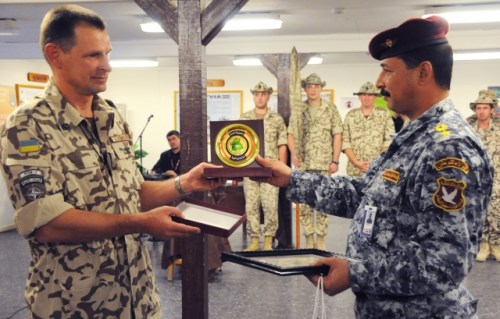
Commander of the Ukrainian contingent in Diwaniya presents a certificate and gift to
a member of the Qadisiya Province Iraqi Police, during an end of mission ceremony
at Camp Echo, Dec. 9, 2008.

“Are you asking as a friend or calling in a chit? A friend would not ask me to do this.”
“A friend just won’t hold it against you if you don’t.”
Adapted from Suits, USA Network

In 2008, Ukrainian troops officially left the U.S.-instigated Iraq War. Since 2003, 5,000 Ukrainian troops had served there (the third largest contingent in the multinational force) and 18 soldiers had died. No service or sacrifice can be minimized, even if these numbers pale in comparison to the American investment. Ukraine answered the call with honor and valor, as it had in other international conflicts, presumably because there are principles at stake, including the principle that modern internationalism means a commitment to mutual trust and support.

At the ceremony marking the end of the Ukrainian mission, Maj. Gen. Michael Ferriter, deputy commanding general for operations, Multi-National Corps-Iraq, said:

We know that violence is at its lowest level in five years, and the Iraqi Security Forces, partnering with Coalition forces, will take the lead in defending their country. And soon, the Iraqi people will vote in the future of their country in the provincial elections. These changes were not brought about naturally, but were instead brought about by the dedication and the hard work of the men and women from the nations such as yours. You helped create the Iraqi Security Force and instilled in them a solid foundation of skills essential to the future security and prosperity of Iraq.

To Iraq’s benefit, and through Ukraine’s efforts, you have helped ensure a higher quality of life for the people of Iraq. Ukraine forces made contributions that enabled all Coalition partners to be successful here, but it has not been without cost. A precious 18 Ukrainian Soldiers have died here.

Ukraine is asking for help from anyone to hold their country together. Under the circumstances, that is going to be difficult and may not be possible.

Are they asking as a friend or calling in a chit? If we don’t provide adequate or effective help, will they hold it against us? Should they?

Putin and the Little Engine That Could

Vladimir Putin - Little Engine

The pro-Russian insurgency in eastern Ukraine, and the Russian warnings to stay away and out, are not surprising. A fifth-grader doing a Social Studies assignment (if there is still Social Studies) had this one figured out.

So obviously did the American intelligence and foreign policy experts. They can’t tell us they know because that would give something away, even if that fifth-grader has already guessed. The other reason it isn’t officially talked about is that, officially, few are sure what to do next.

Vladimir Putin is well set up, for something. He can take little bites out of the region, or if Ukraine should erupt in instigated civil war, he can enter on the pretext of assuring the stability and security of a neighboring country. There is plenty of historical precedent for this strategy, and for this strategy working.

We—and this includes those who claim to know him—are not sure exactly who Putin is: cunning statesman, cowboy, sociopath? Whether he has himself killed people, up close, is a matter of conjecture, but many have no trouble believing it. German Chancellor Angela Merkel, who grew up in Communist East Germany and knows him, suggests that he is out of touch with the realities of the situation. Former U.S. President George W. Bush just displayed his painting of Putin, which picture says as much about W. as an artist as it does about the Russian President.

Putin is not out of touch with reality, any more than those people who believe that visualizing an outcome will ultimately make it so. He is under no delusion that realizing his reality will be cost free. He is just willing to pay the price, or allow others to chip in, maybe profoundly.

The U.S. may have the most distorted view of war in history. It isn’t that great sacrifice or valiant service haven’t been made. The U.S. didn’t just participate in some of the most significant defenses of human freedom; it helped freedom prevail. But for a few generations, there has been a lot of blood and treasure sacrificed in a sometimes well-meaning, sometimes self-serving fog. The source of the confusion is that for more than 150 years, the U.S. has not experienced national war on its soil. Regional conflicts and shocking, fleet- and building-destroying hostilities, but not a national war, inside or on our borders.

Whatever the list of solutions to international problems and provocations, war shouldn’t just be at the bottom of the list. It should be in some strategic sub-basement, below the last resort. At this moment, war in Europe is where it should be: unthinkable. But if something is unthinkable, then everything else has to be more thinkable, more discussed. Right now, the U.S. body politic is fascinated with other matters major and minor, because we need a break.

But trust this: Putin doesn’t give a care for what happened to a plane that has been at the bottom of the Indian Ocean for weeks. He is single-mindedly like that favorite American children’s book The Little Engine That Could, chugging along: I think I can, I think I can.

We don’t have to be concerned about Ukraine or we can be concerned. We don’t have to take action or we can take action. We don’t have to go to war or we can go to war. What isn’t optional is talking about it in the public square, in a conversation led by the President and others. This is not jumping the gun. It is a sensible prelude to an emerging situation, which could at any moment escalate from blah-blah-blah to something more active and serious.

The U.S. has not been very good at sensible preludes. The run-ups to recent wars have been filled with hyper-drama, fueled by the occasional exaggeration or lie. Ukraine, Europe, and the world need something else. Putin thinks he can. Who knows what we think?