Bob Schwartz

Category: Music

An Old Wave of Music Death


The death of musician Bob Welch, former member of Fleetwood Mac, is the latest in a current series of deaths—natural and unnatural—in the pop music world.

A fascination with rock death arose from a cultural and demographic phenomenon. The 1960s saw the meteoric appearance of very young stars to very young audiences. When a plane crash took Buddy Holly at 22 and Richie Valens at 17, this deeply touched teenagers who had little experience of death.

The late 1960s took this to a new level. Not only were young artists dying, but they were dying in strange and often self-inflicted ways. In 1979 the Village Voice published the legendary article Rock Death in the 1970s: A Sweepstakes, by music critic Greil Marcus (unfortunately not available online). Trying to both appreciate lost artists and skewer a fascination with celebrity death, Marcus scored the dozens of musicians according to past contribution, prospective future contribution and manner of death (heroin overdose received 0 points for manner, since he considered it “the common cold of rock death”).  Jimi Hendrix won, with perfect 10s for past and future contribution.

Some portions of the recent deaths bear an uncanny and all too familiar similarity to the worst days decades ago. If a Marcus-like list is to be made now, Amy Winehouse belongs near the top. Others who died too soon could join her there.

But there is something different about the latest wave. While some of the deaths are untimely, some of them preventable, and all of them tragic, we are now seeing a sort of bookend to the first days of the phenomenon. In the beginning, and in Marcus’ bizarre contest, most of the artists were in their twenties or even younger. While sixty may be the new forty, or whatever the baby boomer conceit is, many of these artists who are passing are in their mid- to late-sixties. They may not have died from getting older, but they were getting older. Even if this isn’t a wave touching shore, it is definitely out there on the horizon.

As Paul Simon, who is now 71, wrote forty years ago in a prophetic verse, “Everything put together falls apart.”

Mime Is Money


In the too-much-is-never-enough world of television, singing competitions are spawning wild speculation about what might be next. If successful, ABC’s just-premiered Duets is sure to be followed by singing groups of increasing size, leading to shows like Trios, Quartets, Quintets, and most audience-grabbing of all, Sextets.

One way to deal with too many shows is to thin out the herd. But another way is to do a 180-degree turn. That’s the idea behind a new competition show with the working title Mime Is Money, where silence will be golden.

Mime has become the object of only partly-deserved ridicule. Bad singers and dancers don’t give song and dance a bad name; they just reflect badly on their own lack of artistry. But untalented mimes have, until now, subverted any chance of the classic art of pantomime being taken seriously. This show could change all that.

Still in the concept stage, Mime Is Money will feature much more than the clichéd mime acts. For example, producers are hoping to include at least one example of mime ventriloquism, a little-known but strangely entertaining form. Mime ventriloquism is an outgrowth of the 1930s development of radio ventriloquism, pioneered by Edgar Bergen in the 1930s. Even though listeners couldn’t see Bergen performing with his dummy Charlie McCarthy, the Edgar Bergen-Charlie McCarthy Hour was on NBC radio for twenty years. In the case of Mime Is Money, the viewer can see the ventriloquist and the dummy, but can’t hear them, and so are guaranteed to experience the most perfect ventriloquism act ever.

Also being considered is the possibility of the judges remaining silent too, rendering their opinions only with motions and gestures. In addition to thumbs-up and thumbs-down, the possibilities are limited only by the creativity of the judges and producers. One hope is that if the show proves popular, some of the gestures will become like catch-phrases that will brand the show and will sweep across America.

It’s In The Grooves


Grooves are gone, mostly, from recorded music. Vinyl is still around, maybe even growing a little as a cool, specialty format.

Whether or not those circular scratches in plastic remain how we listen to music, the fundamental truth that was uttered back in the day still holds:

It’s in the grooves.

Meaning: You—artists, arrangers, producers, managers, record labels, media, fans—can blah, blah, blah about business, production, charts, back story, gossip, about what is, what could have been, what should have been.

But in the end, it is about the music, as it plays, as it sounds. Nothing anybody says, no matter how central, no matter how insightful, enlightening or fascinating, changes that.

The real life and real world concerns surrounding a record are far from unimportant, especially to those directly involved. But if that is the beast, then the heart of the beast, or its soul and essence, is the music.

So if you find yourself deeply engaged in all the music chatter, when you can, once in a while, shut out the extraneous and, politely, shut up and listen. Because even if the grooves are gone, they are still the only place recorded music actually lives.

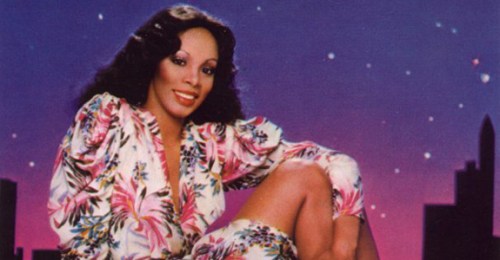
Donna Summer


For those who never stopped listening to Donna Summer, the news of her death was more than nostalgia or a pop culture milestone.

Fans might have wished that the iconic tracks could somehow be stripped of the signature Giorgio Moroder disco production, so that all you could hear was simple pop gems sung by an angel. Maybe that will happen. But in their time, the voice and the thumping beats were what helped elevate disco and make these monster dance floor hits.

True talent overcomes. Her first record I Feel Love was an attempt to exploit her sex appeal as much as her voice, sort of disco porn. That lasted one record. Even though there was plenty of sexiness to come, she was never again presented that way. She was a star, not a sultry gimmick.

She didn’t get enough opportunity to showcase on record all that she was and could do. There are some live recordings that include non-dance arrangements, but these are too rare.

She took the over-the-top Jimmy Webb song MacArthur Park, which had been talk-sung into a 1968 hit by actor Richard Harris, and ten years later made it nearly-beautiful and nearly-plausible through the force of her voice. The disco production is still heavy-handed, but she reached notes that Richard Harris only dreamed of during his alcohol days. It was a massive hit.

One thing to know: On the duet No More Tears (Enough Is Enough), Donna Summer outsings Barbra Streisand. The blending of voices is excellent, but before they come together, listen to them trading lyrics. Even Streisand fans should get that this one belongs to Donna Summer. Streisand never did choose to perform this duet live.

We feel love.

The Spotify Cover Game


Note: Two online music services launched in 2006, one in Palo Alto, California, one in Stockholm, Sweden. Both shared a vision of offering on-demand, track-by-track access to streaming music. Lala, the American service, was a simple and usable platform. It was offered free, and was based on an evolving business model that had something to do with future subscriptions and music sales. It was a wonder. In 2009, Apple bought the company, possibly to integrate the platform into a future streaming service of its own. That vapor service never materialized and, instead, Apple killed Lala.

At the same time, Spotify was developing its own more sophisticated service in Europe. Music licensing held up its introduction in America until 2011. Lala lovers, still smarting from its demise, have to admit that Spotify is indeed everything Lala was and more. Spotify is flourishing, though it still has to prove the viability of its business model, but we enjoy it while it lasts. Maybe Apple will buy it and kill it too. Sorry—still a little bitter.

Spotify has changed the way we listen to music. What music lovers hoped would happen in the future happened: Click on a track, there it is on your computer. The future is here.

Spotify enables a lot of listener creativity and sharing. There are thousands of playlists created and available. Of course, commercial media, artists, and labels are drawn to popular platforms like moths to flame, and there are now plenty of those generated playlists too.

Spotify also allows unlimited exploration and discovery. Among the unique paths is what might be called the Spotify Cover Game. You can choose any song and listen to nearly every version of it ever recorded, minus the small number still unlicensed and unavailable.

The Spotify Cover Game is fun and educational. To try it, take any popular song from any era. Search for the track, and the results will list all—sometimes dozens—of the recorded versions from different artists.

To demonstrate, Mad Men fans might pick The Beatles’ Tomorrow Never Knows from Revolver. (For non-Mad Men fans, this is the track that in a recent episode young and sexy Megan Draper plays for her older and sexy husband Don Draper to introduce him to the Beatles in 1966.)

Here is a very partial list of artists you can hear performing Tomorrow Never Knows on Spotify:

Phil Collins
Junior Parker
Jimi Hendrix
Michael Hedges
Danielle Dax
The Pink Fairies
Cowboy Mouth
Wayne Krantz
Living Colour
Trouble
Monsoon
Tangerine Dream
The Mission UK
Dwight Twilley
Herbie Hancock & Dave Matthews
Dweezil Zappa
Grateful Dead
Phil Manzanera

The proof of the song is in the covers, and Tomorrow Never Knows doesn’t fail. Whether vocals or instrumental only, it pushes artists to rise to the occasion as they aspire to recreate a cultural milestone.

Best: Herbie Hancock and Dave Matthews. A surprise, given the competition from Jimi Hendrix, Living Colour, and others, and given that neither Hancock nor Matthews are noted for this kind of psychedelia.

Worst: Grateful Dead, hands down. They are noted for their psychedelia, but in this particular live version from a 1992 concert in Oakland, the vocals are literally unlistenable and the music isn’t all that great either. Probably better the next night or if you were really high.

Most Interesting: Legendary bluesman Junior Parker, who recorded it as part of a Beatles album. His smooth and full-bodied voice is in stark contrast to the usual ethereal takes. Accompanied by a spare arrangement of hypnotic bass with a touch of guitar and keyboard, this is a perfect realization and transformation of the original. One of the most interesting Beatles covers ever.

In addition to hearing the multiple ways that the strongest songs are treated, the SCG—and Spotify itself—is about serendipity, the exploration and discovery of unheard artists and tracks. The Hancock/Matthews track, for example, is from a 2010 collection of collaborative covers called The Imagine Project (containing Imagine, but it’s not a Beatles-only collection). There you will find a cover of the Peter Gabriel-Kath Bush anthem of hope in hard times, Don’t Give Up, with John Legend and P!nk performing. Nearly (only nearly) as good as the original, it is mesmerizing, heartbreaking, and uplifting at the same time:

No fight left or so it seems
I am a man whose dreams have all deserted
I’ve changed my face, I’ve changed my name
But no one wants you when you lose…

Moved on to another town
Tried hard to settle down
For every job, so many men
So many men no one needs

Don’t give up
’cause you have friends
Don’t give up
You’re not the only one
Don’t give up
No reason to be ashamed
Don’t give up
You still have us
Don’t give up now
We’re proud of who you are
Don’t give up
You know it’s never been easy
Don’t give up
’cause I believe there’s a place
There’s a place where we belong

That’s the Spotify Cover Game. Try it. Enjoy. Explore. Discover. And don’t give up.

Hitmakers Reborn: Etta James and Gil Scott-Heron

Twice, artists who died in the past year have been reborn as hitmakers through the miracle of musical merger.

Both Etta James and Gil Scott-Heron play posthumous parts in two irresistible and near-perfect records—even if only a small number of listeners know exactly what they are listening to and who made these records the success they are.

Hip-hop sampling has been a great creative development. What began as inclusion of bits and pieces has become a full-scale integration unknown in any art. This isn’t quoting or paraphrasing or homage or covering. This is merger.

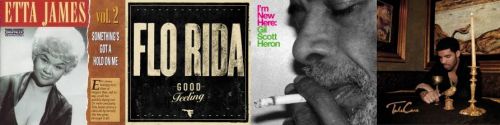
One case is Flo Rida’s Good Feeling, a three-layer cake with the incomparable Etta James at the foundation (and as the icing). You’ll recognize her powerful gospel-soul riff from 1962’s Something’s Got a Hold on Me:

“Oh, oh, sometimes I get a good feeling, I get a feeling that I never, ever, ever had before.”

In 2011, Swedish producer and DJ Avicii made this hook the centerpiece of his dance hit Levels, laying it in the middle of the beats and the record. Flo Rida in turn sampled Avicii’s recording, including Etta James, to create Good Feeling. The song is even named for the lyrics of the original. Flo Rida had the commercial good sense to put Etta James’ voice right out front, just six seconds into the record. For the next four minutes we can’t wait for her voice to rise up again. And to demonstrate just how powerful the riff is, you can now hear the record in major commercial campaigns, including one for Buick.

Then there is Drake’s Take Care, featuring Rihanna. This is even more layered. It begins with the song I’ll Take Care of You, written by Brook Benton and recorded by Bobby “Blue” Bland in 1959. Groundbreaking musician and poet Gil Scott-Heron (The Revolution Will Not Be Televised) recorded the song on his final album I’m New Here (2010). The track was remixed the next year by Jamie xx, amping a plaintive and soulful performance into a beat-based I’ll Take Care of U. This is the mix at the heart of Take Care.

One piece of good news is that the records that emerged from this process are simply great. They are great, especially in the case of Good Feeling, because of the artistry they are based on. There is also good news in that the current artists have given some credit to these predicate performers and performances, though it could have been and still could be much more.

The final good news is that this creates an opportunity for music fans to learn that music didn’t start in 2012, or 2000, or 1990, or wherever the old/new or really-old/old/new line lies for listeners. Listen to Gil-Scott Heron, listen to Bobby “Blue” Bland, and most of all…

Listen to Etta James. You might know Etta James from her biggest hit At Last, which Beyonce sang at an Obama Inaugural Ball. You might know Etta James from the interesting movie Cadillac Records, a dramatized history of Chess Records, featuring Beyonce as Etta James.

But you may not know, and should learn, that Etta James was one of the most talented and versatile artists of her generation, singing standards, pop, R&B, even a little country, and straight blues. Her popularity in other genres kept her from being recognized as one of the blues greats: listen to The Sky Is Crying, Dust My Broom, or Lil’ Red Rooster. A place to start is The Chess Box. And no, there’s no Beyonce anywhere in sight.

Mitt Romney, Ted Nugent and Chevy Chase

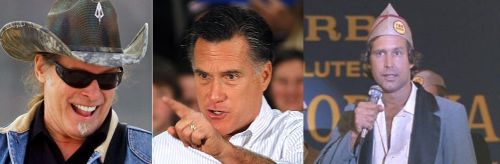
The recent silliness regarding Ted Nugent’s endorsement of Mitt Romney, followed by Nugent’s seeming threats to kill the current President, brought to mind a classic movie moment involving Ted Nugent and another rich guy.

It wasn’t actually Ted Nugent. It was Chevy Chase in Fletch. In the movie, Fletch/Chevy Chase is a smart-mouthed investigative reporter who regularly cracks wise by using ridiculous names. In this scene, Fletch is disguised as a beach bum, and businessman Alan Stanwyk (played by Tim Matheson) offers him a deal:

Stanwyk: Excuse me. I have something I’d like to discuss with you.

Fletch: What’s that?

Stanwyk: We can’t talk about it here.

Fletch: Why not?

Stanwyk: Because we can’t.

Fletch: You on a scavenger hunt, or did I forget to pay my dinner check?

Stanwyk: Come to my house to talk.

Fletch: Wrong gal, fella.

Stanwyk: I’ll give you cash.

Fletch: What?

Stanwyk: Come to my house and listen to the proposition. If you reject the proposition, you keep the thousand…and your mouth shut.

Fletch: Does this entail my dressing up as Little Bo Peep?

Stanwyk: It’s nothing of a sexual nature.

Fletch: Yeah.

Stanwyk: One thousand just to listen? How can you pass that up, Mister…

Nugent. Ted Nugent.

Stanwyk: Alan Stanwyk.

Fletch: Alan, charmed. For an extra grand, I’ll let you take me out to dinner.

There’s no reason to believe that the one conversation between Mitt Romney and Ted Nugent went anything like this. Mitt Romney is much richer than the fictional Alan Stanwyk, and the fictional Fletch/real Chevy Chase is much funnier than Ted Nugent. But it is fascinating to speculate how that endorsement conversation really did go, and if it might have been as surreal as this.

Thinking about Fletch can’t help but bring to mind the scene where Fletch disrupts an American Legion meeting by singing an earnestly terrible version of our national anthem. And thinking about Chevy Chase can’t help but bring to mind National Lampoon’s Vacation and a dog being tied to the bumper of a station wagon. Idle thoughts, none of which have anything to do with Ted Nugent.

But if we were thinking about singing, Mitt Romney, and Ted Nugent, we might idly wonder which song—either Nugent or Amboy Dukes—Romney might choose the next time he sings or recites a song on the campaign trail (though it’s doubtful he ever will again).

Journey to the Center of the Mind (1968) was the biggest Amboy Dukes hit, but maybe the most interesting song on an album that combined blues and psychedelia was Why Is A Carrot More Orange Than An Orange?.  Mitt Romney will not sing or recite it, of course, but it would be a memorable and humanizing moment:

First the world,
Then boy then girl,
Six days it took in all.
In His image he designed us
With no thought of flaw.

Now the question of perfection
Lingers in my mind.
Why is a carrot more orange than an orange?
Why are you greener than green?
Why do we sometimes believe
In things we’ve never seen?
Never doubt what it’s about
And you’ll get along fine.
But thy seeing the true meaning
Proves you’ve got a mind.
My suggestion is inspection of humanity.

I see why the ground is lower than the sky
And why sound can penetrate your mind.
But why is a carrot oranger than an orange?
Oranger than an orange?

Thank you, Ted Nugent.

Levon Helm

Garth Hudson, Robbie Robertson, Levon Helm, Richard Manuel, and Rick Danko

Levon Helm is dead at the age of 71.

The Band was one of the greatest American musical groups of its era. Great as in musically few better, American as in of and about America, which is strange because all but one of the members was Canadian. That was Levon Helm.

Levon was from Arkansas, son of a cotton farmer. Along with Ronnie Hawkins, he was an original member of The Hawks, which evolved into The Band with the addition of Canadians Robbie Robertson, Rick Danko, Richard Manuel, and Garth Hudson. As much as the influences came from every which where, as much astonishing musicianship and creativity as each member constantly demonstrated, this was an American band, an Arkansas band.

That was the key to The Band’s second album, The Band (1969). If The Band, the group, is unlike any other, The Band, the album, is even more unlike. At a time when synthesizing genres and styles was becoming normal, The Band stood out, and still does. These are songs about some sort of 19th century American South, played as if The Band had brought all their electric instruments and modern sensibilities back and forth in a time machine. Impossible to classify because it was created by Canadian rockers reborn in Arkansas, except for the one member who was actually born there the first time. That was Levon Helm.

No Levon, no Band. It’s that simple.

The night they drove old Dixie down
And the bells were ringing
The night they drove old Dixie down
And all the people were singing
They went na na na…