Bob Schwartz

Category: Movies

Sometimes I Think I Must Go Mad: ‘Much-loved’ giant rabbit found dead after United flight to O’Hare

Oh, sometimes I think I must go mad. Where will it all end?
Groucho Marx as Professor Quincy Adams Wagstaff in Horse Feathers (1932)

Here is the story in today’s Washington Post.

Here is the summary: A woman in the UK raises giant rabbits. Darius is 4 feet, 4 inches long, a Guinness World Record (see photo above). His 10-month-old son Simon is already 3 feet 5 inches long. Simon was sold to a buyer in Chicago and shipped via United Airlines. Simon died sometime during the trip.

Not a day goes by that doesn’t hint at some degree of craziness, or scream about it. Maybe it is always like this or maybe we are now more sensitized to it from frequent exposure.

Where will it all end?

Minister of Finance: Here is the Treasury Department’s report, sir. I hope you’ll find it clear.
Rufus T. Firefly, President of Freedonia (Groucho Marx): Clear? Huh. Why a four-year-old child could understand this report. Run out and find me a four-year-old child, I can’t make head or tail of it.
Duck Soup (1933)

Tomorrow Belongs to Me

tomorrow-belongs-to-me

There are two outstanding movie moments—one light, one dark—that tell two stories about Nazi Germany.

We will start light, from the movie The Producers (1968). In it, Mel Brooks incorporated an unthinkable stage musical called Springtime for Hitler. The title song-and-dance number mocks the lunatic aspirations and monstrosity of the Third Reich—mockable because just twenty-three years earlier, they had lost the war. It provides the most laughs anyone has provided or will provide on the subject. It is the most audacious thing any movie director has put on film.

Germany was having trouble
What a sad, sad story
Needed a new leader to restore
Its former glory
Where, oh, where was he?
Where could that man be?
We looked around and then we found
The man for you and me

And now it’s
Springtime for Hitler and Germany
Deutschland is happy and gay!
We’re marching to a faster pace
Look out, here comes the master race!
Springtime for Hitler and Germany
Rhineland’s a fine land once more!
Springtime for Hitler and Germany
Watch out, Europe
We’re going on tour!

Springtime for Hitler and Germany!
Winter for Poland and France
Come on, Germans
Go into your dance!

The second, darker vision is from the movie Cabaret (1972). It is set in 1931 Berlin. The characters sit at an outdoor café. A young man in a brown shirt begins singing Tomorrow Belongs to Me. It is a sweet tune at first (“The sun on the meadow is summery warm…”), but as the crowd stands to join in, the song grows belligerent and menacing. We know how the story turns out, and though some may think rehashing it is overdone and almost clichéd, we are chilled each time. Because the threat is never as far as we might think.

The sun on the meadow is summery warm
The stag in the forest runs free
But gathered together to greet the storm
Tomorrow belongs to me

The branch on the linden is leafy and green
The Rhine gives its gold to the sea
But somewhere a glory awaits unseen
Tomorrow belongs to me

Now Fatherland, Fatherland, show us the sign
Your children have waited to see
The morning will come
When the world is mine
Tomorrow belongs to me
Tomorrow belongs
Tomorrow belongs
Tomorrow belongs to me

What did happen in Sweden on Friday night? Maybe this…

curious_yellow_cover_large1b

From Trump at his Saturday night rally:

“We’ve got to keep our country safe. You look at what’s happening in Germany. You look at what’s happening last night in Sweden. Sweden, who would believe this? Sweden. They took in large numbers. They’re having problems like they never thought possible. You look at what’s happening in Brussels. You look at what’s happening all over the world. Take a look at Nice. Take a look at Paris.”

Was there some terrorist activity in Sweden on Friday night? No. What was Trump talking about? Who knows? Sweden has officially asked the State Department what Trump was talking about.

I have a guess.

curious

The Swedish film I Am Curious—Yellow (1967) is one of the most controversial movies of the 20th century. It is both sexual and political. The Criterion Collection writes:

Seized by customs upon entry to the United States, subject of a heated court battle, and banned in numerous cities, Vilgot Sjöman’s I Am Curious—Yellow is one of the most controversial films of all time. This landmark document of Swedish society during the sexual revolution has been declared both obscene and revolutionary. It tells the story of Lena (Lena Nyman), a searching and rebellious young woman, and her personal quest to understand the social and political conditions in 1960s Sweden, as well as her bold exploration of her own sexual identity. I Am Curious—Yellow is a subversive mix of dramatic and documentary techniques, attacking capitalist injustices and frankly addressing the politics of sexuality.

Yes, there was sex on Friday nights in Sweden in 1967. Yes, there was sex in I Am Curious—Yellow in 1968, when Trump was 22, old enough to get in to see the restricted movie, which he no doubt saw (many times). Yes, there was sex last Friday night in the social democracy of Sweden.

And that, I believe, is what Trump was talking about. “Look at what’s happening last night in Sweden.” Yeah, look.

curious-2

Of course, I could be wrong.

Dirty Dancing Turns 30

nobody-puts-baby-in-the-corner

Ture story: I attended a film festival with three of my favorite people in the world, where one of the premiering movies was Dirty Dancing. They hated it. I loved loved loved it.

I still love it. Yes, there are still haters out there, because haters gonna hate. But they are outnumbered by zillions of people who watch Dirty Dancing regularly, lifted by its cheesy yet irresistible romance, extreme melodrama and, of course, great music and dancing.

And we watch it for its life-affirming qualities, summed up in one declaration (say it together):

NOBODY PUTS BABY IN THE CORNER.

Happy birthday, Dirty Dancing.

International Holocaust Remembrance Day: Conspiracy

conspiracy

Today is International Holocaust Remembrance Day.

Conspiracy (2001) is an HBO movie that tells the story of the Wannsee Conference, held in the Berlin suburb of Wannsee on 20 January 1942. It was a top secret meeting of senior government officials of Nazi Germany and SS leaders to debate the merits of Hitler’s ‘Final Solution,’ the extermination of the entire Jewish population of Europe.

The excellent movie and the horrifying meeting are both mesmerizing and near-sickening. But whatever your knowledge of the Nazis and the Holocaust, you should—must—see it.

Not only because you should know more about the Nazis and the Holocaust, though you should. See it because you will discover how men of supposed culture, faith, education, and managerial and professional stature (many at the meeting were lawyers) can find themselves not just following a debased and subhuman road, but actually designing and building the road themselves. A highway to hell.

Conspiracy should be made freely available, at least on this one day. Unfortunately, besides free availability on Amazon Prime Video, you will have to pay $9.99 to stream or buy it. You can at least view some clips for free.

Movies: Doctor Strange – Comic Books Are Cosmic Books

doctor-strange

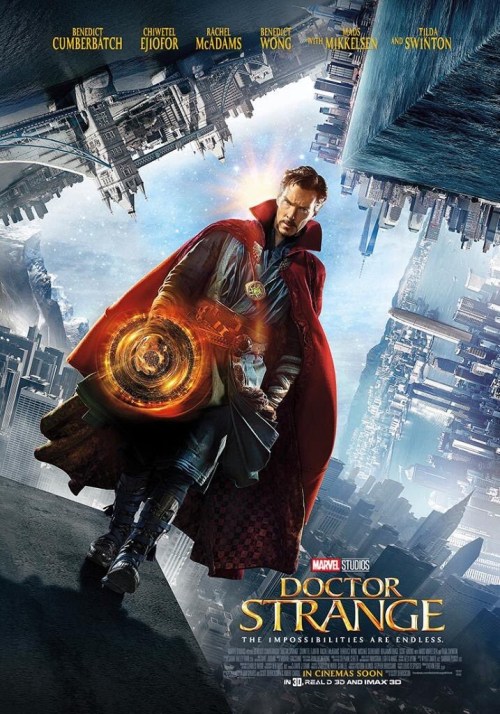
Go see the new movie Doctor Strange. See it if you can in one of those fancy theaters, in 3D if you like. But don’t think that it is just an excellent visual and aural and mental treat, which it is. See it because it represents why comic books and movies were invented. To offer us unique experiences, seasoned with interesting and even mind-altering emotions and ideas, that aren’t like the experiences of our everyday life.

What’s it all about? The answer is: Yes.

The comic book character Doctor Strange first appeared in 1963, as an unusual but not unprecedented special addition to the standard superhero approach. This one incorporated mysticism and spirituality, more so than average (it was after all the 1960s). Comic books are cosmic books, having evolved as the perfect place to tell stories laced with cosmic issues. At first glance, the stories and heroes appear to follow somewhat conventional logic and chronologic. Then, without excuse or explanation, they don’t (if this sounds like many of our religious traditions, well…). They are utterly effective but stop making sense, which as all students of comic books and cosmic arts know, and as Doctor Strange learns, is what it is all about.

If you want more details before you decide, you will find dozens of reviews, almost all of them very positive. Or you can not look for those. Instead, just pull yourself away from your phone or laptop or video game or big home screen to take a digital holiday into the breathtaking mystic—comic book and movie style.

Note: Not too long ago I wrote about mountains moving and walking, a common theme in spiritual traditions. See, for example, Jesus and Dogen and Donovan (♪ First there is a mountain/then there is no mountain/then there is). No mountains are moved in this movie, but they could have been.

Books: W.P. Kinsella

The Essential W.P. Kinsella

The writer W.P. Kinsella has died at the age of 81. He is most famous as the author of the novel Shoeless Joe, which was turned into the beloved baseball movie Field of Dreams. (The book is infinitely better.)

That was only a small part of his work. He wrote many other books and stories, some about baseball, some about indigenous Canadians on the reserve (reservation), and others. All his work was by parts unique and charming and funny, filled with a lot of magic, because Kinsella was such a gifted literary magician.

I looked for an obituary to quote that didn’t spend most of its time talking about Field of Dreams. Not many of those. I also looked for an obituary that didn’t mention his personal life, which seems to have been untidy and ragged in some ways, as he apparently could be a difficult person, as talented artists are wont to be. He may have been difficult, but reading his work is easy, so what does it matter, at least to readers?

Many of his books appear to be out of print, as interest in his work has faded. His death has brought him more attention than he had for years, which is the way it goes. The good news is that last year a collection of his stories was published. Here is the publisher’s description of The Essential W.P. Kinsella:

This career retrospective celebrates the 80th birthday of baseball’s greatest scribe, W. P. Kinsella (Shoeless Joe), as well as the 25th anniversary of Field of Dreams, the film that he inspired.

In addition to his classic baseball tales, W. P. Kinsella is also a critically-acclaimed short fiction writer. His satiric wit has been celebrated with numerous honors, including the Order of British Columbia.

Here are his notorious First Nation narratives of indigenous Canadians, and a literary homage to J. D. Salinger. Alongside the “real” story of the 1951 Giants and the afterlife of Roberto Clemente, are the legends of a pirated radio station and a hockey game rigged by tribal magic.

Eclectic, dark, and comedic by turns, The Essential W. P. Kinsella is a living tribute to an extraordinary raconteur.

And from a starred review in Publishers Weekly:

The career of the incomparable Kinsella is beautifully represented by these 31 short stories, including, of course, “Shoeless Joe Jackson Comes to Iowa,” the haunting tale of a baseball fan’s obsession with a long-dead star that was developed into a bestselling novel and then the film Field of Dreams. Other charming baseball fantasies include “The Night Manny Mota Tied the Record,” in which a fan agrees to sacrifice himself to bring back the recently dead Yankees star Thurman Munson, and “Searching for January,” which concerns an encounter with the deceased Roberto Clemente. Alongside these stories are several more realistic and mostly gentle satires, such as “The Fog,” that present the escapades of several indefatigable members of Canada’s First Nations. “The Grecian Urn” concerns a couple who can inhabit the interior worlds of great works of art. “K Mart” is the touching tale of three boys who use baseball to escape from their unhappy lives. Kinsella is a masterly writer of short fiction.

If you love good writing, please give W.P. Kinsella a read.

Political Expediency and Conscience

Marcellus and Butch - Pulp Fiction

Now the night of the election, you may fell a slight sting, that’s conscience messin’ wit ya. Screw conscience! Conscience only hurts, it never helps.
Loosely adapted from Pulp Fiction

Political pragmatism is a messy business, especially when it looks like pure expediency. That goes for candidates who are not trusted or liked, and for supporters and enablers who overlook obvious shortcomings and transgressions for the sake of some higher goal. (For Democrats and Republicans who think this is only about the other, think again.)

The best movie moment about expediency comes from Pulp Fiction. Those who know this great movie may know the scene. Those who haven’t seen it should, for entertainment and for Tarantino’s willingness to take on interesting moral and ethical questions. Be advised that the movie is rough, as is the language in this scene.

Boss Marsellus Wallace (Ving Rhames) is bribing aging boxer Butch Coolidge (Bruce Willis) to take a dive:

MARSELLUS WALLACE:

I think you’re gonna find ­ when all this shit is over and done ­ I think you’re gonna find yourself one smilin’ motherfucker. Thing is Butch, right now you got ability. But painful as it may be, ability don’t last. Now that’s a hard motherfuckin’ fact of life, but it’s a fact of life your ass is gonna hafta git realistic about. This business is filled to the brim with unrealistic motherfuckers who thought their ass aged like wine. Besides, even if you went all the way, what would you be? Feather-weight champion of the world. Who gives a shit? I doubt you can even get a credit card based on that.

Now the night of the fight, you may fell a slight sting, that’s pride fuckin’ wit ya. Fuck pride! Pride only hurts, it never helps. Fight through that shit. ‘Cause a year from now, when you’re kickin’ it in the Caribbean you’re gonna say, “Marsellus Wallace was right.”

Saturday Night Political Comedy and Science Fiction

Manchurian Candidate

There were two moments of comedy from Saturday night politics, one spontaneous, one planned. And a weird science fiction scene in between.

Comedy. The chaotic opening of the Republican debate was described by Politico as a “train wreck.” But a really funny train wreck:

As Gov. Chris Christie walked out on stage, moderators David Muir and Martha Raddatz called out Dr. Ben Carson. A camera backstage showed Carson starting to walk out, but he stopped himself once he heard the moderators announce the next candidate, Ted Cruz.

Cruz walked out, and Carson stayed put as a stage manager tried to wave Carson on stage. He didn’t move. Donald Trump then walked up next to Carson as his name was called, but also stopped next to Carson.

Marco Rubio was called up next, walking past both Trump and Carson onto the stage, as did Jeb Bush. John Kasich initially didn’t make it out onto the stage at all.

The moderators thought they were done. “Ladies and gentlemen, the Republican candidates.”

But they weren’t. “Dr. Ben Carson, please come out on the stage. He’s standing there, as well. Dr. Carson.

“And Donald Trump,” they added.

Then Carson chimed in. “I can introduce Kasich?”

“Yes, yes, we’re going to introduce Ohio governor John Kasich,” the moderators said.

All that was missing from the botched introductions was the candidates colliding with each other and falling all over the stage. Keystone Cops style (that’s for you, Mitt Romney). This hilarious mess didn’t quite make the endless hours of blah blah that followed tolerable.

Then there was this bit of absolute weirdness at the debate:

Science fiction. Chris Christie attacked Marco Rubio for giving the same canned speech every time, no matter what the question. Rubio responded by giving the exact same speech he had just given. Later in the debate, Rubio did it again, word for word. And then again.

It was like a sci-fi movie where a robot is running for President and the mission is to push him to the point of meltdown. The only way we did know that Rubio was not a robot is that later on he began to sweat. Aha!

Or maybe it was like The Manchurian Candidate, where Christie would show Rubio the Queen of Diamonds from a deck of cards, and Rubio would walk off stage in a hypnotic trance.

Comedy. Bernie Sanders went on Saturday Night Live with his doppelganger Larry David. SNL concocted a bit in which Larry David was the captain of a Titanic-type ship that was sinking. The captain was trying to jump ahead of the women and children getting into the lifeboats. Bernie appeared on deck as a radical immigrant who had had “Enough! Enough!” of the privileged one-percent pushing ordinary people around. The happy ending is that the ship has hit not an iceberg but the Statue of Liberty. Bernie did a charming and self-effacing job of delivering his lines with comic gusto.

Snow White in Iowa

Snow White - Magic Mirror
Hillary Clinton: Magic mirror on the wall, who won the Iowa caucus?

Magic Mirror: Over the seven jeweled hills, beyond the seventh fall, in New Hampshire campaigns Bernie Sanders, the winner in Iowa.

Hillary Clinton: I won Iowa. Bernie Sanders is dead. Behold the results.

Magic Mirror: Bernie Sanders still lives. You failed to vanquish him.

Hillary Clinton: Then I’ve been tricked.

With sincere apologies to Ted Sears, Richard Creedon, Otto Englander, Dick Rickard, Earl Hurd, Merrill De Maris, Dorothy Ann Blank, and Webb Smith, the writers of Disney’s Snow White and the Seven Dwarfs (1937). And to the Brothers Grimm.