Bob Schwartz

Category: Medicine

The Most Significant Shutdown Front Pages

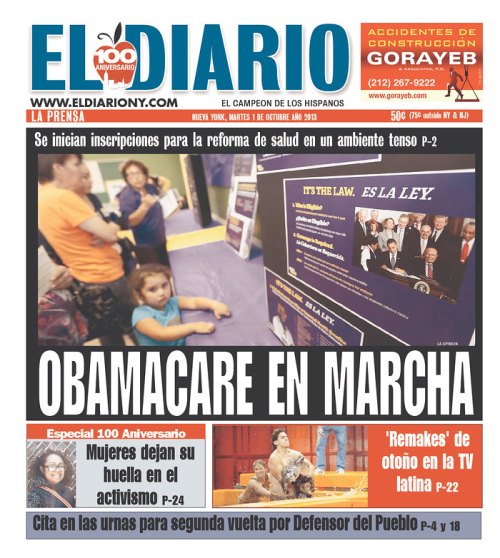
El Diario

Republicans should pay close attention to the front pages of America’s newspapers this morning, the first day of the government shutdown prompted by their obsessive opposition to Obamacare.

Most papers carry some version of “shutdown” or “gridlock,” with photos of John Boehner and Harry Reid, or John Boehner and Barack Obama (it’s all about John Boehner).

But the big story on two front pages is the opening of the Affordable Care Act insurance exchanges. These two papers just happen to be two of the largest Spanish-language dailies—El Diario in New York (above) and La Opinion in Los Angeles (below).

La Opinion

Why is this significant for Republicans? Because they claim (but in their heart of hearts still may not believe) that here in the second decade of the 21st century, they can’t become an American national party without broad Latino support. That is true, but the fact is that a large part of that constituency is uninsured and is deeply interested in the benefits of Obamacare. This is reflected in those front pages. But the Republicans are sworn enemies of Obamacare, so committed that they are willing to put people out of work to do it. How can the Republicans be a party attractive to Latinos under that circumstance?

The answer is that they can’t. It is a circle Republicans cannot square. And no matter how much lip service they pay to underserved populations, everything they do says something else. Actions, like front pages, speak louder than words.

The Government Shutdown and Masturbating Fetuses

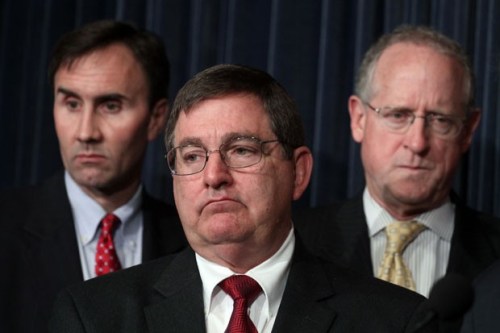
Rep. Michael Burgess
In the contentious Saturday night House debate on the Continuing Resolution to fund the federal government—a resolution that guts Obamacare and will almost certainly lead to a partial government shutdown—Republican Rep. Michael Burgess of Texas revealed a little known fact about the Affordable Care Act: it was “never intended to be law,” even though it obviously is. How so?

And here’s the real crux, Mr. Speaker. Here’s what’s really wrong and why Washington is in such a lather right now: The Affordable Care Act was never intended to become law. It was a vehicle to get the Senators home on Christmas Eve before the snowstorm. It was never intended to be law. The law that was passed by the Senate was a rough draft. It’s equivalent to saying the dog ate my homework so I turned in the rough draft; and, unfortunately, the rough draft got signed into law the following March, and that’s why there’s so much difficulty with this.
Congressional Record, September 28, 2013

Who is Rep. Burgess and why is he saying these things? He is a medical doctor, an ob/gyn, and has become one of the Republican Congressional experts on health care. Research shows that he has some other interesting views. This from U.S. News on June 18 of this year:

Rep. Michael Burgess, R-Texas, said Monday he is opposed to abortion because fetuses masturbate in the womb, and so can feel both pleasure and pain.

“Watch a sonogram of a 15-week baby, and they have movements that are purposeful,” said Burgess, citing his experience as an OB/GYN, during a House Rules Committee hearing on a GOP bill that would ban abortions after 20 weeks. “They stroke their face. If they’re a male baby, they may have their hand between their legs. If they feel pleasure, why is it so hard to think that they could feel pain?”

His comments were first reported by women’s health site RH Reality Check.

But Burgess’s argument isn’t based in science, doctors say. “We certainly can see a movement of a fetus during that time, but in terms of any knowledge about pleasure or pain – there are no data to assess,” says Jeanne Conry, president of the American College of Obstetricians and Gynecologists, a professional association for OB/GYNs. “We don’t know enough about the biology and the science.”

One more medical opinion from Rep./Dr. Burgess on the country’s sickness: President Obama must be impeached. Burgess said to a Tea Party questioner in 2011: “It needs to happen, and I agree with you it would tie things up. No question about that.”

The Wait We Carry

The Wait We Carry
IAVA has been at the forefront of modern veterans advocacy—something desperately needed in the face of modern veterans benefit challenges (that is, much talk, little action).

The latest of these advocacy tools is dazzlingly innovative and personalizing. Here is the IAVA introduction:

This is the true face of the backlog. Introducing: The Wait We Carry.

By now, you’ve seen the big numbers behind the VA disability benefits backlog — over 565,000 vets waiting too long to get their claims resolved. But it’s not enough to talk about the numbers. We wondered: what are those vets going through? How is their wait for benefits affecting them and their families?

We asked vets to tell us about their experiences while waiting for their benefits. Their stories blew me away. I knew immediately that I wanted to do something that would give a voice to their struggle. Harnessing the power of technology, we have created a state-of-the-art data visualization tool to bring those stories to the world. It’s called The Wait We Carry.

The Wait We Carry is an interactive way for anybody to engage with the folks waiting for their benefits through their stories. There are several different search options so you can find a specific story, or you can simply take your time browsing through all of the stories. It drives our point home that there isn’t just one backlog experience. The weight of the wait is different for everybody.

The power of this tool is that it holds everybody accountable for the unacceptably long wait times. That’s why it’s crucial that this thing goes viral.

I’ve been working on this for months, and I am certain that The Wait We Carry is powerful enough to end the VA backlog for good. Make sure you check it out today — thewaitwecarry.org

Thanks,

Jacob Worrell
OIF Veteran, US Army 2004-2007
Product Strategy Associate
Iraq and Afghanistan Veterans of America (IAVA)

DNA and the Supreme Court Reading Program

DNA Court
Today’s Supreme Court decision on the patentability of genetic material, Association for Molecular Pathology v. Myriad Genetics, Inc.  is another example of just how informative and fun these opinions can be, as opposed to just hearing the media summaries. This leads to a suggestion for a Supreme Court Reading Program.

Earlier posts have covered the value—in knowledge and entertainment—of reading current Supreme Court opinions, even if you are not a lawyer. This also includes reading the briefs in support of various positions, from a range of people and organizations. When the marriage equality cases were argued back in March, a post was devoted to The Briefs on Marriage Equality.

In this complex and significant gene case, the unanimous opinion of the Court (Justice Scalia concurred in a very short comment of his own) is that particular genetic material that isolated and identified (here, the site of mutations leading to breast and ovarian cancer) is not patentable, but that a new synthesized version of that same material, with the deletion of some parts, is.

Among the things that makes the opinion so interesting is its cogent explanation of a technical area. Genetics isn’t easy, and the opinion is really an understandable primer on a difficult topic.

Even more interesting are the array of briefs submitted in the case. Along with companies that want to be able to hold lucrative proprietary interest in genes, there are scientists and health care advocates who want nothing to stand in the way of free and open development and application. (The Humane Genome Project, for example, from the first offered all the work on the mapping the human genome to humanity.) Lawyers and intellectual property activists also chimed in, with intense interest in how patent law is a mess in these hyper-advancing times, having fallen so far behind the realities of digital and bio innovation. Also interesting is a brief from the Southern Baptist Convention, which taken from their church perspective makes a pretty good argument that, to put it bluntly, you can’t patent God.

So when you hear mention of an interesting Supreme Court case, either when it is argued or decided, step away from the media reports, even when those are reliable from experts you trust. Instead, visit the Supreme Court site to read or download the opinion (the opinion is published on the site almost immediately). Then visit the American Bar Association site that collects all the amicus briefs for each case that is argued. There will be a lot of those briefs—more than a hundred in the case of marriage equality—so you will want to pick and choose. Sometimes the name of the person or organization submitting the brief will catch your interest, just by who or what they are.

That certainly applies to the gene patent case. There among the many briefs is one identified as Brief for James D. Watson, Ph.D. in Support of Neither Party. Just in case the name isn’t familiar, James Watson, Ph.D. is the co-discoverer of the double helix structure of DNA, for which he and Frances Crick were awarded the Nobel Prize in Physiology in 1963. Even if he wasn’t one of the most important scientists in history, his delightful and erudite 26-page brief would be worth reading. It’s just one more example of how a Supreme Court Reading Program can be an enlightening and surprising addition to whatever else you’re currently paying attention to.

What Must Todd Akin Think of Sarah Palin?


What must Todd Akin think of Sarah Palin?

Todd Akin has lots of opinions about the ladies, inside and out. As for the inside, he has apparently been graced with some sort of revelation—dare we call him a prophet?—about a previously undiscovered physiological process whereby a woman’s body “knows” whether a rape is the kind that should or should not allow a resulting pregnancy. He has been asked to write a monograph about this process, profusely illustrated, but he has been otherwise occupied with his race against Senator Claire McCaskill in Missouri. It is a loss for medical science, but maybe he will have lots more time after the election. Citizens and gynecologists can only hope.

His views about the outside of women came clear after his debate with Sen. McCaskill, when he said:

“I think we have a very clear path to victory, and apparently Claire McCaskill thinks we do, too, because she was very aggressive at the debate, which was quite different than it was when she ran against Jim Talent,” Akin said. “She had a confidence and was much more ladylike, but in the debate on Friday she came out swinging, and I think that’s because she feels threatened.”

A review of Sen. McCaskill’s debate performance shows that she was thoughtful, firm, politely aggressive, and unrelenting—which is exactly what you would expect and hope for from a former prosecutor and current United States Senator.

When it comes to men dealing with women in politics—as candidates and voters—there are two ways of looking at it. One is external and pragmatic. Whether those men are saintly idealists or craven devils, women can play a role in their obtaining and maintaining power—given that women have had the vote for almost a century, and have held public office even longer.

The second and more fascinating view involves what’s going on inside—inside the heads of those men. This political season, something that got touched on in the 2008 campaign is now even clearer. It’s something that can be said about some small number of men who have been complicit, as actors or fellow travelers, in what for a while this cycle was called the “war on women”:

They don’t understand women.
They can’t control women, at least not easily.
They fear women, because they don’t understand them and can’t control them.

Keep these in mind and much will make sense.

What doesn’t make sense is what Todd Akin must think of Sarah Palin.

There are a thousand things to say about Sarah Palin, and particularly about her controversial role in the 2008 election. One thing is certain: she does not fit Todd Akin’s idea of “ladylike.” She is happy to be the pitbull with lipstick. Think of a political woman who is ambitious, confident, outspoken, and likely to dismember the man or moose who crosses her. Quick: Is that Sarah Palin or Hillary Clinton? Exactly.

In America, women have failed to reach their deserved heights and presence in many fields. Elective politics, particularly at the national level, is one of them. By definition, the U.S. Senate can’t be the world’s greatest deliberative body, overstuffed as it is with men. And it certainly won’t be enhanced by Todd Akin’s membership; just ask most Republicans who nearly killed him over his “legitimate rape” remarks.

Conservatives worship Margaret Thatcher. Some of them no doubt hold out hope for the love that dared not speak its name, the hope that the obvious affection between Thatcher and Ronald Reagan went all the way, and that one day, not long from now, the offspring of that union will arrive in our political life as a savior.

If it’s a son, that is. If it’s a daughter, we might still have a problem.

While we are playing with ridiculous fantasies, here’s another one. Suppose that instead of Claire McCaskill on an open stage, Todd Akin had to face Maggie Thatcher, Hillary Clinton and Sarah Palin behind closed doors to explain his visionary, man-centric thinking.

It wouldn’t be ladylike, and it would be worth paying to see.