Bob Schwartz

Category: Literature

Translators May Be Traitors

If you read important books that are written in a language other than your own, you are at a disadvantage. You are depending on the kindness or brilliance of strangers. On translators.

That is doubly complicated if the original text is ancient, and the original language itself is a mystery, even for those who are expert.

The Bible, both First and Second Testaments, not to mention collatral ancient scriptural books and fragments, are a well-known example. The same problem arises with Asian texts such as the Tao Te Ching, the I Ching, or early Buddhist discourses.

So you see the challenge. Jesus or the Buddha said great things in their native language. Nobody transcribed them when spoken. The thoughts and words were remembered and kept accurately alive, as accurately as possible, in oral transmission and storage. Then they were set down in writing, in a language related to the original speech, maybe, but later in entirely different languages. And as the words migrated, the texts were overlaid and transformed, even as there was a sincere attempt to preserve the original.

Finally, they come to you, in the language you speak, read and understand. Which is far removed from the original.

When the French had the audacity to translate Dante into their own language, the Italians came up with a harsh accusation: Traduttore, traditore. Translator, traitor.

Consider that when you read translations, you are someone who cannot read yourself, or even see. You are in the dark. You depend on those who read to you. And hope that they are good and true readers themselves.

Hasidic Tales of the Holocaust

Hasidic Tales of the Holocaust

For International Holocaust Remembrance Day, this story from Hasidic Tales of the Holocaust by Yaffa Eliach.


Good Morning, Herr Müller

Near the city of Danzig lived a well-to-do Hasidic rabbi, scion of prominent Hasidic dynasties. Dressed in a tailored black suit, wearing a top hat, and carrying a silver walking cane, the rabbi would take his daily morning stroll, accompanied by his tall, handsome son-in-law. During his morning walk it was the rabbi’s custom to greet every man, woman, and child whom he met on his way with a warm smile and a cordial “Good morning.” Over the years the rabbi became acquainted with many of his fellow townspeople this way and would always greet them by their proper title and name.

Near the outskirts of town, in the fields, he would exchange greetings with Herr Müller, a Polish Volksdeutsche (ethnic German). “Good morning, Herr Müller!” the rabbi would hasten to greet the man who worked in the fields. “Good morning, Herr Rabbiner!” would come the response with a good-natured smile.

Then the war began. The rabbi’s strolls stopped abruptly. Herr Müller donned an S.S. uniform and disappeared from the fields. The fate of the rabbi was like that of much of the rest of Polish Jewry. He lost his family in the death camp of Treblinka and, after great suffering, was deported to Auschwitz.

One day, during a selection at Auschwitz, the rabbi stood on line with hundreds of other Jews awaiting the moment when their fates would be decided, for life or death. Dressed in a striped camp uniform, head and beard shaven and eyes feverish from starvation and disease, the rabbi looked like a walking skeleton. “Right! Left, left, left!” The voice in the distance drew nearer. Suddenly the rabbi had a great urge to see the face of the man with the snow-white gloves, small baton, and steely voice who played God and decided who should live and who should die. He lifted his eyes and heard his own voice speaking:

“Good morning, Herr Müller!”

“Good morning, Herr Rabbiner!” responded a human voice beneath the S.S. cap adorned with skull and bones. “What are you doing here?” A faint smile appeared on the rabbi’s lips. The baton moved to the right—to life. The following day, the rabbi was transferred to a safer camp.

The rabbi, now in his eighties, told me in his gentle voice, “This is the power of a good-morning greeting. A man must always greet his fellow man.”

Based on my conversation with an elderly Hasidic personality.


In the literature of the Holocaust, Hassidic Tales of the Holocaust stands alone. As the publisher describes it, “Derived by the author from interviews and oral histories, these eighty-nine original Hasidic tales about the Holocaust provide unprecedented witness, in a traditional idiom, to the victims’ inner experience of “unspeakable” suffering. This volume constitutes the first collection of original Hasidic tales to be published in a century.”

As the author writes in her Foreword:

The Hasidic tale of the Holocaust is rooted in the Auschwitz reality, yet it soars to heaven and higher. It can carry the faithful above pits filled with bodies. Despite Auschwitz, the tale still expresses belief that man is good and capable of improvement; it can restore order to a chaotic world and offer unlimited freedom to the creative mind attempting to come to terms with the Holocaust. Its rich Jewish heritage and European tradition make it a unique genre of modern literature. The tales in this collection completed a full cycle from documentation to art to documentation and back to art. For in the beginning there was a tale.

There are many other books that will tell you about the history of the Holocaust. There are few other books that so deeply and creatively offer its soul.

ITUNES TERMS AND CONDITIONS: The Graphic Novel

iTunes Graphic Novel

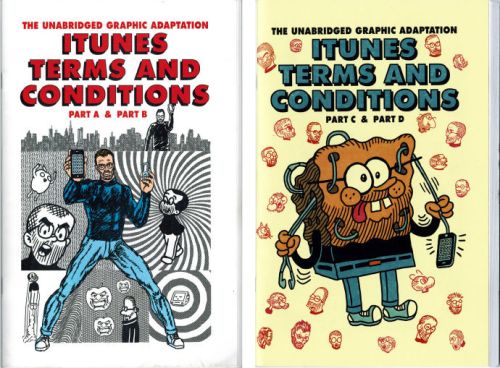
Masterful comic artist R. Sikoryak has created one of the most unique works ever. Ever. ITUNES TERMS AND CONDITIONS: The Graphic Novel.

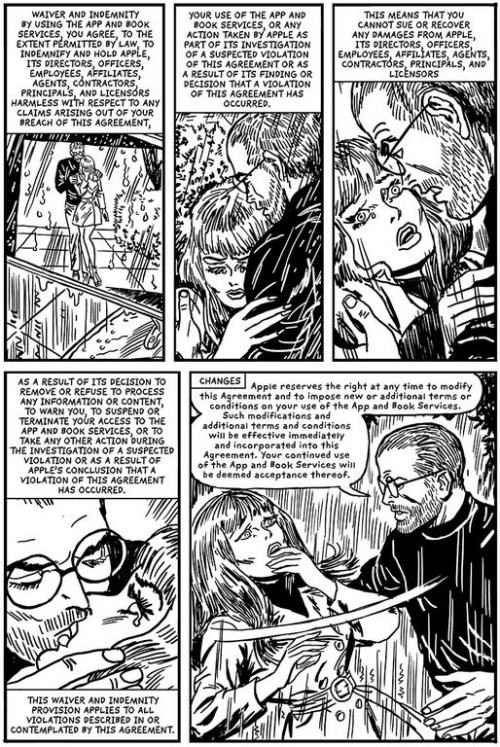
Sikoryak is known for his ability to faithfully reproduce the style and characters of many famous comic book and graphic novel creators. What he has now done is take the entire long, dense and absurdly legalistic mandatory iTunes Terms and Conditions and made it the text of a graphic novel. One new page a day is being released on Tumblr.

Each page is done in a different style (from Chester Gould (Dick Tracy) to Herge (Tintin) to Mort Walker (Beetle Bailey) to Charles Schulz (Peanuts) to Dan DeCarlo (Archie) to Todd McFarlane (Spawn) to Scott Adams (Dilbert) and on and on). The featured “hero” of each page is, naturally, Steve Jobs.

iTunes Graphic Novel - Heck and Romita

You can read an interview with Sikoryak in The New Yorker.

It is an astonishingly simple idea to the point of genius. All it takes to turn the ridiculous (such as the iTunes T&C) into the sublime is artistic vision and talent. Thanks to Sikoryak for gifting us with his.

New Beginnings: The Torah and the I Ching

Bet

In Jewish congregations, the annual Torah reading cycle begins again this week with the first chapters of the Bible. In Hebrew it begins with the word b’reishit, and in its best-known translation, the first verse goes like this:

In the beginning, God created the heavens and the earth.

And with that comes a puzzle.

If B’reishit is the beginning of a very big and consequential story, and if the creators of the Torah were sensitive to the mystical meanings of the Hebrew alphabet and language, why does the Torah begin with the second letter bet (B) rather than the first letter alef (A)?

Looking at a bigger picture, this connects to a related puzzle and an unlikely source: the I Ching.

The I Ching is a classic of Chinese literature and philosophy, a text as ancient as the Torah and just as influential.

Richard J. Smith writes in The I Ching: A Biography:

The Changes first took shape about three thousand years ago as a divination manual, consisting of sixty-four six-line symbols known as hexagrams. Each hexagram was uniquely constructed, distinguished from all the others by its combination of solid (——) and/or broken (— —) lines. The first two hexagrams in the conventional order are Qian and Kun; the remaining sixty-two hexagrams represent permutations of these two paradigmatic symbols….

The operating assumption of the Changes, as it developed over time, was that these hexagrams represented the basic circumstances of change in the universe, and that by selecting a particular hexagram or hexagrams and correctly interpreting the various symbolic elements of each, a person could gain insight into the patterns of cosmic change and devise a strategy for dealing with problems or uncertainties concerning the present and the future.

The first intriguing note is that the I Ching (pronounced Yi Jing) begins with those hexagrams Qian and Kun—known generally in English as Heaven and Earth. The cosmos of change and the I Ching begin then with Heaven and Earth.

It is at the close of the 64 hexagrams that the conundrum appears. Hexagram 63, the penultimate one, is Ji Ji—After Completion. This should be the end of the story. But it isn’t. The final hexagram, Hexagram 64, is Wei Jei—Before Completion. In the end, it doesn’t stop. It begins again. The Book of Changes emphasizes that the changes never end.

This is an explanation of why the Torah does not begin with the beginning of the alphabet. If it starts with A, that presumes a Z, A to Z, or in Hebrew, alef to tav. Creation would thus be represented as a finite element of a finite cosmos. In the text it starts instead, as the Latin phrase goes, in media res—in the middle of things. Just as the Torah will end in the middle of things, after completion of a journey, but with Moses never allowed to experience what is yet to happen, before the next completion. On and on, always beginning, never done. Just like the I Ching. Just like the Torah itself.

For Me To Be A Saint Means To Be Myself: Thomas Merton and Pope Francis

Thomas Merton

In his speech to Congress, Pope Francis put Thomas Merton back in the public light, where he has long belonged as an American spiritual master:

A century ago, at the beginning of the Great War, which Pope Benedict XV termed a “pointless slaughter”, another notable American was born: the Cistercian monk Thomas Merton. He remains a source of spiritual inspiration and a guide for many people. In his autobiography he wrote: “I came into the world. Free by nature, in the image of God, I was nevertheless the prisoner of my own violence and my own selfishness, in the image of the world into which I was born. That world was the picture of Hell, full of men like myself, loving God, and yet hating him; born to love him, living instead in fear of hopeless self-contradictory hungers”. Merton was above all a man of prayer, a thinker who challenged the certitudes of his time and opened new horizons for souls and for the Church. He was also a man of dialogue, a promoter of peace between peoples and religions.

Pope Francis, like Merton, is a natural. One of those players who finds their game and becomes a star because their nature brought them to it. This doesn’t mean there aren’t struggles on the way to greatness. On the contrary, the unceasing struggles are an essential part of their nature. At first we may be inspired by the worthy message and outward model. But ultimately, when we explore them, it is the dimensions and shading we come to admire. A child’s drawing is all black and white, a simple sketch. A master drafts with subtle and powerful lines and shadows, in which we see so much depth.

The Pope’s regard and mention of Merton in his speech to Congress is also natural. Merton chose to be a cloistered monk, then rebelled against his voluntary and self-imposed discipline. The demands of quiet and obedience to authority clashed with the imperative of a great writer freely writing and a great thinker freely thinking. Not gratuitous and loose writing and thought. Always guided by a compass that pointed both higher and back to an inescapable benevolent source, always grounded in the reality of daily life, strong and weak. That sort of creative independence in calling seems to mark Pope Francis too.

Merton died in 1968, almost exactly a year before Pope Francis was ordained. To say they would have loved to have met is understatement. Like many of us, Pope Francis met Merton in countless books, by and about him. In those writings, we learn that Merton was a mystic and a man. What else are saints anyway? “For me to be a saint is to be myself,” Merton said. We can’t be our better self without being our truer self, our littler self and our bigger self. No divine without human, the most and best human possible. It’s all about love and awareness. So Merton lived and wrote. So Pope Francis echoes in his life and his messages.

If you want to learn more about Merton, see The Thomas Merton Center. Among the overwhelming list of books, consider starting small with these:

Thomas Merton: Essential Writings

Love and Living, a collection of essays from the later days of his life.

An excerpt from Learning to Live, the first essay in Love and Living:

What I am saying is this: the score is not what matters. Life does not have to be regarded as a game in which scores are kept and somebody wins. If you are too intent on winning, you will never enjoy playing. If you are too obsessed with success, you will forget to live. If you have learned only how to be a success, your life has probably been wasted. If a university concentrates on producing successful people, it is lamentably failing in its obligation to society and to the students themselves…

The least of the work of learning is done in classrooms. I can remember scores of incidents, remarks, happenings, encounters that took place all over the campus and sometimes far from the campus: small bursts of light that pointed out my way in the dark of my own identity. For instance, Mark Van Doren saying to me as we crossed Amsterdam Avenue: “Well, if you have a vocation to the monastic life, it will not be possible for you to decide not to enter” (or words to that effect). I grasped at once the existential truth of this statement.

One other scene, much later on. A room in Butler Hall, overlooking some campus buildings. Daisetz Suzuki, with his great bushy eyebrows and the hearing aid that aids nothing. Mihoko, his beautiful secretary, has to repeat everything. She is making tea. Tea ceremony, but a most unconventional one, for there are no rites and no rules. I drink my tea as reverently and attentively as I can. She goes into the other room. Suzuki, as if waiting for her to go, hastily picks up his cup and drains it.

It was at once as if nothing at all had happened and as if the roof had flown off the building. But in reality nothing had happened. A very very old deaf Zen man with bushy eyebrows had drunk a cup of tea, as though with the complete wakefulness of a child and as though at the same time declaring with utter finality: “This is not important!”

The function of a university is to teach a man how to drink tea, not because anything is important, but because it is usual to drink tea, or, for that matter, anything else under the sun. And whatever you do, every act, however small, can teach you everything—provided you see who it is that is acting.

Birdman

Birdman

There are too many movies, good bad and ugly, so it is hard to keep up. Even with the good ones. So just yesterday I finally got to see last year’s Academy Award winner Birdman.

It is all it is supposed to be. It is what you ask for from popular art, that it be entertaining and that it be…art. It is as satisfying and memorable as a great novel. And just about as indescribable.

When it was released, and later when it was praised, there were attempts to describe the plot and, for PR purposes, the unusual production technique (it was filmed in a series of very long takes, tracking shots that lasted many minutes, so that if anything went wrong in a take—a missed line of dialogue—the entire scene had to be reshot, start to finish). Also discussed was the parallel between the story (an actor who walks away from a billion dollar comic book film franchise) and the film’s lead actor Michael Keaton (who walked away from the billion dollar Batman franchise). This point turns out to be less than inconsequential.

What is consequential is how Birdman manages to treat big topics like “life” and “art” in so fascinating a way. There is a Broadway play within the film, a drama adapted from Raymond Carver’s unusual, influential and iconic book of stories, What We Talk About When We Talk About Love. But actually, it is the film that is sort of a Carver adaptation, fooling around with form to try saying something significant in a way that can be heard through the clutter of our expectations.

Birdman is the unexpected. The full title of the move hints at this: Birdman or (The Unexpected Virtue of Ignorance). Without giving much away, assuming you have seen or will see it, the movie asks you to root for a happy ending. Except you can’t see, exactly, how there could possibly be a happy ending that is true to the rest of the movie. Yet there is an unexpected ending that is entirely true to the movie, and to life and art.

I could put a quote from Ray Carver’s writing here. God knows there are hundreds of them that would be appropriate and make for good reading. It would be kind of meta, since the play-within-the-movie obviously includes some. But it would also be kind of cheesy and clichéd, and I can hear the voice of Carver laughing or at least chiding me. So just see the movie, if you haven’t. And definitely read Carver if you haven’t.

And remember that a man really can fly.

Winnie-the-Pooh

winnie-the-pooh

Winnie-the-Pooh is not only a children’s book, not exactly, though it should be read to and by every child. It wasn’t read to or by me as a child, but I found it later anyway, and have never let go of it since.

Pooh, as you know or might have heard, is a bear formally known as Edward Bear, but nicknamed by his friend Christopher Robin. He lives with his other friends Rabbit, Piglet, Eeyore, Kanga and her baby Roo in the Hundred Acre Wood.

In this bit from Chapter 7, Pooh and friends are trying to distract Kanga so that they can capture her baby. Pooh recites some spontaneous poetry:

“Talking of Poetry,” said Pooh, “I made up a little piece as I was coming along. It went like this. Er–now let me see–“

“Fancy!” said Kanga. “Now Roo, dear–“

“You’ll like this piece of poetry,” said Rabbit

“You’ll love it,” said Piglet.

“You must listen very carefully,” said Rabbit.

“So as not to miss any of it,” said Piglet.

“Oh, yes,” said Kanga, but she still looked at Baby Roo.

“How did it go, Pooh?” said Rabbit.

Pooh gave a little cough and began.

LINES WRITTEN BY A BEAR OF VERY LITTLE BRAIN

On Monday, when the sun is hot
I wonder to myself a lot:
“Now is it true, or is it not,”
“That what is which and which is what?”

On Tuesday, when it hails and snows,
The feeling on me grows and grows
That hardly anybody knows
If those are these or these are those.

On Wednesday, when the sky is blue,
And I have nothing else to do,
I sometimes wonder if it’s true
That who is what and what is who.

On Thursday, when it starts to freeze
And hoar-frost twinkles on the trees,
How very readily one sees
That these are whose–but whose are these?

On Friday—-

“Yes, it is, isn’t it?” said Kanga, not waiting to hear what happened on Friday. “Just one more jump, Roo, dear, and then we really must be going.”

Note to English and philosophy professors: Shakespeare is great, but if you are not including A.A. Milne and his Pooh books in your syllabus, you are shortchanging your students. As for philosophy, “what is which and which is what?” and “who is what and what is who?” are questions that could take up a full semester, if not a lifetime.

Note to parents and children of all ages: If you are not reading Pooh to your kids or you haven’t read the book yourself, just do it.

Note to lovers: This may not seem like very romantic literature. But it contains the sort of sweet nonsensical silliness that love, stripped down to its unserious basics, is all about.

WARNING TO ALL: The Disney version of Pooh is known and beloved by many, maybe including you. Sweet Christopher Robin and Pooh would never say unkind or harsh things, such as saying that the Disney version completely misses everything wonderful about the Pooh books and characters, and that it might be deemed a creative desecration. They would never say anything like that.

Mad Men: This Is the Way the World Ends

The Real Thing

This is the way the world ends
Not with a bang but a whimper.

T.S. Eliot
The Hollow Men

Readers and viewers know whether they like or are satisfied with the way a novel or movie ends. But they may not recognize the burden of creating those endings, not just to short forms, but to sagas and epics, where possibilities are exponential, and where those dutifully following the tale and trail may be looking for those elusive treasures: resolution and meaning.

It is not surprising that the final episode of Mad Men was written and directed by the show’s creator Matthew Weiner. How could it have been otherwise?

Mad Men is a work of literature disguised as a television show. There are a number of hallmarks of literature and art, including the engagement of those who see and hear. But maybe even above that is coherence, holding together as a work, from one corner of the canvas to another, from the first to last note of the symphony.

Mad Men doesn’t fit it into any particular artistic category: impressionistic or expressionistic, realistic or fantastic, Freudian or Jungian. If anything, it delves into magical realism, where ghosts are real and real people are ghosts and anything can happen and make sense.

Or not make sense. The story of Mad Men in essence begins with the death of the original Don Draper in Korea. Over time, others die, couples come together and apart, people have sex, families are raised, business are started and bought and sold, jobs are lost and found, money is made and spent, some are miserable while others are happy, some grow and all just grow older.

All of it makes just enough sense to be a story. None of it makes enough sense to defy reality, gravity, or time. What more could you ask for? Meaning? What more were you expecting? It’s just the real thing.

Chaos and Order in the Bible

The most important section of the Old Testament, even for non-readers and non-believers, is the beginning, the stories of creation up to the appearance of people. (Stories plural, because there are two different versions of creation in Genesis.)

The second thing that happens in the Bible is that God brings order. But the first thing is the chaos from which that order is brought, chaos presumably also created, and created first.

For most of our religions and their histories, this task of putting matters in good order has been a primary mission. Protocols, hierarchies, calendars, rules. In imitation of God. Orderliness is next to godliness. Order, though, in religion and in our lives, can take on the color of compulsion.

Chaos not only preceded order in the Bible, it became a continuing theme. People are constantly getting lost and tossed around, in floods, in deserts. Being found or finding a way is presumed to be the highest value. And yet the very first moment is not just chaos, but created chaos. Not just a necessary predicate, but a necessary ongoing and perpetual element. No lost, no found.

Time

Salvador Dali - The Persistence of Memory

Driving down a country road, a man sees a farmer. The farmer is holding up a pig so that the pig can eat apples from a tree. The man stops and says to the farmer, “You know, that’s not very efficient. If you put the pig down, shook the tree and let the apples fall to the ground, it would save a lot of time.” The farmer says, “You may be right, but what’s time to a pig?”


The result of our thinginess is our blindness to all reality that fails to identify itself as a thing, as a matter of fact. This is obvious in our understanding of time, which, being thingless and insubstantial, appears to us as if it had no reality.

Indeed, we know what to do with space but do not know what to do about time, except to make it subservient to space. Most of us seem to labor for the sake of things of space. As a result we suffer from a deeply rooted dread of time and stand aghast when compelled to look into its face. Time to us is sarcasm, a slick treacherous monster with a jaw like a furnace incinerating every moment of our lives. Shrinking, therefore, from facing time, we escape for shelter to things of space. The intentions we are unable to carry out we deposit in space; possessions become the symbols of our repressions, jubilees of frustrations. But things of space are not fireproof; they only add fuel to the flames. Is the joy of possession an antidote to the terror of time which grows to be a dread of inevitable death? Things, when magnified, are forgeries of happiness, they are a threat to our very lives; we are more harassed than supported by the Frankensteins of spatial things.

It is impossible for man to shirk the problem of time. The more we think the more we realize: we cannot conquer time through space. We can only master time in time.

Abraham Joshua Heschel
The Sabbath


At the time the mountains were climbed and the rivers were crossed, you were present. Time is not separate from you, and as you are present, time does not go away.

As time is not marked by coming and going, the moment you climbed the mountains is the time being right now. If time keeps coming and going, you are the time being right now. This is the meaning of the time being.

Does this time being not swallow up the moment when you climbed the mountains and the moment when you resided in the jeweled palace and vermilion tower? Does it not spit them out?

Zen Master Dogen
The Time-Being
The Essential Dogen