Bob Schwartz

Category: Law

If Not Now When: Today Is the Day to Talk About Guns

National Rifle Association - Newtown
In the immediate hours after the Newtown, Connecticut shootings, Presidential spokesman Jay Carney was asked whether this would move the President on the issue of gun control. “Today is not the day to talk about guns,” he replied. The focus, he said, should be on the victims and their families.

A few massacres ago, around the time of the Colorado movie theatre shootings, that sounded better. The boldness of those activists wanting to instantly seize the moment and make a point about gun control seemed insensitive. There would be time enough, soon, to talk about public policy.

“Today is not the day,” doesn’t sound so good or so responsible any more. Whether or not we go for years without another incident like this, or whether, as is more likely, it is a matter of a few weeks or months, the day to talk is today.

The National Rifle Association and the related Second Amendment groups are the most powerful and successful lobby in modern America. Grover Norquist is a pretender, thinking that his threats of losing elections have changed America. As much as Americans hate taxes, many love having their guns, and the NRA has helped those Americans get them, keep them and be allowed to use them.

The NRA’s biggest, though not only, problem is that they have constitutional paranoia. They perceive even the slightest hint of regulation as the first step on a slippery slope. That paranoia has mutated and spread to politicians of almost all types. Except that those politicians aren’t pathologically afraid of guns being taken away; they are pathologically afraid of losing their jobs.

Fortunately for him, the President just got his contract renewed for four years. Even if he has something to propose that won’t get the support of his own party, let alone Republicans, even if what he proposes will have trouble passing constitutional muster, that should not stop him, if he is the man of principle we believe him to be.

The dead can’t vote, and in the case of the children killed today at Sandy Hook Elementary School, they weren’t old enough anyway. So we have to speak for them and vote for them. Today is the day. President Obama, lead us and show us what to do.

Reductio Ad Scalia

Justice Antonin Scalia
Supreme Court Justice Antonin Scalia was asked yesterday why his writings compare homosexuality to bestiality and murder. Answering a Princeton freshman, Justice Scalia said:

“It’s a form of argument that I thought you would have known, which is called the ‘reduction to the absurd’. If we cannot have moral feelings against homosexuality, can we have it against murder? Can we have it against other things?”

(“I thought you would have known” seems a bit of a put down. This may have something to do with Justice Scalia having attended Georgetown undergrad, as opposed to Justices Samuel Alito, Sonia Sotomayor and Elena Kagan, all of whom attended Princeton.)

This is a common theme in the logical argument against cultural and moral relativism, particularly when it comes to homosexuality. And it is a provocative argument, as far as it goes. If we are to make no moral judgments about sexuality, then each and every type and instance of behavior is a matter of choice—polygamy, bestiality, you name it. Once we admit morality, we are broadly entitled to hold to it and the distinctions we make, even in the face of popular disagreement.

This is something worth thinking about as we make private and public policy, but it is far from dispositive. Some think we are at our best and doing our best when we hold strictly—including the “strict” construction of the Constitution, or for that matter of the Ten Commandments. But the real world has a funny way of demanding flexibility and fluidity from our philosophers, lawmakers, law interpreters and enforcers.

So Justice Scalia is not entirely wrong. He and all of us are, to avoid the absurd, allowed to attach particular values to homosexuality, bestiality, polygamy, divorce, whatever. There are probably still some out there who believe that slavery is moral; we know at least that it still thrives in the world. As for killing, morals differ for different circumstances; if not we would have outlawed killing entirely, or would admit that we don’t make a clear enough distinction when we seem to be legislating hypocritically.

But the story doesn’t end when we prove logically that different morals are legitimate. In the real world, people suffer at the hands of our “moral feelings” as Justice Scalia calls them. In some ways, it’s always about the suffering. In the face of “moral feelings” among some that there was nothing wrong with slavery, much of America agreed to its greatest national conflict to relieve an equally great suffering. Those who have legitimate “moral feelings” about homosexuality and marriage might want to be weighing their profound discomfort against the suffering of millions, not to mention against the arc of history.

Citizens United Lives: Money Will Still Buy Elections

Thomas Nast
In the aftermath of the election, a certain joyous complacency has set in regarding Citizens United and the impact of Big Money on the electoral process. A derisive attitude of “epic fail” has attached to Sheldon Adelson, Karl Rove and all the others who seemingly wasted their billions (or other people’s billions) on influencing the results. Some have wondered out loud about how much real good those billions would have done for a country and world in need.

In fact, the money was merely mismanaged, channeled into outdated and ineffective strategies, and thereby wasted. But that will not last. There are plenty of talented operatives and strategists out there, even now working on better ways to address electoral problems using modern means. Yes, they are outnumbered by old school consultants relying on some combination of charm, reputation and useless technique, but like the blind squirrels, even Big Money will find the acorns sometimes.

And when the billionaires do find the operatives working on the cutting edge of 21st century electoral influence, what many feared would happen in the 2012 election—but didn’t—will eventually happen. Elections will be bought, even on behalf of those candidates who appear to some as unqualified and even clownish.

It’s time to stop laughing at Karl Rove’s misfortunes and start doubling up on the efforts to neutralize the impact of Citizens United. Proposals are out there, ranging from enhanced disclosure to a constitutional amendment. Whatever the approach, pursue it now. It’s the only way to avoid the Wednesday morning in November we didn’t have, the one where we wake up shaking our heads and asking: How in the world did that happen?

The Presidential Campaign: How Do They Get Away With This Stuff?


The refrain of this Presidential campaign, in the face of the breathtakingly nonsensical and mendacious, should be “How do they get away with this stuff?”

Consider these two related items.

1. In the view of most political scientists and pundits, the single most significant impact of being elected President of the United States is the power to appoint Supreme Court justices.

2. A recent FindLaw.com survey found that only 34 percent of Americans can name any member of the Supreme Court. Only 1 percent could name the entire Court. The percentage who can name any particular justice:

John Roberts – 20%
Antonin Scalia – 16%
Clarence Thomas – 16%
Ruth Bader Ginsburg – 13%
Sonia Sotomayor – 13%
Anthony Kennedy – 10%
Samuel Alito – 5%
Elena Kagan – 4%

Presumably, a number of the people paying attention to the campaign and voting for President are the same people who don’t know the name of a single Supreme Court justice.

That’s how.

Judge Richard Posner: “I’ve Become Less Conservative Since The Republican Party Started Becoming Goofy.”


Last month, Judge Richard Posner of the 7th U.S. Circuit Court of Appeals in Chicago gave an interview to NPR’s Nina Totenberg.

Richard Posner is one of the most widely-respected judges and legal analysts in the country. Brilliant and forthright, he is admired by people across the political spectrum for his integrity, insight and elegant reasoning.

He has traditionally been identified as a conservative and with the Milton Friedman school of economics, but lately he has been reassessing that alignment:

“There’s been a real deterioration in conservative thinking. And that has to lead people to re-examine and modify their thinking….I’ve become less conservative since the Republican Party started becoming goofy.”

During the interview, he wondered aloud about what Chief Justice John Roberts must be thinking, having gone from conservative hero to goat because of his vote to uphold the Affordable Care Act:

“All of a sudden you find out that the people you thought were your friends have turned against you, they despise you, they mistreat you, they leak to the press. What do you do? Do you become more conservative? Or do you say, ‘What am I doing with this crowd of lunatics?’”

One of life’s more subtle and hard-to-accept lessons is this: You may think that you are known by the esteemed company you keep, but you do well to pay close attention to the esteemed company you lose.

Why Compassion Matters


On August 4, in a hospital just a few miles from where this post is being written, John Wise, 66, snuck into the room where his wife Barbara, 65, was lying. They had been married for 45 years. She was suffering, reports indicate, from a triple aneurysm, and her prognosis appears to have been poor. He ended her life, shooting her in the head, though she did not die until the next day. His plan to shoot himself immediately after that was thwarted when his gun jammed. This week, he was charged with aggravated murder and faces life in prison without parole.

This has raised, not for the first or last time, the issue of mercy killing in the face of untreatable illness and declining quality of life. With an aging and ailing population, whether it is our family or ourselves, this goes each passing day from the abstract to the very real.

You can deal with this on an intellectual and practical level, weighing moral and legal issues, determining what you might do or ask others to do under a variety of circumstances. But hearing this story, the most natural thing is to cry. Not out of any failure to resolve those issues, but out of sheer compassion.

Compassion is what matters. All of our spiritual traditions commend it, but maybe none makes it more plainly central than Buddhism. The first truth of Buddhism is the reality of suffering; all else in how we are to live stems from this.

The story is told of a woman whose child had died. She came to the Buddha, who instructed her to visit neighbors and to return with a mustard seed from a house that had not been touched by death. She came back empty handed. This wasn’t to make her feel “better,” which it couldn’t. This was to help her see herself where she was, a living drop in the sea of suffering.

Compassion is more than walking in another’s shoes, more than the Golden Rule, more than “no man is an island.” It is the deepest possible recognition, beyond words, of the need that universal suffering creates. The need to care unconditonally.

If compassion is present in our lives and our politics, whatever we do cannot be completely wrong. If compassion is absent, nothing we do can be right, no matter how good it is meant to seem.

There Is No MAD In Politics


The Supreme Court decision in American Tradition Partnership, Inc. v. Bullock confirms that states like Montana must follow the rule of Citizens United and allow corporations the same political speech rights as individuals, including speaking money in elections.

War Games (1983) is a charming movie with a serious message. The charming comes from a young Matthew Broderick, playing a computer geek whose gaming nearly starts a global thermonuclear war. He is able to avert it, and the serious message for everyone is spoken by the computer: “The only winning move is not to play.”

When nuclear weapons were used for the first and only time in 1945, and it was obvious that portions of the world could be destroyed in an instant, responses followed.  There were moves to keep them out of the hands of “bad guys”, there were demonstrations to “ban the bomb” from everyone, there were attempts to limit and reduce the weapons that everyone eventually got.

And then there was the idea of Mutually Assured Destruction (MAD). It was simple: If anyone with those weapons could as easily be destroyed as they could destroy, it would be “madness” for them to strike. And as much as our deepest humanity wants to deny it, MAD is the reigning paradigm that has prevented nuclear weapons from being used even once in the almost seventy years since Hiroshima and Nagasaki.

In post-Citizens United politics, there is no MAD. There is worthwhile talk of disclosure, transparency and constitutional amendments to at least moderate the influence of corporate money in elections. But there is also a realpolitik sense that in the meantime those with the biggest weapons may well win. And the prospective winners have no worries about being destroyed by any opposing arsenal. That is why, understandably, the Obama campaign very quickly pivoted on the issue of Super Pacs. It was a matter of political survival.

MAD has saved us from blowing ourselves up. It is not available to save the politics of democracy. It is time for the most creative minds to figure out something beyond the virtuously obvious but ineffective. Whatever that might be.

Pete Rose And The Healthcare Decision

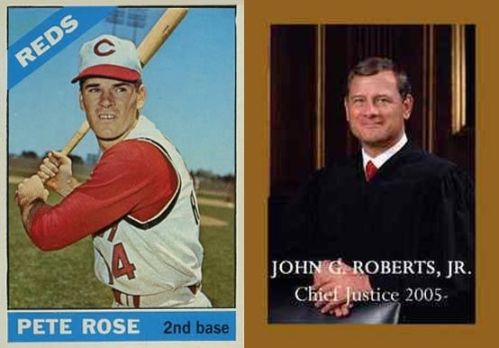
It looks as if the Supreme Court will issue its decision on the Affordable Care Act (aka Heritagecare) this week. An unreported story is the relationship of this to baseball legend Pete Rose.

There has probably been more betting on the outcome of this legal question than any before, at venues such as Intrade. Presumably the bettors include some number of lawyers; with more than a million lawyers in the U.S., what are the odds of that?

Major League Baseball has so far banned Pete Rose from the Hall of Fame because he bet on games. Not games he or his team were involved in, just games. Ever since the Black Sox scandal almost a century ago, baseball has had a zero tolerance rule on gambling by anyone in the sport.

The courts and the bar associations that regulate the practice of law have well developed and strict rules of conduct for lawyers. Obviously illegal gambling is just that— illegal—and clearly out of bounds. Gambling addictions that affect practice have also taken a prominent place in the rules of professional responsibility.

But it doesn’t appear that reasonable and prudent legal gambling of any kind is an ethical problem for lawyers. Unless, that is, there is some kind of Pete Rose issue about it. Specifically: Can lawyers responsibly and ethically bet on court decisions with which they have absolutely no relationship? The answer awaits investigation, and maybe some law review articles.

As for the case itself, they say that only fools predict difficult Supreme Court decisions. So a fool rushes in:

1. The Court will have the law stand or fall as a whole and not pick and choose. There is no severability clause. The court can appropriately say that with such an integrated and complex piece of legislation, if Congress got it wrong constitutionally, it is up to Congress to get it right.

2. If it falls on the basis of the mandate, as widely expected, the reasoning of the majority is going to be a sight to behold and study. A principle of jurisprudence at every level is to decide legal issues as narrowly as possible, unless there is an intention to make a bold legal statement. When the Supreme Court speaks, the bolder the statement, the more far-reaching the impact. In a three-branch democracy, any statement about the limits of powers is very loud and long-echoing.

3. We may not have nine opinions, but we may have an almost complete set of concurring and dissenting opinions. For those who have never read dissents in Supreme Court opinions, be aware that in difficult and controversial cases, it is not unheard of or inappropriate for dissenting Justices to politely but clearly state that the majority is in all respects wrong (see the four dissents in Bush v. Gore).

And now, the bottom line. Intrade traders have placed their bets, and they say the chances of “The US Supreme Court to rule individual mandate unconstitutional before midnight ET 31 Dec 2012” are 76.5%. Judging by the comments on the site, the bettors are some combination of knowledgeable thinkers and anti-Obama ideologues. Intrade and those analysts willing to go out on a limb are right. The mandate will be found wanting, with strenuous disagreement among the Justices. And on the basis of non-severability, so will the entire Affordable Care Act.

Or, then again, maybe not.