Bob Schwartz

Category: Law

May Day, Mayday!

May Day

May 1 is a very busy day.

It has been for ages a celebration of spring, with traditions including dancing around the Maypole.

It is International Workers’ Day, a labor holiday around the world. The date was set to commemorate the tragic Haymarket Riot in Chicago in 1886.

In 1921, to neutralize the socialist/communist aspects, in America it became known as Loyalty Day (originally Americanization Day). Congress and President Eisenhower officially affirmed this in 1959 at the height of the Cold War.

In 1958 President Eisenhower declared May 1 to also be Law Day.

What’s sometimes overlooked is the coincidental similarity to the international radio distress call: Mayday! Mayday! This was reportedly first used in the 1920s by pilots in France. One story has it that it comes from the French “venez m’aidez” (come help me).

Is it just a coincidence? If you are a worker, or a lawyer, or someone who feels put upon by law or lawyers, or just about anybody feeling distressed on May 1, 2014, please feel free to say it loud. Though dancing helps too.

Project One America from the Human Rights Campaign

poa_maingraphic_1

The new Project One America from the Human Rights Campaign is extraordinary for two reasons. As HRC describes it:

HRC’s Project One America is a comprehensive, multi-year campaign to dramatically expand LGBT equality in the South through permanent campaigns in Mississippi, Alabama and Arkansas.

That this is aimed at these three Southern states is extraordinary because of the special circumstances and needs it addresses. These states have enjoyed the presence of gay men and women for generations, including some of the very famous: Tennessee Williams, for example, was not from Tennessee but from Columbus, Mississippi. “Enjoyed” is probably not the right word, since until recently—and still in some parts of these states—gay people had the choice of invisibility, damnation, lack of legal protection, or just leaving (which is precisely what many gay Southerners did).

The second extraordinary thing about Project One America is its strategy. Rather than confrontation, part of the approach is one of the front porch—conversations and discussions among family, friends, neighbors, citizens. This doesn’t mean that legal restrictions and inequities won’t continue to be addressed. It means that the South, some historical and present-day evidence to the contrary, does have a tradition of civility and caring. Caricatures are one part truth, one part projection of our own prejudices, one part wanting to feel morally superior, and the Southern caricature is all of these. Gently opening people’s eyes to the realities and humanity of LGBT life—including the lives of those close to them—is a valuable tactic. The lessons of loving and fairness and tolerance, in a place that tightly embraces its faith, should fall of fertile soil.

McCutcheon: Is This the Electoral Apocalypse? (Maybe Not)

SupremeCourtJustices_2012_032620121

Six months ago I wrote a post called The Man Who Could Kill Democracy about the case of McCutcheon v. Federal Election Commission. McCutcheon was asking the Supreme Court, on free speech grounds, to lift federal limits on aggregate campaign contributions. By a 5-4 decision, the Court today agreed.

In that post I wrote:

The First Amendment is central to American democracy, but it has never been absolute. It could be of course, and we would be free to destroy the reputations of others, or talk freely about overthrowing the government, or republish the words of others without penalty, or yell fire in that crowded theater. Instead, as an exercise in social priorities, we argue about balance, though sometimes the argument for the good of the many and “democracy” is cover for what’s good for me and mine.

Today’s decision finds that limits on what an individual can give to a single candidate is allowable under the First Amendment as a way to prevent corruption (that is, you shouldn’t massively buy a single election on a quid pro quo, one hand washing the other basis). But restrictions on what an individual may give in aggregate offends the First Amendment (that is, you are free to try to buy as many elections as your wealth allows).

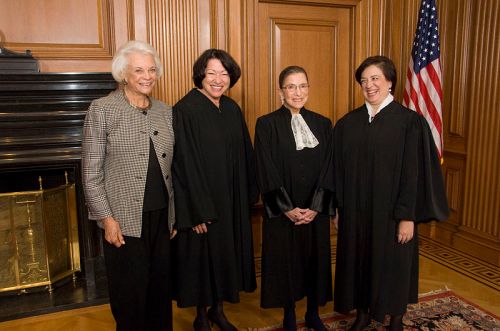
The majority opinion of Justice Roberts was joined in by Justices Scalia, Kennedy and Alito; Justice Thomas concurred, but believes that all limits on campaign finance are impermissible under the First Amendment. Justice Breyer filed a dissent, in which Justices Ginzburg, Sotomayor, and Kagan joined.

Justice Breyer writes in his dissent:

Today a majority of the Court overrules this holding. It is wrong to do so. Its conclusion rests upon its own, not a record-based, view of the facts. Its legal analysis is faulty: It misconstrues the nature of the competing constitutional interests at stake. It understates the importance of protecting the political integrity of our governmental institutions. It creates a loophole that will allow a single individual to contribute millions of dollars to a political party or to a candidate’s campaign. Taken together with Citizens United v. Federal Election Comm’n, 558 U. S. 310 (2010), today’s decision eviscerates our Nation’s campaign finance laws, leaving a remnant incapable of dealing with the grave problems of democratic legitimacy that those laws were intended to resolve.

So is this it, the electoral apocalypse? In the earlier post before the decision I wrote:

Get smart.
Vote.

Without casting aspersions too wide, it does seem that a number of Americans really don’t do their homework on public issues. As far as voting, our abysmal turnout numbers tell the tale. But if Americans did do their homework and did vote, we really could have a pragmatic, centrist, reasonable and successful country—instead of an extremist-obstructed one based more on blustery ideology and vaguely-veiled self-interest. We can hope.

That’s still it. If we have an aware, informed, moral, discerning electorate that votes, there is hope that in spite of McCutcheon (and Citizens United and whatever other shoes the Supreme Court has yet to drop), we can maintain what Justice Breyer calls “democratic legitimacy.” Without that, despite what Imagine Dragons sing, the apocalypse may not be followed by a new age, but by some back to the future America of the overpowered and the underpowered.

If you believe that America has a problem in any of those areas—awareness, information, morality, discernment, voting—then do whatever you can. Don’t blame nice Mr. McCutcheon, or nice Justices Roberts, Scalia, Kennedy, Alito, and Thomas (even if they are wrong). And if you are hand-wringing, which is admittedly hard to avoid, do it only for a moment; it is unattractive and useless. Then get busy.

The Torah and the Supreme Court: Tazria and Scalia

Women of the Supreme Court

This week the portion of the Torah read in Jewish communities is Tazria (Leviticus 12:1–13:59). This week the Supreme Court heard arguments in the widely reported Hobby Lobby case. There is a significant but not obvious connection between the two.

Leviticus is the one of the Five Books of Moses that has the least action and the most rules. Lots of rules about the behavior of the Jewish people. In the thousands of years since those rules flowed into the processes of cultural and social oral tradition, and in the thousands of years since those traditions were set down in writing, different Jewish people and communities have determined which to honor and which to ignore. Those decisions are based on what exactly one thinks these rules are: God-given and inviolable, or ancient and subject to temporizing to suit modern philosophy and life. We should not wear clothing made from two different fabrics, Leviticus says. Non-literal interpretations of this have been conceived for centuries, but it says what it says, or rather, God says what God says. But what’s so wrong about a wrinkle-free, 60/40 cotton-poly blend shirt?

The Tazria portion begins:

The Lord spoke to Moses, saying: Speak to the Israelite people thus: When a woman at childbirth bears a male, she shall be unclean seven days; she shall be unclean as at the time of her menstrual infirmity. On the eighth day the flesh of his foreskin shall be circumcised. She shall remain in a state of blood purification for thirty-three days: she shall not touch any consecrated thing, nor enter the sanctuary until her period of purification is completed. If she bears a female, she shall be unclean two weeks as during her menstruation, and she shall remain in a state of blood purification for sixty-six days.

On the completion of her period of purification, for either son or daughter, she shall bring to the priest, at the entrance of the Tent of Meeting, a lamb in its first year for a burnt offering, and a pigeon or a turtledove for a sin offering. He shall offer it before the Lord and make expiation on her behalf; she shall then be clean from her flow of blood. Such are the rituals concerning her who bears a child, male or female. If, however, her means do not suffice for a sheep, she shall take two turtledoves or two pigeons, one for a burnt offering and the other for a sin offering. The priest shall make expiation on her behalf, and she shall be clean.

 The attitude toward and treatment of this passage in a modern context ranges widely, depending on belief sets. Some express wholesale acceptance and obedience (except for the sheep and bird sacrifice). Some faithfully regard it as God’s word, but pass it through interpretive filters suitable for the times. Some see it as a reflection of ancient people making sense of the mysteries of God and life.

One of those mysteries, of course, is women. Especially for men. Especially for the strange and foreign ways that women “work”. No matter your ideology, no matter how much the passage is accepted or spun, it is not hard to read meaning. Women are different. Some of that difference renders them unclean, even if that part is functionally essential (e.g., sex, birth). That uncleanness can be fixed, but it will cost you (e.g., lambs, pigeons).

The Hobby Lobby cases (Kathleen Sibelius, Secretary of Health and Human Services v. Hobby Lobby; Conestoga Wood Specialties Corp. v. Sebelius) concern the interaction of two federal laws: The Religious Freedom Restoration Act of 1993 (RFRA), which aims to protect Americans from intrusion on their religious lives, and the Affordable Care Act (ACA) which, among other things, requires employers to offer health insurance that includes coverage for contraception. The Tenth Circuit Court of Appeals found that the religious right of companies such as Hobby Lobby, which has Christian objections to providing that coverage, overcomes the particular requirement of the ACA.

The big legal issues are complex and significant. One arises every time religion is in the mix: we protect religion in this country, both in its expression and establishment, but in a nominally secular country, that is bound to clash with civil rights that may contravene religious belief. This isn’t easy to resolve, but resolve it we do. If, for example, your religion happens to believe that people of color are lesser human beings, and you are “commanded” to treat them accordingly, you still cannot follow that faith in the public square or the marketplace.

The other big legal issue is whether a company such as Hobby Lobby is a “person” able to enjoy religious liberties in the first place. We’ve seen this come up before and will again. Citizens United is the most recent and famous case deciding that enterprises may enjoy free speech, First Amendment rights, just as you do. Then there is Mitt Romney, former presidential candidate, who will forever be identified with his own legal interpretation of the issue: “Corporations are people, my friend.”

Besides these, the Hobby Lobby case is widely viewed as being about women, because practically it is. The ACA requirement that health insurance include contraceptives for women is a practically and realistically sound policy. A large majority of women use contraceptives, either for health reasons or, more frequently, to prevent conceiving as a result of sex. Preventing conception has a number of advantages, including avoiding unwanted or unplanned pregnancies. An advantage of this is that women do have sex, and do want to avoid pregnancy. It’s that basic. And then there’s this: many of those women who want to prevent conception are having sex with men.

The transcript of oral arguments in the Hobby Lobby case shows, as usual, a deeply divided court. Beyond the interesting central arguments concerning religious freedom and the personhood of corporations, there is a subtle subtext (some might say not so subtle). To a certain extent, the law, and arguments about it, are clinical. To the greatest extent possible, questions about impact are subservient to questions about the law itself: what it says, what was intended, how it works with other laws and with the Constitution. The rule of law prevails over the rule of people, and if the impact is unfair or disproportionate but still constitutional and legal, well, change the law.

But that has never been, will never be, and can never be how it works. Everyone—judges, lawyers, litigants, citizens—comes to the table with histories, psyches, lives, all the riches and trash we can carry. That’s how a case that seems about one thing can be, at least in small part, about another. That’s how the Hobby Lobby case is about women, something the three women on the Supreme Court without question get, something the six men may or may not.

Do read the transcript of the argument and maybe a few of the almost one hundred appellate briefs filed in the cases. In the arguments, you won’t find any express misunderstanding of the lives and impact of the case on women, though you may if you read between the lines. The briefs, which come from just about every corner of American society and politics, are a little clearer on how this is about women in ways that are not just incidental.

This brings us back to Tazria. It is easy to dismiss the passage as archaic, particularly for those who have found ways to work through or around it. Similarly, you may consider the Hobby Lobby case one about important and respectable religious and legal doctrines, and it is.

It can’t be said often enough: Men don’t get it and they can’t. They don’t know what it’s like to menstruate or be capable of bearing children or of having children. They don’t know what’s it like to be treated as unclean because of all of that, and then to be hypocritically treated as enjoyable and useful for those very same reasons. They don’t know how it feels to have some very simple means of adjusting all that, and then to have those means treated as something both profound and trivial, but not important.

Men don’t know, even if they are at the pinnacle, writing scripture or dispensing justice. So pleading ignorance, a little humility, a little learning, and a little compassion might be in order.

The Strange Case of App Ops and Android Privacy

Android
Last week Google removed a privacy capability from the latest version of its Android operating system. Odd because Android is all about onward and upward. Always more and not less.

Not so odd in its being under-reported and relatively unnoticed. The capability was something that’s been called App Ops—application options—that allows users to pick and choose which permissions an application can have. It would, for example, allow you to tell that flashlight app that it could use your smartphone lights but it could not read your list of contacts (which, infamously, one flashlight app has done). App Ops was included last fall in Android 4.3, but was never officially documented and was unreachable and unusable by the non-tech oriented.

But Android fans never sleep, and so dozens of apps were developed just so that a user could access the capability and tell even the most popular apps to quit snooping around places they didn’t need to be to be functional. Then, with the release of Android 4.2.2, App Ops was gone.

You may be one of the many millions who don’t care, because all you want is for your Android device to run trouble-free, and even because you have decided that privacy is something you give to get—in this case to get some pretty awesome apps for free.

In case you do care, here’s a brief on how we got here.

Android is the most popular mobile operating system in the world, with iOS substantial for Planet Apple, and Windows insurgent. Development of Android apps has been like nothing in digital history. Anyone can do it and has, to varying degrees of technical and user success. Just as importantly, with Android apps, free is the norm. To make free work commercially, developers to varying degrees scrape your device for personal data that can be synthesized and used for marketing purposes. Permission to gather the information is requested, but on an all or nothing basis: either you agree to all the requests or you use some other app.

That is, of course, why App Ops is so radical and dangerous. Many of the permissions don’t in any way affect the functionality of any given app. They are there for collateral purposes. If users could just cut off the flow of personal information, certain commercial support would be hindered, if not collapse entirely. To put it another way, users might have to start paying for apps that they take for granted are free. Or they might look for similar apps that are actually free.

Google now says that App Ops was never intended for users. It was built for developers working on Android 4.3 as a testing and experimental capability. It was supposed to be removed before the new version was released. It was, in short, an accident.

Privacy advocates such as the Electronic Frontier Foundation are understandably upset. They have been pushing for just such a capability, and now that it appeared and just as quickly disappeared, it is defeat snatched from the jaws of victory. Even if the victory was accidental.

All is not lost, not entirely, not for everybody, not for the moment. Because of the tortuous path to Android upgrade, some of the most popular smartphones such as the Samsung Galaxy S4 just got their update to 4.3, which is App Ops capable. If you are in that cohort, please check out one of the many simple enablers on Google Play, such as Permission Manager – App Ops.

For those who like Android and privacy esoterica, here’s one last point. App Ops doesn’t just allow you to turn permissions on and off. It also allows you to see how often and how recently the app has used that permission. In that respect, it is actually kind of heartening. The assumption has been that with these permissions in hand, developers have been using our devices as open books. It turns out that a number of well-known apps have never used most of the permissions they’ve requested and been granted. This is no reason for a party, and if anything proves the contention that they didn’t need those permissions in the first place. But it does provide the tiniest bit of comfort knowing that your personal life is a little less compromised than it might have been.

Comic Book Plus: Digital Superheroes

Comic Book Plus
If it isn’t apparent from previous posts, the premier pop cultural medium of these times (meaning the last century) may not be movies or music or television or any of the usual suspects. It is comic books, and while explaining that in detail will have to wait for another post, just ask the entertainment enterprises that have built billion-dollar franchises on that foundation. Hint: Don’t just look at the movies; look at video games, which are sometimes expressly, sometimes implicitly interactive comic books at heart.

Digital has provided new ways to enjoy the old and the new. Comixology, for example, offers an excellent cross-device platform for digital comics. But if you love comic books as essential cultural artifacts, the digital pickings have been slim and erratic. Of course comic book connoisseurs and scholars have been scanning and distributing them for as long as there has been an internet, but organization, information and, above all, copyright integrity has been missing.

The developers of the Comic Book Plus are digital and cultural superheroes. “Free and Legal” they trumpet, and nowhere in the universe can you both read and download such a collection representing decades of this historical basis of American—of world—culture. Free and legal. (Note: The downloads are in special comic book file formats that require some sort of reader. One way to deal with this is with Calibre, the world’s most popular free ebook manager and converter. Calibre will convert the comics to any format you choose, e.g., epub or pdf, to be read on your existing readers.)

If you love comic books and graphic novels, no more needs to be said. If you love pop culture and its origins, immerse yourself in the sequential art of these digital waters. Just make sure you have some time to spare because you won’t want to come out. And for those in the know, just tell them Will Eisner sent you.

The Book of Matt: Hidden Truths About the Murder of Matthew Shepard

Kennedy Monore Kennedy
When the legend becomes fact, print the legend.
Director John Ford in The Man Who Shot Liberty Valence

The Book of Matt by Stephen Jimenez is about the heinous and now-legendary murder of Matthew Shepard. It obliquely brings three people to mind: John F. Kennedy, Bobby Kennedy and Marilyn Monroe.

All three are legends apart, so maybe it is not surprising that legends have grown up about all three in various pairings, and even all together on at least one purported occasion. Whether or not Monroe had an affair with either or both of the Kennedys, whether Bobby was with her on the night of her death, whether evidence of those affairs was covered up or destroyed, is almost certainly never going to be incontrovertibly established. Some will say that some of it appears near certain while other of it is sordid and unsubstantiated conjecture. For the most part, we’ve reached a general consensus that none were saints, none were complete role models, but that we liked some of what they did, and we liked them for what they did, including inspiring us, and the rest is just shades of humanity. JFK helped prevent a nuclear war, Bobby Kennedy helped end the Vietnam War, and Marilyn was just Marilyn. If they didn’t live like saints, they died as complex and heartbreaking lessons.

Jimenez has investigated the Matthew Shepard murder for more than a decade. He concludes that this was not a vicious hate crime against a young gay man. Instead, it is a cautionary tale about the epidemic of methamphetamine. According to this report, Shepard was troubled, and was involved in the Laramie meth scene. The killer, who knew Shepard, was a meth head who had been up for a week, and was trying to get information from Shepard about a meth deal. He intended to coerce the information from Shepard, but out of his mind, simply beat Shepard mercilessly and insanely. The killer and his accomplice pled guilty, which kept details of the local meth market and the killer’s gay dealings with Shepard—trading meth for sex—secret.

The police investigation never involved a hate crime. The now-infamous imagining of Shepard being trussed up on a fence in a crucifix position never happened; he was found on the ground, hands tied behind his back. The anti-gay angle for the horrific event was soon added.

This might present a problem.

Jiminez has found himself in an odd position. He is accused of being anti-gay, though he is gay himself, in which case he is accused of being a “traitor” to a cause. He is accused of being a tool of the reactionary right wing, though he himself is far from being a right winger. What he is, he repeats, is a journalist who wants to do what he is supposed to do: find and tell the truth, as best as it ever can be found and told.

Matthew Shepard has become very important to the movement for gay rights. It is a powerful story: the young man who did nothing wrong, who only wanted to live a free and openly gay life, who had the misfortune of running into a black-hearted, hate-filled, intolerant stranger—the sort that fifteen years ago, and today, you can meet anywhere.

If it turns out that some or more than some of what Jimenez concludes is true, what happens to Matthew Shepard, the young man and the legend? In essence, Jimenez says that nothing happens. The issues remain the same, the good fight remains the good fight, but we will be fighting it armed with a little more truth about the story, convenient or not.

That sort of complication should be welcome, but it may not be, at least not everywhere. We like our stories simple, because so much of life is convoluted and mysterious. There are lines that are clear, but simple stories are mostly for children. Grownups have to work and stretch. This is a warts-and-all age, so we take our big characters as they come: flawed but still valuable. People work every day, their entire lives, on establishing equality—some of those people under the Matthew Shepard banner. That cause isn’t going away, and if we have to accept a little bit of historical adjustment, that’s the price we pay for having our eyes open.

Republicans Miss Another Opportunity to Be a Popular National Party

Goat
The shortcomings of the ACA website during its high-profile first weeks could have been a gift to the struggling Republicans. A softball to hit out of the park. While Democrats are understandably busy trying to make the best, to explain how complex systems are frequently troubled when they go live (true), to be, in essence, apologists, the Republicans could have been that thing that Americans of all stripes ache for: problem solvers.

Instead they heard the fire bell/dog whistle (or is it an elephant call?) and marched fiercely into battle mode. The current House hearings on the website seem more like a trial: at one point, one Republican member asked all the testifying contractors whether they had discussed their testimony with anyone from the government team beforehand. (Answer: no.)

What a missed opportunity. If the Republicans as a single voice had said that this is, from their perspective, still an awful program, but that we are all Americans, and if we are going to do something, we don’t do it half-assed, and let us today find a way to solve the problem. In earnest. That would have made any defensive positions by the Democrats more glaringly apologist, and would have made the Republicans not just heroes but responsible, reasonable heroes who don’t deserve to be despised by large parts of America, including some people in their own party.

But to some, this would have made these problem-solving heroes EINO—Elephants in Name Only—that is, goats. Watching this kangaroo court, some others might think that goats might be an improvement.

The Marijuana Dilemma: It’s About Age

Marijuana
This was going to be a note about the Gallup poll showing that 58% of Americans think that the use of marijuana should be legal, and that 38% have tried it. It would include arguments about how pot stands in relation to other legal intoxicants—alcohol, tobacco, firearms (sorry, that’s the federal law enforcement agency)—and about how our justice system is distorted and how lives are ruined by reflexive, thoughtless, moralistic public policy.

But no. This is about a simple solution. It won’t make everybody happy, particularly those hypocritical it’s-all-bad-for-you-and-society Puritans who apparently missed the Sunday School class where Jesus mentioned getting the log out of your own eye before criticizing someone else’s splinter. But this might work.

Add marijuana to the list of acceptable American intoxicants. Then take the three biggies—alcohol, tobacco and marijuana—and make their distribution to children, particularly younger children, an even bigger deal than it is, so that the jail cells currently filled with marijuana-guilty adults could then be filled by real bad guys. Draconian punishment. Because while adult use of these intoxicants may be equivocal, childhood use of them is not.

We did not need American alcohol prohibition to learn that nothing will stop people using intoxicants. (Another hint: sex, at least if you’re doing it right, is also an intoxicant, the world’s most popular and, yes, one that the Puritans have also tried to circumscribe.) In another missed Sunday School lesson, Jesus did not smash the jars at the wedding at Cana, as he did the moneylender tables at the Temple; he actually made more wine for the celebrants. The poor we have with us always; so too the wine drinkers.

It is widely agreed that none of the three intoxicants are perfect: all of them are abused, all of them have real potential for ruining life and health. (America’s other big intoxicant, coffee, is excepted from this discussion, in part because any regulation of coffee would start a national revolt that really would prompt a new party, the Coffee Party, and in part because it is coffee that makes posts like this possible.) But as much as adolescents want to indulge, and as much as they already find a way to do it, if there’s a beneficial bargain to be made, this may be it. Let the grownups smoke/drink/smoke, let them explain to their kids why it isn’t a good idea for the younger set.

If you are currently a pre-teen or teenager yourself, or you once were, and you indulge in weed or once did, this may seem silly, arbitrary and unworkable. Here’s the news: all social policy is ultimately unworkable, or at least challenging and perplexing. The truth is that marijuana abuse by adolescents, just like alcohol and tobacco abuse by them, really is a bad thing, and really can cause irreversible damage. Adults should be free to get blissed out or ruin their lives (with minimal harm to others); kids shouldn’t be. If we are going to have some sort of marijuana policy, it ought to be a lot more sensible than the one we have now, even if the solution isn’t perfect.
10:39 AM 10/23/2013

Random Notes on Editing

Random Notes on Editing
1. Whether working on a business report, legal brief, story or even a non-written creation, you have either had the privilege to edit others or have suffered the tough medicine of being edited.

2. All works are improvable. Ask God.

3. There is a difference between edits that are improvements and changes based on subjective sensibilities, though there is a gray area in between.

4. It is easiest to identify improvement editing when the creation is discretely functional and results are measurable, as with some sorts of advertising copy. Some would say readability and clarity fall into this functional category—that is, unless tortured readability is a creative choice and can be handled deftly. Ask Faulkner or Joyce.

5. Voice may be the hardest part of editing. It may also be the hardest part of writing. Even the most technical sorts of work can convey a distinctive voice—you will find this in textbooks, in legal articles, even in judicial rulings. Some writers don’t know abstractly what a distinctive voice is because they just naturally have one. Others work to develop it. That is the dual quandary for editors. If a writer has a voice, or the beginnings of one, you want to cultivate it without editing it away. If a writer doesn’t have much of a voice, there is a risk of the editor—who is often a pretty good writer too—to substitute a different voice entirely.

6. The Bible is the most importantly edited work in Western history, maybe in human history. Speaking of voice, imagine being the one responsible for editing the voice of God, Moses or Jesus. Yet somebody did. These editors took no credit, though it is fun to consider what those acknowledgements might look like. “And finally I’d like to thank my editor, without whom these transcripts of my speeches would not have the power that they do. JC.”