Bob Schwartz

Category: Holidays

Thanksgiving and Hanukkah in America: A History
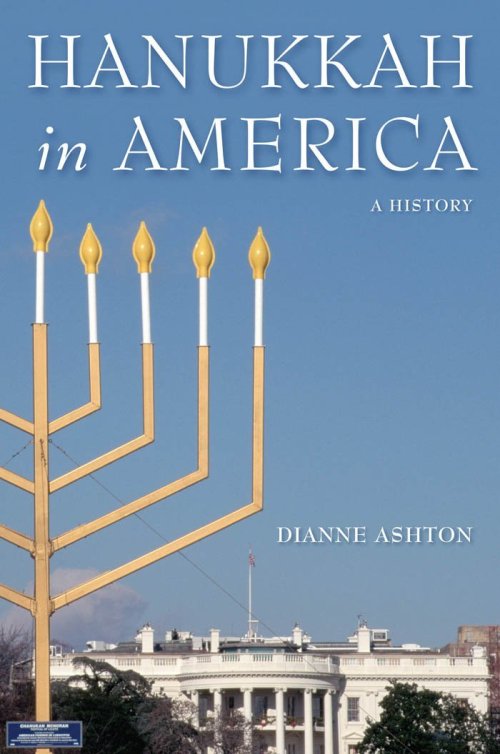
Hanukkah in America
Hanukkah is getting lots more attention this year than it usually does, because it starts on Thanksgiving, rather than on or about Christmas.

This is nearly unprecedented. Of course there’s lots of controversy about just how rare it is, partly because Thanksgiving has officially moved from the last Thursday in November to the fourth Thursday, partly because the Jewish calendar is a lunar calendar, partly because of some esoterica of interest to extreme calendar freaks. Some say it won’t happen again for 70,000 years, others say it will never, ever happen again. If you happen to be around when it does, if it does, please e-mail, post, tweet, or whatever sort of advanced messaging will be used then to communicate with the curious but departed.

Thanksgivingukkah, or whatever other ridiculous and ear-hurting names people are coming up with, is second only to Black Friday as a cultural meme this week. We will be seeing lots of turkeys with Hanukkah candles stuck in them—actual ones, not just Photoshopped ones, at actual Thanksgiving tables, with plenty of videos to prove it. Might even see some turkey selfies. On the food front, we will have combined cuisines, where things not usually seen on the Thanksgiving table make an appearance, such as latkes and sour cream. (Note: I am promoting latke stuffing as the best of all possible hybrids.)

There’s a lot to talk about when Hanukkah and Christmas collide and coincide, theologically, historically and socially. Both involve charismatic Jewish religious leaders taking on tyranny—though one battles on the military and political front, while the other wields an entirely different set of weapons. As a central theme, both at some point take on the profaning of the Temple, in one case made unholy by soldiers, in the other made unholy by turning sacred space into a commercial enterprise. Both involve miracles and miraculous lights challenging the darkness. Not to mention that at the time of Jesus, Jews knew and marked the events of the Maccabee revolution, which had taken place less than two hundred years earlier.

Whether you are Jewish, or just newly fascinated by Hanukkah because it is for once not getting lost in the Christmas mishegas (“craziness” in Yiddish), have I got a book for you. Hanukkah in America: A History by Dianne Ashton is more than just a review of how American Jews regarded and celebrated this once-minor holiday. It is the definitive and delightful book about how Hanukkah evolved to become a laboratory for what it means to be a Jew in America, and for that matter what it means to be Americans of any kind.

Here’s something Ashton writes about Thanksgiving and the “deluxe Hanukkah turkey dinner”:

Many Jews combined food products available in America with recipes they deemed appropriate for Hanukkah meals. Even with a simple meal at home, immigrants could imagine a different Hanukkah past than the one in Eastern Europe. They could envision a personal bond with Judah Maccabee by selecting Carmel wine, which claimed to be “what the Maccabees drank.” Local food shops such as Goldman’s Tea and Coffee Store held special sales in honor of Sabbath Hanukkah. Jewish restaurateurs sometimes targeted immigrants’ desires for American foods at special occasions. Perhaps no food is so identified with America as the turkey, an animal native to North America and the featured dish of the Thanksgiving dinners that take place across the country only a few weeks before Hanukkah. When Gorfein’s, a kosher restaurant, advertised a deluxe Hanukkah turkey dinner in the Forverts, it apologized in print the next day to “hundreds [who had to be] turned away” because the restaurant “had no space or food left for them.” Gorfein’s offered the same dinner a second night.

My usual Hanukkah post, sometime around Christmas, ends with a mention of a wonderful Comedy Central special, A Colbert Christmas: The Greatest Gift of All. Our comic saviors Jon Stewart and Stephen Colbert perform the song Can I Interest You In Hanukkah? with Stewart making the case for the Jewish holiday:

Jon: Can I interest you in Hanukkah? Maybe something in a Festival of Lights. It’s a sensible alternative to Christmas. And it lasts for seven – for you – eight nights.
Stephen: Hanukkah huh? I’ve never really thought about it.
Jon: Well, you could do worse.
Stephen: Is it merry?
Jon: It’s kind of merry.
Stephen: Is it cheery?
Jon: It’s got some cheer.
Stephen: Is it jolly?
Jon: Look, I wouldn’t know from jolly. But it’s not my least unfavorite time of year.
Stephen: When’s it start?
Jon: The 25th.
Stephen: Of December?
Jon: Kislev.
Stephen: Which is when exactly?
Jon: I will check
Stephen: Are there presents?
Jon: Yes, indeed eight days of presents. Which means one nice one, then a week of dreck.
Stephen: Does Hanukkah commemorate events profound and holy? A king who came to save the world?
Jon: No, oil that burned quite slowly.
Stephen: Well, it sounds fantastic!
Jon: There’s more. We have latkes.
Stephen: What are they?
Jon: Potato pancakes. We have dreidels.
Stephen: What are they?
Jon: Wooden tops. We have candles.
Stephen: What are they?
Jon: THEY ARE CANDLES! And when we light them, oh the fun it never stops. What do you say, Stephen, do you want to give Hanukkah a try?
Stephen: I’m trying see me as a Jew. I’m trying even harder. But I believe in Jesus Christ
So it’s a real non-starter.
Jon: I can’t interest you in Hanukkah? Just a little bit?
Stephen: No thanks I’ll pass. I’ll keep Jesus, you keep your potato pancakes. But I hope that you enjoy ‘em on behalf of all of the goyim.
Jon: Be sure to tell the Pontiff, my people say “good yontif”.
Stephen: That’s exactly what I’ll do.
Both: Happy holidays, you
Jon: too!
Stephen: Jew!
Jon: Too?

That’s it for this holiday mashup. Read the book; it’s great. Celebrate religious freedom by eating too much food. Spin the turkey. Light the candles. But whatever you do, don’t smoke the turkey, because it is impossible to keep that thing lit.

Happy holidays. Be safe.

Saints for All

Catherine Wheel
It is All Saints’ Day, and you don’t have to be Catholic, Christian or a believer of any kind to appreciate it.

Observed in the Western Christian church on November 1, it is the day that makes All Hallows’ (Saints’) Eve, aka Halloween, possible. Many denominations, including Anglicans, Lutherans and others, find a place and meaning for the holiday. But it is most associated with the Catholic Church, where it is a celebration of all saints known and unknown.

Saints are most specifically and tightly defined in the Catholic context. Saints are those whose lives allow them a special theological position and a special relationship with the divine after death, so that they may intercede on behalf of the faithful. You’ve no doubt heard reports about the two-step process of being designated a saint by the Pope: beatification (with the title “Blessed”), followed by canonization, based on the investigation and proof of intercessory miracles. It is usually a long road, though it appears that the very popular Pope John Paul II is on the fast track to sainthood.

The Catholic Church has had an historic problem with saints, one that continues to the moment. Two related problems really. The first is that from the beginning, people had a way of venerating those who inspired and who they admired, essentially developing cults around them, whether or not it was “official.” The related problem is that this enthusiasm was often based more on legend and even on superstition, rather than on actual biography or theological fine points. Early on the Church took control of saint making, though sometimes to little avail. As for saints whose life stories were questionable or constructed out of whole cloth, in recent years the Church has begun cleaning up the database, literally demoting some and stripping them of their sainthood.

Many religions, including Judaism, Islam and Buddhism, hold special regard for those we might call saints, ones whose holiness goes above and beyond those of regular mortal people. In Judaism, for example, a tzadik is one whose righteousness sets him apart and allows him to serve as a channel flowing between the earthly and the divine, or better yet, serving as a model for the divine in the earthly.

Even if you don’t like religion but love good stories, saints are for you. Take Saint Catherine of Alexandria. In the early 4th century, this pious Christian scholar attempted to convince the Roman Emperor Maxentius not to persecute Christians. He arranged for Catherine to debate great pagan philosophers, but she won the argument. He tortured her. He proposed marriage, but she claimed her only marriage was to Jesus Christ. He condemned her to die on a spiked wheel that was to break her body apart. Instead, the wheel was destroyed at her touch. Maxentius then beheaded her; she became a martyr and a saint. (The wheel had its own life. Now known as a Catherine Wheel, it is used to this day as a spectacular spinning fireworks display.)

Or so the story goes. Despite her importance as one of the most revered of saints in the Middle Ages, this is now regarded as legend, with no evidence of the events or even of Catherine’s existence. Though she still has a place in Church tradition, her feast day was removed from the official Church calendar in 1969, only to have her day restored to the list in 2002 as optional.

Besides good stories, and besides the miraculous aspects that some find outside the circle of their own tradition, rationality or belief, the saints often provide some inspiring modeling in their lives. It isn’t necessarily the difference between the sacred and the profane, although there’s plenty of that in cases such as Augustine, where the base and worldly give way to something greater. It is the difference between the ordinary and the extraordinary—no more or less than we might admire athletes, artists or anyone who excels in ways that make the impossible seem possible for us too.

In a way, it is a back door path to redefining exactly what miracles are. We might not be martyrs, we might not make a deadly instrument of torture disappear at a touch, we might not heal the incurably sick. Saints reach beyond grasp, and besides asking them for help when no help seems available, that is why people are excited by them. We have arms, we can reach too. We can help, even if it isn’t the kind that gets us listed in some official church roster.

Good stories. Some fireworks. Plenty of inspiration. Maybe every day can be All Saints’ Day.

Miley Ray Cyrus for Halloween

Miley Ray Cyrus
Millions of children and adults will spend Halloween dressed as some version of Miley Cyrus, which is a scary thought in so many ways.

The first suggestion to counteract this is that people dress as her father, Billy Ray Cyrus, as seen during the heyday of his popularity. But just wearing a mullet and spending the entire halloday singing Achy Breaky Heart seems cruel, with lots of pain and not much payoff.

Then an epiphany. Why not mash up father and daughter, Billy Ray and Miley. Dress as Miley Ray Cyrus. The most outrageous near-nude mullet-headed sex-crazed country dance pop tart in the history of music. Anyway, it’s all in the DNA.

For those who still don’t get it, and still need convincing, here are just some of the lyrics from the remix that you’ve all been asking for, know it or not:

Achy Breaky Wrecky Ball

You can tell my arms to go back onto the phone
You can tell my feet to hit the floor
Or you can tell my lips to tell my fingertips
They won’t be reaching out for you no more

We clawed, we chained our hearts in vain
We jumped never asking why
We kissed, I fell under your spell.
A love no one could deny

But don’t tell my heart, my achy breaky heart
I just don’t think it’d understand
And if you tell my heart, my achy breaky heart
He might blow up and kill this man

Don’t you ever say I just walked away
I will always want you
I can’t live a lie, running for my life
I will always want you

You can tell your ma I moved to Arkansas
Or you can tell your dog to bite my leg
Or tell your brother Cliff who’s fist can tell my lips
He never really liked me anyway

I came in like a wrecking ball
I never hit so hard in love
All I wanted was to break your walls
All you ever did was wreck me
Yeah, you, you wreck me