Bob Schwartz

Category: Holidays

The Radical Book of Job

The Bible is a radical document. Just ask Pope Francis, who will be visiting the U.S. for Yom Kippur. Just ask the conservative critics of Pope Francis, who have been made very uncomfortable.

The Gospels particularly offer subversive guidelines for individuals and society. But there is also much of this in the Old Testament. Take the Book of Job.

As a Bible text, the book of Job is one of the most complex and challenging for biblical translators, interpreters and scholars. So it is no surprise that it has been boiled down in common understanding and tradition to a simple story. A good man suffers, his faith in God is shaken, God explains, the man renews his faith, God returns him to good fortune. End of story.

Except that is not what happens. There are many ways to interpret Job that look nothing like that. A number of characters appear, do a lot of talking, and offer divergent views of what Job should do in the face of his intolerable burden. Most infamously his wife, whose recommendation to her husband is “Curse God and die.” Someone named Elihu makes a late brief appearance (likely the result of a later addition to the book), offering his own take on things. And of course, God has (almost) the final word.

In his overview of Job in The Jewish Study Bible, Prof. Ed Greenstein reviews the possibilities, including this one:

A second, and arguably even more prevalent, theme in Job is that of honesty in talking about God. The book examines and tests the limits of appropriate speech. The test of Job is all about speech—will Job, severely afflicted with anguish and physical distress, “blaspheme [God] to [His] face” (1.11)? The dialogues, it goes without saying, consist only of speech—there is no action within them. Job’s companions continually denigrate the way he talks (e.g., 11.2–4), and he feels he must beg to be heard (13.13). Their view is shared by readers such as the Talmudic Sage Rav, who suggests that “dirt be put in Job’s mouth” to silence him.

But while the friends regard Job’s discourse as no more than hot air, “useless talk” (e.g., 15.2–3), Job takes pride in his absolute commitment to speaking only truth (see 27.3–4). The radical turning point in the book comes at its conclusion: God turns to Job’s companions and reproves them for not speaking “truthfully” (nekhonah is adverbial) about Him as Job “My servant” had done (42.7–8). Job may not have arrived at the truth, but he had reason to believe in what he was saying, as it came to him honestly, unlike the words of the companions, who merely repeated uncritically the wisdom they had received. Seen this way, the book of Job promotes honesty in theological discourse and rejects a blind reliance on tradition.

Promoting honesty in theological discourse and rejecting blind reliance on tradition. A radical approach we can consider this Yom Kippur, along with the universe of our humble introspections and pleas for forgiveness. A radical approach that Pope Francis seems very good at. A radical approach missing in the hot air and useless talk we hear from so many of our self-righteous public figures.

Rosh Hashanah: God Is Busy Writing

Hebrew Alphabet

This week begins the Jewish Days of Awe, starting with Rosh Hashanah, the New Year. Shana Tova – a good year.

A tale about Hasidic master Reb Levi Yitzchak of Berditchev (1740-1809):

It was Yom Kippur. The faithful, weak from fasting, were waiting for the Rebbe to begin the Mussaf prayer, but he too was waiting. An hour went by, and another. Impatience turned into anguish. This time the Rebbe was really going too far. It was late. Why was he waiting?

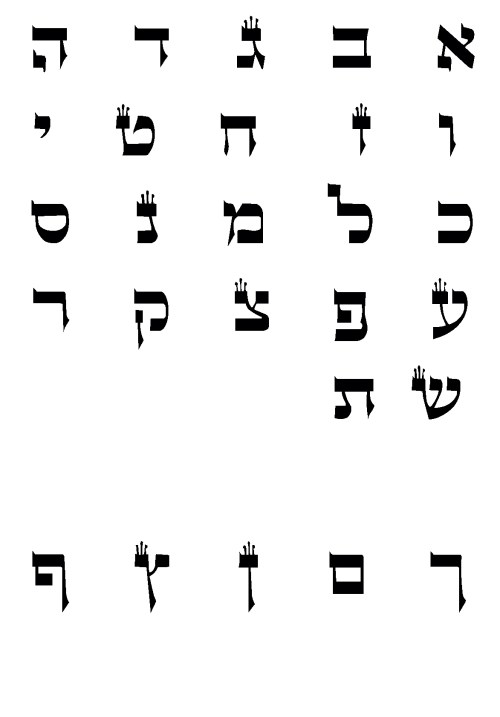
When he finally emerged from his meditation, he explained: “There is in our midst someone who cannot read. It is not his fault; he has been too busy providing for his family to go to school or study with a teacher. But he wishes to sing. And so he allows his heart to speak: ‘You are God; I am but a man. You are Almighty and know everything; I am weak and ignorant. All I can do is decipher the twenty-two letters of the sacred tongue; let me give them to You to make into prayers for me and they will be more beautiful than mine.’ ” The Rebbe raised his voice: “And that, brethren, is why we had to wait. God was busy writing.”

From Souls on Fire: Portraits and Legends of Hasidic Masters by Elie Wiesel


New Year Non-Resolution: Less Nonsense

Maxfield Parrish - Winter Twilight

No New Year resolutions for me, for many reasons. Here is a related thought from Shunryu Suzuki Roshi:

When we reflect on what we are doing in our everyday life, we are always ashamed of ourselves. One of my students wrote to me saying, “You sent me a calendar, and I am trying to follow the good mottoes which appear on each page. But the year has hardly begun, and already I have failed!” Dogen-zenji said, “Shoshaku jushaku.” Shaku generally means “mistake” or “wrong.” Shoshaku jushaku means “to succeed wrong with wrong,” or one continuous mistake. According to Dogen, one continuous mistake can also be Zen. A Zen master’s life could be said to be so many years of shoshaku jushaku. This means so many years of one single-minded effort.

It is hard to talk about what is and isn’t nonsense. Waiting with anticipation for the new season of your favorite TV series or playing games is not necessarily more nonsense than discussing political affairs. And don’t even get started on food and sex, which can be critically important, nonsense, or both at the same time.

It is a matter of attention, depth, and priority appropriate for you at the time. A way to determine this is discernment, keeping just quiet enough to hear the voices coming from above, below, outside, and especially inside, that suggest just how much of what might be good for you.

Examples abound. More than ever, there is the theoretical possibility of paying attention to just about everything, and no possibility—even with multi-sensing capabilities we are equipped with—of actually doing it. Even when you do limit and choose, you may find that the coverage or talk is just repeating versions of the same stuff—nonsense—over and over, without its going much of anywhere except around in circles.

So for me—call it a wish or a perspective or a direction but not a resolution—I will try to discern who and what matters, pay better attention to those, and avoid some of the rest. This is not necessarily a matter of serious or world-changing: the new seasons of Downtown Abbey and Mad Men will have my attention. But as things come along, I will try to listen to just which way they might be moving me. Just a little less nonsense.

The Eight Ways of Hanukkah

happy-hanukkah

Hanukkah, which begins at sunset with the lighting of the first candle, may be the most interesting, confusing, and confused of Jewish holidays. Let me count the ways.

1. It is the most historic of the traditional Jewish holidays. The historicity of more important holidays is somewhat shrouded in antiquity, bible stories, and faith. We have a pretty good chronicle of the events commemorated by Hanukkah: the Jewish rebellion of around 163 BCE led by the Maccabee family against the Seleucid/Syrian occupiers of Israel.

2. The best chronicle of Hanukkah is found in the Books of Maccabees. Maccabees is found in the bible, but because of textual happenstance, not in the Jewish Bible. Books of Maccabees are part of the Roman Catholic and Eastern Orthodox bibles, and are apocryphal books of the Protestant bible. But the Jewish biblical canon (the books officially included) was closed before these books were available. So if Jews want to read this particular biblical story, they have to turn to Christian bibles. Not that there’s anything wrong with that.

3. Hanukkah is probably not just about the Maccabees. As with other holidays, including Christmas, it is likely a melding of other seasonal celebrations at that time of year.

4. Because Hanukkah is extra-biblical, it did not achieve the stature of other holidays. You will often see it referred to as a “minor” holiday. In baseball terms, though, Hanukkah is at least AAA minor league, that is, completely ready to play in the majors. Which, as it turned out, it kind of does.

5. How Hanukkah became a much more important holiday than ever is covered by the wonderful book Hanukkah in America. For one thing, the original story of the Maccabees is about fighting not just the occupiers but the tendency of Jews in that situation toward assimilation and Hellenization. This obviously resonated in America, where secular culture and particularly Christmas became a juggernaut.

6. The candelabra used on Hanukkah for the eight nights of lights is usually referred to, by Jews and non-Jews alike, as a menorah. This is not exactly right. A menorah is a lamp, more particularly the seven-armed lamp that is an abiding symbol of Judaism and Israel. The lamp lit at Hanukkah is more properly called a hanukkiah. But hardly ever is.

7. The spelling of the word Hanukkah in English remains an unsettled mess. “Hanukkah” is now prevalent, but there is still plenty of the older “Chanukah” or, less likely, “Chanukkah” or other variations. The problem stems from trying to transliterate a Hebrew word into English—especially a word that has the guttural “ch” sound not heard in English (that is, not “ch” as in China). But as the saying goes: You can spell it Hanukkah or Chanukah, just don’t call me late for latkes. (No, that’s not an actual saying.)

8. This is from a little book that is a century old. The Hanukkah Festival: Outline of Lessons for Teachers (1914) was published by The Teachers’ Institute of the Hebrew Union College in Cincinnati and written by Rabbi Louis Grossmann, its principal. One of the benedictions for lighting the candles goes well beyond Judaism, history, or faith. It should work for just about anyone, tonight and every night.

Eight days long the Lights burned in the homes of our Fathers, and eight days long they rejoiced. One little flask of sacred oil was enough to illumine the Temple and to keep it bright. So each one of us may gladden those with whom we are, and the Light within our heart may make bright all who are about us.

Happy Hanukkah.

Thanksgiving: Simple Gifts

Shaker Sewing Table

The Shaker dance song Simple Gifts (Joseph Brackett, 1848) is the ultimate Thanksgiving song. It is also the ultimate American song, provided we recognize that in America, the most religious and richest nation on earth, simplicity and humility are ideals worth aspiring to and striving for.

Ken Burns writes this about his documentary The Shakers:

They called themselves the United Society of Believers in Christ’s Second Appearing, but because of their ecstatic dancing, the world called them Shakers. Though they were celibate, they are the most enduring religious experiment in American history. They believed in pacifism, natural health and hygiene, and for more than 200 years insisted that their followers should strive for simplicity and perfection in everything they did.

Shaker design, including furniture and baskets, may be familiar to you. So may the melody of Simple Gifts. It is frequently used in pop culture, and is most famous musically in Aaron Copland’s orchestral masterpiece, Appalachian Spring. And while the tune is often heard, the lyrics are not as frequently sung. Here is an appropriately unadorned version by Judy Collins.

Even if you can’t read music, you can look at the musical score and see how very simple this song is:

SimpleGifts

Here are the lyrics. Happy Thanksgiving.

‘Tis the gift to be simple, ’tis the gift to be free
‘Tis the gift to come down where we ought to be,
And when we find ourselves in the place just right,
‘Twill be in the valley of love and delight.

When true simplicity is gain’d,
To bow and to bend we shan’t be asham’d,
To turn, turn will be our delight,
Till by turning, turning we come ’round right.

Return to the Four Freedoms

Four Freedoms

As we approach the holiday season, we might think about the big metaphorical American family gathering around the big metaphorical American table. One thing you notice, as with a lot of families and tables, is that there’s going to be a few disagreements, some pretty heated.

But at some point, in keeping with the spirit of the season, the family will be looking for common ground, those shared ideals that unite us. Unfortunately, we seem to be losing sight of those ideals because, to be honest, it isn’t always clear what they are.

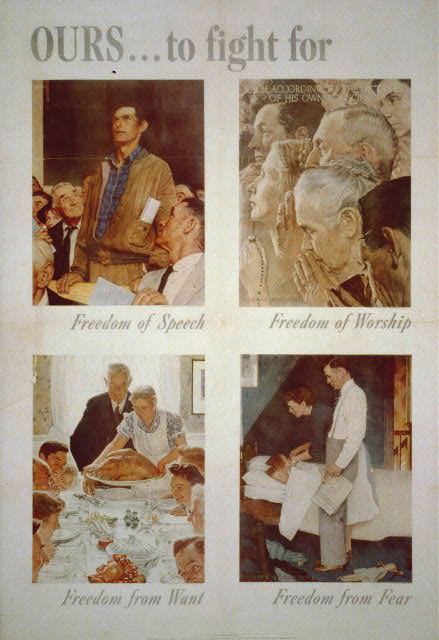
In early 1941, while war was already raging in Europe, but almost a year before Pearl Harbor, FDR gave one of the most famous speeches of the era and of American history. It was the 1941 State of the Union address, but it will always be known as the Four Freedoms speech. To bolster American support for our almost inevitable involvement in the war, he enunciated the Four Freedoms we would be fighting for: Freedom of Speech, Freedom of Worship, Freedom from Want, Freedom from Fear:

In the future days, which we seek to make secure, we look forward to a world founded upon four essential human freedoms.

The first is freedom of speech and expression — everywhere in the world.

The second is freedom of every person to worship God in his own way — everywhere in the world.

The third is freedom from want, which, translated into world terms, means economic understandings which will secure to every nation a healthy peacetime life for its inhabitants — everywhere in the world.

The fourth is freedom from fear, which, translated into world terms, means a world-wide reduction of armaments to such a point and in such a thorough fashion that no nation will be in a position to commit an act of physical aggression against any neighbor — anywhere in the world.

Art turned out to play an important role in keeping these ideals front and center, especially as the prospect of American sacrifice became a reality. The most famous example may be a series of paintings by Norman Rockwell (above), who was then and maybe still the greatest American illustrator. The Library of Congress explains:

Taken from Franklin Roosevelt’s 1941 speech to Congress, the “Four Freedoms” –Freedom of Speech, Freedom of Worship, Freedom from Want, and Freedom from Fear–became a rallying point for the United States during WWII. Artist Norman Rockwell created four vignettes to illustrate the concepts. Rockwell intended to donate the paintings to the War Department, but after receiving no response, the painter offered them to the Saturday Evening Post, where they were first published on February 20, 1943. Popular reaction was overwhelming, and more than 25,000 readers requested full-color reproductions suitable for framing.

Some will say that these Four Freedoms are today “controversial” because we don’t seem to be able as a nation—as an American family—to agree on the strategies to maintain and attain those ideals. Those disagreements are undeniable, as are the related invective, disparagement, and even hatefulness that goes with them. But those disagreements can’t make us give up. On the contrary, they should send us back to the words of FDR, getting past the ideologies and labels, and really look within and at the family of Americans.

Do you really believe that these ideals are exclusive to you, and not shared by others of good will? Are your principles and affiliations so very important that you would sacrifice those ideals to be “right?” Or can we come to the table, dig deeper, and not leave until we have given up a little of our own self-importance and focused instead on getting a little closer to the country and world envisioned in the shared Four Freedoms? And maybe just a little closer to each other?

Mitt Romney Midterm Mask

Mitt Romney Mask

When there’s not a big election with big characters, Halloween masks are not overwhelmingly political. Walking the Walgreens aisles a few days before the holiday, I saw only one official or candidate hanging from a hook: Mitt Romney at the bargain price of $9.99 (see above).

Best guess is that after 2012 there was a surplus of these, and with no big interest in anybody anyway right now, 2014 seemed like as good a time as any to dump them. Or maybe Walgreens is more politically savvy than most, and just wants to get on the latest Romney bandwagon first. Of course the mask doesn’t much look like Romney or anybody else in particular (maybe a bit like Prince Charles), so you could just wear it as a generic face, and when asked, take your pick.

As for Mitt Romney being  surrouneded on the shelf by scary skulls, sexy kittens, the Phantom of the Opera, etc., he does look out of place. But when Halloween 2016 rolls around, who knows?

Jonah, Yom Kippur, Iran and Irony

Mohsen Amir-Aslani

Sometimes coincidence is irony to the point of cruelty.

This week, the Book of Jonah is read as a part of the Yom Kippur service.

Last week, Iranian psychotherapist Mohsen Amir-Aslani was hanged for, among other things, insulting the prophet Jonah.

In a post last week, Jonah and the New Year, I gave free rein to biblical possibilities. I pointed out, “It is supposedly so simple a story that we tell it to the youngest children. It isn’t that simple.”

For many reasons, it is a good thing that I am not in Iran. It is also a good thing to be part of a faith and a country that not only tolerate interpretive iconoclasm but (theoretically) encourage and thrive on it. According to the report in The Guardian:

Mohsen Amir-Aslani was arrested nine years ago for his activities which the authorities deemed were heretical. He was engaged in psychotherapy but also led sessions reading and reciting the Qur’an and providing his own interpretations of the Islamic holy book, his family said….

According to the source, Iran’s ministry of intelligence was behind Amir-Aslani’s arrest. “He was initially held for making innovations in Islam and providing his own interpretations of the Qur’an but later he was accused of insulting prophet Jonah and also faced accusations of having sex outside marriage,”

This week, whether you read the Book of Jonah at Yom Kippur services or on your own, consider Amir-Aslani. We can do little directly about this aspect of Iranian life. And if we are not Muslims, there is little that we can do about the evolution of someone else’s religion, other than encouragement and modeling progressive behavior. The best we can do—and it is no small thing—is to honor openness in religion by demonstrating openness in our own religion. By supporting innovation, and making sure it is never tantamount to a capital crime.

Jonah and the New Year

Jonah

“Like Jonas himself I find myself traveling toward my destiny in the belly of a paradox.”
Thomas Merton
The Sign of Jonas

The Jewish High Holy Days begins this evening, starting with Rosh Hashanah (New Year 5775) and ending on the tenth day with Yom Kippur (Day of Atonement). So it is a good time to talk about Jonah.

On Yom Kippur, the Book of Jonah is read at services. It is supposedly so simple a story that we tell it to the youngest children. It isn’t that simple.

Prof. Barry Bandstra writes:

The book of Jonah has been interpreted in many different ways: as a satire on prophetic calling and the refusal of prophets to follow God’s call; as a criticism of Israelite prophets who were insincere in preaching repentance (because they really wanted to see destruction); as a criticism of the Jewish community’s unwillingness to respond to prophetic calls to repentance (in contrast with Nineveh); as a criticism of an exclusive view of divine election (God only cares about “chosen people”); as an assertion of God’s freedom to change God’s mind over and against prophets who would limit that freedom; as emphasizing the problem with true and false prophecy (even true prophets have words that do not come true); or as an allegory of Israel in exile (both Jonah and Judah look to God for destruction of an evil empire). De La Torre argues for an interpretation of the book that views Jonah as a marginalized person frustrated with God for not punishing those who have brutally oppressed people. Person reads the book of Jonah as a conversation between author and reader, focusing on the implied verbal rejection of God’s command by Jonah in 1:3.

The entire very brief Book of Jonah is at the end of this post. It goes something like this:

God tells Jonah to preach to the wicked city of Nineveh.
Jonah runs away from this assignment and gets on a ship.
A storm batters the ship and the sailors figure out Jonah is the cause.
The sailors say they don’t want to throw him overboard to appease God, but then they do anyway.
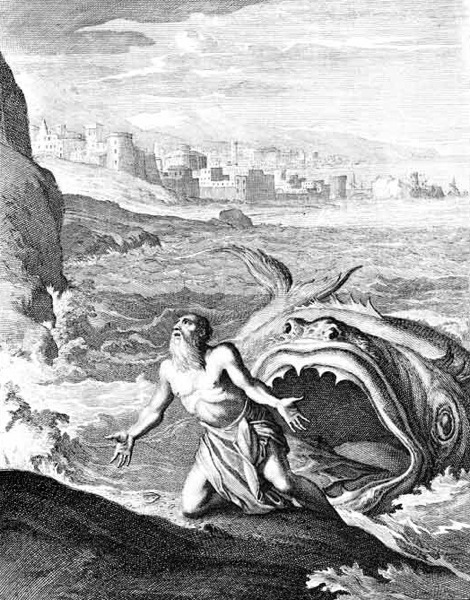
Jonah is swallowed by a big fish.
After three days, the fish disgorges Jonah on land.
Jonah finally preaches repentance to Nineveh.
Nineveh does repent.
God has mercy and doesn’t destroy Nineveh.
Jonah complains that he went through a lot of trouble, so God should have destroyed Nineveh.
God gives Jonah a special plant and then destroys it, as an example of how a prophet has nothing to do with what happens and shouldn’t care how God ultimately deals with things. God explains:

“You are concerned for the castor-oil plant which has not cost you any effort and which you did not grow, which came up in a night and has perished in a night. So why should I not be concerned for Nineveh, the great city, in which there are more than a hundred and twenty thousand people who cannot tell their right hand from their left, to say nothing of all the animals?”

So for the New Year, among the many things you may ask yourself:

Was God too lenient? Was Jonah not compassionate enough, taking joy in the misfortune of others? Am I or should I be more like God? Like Jonah? Like the sailors on the ship? Like the people of Nineveh? Like the fish? Can I tell my right hand from my left?

Whatever your faith or no-faith, you can never have enough New Years and new starts. Please have a happy one.


Book of Jonah from the Jerusalem Bible (J.R.R. Tolkien)

Selecting a Catholic translation of the Book of Jonah on Rosh Hashanah may seem odd. There are two reasons. The Jerusalem Bible is the best English-language combination of literary style and scholarship. And this particular book has a very special translator/editor: J.R.R. Tolkien.

The original Jerusalem Bible, published in English in 1966, was conceived as a very modern Catholic Bible—modern in terms of both language and scholarship. A French edition had already been published, and for the English version, a number of English-language scholars and writers were enlisted. Some texts were translated from original languages (Hebrew, Greek) while other texts were re-translations of the French. Tolkien was brought on as an editor, but he did create one book in English, taken from the French: The Book of Jonah.

Jonah 1

1. The word of Yahweh was addressed to Jonah son of Amittai:
2. ‘Up!’ he said, ‘Go to Nineveh, the great city, and proclaim to them that their wickedness has forced itself upon me.’
3. Jonah set about running away from Yahweh, and going to Tarshish. He went down to Jaffa and found a ship bound for Tarshish; he paid his fare and boarded it, to go with them to Tarshish, to get away from Yahweh.
4. But Yahweh threw a hurricane at the sea, and there was such a great storm at sea that the ship threatened to break up.
5. The sailors took fright, and each of them called on his own god, and to lighten the ship they threw the cargo overboard. Jonah, however, had gone below, had lain down in the hold and was fast asleep,
6. when the boatswain went up to him and said, ‘What do you mean by sleeping? Get up! Call on your god! Perhaps he will spare us a thought and not leave us to die.’
7. Then they said to each other, ‘Come on, let us draw lots to find out who is to blame for bringing us this bad luck.’ So they cast lots, and the lot pointed to Jonah.
8. Then they said to him, ‘Tell us, what is your business? Where do you come from? What is your country? What is your nationality?’
9. He replied, ‘I am a Hebrew, and I worship Yahweh, God of Heaven, who made both sea and dry land.’
10. The sailors were seized with terror at this and said, ‘Why ever did you do this?’ since they knew that he was trying to escape from Yahweh, because he had told them so.
11. They then said, ‘What are we to do with you, to make the sea calm down for us?’ For the sea was growing rougher and rougher.
12. He replied, ‘Take me and throw me into the sea, and then it will calm down for you. I know it is my fault that this great storm has struck you.’
13. The sailors rowed hard in an effort to reach the shore, but in vain, since the sea was growing rougher and rougher.
14. So at last they called on Yahweh and said, ‘O, Yahweh, do not let us perish for the sake of this man’s life, and do not hold us responsible for causing an innocent man’s death; for you, Yahweh, have acted as you saw fit.’
15. And taking hold of Jonah they threw him into the sea; and the sea stopped raging.
16. At this, the men were seized with dread of Yahweh; they offered a sacrifice to Yahweh and made vows to him.

Jonah 2

1. Now Yahweh ordained that a great fish should swallow Jonah; and Jonah remained in the belly of the fish for three days and three nights.
2. From the belly of the fish, Jonah prayed to Yahweh, his God; he said:
3. Out of my distress I cried to Yahweh and he answered me, from the belly of Sheol I cried out; you heard my voice!
4. For you threw me into the deep, into the heart of the seas, and the floods closed round me. All your waves and billows passed over me;
5. then I thought, ‘I am banished from your sight; how shall I ever see your holy Temple again?’
6. The waters round me rose to my neck, the deep was closing round me, seaweed twining round my head.
7. To the roots of the mountains, I sank into the underworld, and its bars closed round me for ever. But you raised my life from the Pit, Yahweh my God!
8. When my soul was growing ever weaker, Yahweh, I remembered you, and my prayer reached you in your holy Temple.
9. Some abandon their faithful love by worshipping false gods,
10. but I shall sacrifice to you with songs of praise. The vow I have made I shall fulfil! Salvation comes from Yahweh!
11. Yahweh spoke to the fish, which then vomited Jonah onto the dry land.

Jonah 3

1. The word of Yahweh was addressed to Jonah a second time.
2. ‘Up!’ he said, ‘Go to Nineveh, the great city, and preach to it as I shall tell you.’
3. Jonah set out and went to Nineveh in obedience to the word of Yahweh. Now Nineveh was a city great beyond compare; to cross it took three days.
4. Jonah began by going a day’s journey into the city and then proclaimed, ‘Only forty days more and Nineveh will be overthrown.’
5. And the people of Nineveh believed in God; they proclaimed a fast and put on sackcloth, from the greatest to the least.
6. When the news reached the king of Nineveh, he rose from his throne, took off his robe, put on sackcloth and sat down in ashes.
7. He then had it proclaimed throughout Nineveh, by decree of the king and his nobles, as follows: ‘No person or animal, herd or flock, may eat anything; they may not graze, they may not drink any water.
8. All must put on sackcloth and call on God with all their might; and let everyone renounce his evil ways and violent behaviour.
9. Who knows? Perhaps God will change his mind and relent and renounce his burning wrath, so that we shall not perish.’
10. God saw their efforts to renounce their evil ways. And God relented about the disaster which he had threatened to bring on them, and did not bring it.

Jonah 4

1. This made Jonah very indignant; he fell into a rage.
2. He prayed to Yahweh and said, ‘Please, Yahweh, isn’t this what I said would happen when I was still in my own country? That was why I first tried to flee to Tarshish, since I knew you were a tender, compassionate God, slow to anger, rich in faithful love, who relents about inflicting disaster.
3. So now, Yahweh, please take my life, for I might as well be dead as go on living.’
4. Yahweh replied, ‘Are you right to be angry?’
5. Jonah then left the city and sat down to the east of the city. There he made himself a shelter and sat under it in the shade, to see what would happen to the city.
6. Yahweh God then ordained that a castor-oil plant should grow up over Jonah to give shade for his head and soothe his ill-humour; Jonah was delighted with the castor-oil plant.
7. But at dawn the next day, God ordained that a worm should attack the castor-oil plant — and it withered.
8. Next, when the sun rose, God ordained that there should be a scorching east wind; the sun beat down so hard on Jonah’s head that he was overcome and begged for death, saying, ‘I might as well be dead as go on living.’
9. God said to Jonah, ‘Are you right to be angry about the castor-oil plant?’ He replied, ‘I have every right to be angry, mortally angry!’
10. Yahweh replied, ‘You are concerned for the castor-oil plant which has not cost you any effort and which you did not grow, which came up in a night and has perished in a night.
11. So why should I not be concerned for Nineveh, the great city, in which there are more than a hundred and twenty thousand people who cannot tell their right hand from their left, to say nothing of all the animals?’
May Day, Mayday!

May Day

May 1 is a very busy day.

It has been for ages a celebration of spring, with traditions including dancing around the Maypole.

It is International Workers’ Day, a labor holiday around the world. The date was set to commemorate the tragic Haymarket Riot in Chicago in 1886.

In 1921, to neutralize the socialist/communist aspects, in America it became known as Loyalty Day (originally Americanization Day). Congress and President Eisenhower officially affirmed this in 1959 at the height of the Cold War.

In 1958 President Eisenhower declared May 1 to also be Law Day.

What’s sometimes overlooked is the coincidental similarity to the international radio distress call: Mayday! Mayday! This was reportedly first used in the 1920s by pilots in France. One story has it that it comes from the French “venez m’aidez” (come help me).

Is it just a coincidence? If you are a worker, or a lawyer, or someone who feels put upon by law or lawyers, or just about anybody feeling distressed on May 1, 2014, please feel free to say it loud. Though dancing helps too.