Bob Schwartz

Category: History

The Abstract Perpetual War Is Real

Rome

Consider this: If you have a child or grandchild age 12 or younger, they have lived their lives with America at war.

And this: In six years that child will be old enough for military service, but will not necessarily have to serve because we have no mandatory universal service. So even if we are still at war, that child is probably not at risk.

And this: Why don’t we have mandatory universal service, especially if we are in perpetual war? Do we have perpetual war because we don’t have mandatory universal service?

Michael Auslin, a Resident Scholar at the American Enterprise Institute, has a fascinating piece in Politico about the prospect of a perpetual war footing, Don’t Do As the Romans Did… His politics may not be yours, but his analysis is compelling and worth reading in its entirety:

For Washington, which has already spent at least $2 trillion on relatively limited wars in Iraq and Afghanistan, the prospect of decades more competition, deterrence and fighting at an unknown cost represents the greatest security challenge since the Cold War, and perhaps since World War II. It is just as much a domestic political issue, and will figure as prominently in the debates over the future direction of the country, as do the battles over Obamacare, the regulatory burden or the transformation of the economy. Yet so far, it does not seem that either the country’s political elites or ordinary citizens have fully appreciated both the scope and, more importantly, the nature of America’s new two-front conflict. They soon will, as the country’s economic health and domestic political stability will be directly affected by rising global risk. To quote Leon Trotsky, “You may not be interested in war, but war is interested in you.”

Americans must accept the fact that, while their country may not be engaged in daily fighting, neither will it know peace for the foreseeable future. The world will become far more insecure and unstable over the next decades, and the amorphous yet crucial idea of global “order” will be strained, perhaps to the breaking point.

America’s greatest strength is also its greatest weakness. The spirit of can-do, roll up your sleeves, and in the words of Larry the Cable Guy, “get ‘er done” is a model for the world. But a related failure to think things through, apply broad and deep vision, and act deliberately and more slowly, can neutralize or outweigh the benefits of that spirit.

Living in the moment, in the now, is a great way for people to not be mired in the mistakes of the past and not be intimidated by the hypothetical misfortunes of the future. That is, unfortunately, not a luxury that nations, particularly super powerful ones, have. When you can spend trillions of dollars of your citizens’ money, send thousands of citizens to their deaths, and have the potential to blow up cities and the whole world, we expect you to think twice or more before you roll up those sleeves and get ‘er done.

Newark and Detroit: The Long Hot Summer of 1967

Newark 1967

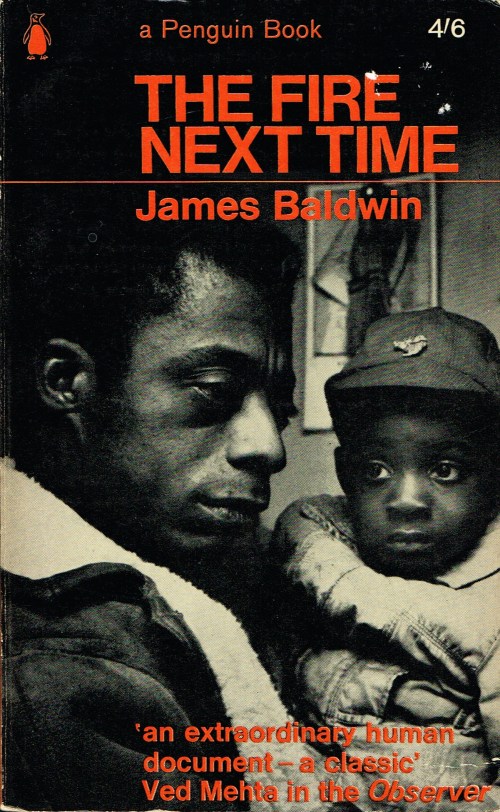
The last post about James Baldwin’s The Fire Next Time (1963) skipped a beat about what happened next. What happened in America was the race riots between 1964 and 1966 (including Watts in Los Angeles), culminating with the so-called Long Hot Summer of 1967. During that summer, among the many cities affected, the two disturbances that stand out are Newark and Detroit.

Baldwin did not overstate any prophetic intention in his book. Instead, he simply opened with this epigraph, from which he took the book’s title:

God gave Noah the rainbow sign,
No more water, the fire next time!

Newark, July 12-17, began with the arrest of a black cabdriver for passing a police car. The riots left 26 dead and hundreds injured.

Detroit, July 23-27, began with a police raid of a black drinking club. The riots left 43 dead, 1,189 injured, over 7,200 arrests, and more than 2,000 buildings destroyed.

There are at least three reasons we don’t hear much or talk much about that summer in the context of Ferguson.

We are abysmally ahistorical. If it isn’t in the latest Twitter feed, it may already be old news. Things that happened forty or fifty years ago might as well be from the Middle Ages.

We want to highlight and not overshadow the clear progress that has been made. Progress to be sure, as reflected in the photo of a black President talking to a black Attorney General about the events in Ferguson.

We are afraid. Afraid that the progress we have made may be as illusory as it is real. Afraid that we solved the easier problems, leaving us with stubborn, intractable ones that are beyond comfortable solutions. Afraid that we may not be as good as we think we are. Mostly afraid that history is TMI, telling us way more than we want to know, showing us images not from the distant past but from tomorrow.

Ferguson and The Fire Next Time

James Baldwin - The Fire Next Time

James Baldwin’s The Fire Next Time may be the best and most eloquent statement of relations between whites and blacks in America ever written. From the publisher:

The appearance of The Fire Next Time in 1963, just as the civil rights movement was exploding across the American South, galvanized the nation and continues to reverberate as perhaps the most prophetic and defining statement ever written of the continuing costs of Americans’ refusal to face their own history. It became a national bestseller, and Baldwin was featured on the cover of Time magazine. Critic Irving Howe said that The Fire Next Time achieved “heights of passionate exhortation unmatched in modern American writing.”

Baldwin was one of the great writers of his or any other American generation. He shouldered the burden of being a triple threat to America of the 1960s—a black man, a brilliant and outspoken intellectual, and gay. This he did with unequaled prose grace, and this work and others are required reading for anyone who wants or claims to be a writer.

The first of the two essays is My Dungeon Shook: Letter to My Nephew on the One Hundredth Anniversary of the Emancipation. Brief and unforgettable, it is a summary of how things are and why his teenage namesake cannot give up and in. It does no justice to this book to excerpt it; it stands as a whole that must be read—not the least of all because with the real progress we have made, we are foolish and destructive to over-measure how far we have come. But here is how the essay closes:

And if the word integration means anything, this is what it means: that we, with love, shall force our brothers to see themselves as they are, to cease fleeing from reality and begin to change it. For this is your home, my friend, do not be driven from it; great men have done great things here, and will again, and we can make America what America must become. It will be hard, James, but you come from sturdy, peasant stock, men who picked cotton and dammed rivers and built railroads, and, in the teeth of the most terrifying odds, achieved an unassailable and monumental dignity. You come from a long line of great poets, some of the greatest poets since Homer. One of them said, “The very time I thought I was lost, My dungeon shook and my chains fell off.”

You know, and I know, that the country is celebrating one hundred years of freedom one hundred years too soon. We cannot be free until they are free. God bless you, James, and Godspeed.

Your uncle,
James

Fortune Magazine Pleads: Heed the Authentic Cry of Our Youth

Youth in Turmoil Cover

It is January 1969. Fortune, one of the world’s most conservative business magazines, publishes a special issue about Youth in Turmoil. It then adapts the issue into a book, with an image of a flame on the cover.

The message is not, as you might expect, about how these ungrateful long-haired drug-addled rebels are destroying the country. On the contrary, the message is that these young people are trying to tell us something important and we should listen—before it’s too late.

Here is the introduction:

American youth is trying to tell us something important. The brightest of our young men and women are telling us that as far as they are concerned the choices for our society are narrowing rapidly. We can, at worst, look ahead to a future, very near, in which they lose all heart for our national effort, thus robbing it of its nerve, vitality, and point—a state of affairs in which they range themselves against us either in violence or in withdrawal. Or we can heed the cry of these young adults. Though often marred by shrillness, arrogance, and negativism, that cry is authentic and valid in its central message. It tells us that in our rush to well-being we have left much undone at the same time we have made so much more do-able. It tells us that we should rechannel our enormous energies to deal with the lengthening list of environmental and social grievances. If we can enlist these young idealists and they can enlist us, the nation will evolve toward a life style that once again sets a new standard for the world. I hope that this book, adapted from the January, 1969, special issue of FORTUNE, will contribute to that mutual enlistment.

LOUIS BANKS,
MANAGING EDITOR, FORTUNE

Please read this word-for-word. It is extraordinary. This is a bible of the establishment, during one of our most anti-establishment times, acknowledging that many things are wrong—including environmental and social problems—and admitting that young people are trying to remind us of our responsibilities to make it right. If the establishment fails, Fortune says, “We can, at worst, look ahead to a future, very near, in which they lose all heart for our national effort, thus robbing it of its nerve, vitality, and point—a state of affairs in which they range themselves against us either in violence or in withdrawal.”

Consider how far we have come. Youth seems to be somewhat disaffected, maybe even having lost heart and been robbed of its nerve—but not exactly in turmoil. Much of the conservative establishment would now never dream of agreeing that we have justifiable environmental and social grievances, let alone that these should be aggressively addressed.

The Sixties are variously celebrated, trivialized, and even laughed at. Maybe it’s funny to see a Big Business publication like Fortune willing to open its eyes, look around, and decide that these kids just might have a point and we can do a whole lot better. Or maybe it’s a little sad that we don’t see more of that today.

Honeywell Kitchen Computer and the Delights of Old Tech

Kitchen Computer - Menu Selection

Some people love old cars. Others of us delight in old digital tech.

We are not alone. The latest episode of Mad Men on AMC includes the installation of a computer at the agency. And the new AMC series Halt and Catch Fire is (coincidentally?) about the early days of personal computing. (Halt and Catch Fire is a real/apocryphal/funny code instruction that might send a computer into an endless loop, resulting in its ultimately stopping or bursting into flames.)

This is a page from the Neiman-Marcus Christmas 1969 catalog. The impeccably dressed N-M housewife is standing next to what appears to be an unusual table, but is actually the Honeywell Kitchen computer, which can be purchased for $10,000. (The apron will cost you another $28.) “If she can only cook as well as Honeywell can compute.” Indeed.

Kitchen Computer

Here is something completely different from the era, prophetic rather than silly. It is Isaac Asimov, a science fiction great, advertising Radio Shack’s TRS-80.

Asimov - TRS-80

Note that in the spirit of what goes around comes around, this is a pocket computer almost exactly the size of a smartphone—or is a smartphone a pocket computer exactly the size of a TRS-80? Either way, Neiman-Marcus and Honeywell were clueless, but Asimov and Radio Shack were not.

That would be a pretty good close for this post. Except that the following ad is irresistible, telling us something else about the early days of computing.

TSP Plotter

Just as cars were, and to some extent still are, sold by using sex, sometimes so were computers. This is an ad for a plotter, possibly the least sexy of all peripherals. The copy is mostly bone-dry and technical. But then there’s the trio of the model with her dress open to her navel, the headline “New, Fast, and Efficient!”, and the lead “The TSP-212 Plotting System is a real swinger.” $3,300 COMPLETE. Well, almost complete, as the model is presumably not included. But you know, that cool plotter just might attract one.

Putin and the Little Engine That Could

Vladimir Putin - Little Engine

The pro-Russian insurgency in eastern Ukraine, and the Russian warnings to stay away and out, are not surprising. A fifth-grader doing a Social Studies assignment (if there is still Social Studies) had this one figured out.

So obviously did the American intelligence and foreign policy experts. They can’t tell us they know because that would give something away, even if that fifth-grader has already guessed. The other reason it isn’t officially talked about is that, officially, few are sure what to do next.

Vladimir Putin is well set up, for something. He can take little bites out of the region, or if Ukraine should erupt in instigated civil war, he can enter on the pretext of assuring the stability and security of a neighboring country. There is plenty of historical precedent for this strategy, and for this strategy working.

We—and this includes those who claim to know him—are not sure exactly who Putin is: cunning statesman, cowboy, sociopath? Whether he has himself killed people, up close, is a matter of conjecture, but many have no trouble believing it. German Chancellor Angela Merkel, who grew up in Communist East Germany and knows him, suggests that he is out of touch with the realities of the situation. Former U.S. President George W. Bush just displayed his painting of Putin, which picture says as much about W. as an artist as it does about the Russian President.

Putin is not out of touch with reality, any more than those people who believe that visualizing an outcome will ultimately make it so. He is under no delusion that realizing his reality will be cost free. He is just willing to pay the price, or allow others to chip in, maybe profoundly.

The U.S. may have the most distorted view of war in history. It isn’t that great sacrifice or valiant service haven’t been made. The U.S. didn’t just participate in some of the most significant defenses of human freedom; it helped freedom prevail. But for a few generations, there has been a lot of blood and treasure sacrificed in a sometimes well-meaning, sometimes self-serving fog. The source of the confusion is that for more than 150 years, the U.S. has not experienced national war on its soil. Regional conflicts and shocking, fleet- and building-destroying hostilities, but not a national war, inside or on our borders.

Whatever the list of solutions to international problems and provocations, war shouldn’t just be at the bottom of the list. It should be in some strategic sub-basement, below the last resort. At this moment, war in Europe is where it should be: unthinkable. But if something is unthinkable, then everything else has to be more thinkable, more discussed. Right now, the U.S. body politic is fascinated with other matters major and minor, because we need a break.

But trust this: Putin doesn’t give a care for what happened to a plane that has been at the bottom of the Indian Ocean for weeks. He is single-mindedly like that favorite American children’s book The Little Engine That Could, chugging along: I think I can, I think I can.

We don’t have to be concerned about Ukraine or we can be concerned. We don’t have to take action or we can take action. We don’t have to go to war or we can go to war. What isn’t optional is talking about it in the public square, in a conversation led by the President and others. This is not jumping the gun. It is a sensible prelude to an emerging situation, which could at any moment escalate from blah-blah-blah to something more active and serious.

The U.S. has not been very good at sensible preludes. The run-ups to recent wars have been filled with hyper-drama, fueled by the occasional exaggeration or lie. Ukraine, Europe, and the world need something else. Putin thinks he can. Who knows what we think?

Ukraine: Adolf Hitler and William Faulkner

Adolf Hitler - William Faulkner
The term lingua franca means a language that is understood across cultures. It literally means “Frankish language,” referring to a hybrid language that was used for commerce and diplomacy during the Renaissance. Today, one might call English a lingua franca, since unofficially and officially (as in air transport), it is the one universally used and understood.

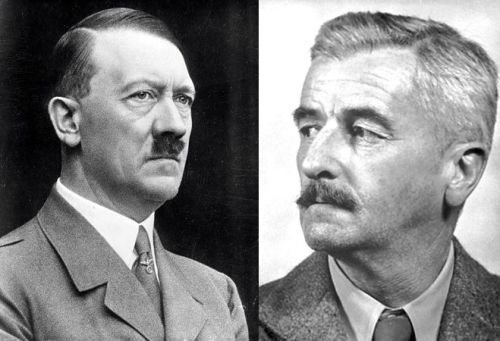
In contemporary history, the person who comes up most often as an historical analogy is Adolf Hitler. For good reason. Others may have killed more. Others may have conquered more territory. But Hitler did it all, ignited world war, and did it in our times, in living memory, and in ways that shaped the world—and thus shaped our thinking and conversation now and for generations to come. He is the historical persona franca.

A previous post pointed out that Putin’s post-Olympics invasion of Ukraine bested Hitler’s annexation of Austria in March 1938. Hitler waited almost two years after his self-promotional 1936 Berlin Olympics before the Anschluss; somewhat bizarrely, even though Putin politely waited for two days after the Paralympics in Sochi closed, the annexation of Crimea was effectively done while the Olympics were still being held.

When Hillary Clinton mentioned in a speech that Putin’s actions were reminiscent of Hitler, she was shushed up by her supporters and her detractors. Talk like that was deemed premature, alarmist, undiplomatic, and, in Hillary’s case, unpresidential. And yet as events have sped along, the mentions increase. Just today, the former U.S. Ambassador to Russia had to admit that we have not seen an event like the annexation of Crimea since…the 1930s. And whether Hitler is a persona franca or a trump card, Putin uses it himself, claiming that the Ukrainian ouster of Yanakovych was orchestrated by Nazi thugs who are now in power.

History matters, and Hitler matters in history, whatever use he may be in thinking about the critical issues developing in Ukraine. This year is the centennial of World War I (also known as THE World War and the War to End All Wars, before there was a second one). So maybe take a little time to learn a little more about Europe in the period from 1914 to 1945—a mere thirty years or so in which there were two world wars, one of the most evil men in history, an attempt to eliminate an entire people from the earth, and the development of an apocalyptic weapon that gives God a run for his money.

Why learn this history? Because literally everything that is in the news about Russia and the Ukraine is joined with it. Because history never goes away, particularly in Europe. Or anywhere. As William Faulkner wrote, having lived in the American South where history never goes away, where understanding history is the only way to understand today, “The past is never dead. It’s not even past.”

Anschluss 1938

Anschluss
History doesn’t have to be analogical, though that is often tempting. Instead, it can just be generally informative, not predictive about how particular parties may act and should react, but just as lessons in the variety of global experience.

In March 1938—the anniversary just passed last week—Hitler annexed Austria, an event now known as the Anschluss. Here, for general information, and not necessarily for comparison, are excerpts from the BBC Bitesize site:


Hitler wanted all German-speaking nations in Europe to be a part of Germany. To this end, he had designs on re-uniting Germany with his native homeland, Austria. Under the terms of the Treaty of Versailles, however, Germany and Austria were forbidden to be unified.

Hitler also wanted control of the largely German-speaking area within Czechoslovakia, called the Sudetenland. Importantly, Austria shared a border with this area.

In an attempt to realise his goals, Hitler was determined to destabilise Austria and undermine its independence. His ultimate goal was anschluss (union) with Austria…

The new Austrian Chancellor, Schuschnigg tried to preserve the country from German invasion by trying not to give Hitler an excuse for aggression. He tried to co-operate with Hitler as much as possible…

Hitler ordered Austrian Nazis to create as much trouble and destruction as possible in order to put pressure on Schuschnigg. If Hitler could claim that Austrian law and order had broken down he could justify marching German troops into Vienna to restore peace – despite the fact that he was responsible for the chaos in the first place.

Four days in March

Wednesday 9th March 1938

On the 9 March 1938, in a desperate act, Schuschnigg announced a referendum whereby the Austrian people would decide for themselves if they wanted to be a part of Hitler’s Germany. Hitler was furious. If the Austrians voted against joining Germany his excuse for invasion would be ruined.

Thursday 10th March 1938

Hitler told his generals to prepare for the invasion of Austria. He ordered Schuschnigg to call off the referendum. Knowing he would receive no help from Italy, and that France and Britain would not interfere in Hitler’s plans, Schuschnigg conceded. He called off the referendum and resigned.

The Nazi Austrian Interior Minister, Seyss-Inquart, was ordered by Hitler to ask for German help in restoring order in Austria.

Friday 11th March 1938

Hitler reassured Czechoslovakia that they had nothing to fear.

Saturday 12th March 1938

German troops marched into Austria unopposed. Hitler now had control of Austria. A month later, Hitler held a rigged referendum. The results showed that the Austrian people approved of German control of their country.


Note: Czechoslovakia indeed had something to fear. That same year, Germany invaded the German-speaking Czech region, the Sudetenland, and ultimately conquered the entire nation. It was that invasion that prompted the intervention of British Prime Minister Neville Chamberlain, who tried to “make peace” with Hitler at the infamous Munich conference.

In 1968, exactly thirty years later, the Prague Spring of political and cultural liberalization led to an invasion of Czechoslovakia by the Soviet Union. Fortunately, the spirit of that spring was never fully crushed, and inspired a flowering of sometimes secret creativity and rebellion.

Putin’s Bizarro World: Simultaneously Defending and Attacking Jews

Babi Yar Momument Kiev
In the last few days, Vladimir Putin has represented himself as the enemy of anti-Semitism and therefore the friend of Jews. He says, with a selective bit of truth, that among the many constituencies who deposed former Ukraine President Viktor Yanukovych were ultra-nationalists and neo-Nazis who are themselves anti-Semitic. By this logic, Putin claims that his intervention in Ukraine is in part to restore Yanukovych and deny power to those anti-Semites.

In those same last few days, synagogues in the Ukraine have been vandalized and attacked, according to Russia by those same ultra-nationalists and neo-Nazis. Few believe that. Instead it is widely believed that Russia is responsible for this anti-Semitic mischief, which conveniently fits the Russian story line.

Jews have had a tough time in Europe, in Eastern Europe, in Russia, and certainly in Ukraine. In September 1941, about 33,000 Jews were rounded up by the Nazis in Kiev, and along with tens of thousands of others, massacred in a ravine known as Babi Yar. Say what you will about the execrable, pathological and murderous Hitler, he knew how to play the strategic blame game. He regularly blamed the Jews for just about everything, but he rarely blamed someone else for hating and attacking the Jews. That was something he wanted full credit for.

So the suggestion for Putin is this: leave the Jews out of this particular rationale. The Jewish community in Ukraine is small, and it is true that in the just-evolving democratic regime, Jews will be uncomfortably standing side-by-side with people who don’t like them. Democracy makes for strange bedfellows, or at least that’s the lesson in America. Jews have enough problems without Putin as their friend and defender. Because with friends like that…

Putin About to Win Post-Olympics Invasion Competition

Putin Olympics
In August 1936 Adolf Hitler hosted the Olympics in Germany. In March 1938 he invaded Austria. He waited about 18 months.

In February 2014 Vladimir Putin hosted the Olympics in Russia. Just a few days after the closing ceremonies, Putin is hosting ousted Ukraine President Viktor Yanukovych. Putin is also engaging in rhetoric and military movements that reasonably look like a prelude to some sort of Russian intervention in the Crimea region of eastern Ukraine, or he is at least engaging in bullying and sabre rattling.

Putin is on his way to winning the gold for post-Olympics invasions, moving Hitler down to the silver. Well done.