Bob Schwartz

Category: History

Lincoln Proclaims Thanksgiving: “Penitence for our national perverseness”

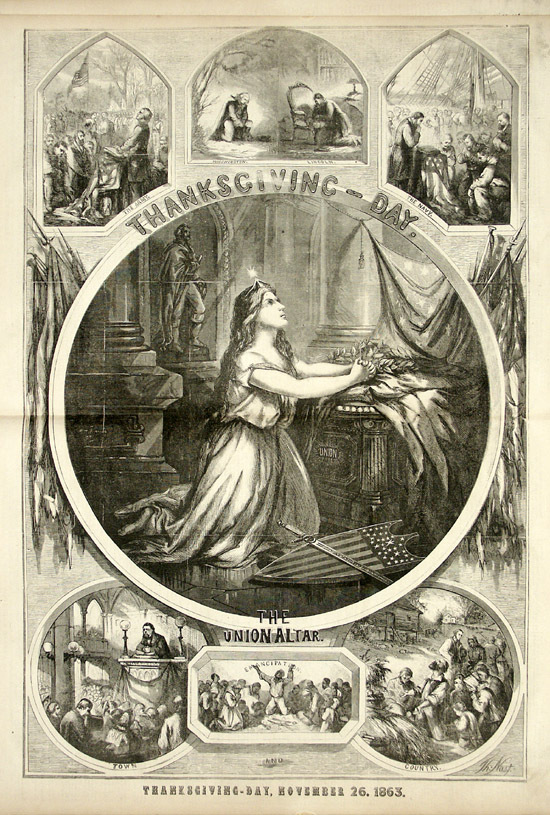
“Thanksgiving-Day,” by Thomas Nast, Harper’s Weekly, December 5, 1863.

“Thanksgiving-Day,” by Thomas Nast, Harper’s Weekly, December 5, 1863.

The modern Thanksgiving holiday begins with Abraham Lincoln issuing a Thanksgiving Day proclamation on October 3, 1863, at the height of the Civil War.

At that point, America was a country of two cultures; in fact, of two nations at war. Even history was the subject of dispute. The North traced our national origin to the Puritans of New England, thus Thanksgiving was their American holiday. The South believed America began with the settlement of Jamestown, Virginia.

In his proclamation, Lincoln calls for healing and for “peace, harmony, tranquillity, and union.” In terms of union, however, it isn’t clear who Lincoln refers to when he asks for “humble penitence for our national perverseness and disobedience.” Exactly who has been perverse and disobedient?

One thing is clear. Even with all his divine pleas, Lincoln calls this conflict of principles and cultures inevitable—“the lamentable civil strife in which we are unavoidably engaged.”

Lincoln held a famously and understandably dark view of his American times, shaded by realities and by his own depressive personality. We can and should take a brighter view this Thanksgiving, having come so far from the America of 1863, and having much to be thankful for. But just as we repeat his call for “peace, harmony, tranquillity” we are remiss to ignore the realities of 2016. Like Lincoln, we should be big, open and wise enough to see things as they are, and to change them as needed, always being painfully aware of the cost.

From his proclamation:

It has seemed to me fit and proper that they should be solemnly, reverently, and gratefully acknowledged as with one heart and one voice by the whole American people. I do, therefore, invite my fellow-citizens in every part of the United States, and also those who are at sea, and those who are sojourning in foreign lands, to set apart and observe the last Thursday of November next as a Day of Thanksgiving and Prayer to our beneficent Father who dwelleth in the heavens. And I recommend to them that, while offering up the ascriptions justly due to Him for such singular deliverances and blessings, they do also, with humble penitence for our national perverseness and disobedience, commend to His tender care all those who have become widows, orphans, mourners, or sufferers in the lamentable civil strife in which we are unavoidably engaged, and fervently implore the interposition of the Almighty hand to heal the wounds of the nation, and to restore it, as soon as may be consistent with the Divine purposes, to the full enjoyment of peace, harmony, tranquillity, and union.

© 2025 Bob Schwartz

Thanksgiving: Simple Gifts

Shaker Sewing Table

The Shaker dance song Simple Gifts (Joseph Brackett, 1848) is the ultimate Thanksgiving song. It is also the ultimate American song, provided we recognize that in America, the most religious and richest nation on earth, simplicity and humility are ideals worth aspiring to and striving for.

Ken Burns writes this about his documentary The Shakers:

They called themselves the United Society of Believers in Christ’s Second Appearing, but because of their ecstatic dancing, the world called them Shakers. Though they were celibate, they are the most enduring religious experiment in American history. They believed in pacifism, natural health and hygiene, and for more than 200 years insisted that their followers should strive for simplicity and perfection in everything they did.

Shaker design, including furniture and baskets, may be familiar to you. So may the melody of Simple Gifts. It is frequently used in pop culture, and is most famous musically in Aaron Copland’s orchestral masterpiece, Appalachian Spring. And while the tune is often heard, the lyrics are not as frequently sung. Here is an appropriately unadorned version by Judy Collins.

Even if you can’t read music, you can look at the musical score and see how very simple this song is:

Here are the lyrics. Happy Thanksgiving.

‘Tis the gift to be simple, ’tis the gift to be free
‘Tis the gift to come down where we ought to be,
And when we find ourselves in the place just right,
‘Twill be in the valley of love and delight.

When true simplicity is gain’d,
To bow and to bend we shan’t be asham’d,
To turn, turn will be our delight,
Till by turning, turning we come ’round right.

A year of staggering and stupefying realizations. Again.

Church

Black Church Burned, With ‘Vote Trump’ Scrawled on Side (2016)

“This has been a year of staggering, stupefying realizations.”

I published a post five days before the 2016 election, writing that “This has been a year of staggering, stupefying realizations.” The post wasn’t really about Trump, who seemed unlikely to be our next president. It was about America and us in America, whatever the results of the election.

I did not yet know what a year of staggering, stupefying realizations could be. The Talking Heads sang “Say it once/Why say it again?”, and this is mostly right. Even so, below is that post from four years ago, which is just as pertinent now.


After 70 Years of Progress, America Must Face Itself Again

In 1945 America helped defeat Nazi Germany, a global force that threatened to engulf the world in virulent hate and tyranny. In the aftermath of a brutal but noble victory, and despite deserved self-congratulation, America was forced to look at itself. It was not immune to or unfamiliar with similar levels and types of hate within—in certain places, among certain people.

We worked at identifying and eliminating that sort of hate, institutionally and individually, to the extent that is ever possible. There were missteps and resistance, along with denials and rationalizations. Progress was made, sometimes in fits and starts, and the work goes on.

This has been a year of staggering, stupefying realizations. Among the things we know better, as if we weren’t aware, is that there are plenty of people with hate in their hearts who for a long while have felt marginalized and silenced by a degree of public decency. Another thing we learned, and should know, is that once public decency is called into question or invalidated, those same people will be encouraged and emboldened.

Like it or not, these are our countrymen. Pretending they are not has never worked, nor has giving up because there’s nothing to be done. Progress has been made, and though it would be comfortable to believe things inevitably move forward, they don’t. Backwards happens, but not if we start by facing up again to who we are and hope to be. And then get back to work.

Barbara Jordan: “If the impeachment provision in the Constitution of the United States will not reach the offenses charged here, then perhaps that 18th-century Constitution should be abandoned to a 20th-century paper shredder!”

“It is wrong, I suggest, it is a misreading of the Constitution for any member here to assert that for a member to vote for an article of impeachment means that that member must be convinced that the President should be removed from office. The Constitution doesn’t say that. The powers relating to impeachment are an essential check in the hands of the body of the Legislature against and upon the encroachments of the Executive….

James Madison again at the Constitutional Convention: “A President is impeachable if he attempts to subvert the Constitution.” The Constitution charges the President with the task of taking care that the laws be faithfully executed, and yet the President has counseled his aides to commit perjury, willfully disregard the secrecy of grand jury proceedings, conceal surreptitious entry, attempt to compromise a federal judge, while publicly displaying his cooperation with the processes of criminal justice. “A President is impeachable if he attempts to subvert the Constitution.”…

If the impeachment provision in the Constitution of the United States will not reach the offenses charged here, then perhaps that 18th-century Constitution should be abandoned to a 20th-century paper shredder!”

From Statement on the Articles of Impeachment, 25 July 1974, House Judiciary Committee by Rep. Barbara Jordan. Barbara Jordan is ranked by experts as one of the greatest American orators of the 20th century, alongside FDR, John F. Kennedy and Martin Luther King Jr. This speech is ranked number 13 on the all-time list.


Complete Statement on the Articles of Impeachment, 25 July 1974, House Judiciary Committee by Rep. Barbara Jordan

Mr. Chairman, I join my colleague Mr. Rangel in thanking you for giving the junior members of this committee the glorious opportunity of sharing the pain of this inquiry. Mr. Chairman, you are a strong man, and it has not been easy but we have tried as best we can to give you as much assistance as possible.

Earlier today, we heard the beginning of the Preamble to the Constitution of the United States: “We, the people.” It’s a very eloquent beginning. But when that document was completed on the seventeenth of September in 1787, I was not included in that “We, the people.” I felt somehow for many years that George Washington and Alexander Hamilton just left me out by mistake. But through the process of amendment, interpretation, and court decision, I have finally been included in “We, the people.”

Today I am an inquisitor. An hyperbole would not be fictional and would not overstate the solemnness that I feel right now. My faith in the Constitution is whole; it is complete; it is total. And I am not going to sit here and be an idle spectator to the diminution, the subversion, the destruction, of the Constitution.

“Who can so properly be the inquisitors for the nation as the representatives of the nation themselves?” “The subjects of its jurisdiction are those offenses which proceed from the misconduct of public men.”1 And that’s what we’re talking about. In other words, [the jurisdiction comes] from the abuse or violation of some public trust.

It is wrong, I suggest, it is a misreading of the Constitution for any member here to assert that for a member to vote for an article of impeachment means that that member must be convinced that the President should be removed from office. The Constitution doesn’t say that. The powers relating to impeachment are an essential check in the hands of the body of the Legislature against and upon the encroachments of the Executive. The division between the two branches of the Legislature, the House and the Senate, assigning to the one the right to accuse and to the other the right to judge, the Framers of this Constitution were very astute. They did not make the accusers and the judgers — and the judges the same person.

We know the nature of impeachment. We’ve been talking about it awhile now. It is chiefly designed for the President and his high ministers to somehow be called into account. It is designed to “bridle” the Executive if he engages in excesses. “It is designed as a method of national inquest into the conduct of public men.”² The Framers confided in the Congress the power if need be, to remove the President in order to strike a delicate balance between a President swollen with power and grown tyrannical, and preservation of the independence of the Executive.

The nature of impeachment: a narrowly channeled exception to the separation-of-powers maxim.  The Federal Convention of 1787 said that. It limited impeachment to high crimes and misdemeanors and discounted and opposed the term “maladministration.” “It is to be used only for great misdemeanors,” so it was said in the North Carolina ratification convention. And in the Virginia ratification convention: “We do not trust our liberty to a particular branch. We need one branch to check the other.”

“No one need be afraid” — the North Carolina ratification convention — “No one need be afraid that officers who commit oppression will pass with immunity.” “Prosecutions of impeachments will seldom fail to agitate the passions of the whole community,” said Hamilton in the Federalist Papers, number 65. “We divide into parties more or less friendly or inimical to the accused.”³ I do not mean political parties in that sense.

The drawing of political lines goes to the motivation behind impeachment; but impeachment must proceed within the confines of the constitutional term “high crime[s] and misdemeanors.” Of the impeachment process, it was Woodrow Wilson who said that “Nothing short of the grossest offenses against the plain law of the land will suffice to give them speed and effectiveness. Indignation so great as to overgrow party interest may secure a conviction; but nothing else can.”

Common sense would be revolted if we engaged upon this process for petty reasons. Congress has a lot to do: Appropriations, Tax Reform, Health Insurance, Campaign Finance Reform, Housing, Environmental Protection, Energy Sufficiency, Mass Transportation. Pettiness cannot be allowed to stand in the face of such overwhelming problems. So today we are not being petty. We are trying to be big, because the task we have before us is a big one.

This morning, in a discussion of the evidence, we were told that the evidence which purports to support the allegations of misuse of the CIA by the President is thin. We’re told that that evidence is insufficient. What that recital of the evidence this morning did not include is what the President did know on June the 23rd, 1972.

The President did know that it was Republican money, that it was money from the Committee for the Re-Election of the President, which was found in the possession of one of the burglars arrested on June the 17th. What the President did know on the 23rd of June was the prior activities of E. Howard Hunt, which included his participation in the break-in of Daniel Ellsberg’s psychiatrist, which included Howard Hunt’s participation in the Dita Beard ITT affair, which included Howard Hunt’s fabrication of cables designed to discredit the Kennedy Administration.

We were further cautioned today that perhaps these proceedings ought to be delayed because certainly there would be new evidence forthcoming from the President of the United States. There has not even been an obfuscated indication that this committee would receive any additional materials from the President. The committee subpoena is outstanding, and if the President wants to supply that material, the committee sits here. The fact is that on yesterday, the American people waited with great anxiety for eight hours, not knowing whether their President would obey an order of the Supreme Court of the United States.

At this point, I would like to juxtapose a few of the impeachment criteria with some of the actions the President has engaged in. Impeachment criteria: James Madison, from the Virginia ratification convention. “If the President be connected in any suspicious manner with any person and there be grounds to believe that he will shelter him, he may be impeached.”

We have heard time and time again that the evidence reflects the payment to defendants money. The President had knowledge that these funds were being paid and these were funds collected for the 1972 presidential campaign. We know that the President met with Mr. Henry Petersen 27 times to discuss matters related to Watergate, and immediately thereafter met with the very persons who were implicated in the information Mr. Petersen was receiving. The words are: “If the President is connected in any suspicious manner with any person and there be grounds to believe that he will shelter that person, he may be impeached.”

Justice Story: “Impeachment” is attended — “is intended for occasional and extraordinary cases where a superior power acting for the whole people is put into operation to protect their rights and rescue their liberties from violations.” We know about the Huston plan. We know about the break-in of the psychiatrist’s office. We know that there was absolute complete direction on September 3rd when the President indicated that a surreptitious entry had been made in Dr. Fielding’s office, after having met with Mr. Ehrlichman and Mr. Young. “Protect their rights.” “Rescue their liberties from violation.”

The Carolina ratification convention impeachment criteria: those are impeachable “who behave amiss or betray their public trust.”4 Beginning shortly after the Watergate break-in and continuing to the present time, the President has engaged in a series of public statements and actions designed to thwart the lawful investigation by government prosecutors. Moreover, the President has made public announcements and assertions bearing on the Watergate case, which the evidence will show he knew to be false. These assertions, false assertions, impeachable, those who misbehave. Those who “behave amiss or betray the public trust.”

James Madison again at the Constitutional Convention: “A President is impeachable if he attempts to subvert the Constitution.” The Constitution charges the President with the task of taking care that the laws be faithfully executed, and yet the President has counseled his aides to commit perjury, willfully disregard the secrecy of grand jury proceedings, conceal surreptitious entry, attempt to compromise a federal judge, while publicly displaying his cooperation with the processes of criminal justice. “A President is impeachable if he attempts to subvert the Constitution.”

If the impeachment provision in the Constitution of the United States will not reach the offenses charged here, then perhaps that 18th-century Constitution should be abandoned to a 20th-century paper shredder!

Has the President committed offenses, and planned, and directed, and acquiesced in a course of conduct which the Constitution will not tolerate? That’s the question. We know that. We know the question. We should now forthwith proceed to answer the question. It is reason, and not passion, which must guide our deliberations, guide our debate, and guide our decision.

A Comic Book about Presidents for Presidents Who Don’t Read

Once upon a time, children got a lot of important information about subjects like history and science from comic books. It was easier and more fun than actually reading.

Here is a comic book from 1957 called Life Stories of American Presidents. Each president up to that time (it ends with Eisenhower) gets at least a page, and some of the more significant presidents such as Lincoln get as many as eight pages.

Now you or anybody else who might need a quick education on American presidents, but who prefer pictures to words, can view this comic book online. It is found at Comic Book Plus, an amazing site that offers online viewing of vintage comic books and other related literature. Best of all, the comic books are in the public domain, so you can download this one and many others.

We don’t know whether Trump was a fan of comic books as a kid, though he is the right age. So maybe this is the way to school him on subjects such as the history of the presidency.

He might learn that Lincoln was a Republican:

He might learn that there used to be another most corrupt president:

He might learn that there used to be another worst president:

He might learn that other presidents may have accomplished more than him during their presidency:

So much to learn when you know so little. That’s why comic books might help.


Rhetoric and reality: Ideal America has always depended on us

It may come as news to the less historically minded, but democracy, the kind we embrace in America, is a relatively new and novel way of government. We are still in the process of learning how it works, how it lives and how it dies.

Rhetoric has always been the way of government, long before modern democracy. Leaders say stuff, citizens repeat that stuff or say different stuff, citizens believe some stuff and don’t believe other stuff, and leaders respond to what citizens say and do.

In its relatively brief democratic life, America has typically embraced rhetoric. Much of it, in simplest terms, concerns just how exceptional and durable—eternal—American democracy really is.

As usual with compelling rhetoric in any sector—government, business, religion, whatever—rhetoric can make us lazy and careless. We come to believe that rhetoric is reality, almost a form of magical thinking. What we say and believe becomes the way things are.

And so, looking at just one aspect, Americans don’t vote in nearly great enough numbers, and those who do vote don’t always study and think hard about the issues and personalities, both of which are complicated. Things will just naturally be alright, we think, because this is a democracy and this is America. Both will last uninterruptedly forever.

But in reality, talk is not just cheap, it can be useless and tragic. All of this, all this glorious American democracy, has always and solely depended on us.

Hitler’s Lawyer

“Frank was a typical example of the Nazi intellectual gangster. He had joined the party in 1927, soon after his graduation from law school, and quickly made a reputation as the legal light of the movement. Nimble-minded, energetic, well-read not only in the law but in general literature, devoted to the arts and especially to music, he became a power in the legal profession after the Nazis assumed office, serving first as Bavarian Minister of Justice, then Reichsminister without Portfolio and president of the Academy of Law and of the German Bar Association. A dark, dapper, bouncy fellow, father of five children, his intelligence and cultivation partly offset his primitive fanaticism and up to this time made him one of the least repulsive of the men around Hitler. But behind the civilized veneer of the man lay the cold killer. The forty-two-volume journal he kept of his life and works, which showed up at Nuremberg, was one of the most terrifying documents to come out of the dark Nazi world, portraying the author as an icy, efficient, ruthless, bloodthirsty man. Apparently it omitted none of his barbaric utterances.”
William L. Shirer, The Rise and Fall of the Third Reich

Hitler, like all successful tyrants, subverted the legal system to his own ends. Part of this was finding lawyers willing to switch their allegiance from law and morality to Der Fuehrer. Some switched out of fear, but many switched because they agreed with Hitler’s ideology and were passionate enablers of his plans.

Hans Frank is often called Hitler’s Lawyer. That is precisely how he began his Nazi career, going on to roles as Commissioner of Justice and Reich Law Leader and as Governor General of Poland.

Hans Frank was tried and convicted of war crimes at the Nuremberg Trials. Before his execution, he claimed contrition. Along with other Nazi war criminals, he was executed.

Following are excerpts about Hans Frank from William L. Shirer’s The Rise and Fall of the Third Reich.


In the spring of 1930 three young lieutenants, Ludin, Scheringer and Wendt, of the garrison at Ulm were arrested for spreading Nazi doctrines in the Army and for trying to induce their fellow officers to agree that in the case of an armed Nazi revolt they would not fire on the rebels….A week after the Nazi successes in the September elections of 1930, the three subalterns were arraigned before the Supreme Court at Leipzig on charges of high treason. Among their defenders were two rising Nazi lawyers, Hans Frank and Dr. Carl Sack.

But it was neither the lawyers nor the accused who occupied the limelight at the trial, but Adolf Hitler. He was called by Frank as a witness. His appearance represented a calculated risk. It would be embarrassing to disown the three lieutenants, whose activities were proof of the growth of Nazi sentiment in the Army, which he did not want to discourage. It was embarrassing that Nazi efforts to subvert the Army had been uncovered. And it was not helpful to his present tactics that the prosecution had charged the Nazi Party with being a revolutionary organization intent on overthrowing the government by force. To deny that last charge, Hitler arranged with Frank to testify for the defense. But in reality the Fuehrer had a much more important objective. That was, as leader of a movement which had just scored a stunning popular triumph at the polls, to assure the Army and especially its leading officers that National Socialism, far from posing a threat to the Reichswehr, as the case of the Nazi subalterns implied, was really its salvation and the salvation of Germany….

The Civil Service law of April 7, 1933, was made applicable to all magistrates and quickly rid the judiciary not only of Jews but of those whose Nazism was deemed questionable, or, as the law stipulated, “who indicated that he was no longer prepared to intercede at all times for the National Socialist State.” To be sure, not many judges were eliminated by this law, but they were warned where their duty lay. Just to make sure that they understood, Dr. Hans Frank, Commissioner of Justice and Reich Law Leader, told the jurists in 1936, “The National Socialist ideology is the foundation of all basic laws, especially as explained in the party program and in the speeches of the Fuehrer.” Dr. Frank went on to explain what he meant:

There is no independence of law against National Socialism. Say to yourselves at every decision which you make: “How would the Fuehrer decide in my place?” In every decision ask yourselves: “Is this decision compatible with the National Socialist conscience of the German people?” Then you will have a firm iron foundation which, allied with the unity of the National Socialist People’s State and with your recognition of the eternal nature of the will of Adolf Hitler, will endow your own sphere of decision with the authority of the Third Reich, and this for all time.

That seemed plain enough, as did a new Civil Service law of the following year (January 26, 1937), which called for the dismissal of all officials, including judges, for “political unreliability.” Furthermore, all jurists were forced to join the League of National Socialist German Jurists, in which they were often lectured on the lines of Frank’s talk….

Such was the government of the Third Reich, administered from top to bottom on the so-called leadership principle by a vast and sprawling bureaucracy, having little of the efficiency usually credited to the Germans, poisoned by graft, beset by constant confusion and cutthroat rivalries augmented by the muddling interference of party potentates and often rendered impotent by the terror of the S.S.-Gestapo.

At the top of the swarming heap stood the onetime Austrian vagabond, now become, with the exception of Stalin, the most powerful dictator on earth. As Dr. Hans Frank reminded a convention of lawyers in the spring of 1936, “There is in Germany today only one authority, and that is the authority of the Fuehrer.”….

What was left of Poland after Russia seized her share in the east and Germany formally annexed her former provinces and some additional territory in the west was designated by a decree of the Fuehrer of October 12 as the General Government of Poland and Hans Frank appointed as its Governor General, with Seyss-Inquart, the Viennese quisling, as his deputy. Frank was a typical example of the Nazi intellectual gangster. He had joined the party in 1927, soon after his graduation from law school, and quickly made a reputation as the legal light of the movement. Nimble-minded, energetic, well-read not only in the law but in general literature, devoted to the arts and especially to music, he became a power in the legal profession after the Nazis assumed office, serving first as Bavarian Minister of Justice, then Reichsminister without Portfolio and president of the Academy of Law and of the German Bar Association. A dark, dapper, bouncy fellow, father of five children, his intelligence and cultivation partly offset his primitive fanaticism and up to this time made him one of the least repulsive of the men around Hitler. But behind the civilized veneer of the man lay the cold killer. The forty-two-volume journal he kept of his life and works, which showed up at Nuremberg,* was one of the most terrifying documents to come out of the dark Nazi world, portraying the author as an icy, efficient, ruthless, bloodthirsty man. Apparently it omitted none of his barbaric utterances.

“The Poles,” he declared the day after he took his new job, “shall be the slaves of the German Reich.” When once he heard that Neurath, the “Protector” of Bohemia, had put up posters announcing the execution of seven Czech university students, Frank exclaimed to a Nazi journalist, “If I wished to order that one should hang up posters about every seven Poles shot, there would not be enough forests in Poland with which to make the paper for these posters.”

Himmler and Heydrich were assigned by Hitler to liquidate the Jews. Frank’s job, besides squeezing food and supplies and forced labor out of Poland, was to liquidate the intelligentsia. The Nazis had a beautiful code name for this operation: “Extraordinary Pacification Action” (Ausserordentliche Befriedigungsaktion, or “AB Action,” as it came to be known). It took some time for Frank to get it going. It was not until the following late spring, when the big German offensive in the West took the attention of the world from Poland, that he began to achieve results. By May 30, as his own journal shows, he could boast in a pep talk to his police aides of good progress—the lives of “some thousands” of Polish intellectuals taken, or about to be taken.

“I pray you, gentlemen,” he asked, “to take the most rigorous measures possible to help us in this task.” Confidentially he added that these were “the Fuehrer’s orders.” Hitler, he said, had expressed it this way:

“The men capable of leadership in Poland must be liquidated. Those following them… must be eliminated in their turn. There is no need to burden the Reich with this… no need to send these elements to Reich concentration camps.”

They would be put out of the way, he said, right there in Poland.

At the meeting, as Frank noted in his journal, the chief of the Security Police gave a progress report. About two thousand men and several hundred women, he said, had been apprehended “at the beginning of the Extraordinary Pacification Action.” Most of them already had been “summarily sentenced”—a Nazi euphemism for liquidation. A second batch of intellectuals was now being rounded up “for summary sentence.” Altogether “about 3,500 persons,” the most dangerous of the Polish intelligentsia, would thus be taken care of.

Frank did not neglect the Jews, even if the Gestapo had filched the direct task of extermination away from him. His journal is full of his thoughts and accomplishments on the subject. On October 7, 1940, it records a speech he made that day to a Nazi assembly in Poland summing up his first year of effort.

My dear Comrades! …I could not eliminate all lice and Jews in only one year. [“Public amused,” he notes down at this point.] But in the course of time, and if you help me, this end will be attained.

A fortnight before Christmas of the following year, Frank closed a cabinet session at Cracow, his headquarters, by saying:

As far as the Jews are concerned, I want to tell you quite frankly that they must be done away with in one way or another… Gentlemen, I must ask you to rid yourself of all feeling of pity. We must annihilate the Jews.

It was difficult, he admitted, to “shoot or poison the three and a half million Jews in the General Government, but we shall be able to take measures which will lead, somehow, to their annihilation.” This was an accurate prediction….

Everything possible was squeezed out of Poland by the greedy Nazi conquerors. “I shall endeavor,” said Dr. Frank, the Governor General, “to squeeze out of this province everything that is still possible to squeeze out.” This was at the end of 1942, and in the three years since the occupation he had already squeezed out, as he continually boasted, a great deal, especially in foodstuffs for hungry Germans in the Reich. He warned, however, that “if the new food scheme is carried out in 1943 a half-million people in Warsaw and its suburbs alone will be deprived of food.”

The nature of the New Order in Poland had been laid down as soon as the country was conquered. On October 3, 1939, Frank informed the Army of Hitler’s orders.

“Poland can only be administered by utilizing the country through means of ruthless exploitation, deportation of all supplies, raw materials, machines, factory installations, etc., which are important for the German war economy, availability of all workers for work within Germany, reduction of the entire Polish economy to absolute minimum necessary for bare existence of the population, closing of all educational institutions, especially technical schools and colleges in order to prevent the growth of the new Polish intelligentsia. Poland shall be treated as a colony. The Poles shall be the slaves of the Greater German Reich.
 

Barbara Jordan: Impeachment Is Not About Removal from Office

It is wrong, I suggest, it is a misreading of the Constitution for any member here to assert that for a member to vote for an article of impeachment means that that member must be convinced that the President should be removed from office. The Constitution doesn’t say that. The powers relating to impeachment are an essential check in the hands of the body of the Legislature against and upon the encroachments of the Executive….

James Madison again at the Constitutional Convention: “A President is impeachable if he attempts to subvert the Constitution.” The Constitution charges the President with the task of taking care that the laws be faithfully executed, and yet the President has counseled his aides to commit perjury, willfully disregard the secrecy of grand jury proceedings, conceal surreptitious entry, attempt to compromise a federal judge, while publicly displaying his cooperation with the processes of criminal justice. “A President is impeachable if he attempts to subvert the Constitution.”…

If the impeachment provision in the Constitution of the United States will not reach the offenses charged here, then perhaps that 18th-century Constitution should be abandoned to a 20th-century paper shredder!

Barbara Jordan, Statement on the Articles of Impeachment, 25 July 1974, House Judiciary Committee

Politician, legislator, educator, groundbreaker. Most especially orator. Former Congressman Barbara Jordan (1936-1996) was an American hero. And objectively one of the greatest American public figures of all time.

Objectively? How do we know this?

When you review American Rhetoric’s list of Top 100 Speeches you find Barbara Jordan at Number 5 (1976 Democratic National Convention Keynote Address) and Number 13 (Statement on the Articles of Impeachment, 25 July 1974, House Judiciary Committee). Her 1976 DNC speech is ranked below only MLK’s I Have A Dream, JFK’s Inaugural Address, and two speeches by FDR (First Inaugural Address and Pearl Habor Address to the Nation).

The reason her impeachment speech achieved its status is not only because of her unmatched talents as wordsmith and orator. It is because, as she often did, she went to the heart of the matter, which in the case of impeachment is not removal from office, but subverting the Constitution.

Mr. Chairman, I join my colleague Mr. Rangel in thanking you for giving the junior members of this committee the glorious opportunity of sharing the pain of this inquiry. Mr. Chairman, you are a strong man, and it has not been easy but we have tried as best we can to give you as much assistance as possible.

Earlier today, we heard the beginning of the Preamble to the Constitution of the United States: “We, the people.” It’s a very eloquent beginning. But when that document was completed on the seventeenth of September in 1787, I was not included in that “We, the people.” I felt somehow for many years that George Washington and Alexander Hamilton just left me out by mistake. But through the process of amendment, interpretation, and court decision, I have finally been included in “We, the people.”

Today I am an inquisitor. An hyperbole would not be fictional and would not overstate the solemnness that I feel right now. My faith in the Constitution is whole; it is complete; it is total. And I am not going to sit here and be an idle spectator to the diminution, the subversion, the destruction, of the Constitution.

“Who can so properly be the inquisitors for the nation as the representatives of the nation themselves?” “The subjects of its jurisdiction are those offenses which proceed from the misconduct of public men.”1 And that’s what we’re talking about. In other words, [the jurisdiction comes] from the abuse or violation of some public trust.

It is wrong, I suggest, it is a misreading of the Constitution for any member here to assert that for a member to vote for an article of impeachment means that that member must be convinced that the President should be removed from office. The Constitution doesn’t say that. The powers relating to impeachment are an essential check in the hands of the body of the Legislature against and upon the encroachments of the Executive. The division between the two branches of the Legislature, the House and the Senate, assigning to the one the right to accuse and to the other the right to judge, the Framers of this Constitution were very astute. They did not make the accusers and the judgers — and the judges the same person.

We know the nature of impeachment. We’ve been talking about it awhile now. It is chiefly designed for the President and his high ministers to somehow be called into account. It is designed to “bridle” the Executive if he engages in excesses. “It is designed as a method of national inquest into the conduct of public men.”² The Framers confided in the Congress the power if need be, to remove the President in order to strike a delicate balance between a President swollen with power and grown tyrannical, and preservation of the independence of the Executive.

The nature of impeachment: a narrowly channeled exception to the separation-of-powers maxim.  The Federal Convention of 1787 said that. It limited impeachment to high crimes and misdemeanors and discounted and opposed the term “maladministration.” “It is to be used only for great misdemeanors,” so it was said in the North Carolina ratification convention. And in the Virginia ratification convention: “We do not trust our liberty to a particular branch. We need one branch to check the other.”

“No one need be afraid” — the North Carolina ratification convention — “No one need be afraid that officers who commit oppression will pass with immunity.” “Prosecutions of impeachments will seldom fail to agitate the passions of the whole community,” said Hamilton in the Federalist Papers, number 65. “We divide into parties more or less friendly or inimical to the accused.”³ I do not mean political parties in that sense.

The drawing of political lines goes to the motivation behind impeachment; but impeachment must proceed within the confines of the constitutional term “high crime[s] and misdemeanors.” Of the impeachment process, it was Woodrow Wilson who said that “Nothing short of the grossest offenses against the plain law of the land will suffice to give them speed and effectiveness. Indignation so great as to overgrow party interest may secure a conviction; but nothing else can.”

Common sense would be revolted if we engaged upon this process for petty reasons. Congress has a lot to do: Appropriations, Tax Reform, Health Insurance, Campaign Finance Reform, Housing, Environmental Protection, Energy Sufficiency, Mass Transportation. Pettiness cannot be allowed to stand in the face of such overwhelming problems. So today we are not being petty. We are trying to be big, because the task we have before us is a big one.

This morning, in a discussion of the evidence, we were told that the evidence which purports to support the allegations of misuse of the CIA by the President is thin. We’re told that that evidence is insufficient. What that recital of the evidence this morning did not include is what the President did know on June the 23rd, 1972.

The President did know that it was Republican money, that it was money from the Committee for the Re-Election of the President, which was found in the possession of one of the burglars arrested on June the 17th. What the President did know on the 23rd of June was the prior activities of E. Howard Hunt, which included his participation in the break-in of Daniel Ellsberg’s psychiatrist, which included Howard Hunt’s participation in the Dita Beard ITT affair, which included Howard Hunt’s fabrication of cables designed to discredit the Kennedy Administration.

We were further cautioned today that perhaps these proceedings ought to be delayed because certainly there would be new evidence forthcoming from the President of the United States. There has not even been an obfuscated indication that this committee would receive any additional materials from the President. The committee subpoena is outstanding, and if the President wants to supply that material, the committee sits here. The fact is that on yesterday, the American people waited with great anxiety for eight hours, not knowing whether their President would obey an order of the Supreme Court of the United States.

At this point, I would like to juxtapose a few of the impeachment criteria with some of the actions the President has engaged in. Impeachment criteria: James Madison, from the Virginia ratification convention. “If the President be connected in any suspicious manner with any person and there be grounds to believe that he will shelter him, he may be impeached.”

We have heard time and time again that the evidence reflects the payment to defendants money. The President had knowledge that these funds were being paid and these were funds collected for the 1972 presidential campaign. We know that the President met with Mr. Henry Petersen 27 times to discuss matters related to Watergate, and immediately thereafter met with the very persons who were implicated in the information Mr. Petersen was receiving. The words are: “If the President is connected in any suspicious manner with any person and there be grounds to believe that he will shelter that person, he may be impeached.”

Justice Story: “Impeachment” is attended — “is intended for occasional and extraordinary cases where a superior power acting for the whole people is put into operation to protect their rights and rescue their liberties from violations.” We know about the Huston plan. We know about the break-in of the psychiatrist’s office. We know that there was absolute complete direction on September 3rd when the President indicated that a surreptitious entry had been made in Dr. Fielding’s office, after having met with Mr. Ehrlichman and Mr. Young. “Protect their rights.” “Rescue their liberties from violation.”

The Carolina ratification convention impeachment criteria: those are impeachable “who behave amiss or betray their public trust.”4 Beginning shortly after the Watergate break-in and continuing to the present time, the President has engaged in a series of public statements and actions designed to thwart the lawful investigation by government prosecutors. Moreover, the President has made public announcements and assertions bearing on the Watergate case, which the evidence will show he knew to be false. These assertions, false assertions, impeachable, those who misbehave. Those who “behave amiss or betray the public trust.”

James Madison again at the Constitutional Convention: “A President is impeachable if he attempts to subvert the Constitution.” The Constitution charges the President with the task of taking care that the laws be faithfully executed, and yet the President has counseled his aides to commit perjury, willfully disregard the secrecy of grand jury proceedings, conceal surreptitious entry, attempt to compromise a federal judge, while publicly displaying his cooperation with the processes of criminal justice. “A President is impeachable if he attempts to subvert the Constitution.”

If the impeachment provision in the Constitution of the United States will not reach the offenses charged here, then perhaps that 18th-century Constitution should be abandoned to a 20th-century paper shredder!

Has the President committed offenses, and planned, and directed, and acquiesced in a course of conduct which the Constitution will not tolerate? That’s the question. We know that. We know the question. We should now forthwith proceed to answer the question. It is reason, and not passion, which must guide our deliberations, guide our debate, and guide our decision.

Chaim Rumkowski, Hannah Arendt and the Banality of Evil

Mordechai Chaim Rumkowski, Jewish council chairman in Lodz ghetto, seen here speaking amongst Jewish ghetto policemen. Lodz, Poland, ca. 1942.


It [evil] possesses neither depth nor any demonic dimension. It can overgrow and lay waste the whole world precisely because it spreads like a fungus on the surface.
Hannah Arendt

Citizens and respected leaders alike, in disgust and frustration, are heard comparing Trump policies and enablers to fascism and Nazis. This is treated by many, even those sympathetic to this disgust and frustration, as understandable but unhelpful and far too extreme.

In some ways, though, this is not entirely unhelpful. Theorize and moralize all we want, at some point we must look to concrete lessons from history for context and insight. Just because those examples seem so far outside an American context doesn’t mean that something can’t be learned.

Chaim Rumkowski:

During World War II, the Germans established Jewish councils, usually called Judenraete. These Jewish municipal administrations were required to ensure that Nazi orders and regulations were implemented. Jewish council members also sought to provide basic community services for ghettoized Jewish populations.

Forced to implement Nazi policy, the Jewish councils remain a controversial and delicate subject. Jewish council chairmen had to decide whether to comply or refuse to comply with German demands to, for example, list names of Jews for deportation. In Lvov, Joseph Parnes refused to hand over Jews for deportation to the Janowska forced-labor camp and was killed by the Nazis for his refusal. In Warsaw, rather than aid in the roundup of Jews, Jewish council chairman Adam Czerniakow committed suicide on July 22, 1942, the day deportations began.

Other Jewish council officials advocated compliance, believing that cooperation would ensure the survival of at least a portion of the population. In Lodz, Mordechai Chaim Rumkowski, who tried in vain to persuade the Nazis to reduce the number of Jewish deportees, urged ghetto residents to report for deportation as ordered. Rumkowski also adopted a policy of “rescue through labor,” believing that if the Germans could exploit Jewish labor, deportation might be averted….

On German orders Rumkowski delivered a speech on September 4, 1942 pleading with the Jews in the ghetto to give up children 10 years of age and younger, as well as the elderly over 65, so that others might survive. “Horrible, terrifying wailing among the assembled crowd” could be heard, reads the transcriber’s note to his parlance often referred to as: “Give Me Your Children”. Some commentators see this speech as exemplifying aspects of the Holocaust:

“A grievous blow has struck the ghetto. They [the Germans] are asking us to give up the best we possess – the children and the elderly. I was unworthy of having a child of my own, so I gave the best years of my life to children. I’ve lived and breathed with children. I never imagined I would be forced to deliver this sacrifice to the altar with my own hands. In my old age, I must stretch out my hands and beg: Brothers and sisters! Hand them over to me! Fathers and mothers: Give me your children!”

— Chaim Rumkowski, September 4, 1942 [27]

Hannah Arendt:

Born in Germany in 1906, philosopher Hannah Arendt gained much attention for her writings on totalitarianism and Jewish affairs after World War II. Arendt’s Origins of Totalitarianism (1951) addressed the rise of the totalitarian state out of the collapse of traditional nation-states. Following the war crimes trial of Adolph Eichmann, she wrote Eichmann in Jerusalem (1963). She died in New York City in 1975….

Arendt completed her Ph.D. at the University of Heidelberg in 1928, after writing her doctoral thesis on Saint Augustine under the direction of Karl Jaspers. The following year, she married Gunther Stern. With the rise of the Nazi Party in Germany, Arendt soon found herself in trouble for gathering evidence of the regime’s anti-Semitism.

In 1933, Arendt fled her native Germany for the relative safety of Paris, France. There, she worked for Youth Aliyah, an organization that helped rescue Jewish children from Eastern Europe. In 1940, Arendt married her second husband, Heinrich Blücher. Their wedded bliss was short-lived, however: The pair was soon interned at a concentration camp in Gurs, France. After managing to escape, the couple made their way to the United States in 1941….

In 1961, Arendt covered the trial of infamous Nazi war criminal Adolf Eichmann, held in Jerusalem, for The New Yorker magazine. Her writings on the trial were later published as Eichmann in Jerusalem: A Report on the Banality of Evil (1963), and she was criticized for some of the views she expressed in the work. Among these views, Arendt posited that Eichmann was more of an ambitious bureaucrat than a figure of extreme evil.

The Banality of Evil

Arendt’s coining of the term “banality of evil” and what some perceived to be her blaming the Jews for their own victimhood remain hotly controversial. Some think that seemingly characterizing the sort of evil perpetrated by Eichmann and other bureaucrats as banal and ordinary is dangerous and mistaken; if anything, they say, it should be forever described as radical and extraordinary.

Arendt on Eichmann:

What he [Eichmann] said was always the same, expressed in the same words. The longer one listened to him, the more obvious it became that his inability to speak was closely connected with an inability to think, namely, to think from the standpoint of somebody else. No communication was possible with him, not because he lied but because he was surrounded by the most reliable of all safeguards against the words and the presence of others, and hence against reality as such.

Arendt on the banality of evil:

It is indeed my opinion now that evil is never “radical,” that it is only extreme, and that it possesses neither depth nor any demonic dimension. It can overgrow and lay waste the whole world precisely because it spreads like a fungus on the surface. It is “thought-defying,” as I said, because thought tries to reach some depth, to go to the roots, and the moment it concerns itself with evil, it is frustrated because there is nothing. That is its “banality.” Only the good has depth that can be radical.

https://www.youtube.com/watch?v=RB1UJxA03mE

Yom HaShoah—Holocaust Remembrance Day

Birkenau – Gerhard Richter

Today is Yom HaShoah, Holocaust Remembrance Day. It is a memorial day for those who died in the Holocaust, a Greek word meaning “sacrifice by fire.” Established by Israel in 1951, the day is now commemorated around the world. In the U.S., Congress has made it part of the week-long Days of Remembrance.

A new study released today “finds significant lack of Holocaust knowledge in the United States.” Without repeating the painful findings, it is enough to say that if trends continue, in a couple of generations a large majority of Americans will have very vague and erroneous views of what took place, if they know anything about the Holocaust at all. Painful but not surprising, given that Americans’ knowledge of their own history is pretty vague and often erroneous.

In 2018, and at any point in history, the phenomenon of the Holocaust matters for a lot reasons. Here at just a few.

The depths of human depravity exceed our imagination. The heights of human heroism, which the Holocaust also demonstrated, exceed our imagination too.

Whatever identity group you belong to, you can never be confident that you will not be the next despised “other” who must be totally eliminated. Which means that hatred of the other is to be avoided and acceptance of the other is to be applauded.

Science and technology can be very evil. It is true that Hitler couldn’t rely only on sophisticated chemical gas to kill Jews, supplementing that with old-fashioned mass shootings and body pits. But if he had had the opportunity to complete his work on rockets and atomic bombs, for example, who knows what the number of eliminated non-Aryans might have been?

As important as remembrance is, it is not as important as living, acting and speaking in ways to relieve current suffering. Dead and displaced at the hands of an evil leader is not history. It is now. “Never again” cannot be just for what happens to Jews. “Never again” is for everybody, or it is for nobody.