Bob Schwartz

Category: Government

Four Freedoms Passover

Four Freedoms - Norman Rockwell

Passover is coming. The first seder meal will be held on the evening of Friday, April 22. Even for non-observant Jews, this holiday is frequently a time for participation. One estimate says that 80% of Jews attend some sort of seder.

This year I suggest we go way back for a Passover theme. Back to FDR’s Four Freedoms from 1941.

The overall order of the seder (“seder” actually means order) has been standardized for centuries—the blessings, the rituals, the symbolic food and drink, the songs, and most of all, the recitation of the events of the exodus from Egypt. But the text and the form and the meaning have been subject to remixing, some of it pretty adventurous.

In the modern era, the freedom embedded in Passover has been extended to all sorts of concerns. During the time of the civil rights movement, the obvious connection was made between ancient and modern oppression, and the struggle to end that oppression.

In 1969 Rabbi Arthur Waskow created a Freedom Seder, making this connection more direct. He explains:

One of my earliest and warmest memories is that of my father reciting the Dayenu, the chant of rebellion, liberation, travail, and the creation of a new law that is the story of Passover. One of my latest and warmest memories is that of working with my wife and children to make of our own Passover Seder something that would speak to our deep concerns about our selves and our world.

Our efforts became sharper and more urgent in 1968, when the Passover came one bare week after the murder of Martin Luther King, the April uprising of black Washington against the blank-eyed pyramid-builders of our own time, and the military occupation of our city. Who in
those days could forget that the prophet King had remembered Moses?– had spoken of how he had been to the mountain-top, had seen the promised land, but might never enter. … And then we realized that in 1969, the third night of Passover, April 4, would be the first anniversary of King’s death.

Since then, Passover has become the platform for seders centered around all kinds of affliction, oppression, aspiration and freedom. Women. LGBT. Poverty. Peace. The Earth. And so on.

One example of this concerns a new tradition that is widely practiced. The seder plate contains a number of foods symbolizing the story of the Egyptian captivity and the fight for freedom. Susannah Heschel conceived of one more thing to add:

So how was it that the orange found its place on the seder plate as a Passover symbol of feminism and women’s rights?

Susannah Heschel, daughter of Abraham Joshua Heschel and a scholar in her own right, says that at the height of the Jewish feminist movement of the 1980s, she was inspired by the abundant new customs expressing women’s viewpoints and experiences and started placing an orange on the seder plate.

At an early point in the seder, she asked each person to take a segment of the orange, make the blessing over fruit and eat the segment in recognition of gay and lesbian Jews and of widows, orphans, Jews who are adopted and all others who sometimes feel marginalized in the Jewish community. She encouraged each guest to spit out the seeds in their orange segment to reject homophobia and hatred. The orange suggests the fruitfulness for all Jews when everyone in our community is a contributing and active member of Jewish life. (From The Wandering Is Over Haggadah, JewishBoston.com)

On January 6, 1941 President Franklin D. Roosevelt delivered an historic State of the Union Address. The world was increasingly gripped by brutal tyranny. On top of that, America was still recovering from the effects of the Great Depression. And it seemed almost impossible for the U.S. to stay out of the global fight for freedom.

In the address, FDR summarized what freedom meant—and why we would fight for it, here and abroad. That statement became known as the Four Freedoms–Freedom of Speech, Freedom of Worship, Freedom from Want, Freedom from Fear:

In the future days, which we seek to make secure, we look forward to a world founded upon four essential human freedoms.

The first is freedom of speech and expression—everywhere in the world.

The second is freedom of every person to worship God in his own way—everywhere in the world.

The third is freedom from want—which, translated into world terms, means economic understandings which will secure to every nation a healthy peacetime life for its inhabitants—everywhere in the world.

The fourth is freedom from fear—which, translated into world terms, means a world-wide reduction of armaments to such a point and in such a thorough fashion that no nation will be in a position to commit an act of physical aggression against any neighbor—anywhere in the world.

That is no vision of a distant millennium. It is a definite basis for a kind of world attainable in our own time and generation. That kind of world is the very antithesis of the so-called new order of tyranny which the dictators seek to create with the crash of a bomb.

Some will point out the hypocrisies and ironies of the statement. At that point in American history, millions were not free and were under attack because of their race, religion, and economic circumstances. Maybe the biggest irony of all is that the final call for disarmament and the final phrase “crash of a bomb” ultimately faced the reality of a horrific war and an unthinkable bomb to end it.

But as a goal and aspiration, the Four Freedoms still ring out. Maybe we can ring them this Passover.

The posters above are by Norman Rockwell. Maybe more famous than FDR’s speech are the propaganda posters that Rockwell painted based on the Four Freedoms. As with the speech, some complain that Rockwell’s America was over-idealized and far too white. Probably so, and the images themselves may look quaint and, from today’s perspective, backward looking.

To counter that, following are a couple of works from Ben Shahn, an illustrator who was contemporary with Rockwell, artistically his equal, culturally his opposite:

Ben Shahn was born in Kovno, Russia on September 12, 1898 to Joshua Hessel and Gittel (Lieberman) Shahn and died on March 14, 1969. A Jewish-born artist, muralist, social activist, photographer and teacher, he is best known for his works of Social realism…From May to June of 1933, Shahn served as an assistant to Diego Rivera while the artist executed the infamous Rockefeller Center mural. By circulating a petition among the workers to keep the mural on display, Shahn played an important role in fanning the controversy.

Among his many famous works, in 1930 Shahn created a series of watercolor drawings for a Passover Haggadah. In 1965 these drawings were incorporated into a complete haggadah. Here, in an illustration called The Bread of Affliction, the hand of God leads the people out Egypt:

Bread of Affliction 2 - Ben Shahn

And here is a bit of Shahn’s later work, part of a series of union posters urging people to register and vote:

M25958-1 001
Happy Passover! Let freedom ring!
A Visual Vacation in Fun and Relevant History: WPA Posters

WPA - Shall the Artist Survive

In case you think that government has no positive role to play in our lives, society or culture, especially in times of national stress, please have a look at the WPA posters from 1936 to 1943.

The Library of Congress has the largest collection:

The Work Projects Administration (WPA) Poster Collection consists of 907 posters produced from 1936 to 1943 by various branches of the WPA. Of the 2,000 WPA posters known to exist, the Library of Congress’s collection of more than 900 is the largest. The posters were designed to publicize exhibits, community activities, theatrical productions, and health and educational programs in seventeen states and the District of Columbia, with the strongest representation from California, Illinois, New York, Ohio, and Pennsylvania. The results of one of the first U.S. Government programs to support the arts, the posters were added to the Library’s holdings in the 1940s.

Here is a description of the WPA:

Of all of Roosevelt’s New Deal programs, the Works Progress Administration (WPA) is the most famous, because it affected so many people’s lives. Roosevelt’s vision of a work-relief program employed more than 8.5 million people. For an average salary of $41.57 a month, WPA employees built bridges, roads, public buildings, public parks and airports.

Under the direction of Harry Hopkins, an enthusiastic ex-social worker who had come from modest means, the WPA would spend more than $11 million in employment relief before it was canceled in 1943. The work relief program was more expensive than direct relief payments, but worth the added cost, Hopkins believed. “Give a man a dole,” he observed, “and you save his body and destroy his spirit. Give him a job and you save both body and spirit”….

When federal support of artists was questioned, Hopkins answered, “Hell! They’ve got to eat just like other people.” The WPA supported tens of thousands of artists, by funding creation of 2,566 murals and 17,744 pieces of sculpture that decorate public buildings nationwide. The federal art, theater, music, and writing programs, while not changing American culture as much as their adherents had hoped, did bring more art to more Americans than ever before or since.

It would be lovely to include dozens of the posters here. Instead, here are just a few more. Please visit and enjoy the entire collection.

WPA - Yellowstone

WPA - Mural Studies

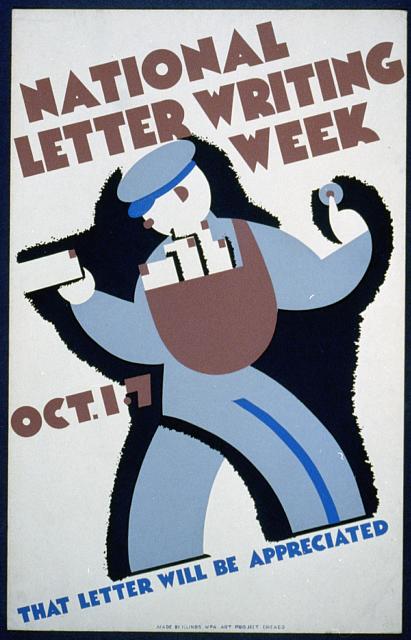
WPA - Letter Writing

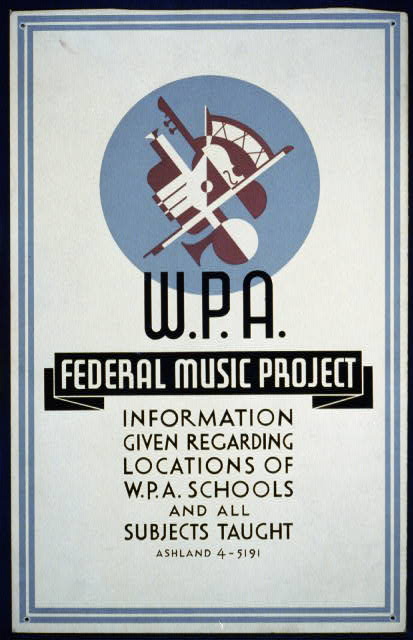
WPA - Music Project

WPA - Lack of Funds

James Carville says Hillary is the most qualified presidential candidate since George Washington—and that includes Bill

James Carville says Hillary is the most qualified presidential candidate since George Washington—and that includes Bill. And the likes of Thomas Jefferson. Here’s what Carville just wrote to potential Hillary donors:

I read the other day that more of Bernie’s supporters have donated to support his campaign than Hillary’s.

I don’t mean to be cranky, but what in the hell is that all about?! We’ve got the best chance we’ve ever had to put a woman in the White House, and oh, by the way, she just happens to be the most qualified candidate maybe since General George Washington himself!!

Aside from Carville’s crankiness, it does make you want to list the credentials of the more than one hundred people who have run for President, some who made it, many who didn’t.

Just looking at the successful candidates, we’ve got a bunch of pretty qualified people. A number of them had been Vice President. Some of those who were Vice President had also been Cabinet members. And some of those had also been governors. Thomas Jefferson, for just one, comes to mind: Governor of Virginia, Secretary of State, Vice President, President. (Also wrote the Declaration of Independence, founded a university, etc.) But I guess it depends on what the meaning of “qualified” is.

One thing is clear. If Carville meant what he said, then the list of people less qualified than Hillary includes her husband, former President Bill Clinton. Don’t worry, Bill. With Jefferson and so many other underqualified candidates, you’re in good company.

The I Ching of Paris

Hexagrams 44 and 29

Question for the I Ching (using the coin method of consultation): How do we deal with the events in Paris?

The I Ching replies:

Hexagram 44 – Gou (Encountering, Coming to Meet)
Heaven above, Wind below.
Changing lines in the third, fourth and top place.

Changes to:

Hexagram 29 – Kan (Water, Darkness, The Abysmal)
Water above, Water below.

Excerpts from two leading translations:

The Complete I Ching
Alfred Huang

Hexagram 44 – Gou

The structure of the gua [hexagram] is Heaven above, Wind below. The wind blows everywhere under Heaven, encountering every being. It should be an auspicious gua. However, there is only one yielding line beneath five solid lines, symbolizing that the yin element is advancing and approaching the yang elements. When King Wen saw this happening, he heightened his vigilance. He realized that an unworthy person was worming his way into favor at the court. The growing negative influences would displace good people one after another. Darkness and difficulties had been eliminated, but their negative influences had not totally faded. These influences were permeating different areas. One must beware of this tendency and take prompt precautions against possible misfortune. Thus King Wen’s Decision and the Duke of Zhou’s Yao Text are full of warnings. But Confucius’s commentaries still shed light on the positive side.

This gua discusses the principle of encountering. In Chinese, meeting a person (or anything) unexpectedly is defined as encountering. When people encounter each other, either they are attracted, making adjustment for a harmonious relationship, or they reject each other, creating conflict between them. In human life sometimes one cannot refrain from misunderstanding and conflict. But one should not indulge in it and think that conflict is unavoidable and cannot be resolved. The ancient sages advocated adopting a conciliatory attitude. Here one yin element approaches five yang elements. She dares to come forward because her strength grows stronger. In this situation, one should not overlook taking preventive measures.

King Wen’s strategy of eliminating evil forces was to show no animosity but to act without tolerance. His administration constrained evil elements like tying up rams. But evil elements still wormed themselves into the favor of the court. King Wen realized that the evil forces had been eliminated, yet their influence had not totally faded. His analogy was that the maiden was too strong; it was not good to marry such a woman. The Duke of Zhou describes the evil forces as waiting to move forward like a lean pig. They should be stopped as if fastened with a metal brake. It is wise to restrain their influence by not letting them influence other people, but it was wiser to influence people with positive virtue.

[Changes to:]

Hexagram 29 – Kan

The central theme of this gua is: falling but not drowned; in danger but not lost. Maintain your confidence: soothe your mind. With assurance and faith, caution and trust, you can pass through any difficult situation. Both Abysmal and Abyss carry the sense of being bottomless. Kan is a pit, but it is not bottomless. There is hope.

Darkness represents not only a pit but also a situation of difficulty or danger. The structure of this gua is a doubling of the primary gua, Water. The image of Water is a yang line plunging between two yin lines, like running water flowing along and between the banks of a river. In ancient times, crossing a river represented a great danger. Thus, the attribute of Water was designated a situation of difficulty or danger. Here, Water is doubled, suggesting that one is plunging into a situation fraught with difficulties or danger. However, the ancient Chinese believed that no matter how dangerous or dark a situation was, if one was able to follow the way of Heaven, one could pass through it as safely as water passes through a ravine.

Water flows on twice over,
Darkness is doubled.
In correspondence with this,
The superior person cultivates and practices virtue constantly
And responds through teaching.


The I Ching
Wilhelm/Baynes

Hexagram 44 – Kou

This hexagram indicates a situation in which the principle of darkness, after having been eliminated, furtively and unexpectedly obtrudes again from within and below. Of its own accord the female principle comes to meet the male. It is an unfavorable and dangerous situation, and we must understand and promptly prevent the possible consequences.

The inferior man rises only because the superior man does not regard him as dangerous and so lends him power. If he were resisted from the first, he could never gain influence.
The time of COMING TO MEET is important in still another way. Although as a general rule the weak should not come to meet the strong, there are times when this has great significance. When heaven and earth come to meet each other, all creatures prosper; when a prince and his official come to meet each other, the world is put in order. It is necessary for elements predestined to be joined and mutually dependent to come to meet one another halfway. But the coming together must be free of dishonest ulterior motives, otherwise harm will result.

[Changes to:]

Hexagram 29 – K’an

In man’s world K’an represents the heart, the soul locked up within the body, the principle of light inclosed in the dark—that is, reason. The name of the hexagram, because the trigram is doubled, has the additional meaning, “repetition of danger.” Thus the hexagram is intended to designate an objective situation to which one must become accustomed, not a subjective attitude. For danger due to a subjective attitude means either foolhardiness or guile. Hence too a ravine is used to symbolize danger; it is a situation in which a man is in the same pass as the water in a ravine, and, like the water, he can escape if he behaves correctly.

Through repetition of danger we grow accustomed to it. Water sets the example for the right conduct under such circumstances. It flows on and on, and merely fills up all the places through which it flows; it does not shrink from any dangerous spot nor from any plunge, and nothing can make it lose its own essential nature. It remains true to itself under all conditions. Thus likewise, if one is sincere when confronted with difficulties, the heart can penetrate the meaning of the situation. And once we have gained inner mastery of a problem, it will come about naturally that the action we take will succeed. In danger all that counts is really carrying out all that has to be done—thoroughness—and going forward, in order not to perish through tarrying in the danger.

Properly used, danger can have an important meaning as a protective measure. Thus heaven has its perilous height protecting it against every attempt at invasion, and earth has its mountains and bodies of water, separating countries by their dangers. Thus also rulers make use of danger to protect themselves against attacks from without and against turmoil within.

Veterans Day: The Annual Shame of a Nation

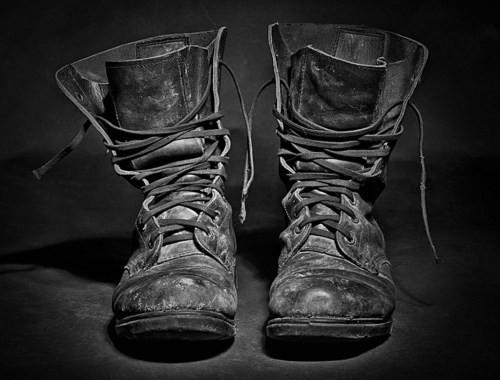
Veterans Boots

Failure to take full and proper care of veterans is not a Democratic or Republican shame. The only reason to focus on Republicans here is that last night, in their debate, on the eve of Veterans Day, only four passing mentions of veterans were made during two hours.

The debate was formally about the economy, but since every one behind the podiums is practiced at changing the subject, there’s no reason some or all of them couldn’t have just said: The economy is an important topic, but just tonight, this particular night, I’d like to focus my time exclusively on veterans matters.

Here’s what one of them might have said:

There is enough responsibility to go around for getting this nation involved in military conflicts. It doesn’t matter what party started it or finished it or didn’t finish it. It doesn’t matter whether it was a great idea or a terrible idea or whether it is too soon to tell. As a nation, we do what we do, and we have to pay the price and keep our promises. In the case of military service, that promise is to spare no expense or effort to not only make combatants whole, or whole as humanly possible, but to elevate their service to priority status in our national consciousness and commitments.

That’s why I’m going to spend whatever minutes I have on this national debate platform tonight to talk specifically about immediate solutions to veterans issues, rather than casting blame or blowing hot air. I also call upon the millionaires and billionaires supporting us and trying to influence the election to divert just a little of that money to nonpartisan efforts such as Iraq and Afghanistan Veterans of America to start solving the problem. Of course, making this a government first priority would be nice too. Because if it comes down to a choice between any of us actually getting the nomination, which is admittedly a long shot for most of us anyway, and the comfort and well-being of those men and women we’ve flag-wavingly asked to fight on our behalf, I’d rather ask that those veterans be made whole than that I be President.

I know. Dream on.

If You’re Tired of Hearing About the Vietnam War, Tell Our Leaders to Stop Reenacting It

This weekend, an administration official tried to explain in an interview what exactly we are now doing in Iraq and Syria. It was like a ghost or the walking dead, sounding eerily and unhappily exactly like the rhetoric that was rolled out in the middle days of the Vietnam War.

There are roughly three groups about Vietnam: those who lived through it on the home front, those who lived through it (or not) in battle, and a generation or more that is so tired of hearing about a war that ended forty years ago. So tired of it. Can’t you all ever get over it?

Too bad. No, we should never “get over” Vietnam, no matter how many generations pass, and no matter how tired those generations are about the lessons we might learn. Vietnam was the first truly modern war of the media age and of the post-national era.

In media terms, it offered the best possibility up to that time to say positive stuff about a complex war policy, have it widely broadcast (though not as widely as digital today), and have the media endorse it and people believe it. Okay, that does sound like a description of what happened in Iraq, but that just proves the point.

As far as post-national warfare, Vietnam was technically a civil war, but it was obviously something else too. There was an army of North Vietnam, but there were also indigenous forces and a people’s movement trying to upset an unacceptable status quo, which we supported and ultimately defended. For a while. Until there was no more government of South Vietnam. And then it became a matter of just not losing. Which we did.

Another parallel is not paying attention to history, our own and that of others. The French abandoned Indochina, but that was supposedly just because they were, well, French. Americans know and are better than that. Just as in Afghanistan, where the Soviets abandoned their war, but that was supposedly because, well, they were Commies. Freedom loving Americans know and are better.

Which brings us back round to Iraq and Syria today. If you make the effort, you could go back to the LBJ days of Vietnam and hear exactly the same words that were spoken this weekend. Not just something like it, but exactly. Such as: it’s their fight, not ours.

There are things worth fighting for on the world stage, even when it is not on our homeland. But it is hard enough to figure out what those things are, and even harder to commit ourselves and our loved ones to the fight, when we are swimming in a sea of official stuff and nonsense. We want the brutal truth, if our leaders can tell it, especially when it is bound to be a brutal and long fight.

Afghanistan Without End. Amen.

It is time to stop expecting American leadership in either party, at any level, to reasonably articulate an achievable goal in Afghanistan. Either the conclusion they’ve reached is that there is none or it is too hard to tell us the inconvenient truth they have concluded.

So we are just going to have to take on the role of citizen policy analysts and do it ourselves.

We are unlikely to ever help establish an Afghan military capable or willing to hold back whatever insurgent force mortally threatens stability and national integrity.

We are unlikely to see the establishment of a stable semi-permanent semi-democracy in Afghanistan.

We are never going to “defeat” the Taliban or other similar threats in Afghanistan, in the sense of forever eliminating and precluding such evil developments.

That leaves one possibility. We are keeping troops in Afghanistan to help keep things from getting worse.

It’s a problem to admit that. First, because a military mission of stopping things from getting worse seems unending, which it well might be. Entropy tells us that things fall apart naturally unless acted upon otherwise. In Afghanistan that otherwise is us. It’s also hard to tell those who serve that the point of their sacrifice is to keep things from getting worse, rather than seeing a genuinely better future and having a defined endpoint.

But at least it would be honest. And on top of the war without end, that is an equally big problem. From the Vietnam War to today, there has been a lot of official and political obfuscation. Well, let’s call it lying. It isn’t that the policy makers don’t have noble principles in mind, such as freedom, self-determination, and the like. It’s just that the plans they put in place—very expensive plans—have practically no chance of fulfilling any of those principles.

Bacon and Ribs Illegal in America When Jews and Muslims Take Over

When Orthodox Jews or Muslims are in charge, bacon, ribs, and all sorts of other things will be made illegal.

Of course, that will never happen. Not because Orthodox Jews or Muslims will never take control of American democracy (anything’s possible). But because the U.S. Constitution—that imperfectly perfect protector of individual rights—would not permit it.

In the secular sphere, there is no higher law than the Constitution. Beyond being the law of the land, it is the law of the law of the land. Those who study it in the context of world history and politics recognize that it is a one-of-a-kind, no-other-time-or-place achievement.

Those who say there is some kind of higher law than that in the civic arena are misinformed, or in some cases, such as Ted Cruz who should know better, strategically mistaken. The question those folks have to answer is this: If there is higher law than the Constitution, whose law is it? If it’s “God’s” law, recall that God talks to lots of people in lots of religious traditions, and apparently isn’t always heard to say the same thing to everyone. It will shock some Christians to learn that God has been speaking to Jews for thousands more years, and while there seemed to have been plenty of talk about a messiah, nothing to indicate that one actually arrived. Or asked county clerks in Kentucky to stop issuing marriage licenses. Or told presidential candidates who claim to believe in law and order to defy the law of the law of the land. In his name. Amen.

Joe Biden and the Kennedys: Profiles in Service and Tragedy

Joe Biden

Thinking about Joe Biden’s decision on whether to run for the Democratic presidential nomination, the Kennedys come to mind. All the brothers.

Like the Kennedys, Biden is Irish-American, with a fanatical sense of public service and family. Like the Kennedys, he is a pragmatic liberal, maybe a bit to the left of that dynasty, but deeply aware of the obligation of those who have much to those who have much less.

(Speaking of the haves, unlike the Kennedys, Biden may be the least wealthy politician ever to emerge from decades of high-profile public service.)

Most of all, like the each of the Kennedy brothers, he has had to struggle with multiple tragedies, each one a reason to choose a different path, each one instead a reason to keep going—because of rather than in spite of.

Not a single person, no matter the party, no matter who they support, would begrudge Biden a decision not to run this time. But—unlike the position taken by those who say running might tarnish his legacy—he would crown his career by demonstrating the idea that what does not kill us can make us stronger, and can make us give more, even when so much has been taken.

August 17, 1998: Clinton Admits to Misleading People

Bill Clinton

Exactly seventeen years ago, on August 17, 1998, Bill Clinton admitted that, under oath, he had not told the truth about his relationship with Monica Lewinsky.

Why mention this now, other than the anniversary? To understand that, you might check out the most famous quote from American philosopher George Santayana—one of the most often repeated quotes in modern times.

On that day in August, President Clinton gave a brief television address to admit: “While my answers were legally accurate, I did not volunteer information….I know that my public comments and my silence about this matter gave a false impression. I misled people.”

Clinton was subsequently impeached by the House of Representatives on charges including perjury and obstruction of justice, but retained his office when the Senate failed to convict by a two-thirds majority.

Note in passing that his lead counsel in the impeachment trial was Cheryl Mills, who went on to become Hillary Clinton’s Chief of Staff at the Department of State. And that another Bill Clinton lawyer in the proceedings was David Kendall, who is currently one of Hillary Clinton’s lead attorneys in the matter of her e-mail server. For what it’s worth.

Here is an excerpt from Bill Clinton’s address to the nation:

This afternoon in this room, from this chair, I testified before the Office of Independent Counsel and the grand jury.

I answered their questions truthfully, including questions about my private life, questions no American citizen would ever want to answer.

Still, I must take complete responsibility for all my actions, both public and private. And that is why I am speaking to you tonight.

As you know, in a deposition in January, I was asked questions about my relationship with Monica Lewinsky. While my answers were legally accurate, I did not volunteer information.

Indeed, I did have a relationship with Miss Lewinsky that was not appropriate. In fact, it was wrong. It constituted a critical lapse in judgment and a personal failure on my part for which I am solely and completely responsible.

But I told the grand jury today and I say to you now that at no time did I ask anyone to lie, to hide or destroy evidence or to take any other unlawful action.

I know that my public comments and my silence about this matter gave a false impression. I misled people, including even my wife. I deeply regret that.