Bob Schwartz

Category: Government

The Day We Discovered the Gamers


It’s a cliché from a hundred movies: Right before the wedding, the father of the bride looks over at his daughter and discovers something: the little girl is all grown up. This isn’t the day she grew up; that has been going on all along, for years. This is just the day he learned that.

Sean Smith, the Libyan embassy officer killed yesterday along with Ambassador Chris Stevens and two others, was also a world-class online gamer. In the 400,000-member EV Online community, where his name was Vile Rat, he was known as perhaps the greatest of all space diplomats. Most did not know that was what he did in his other life.

The community responded immediately and in force. Members gave assurances that his family would be supported, including making sure that his children went to college. In the digital world, space stations were named in his honor.

Those two things may not make sense together to some, but it is fitting. There is an image, outdated if it was ever true, that digital gaming is filled with socially inept people, mostly men, suffering from some form of arrested development. To the contrary, just ask the digital gaming industry, which is reaping the rewards of one of the few truly healthy entertainment genres. Or ask the millions who are citizens of the communities, who are also grown-up, responsible men—and women—who live complete and complex non-digital lives.

Or ask the wife and young children of Sean Smith, who may or may not have understood the different way he was important as an online diplomat, esteemed member of that community, and friend to thousands who had never met him. As one member posted, it is a “stupid game” that stands in the shadow of Sean Smith’s real world contributions and passing. But the gaming itself and the community it fostered is not stupid.

This is the day we learned that.

Barbara Jordan And The National Community

Well I am going to close my speech by quoting a Republican President and I ask you that as you listen to these words of Abraham Lincoln, relate them to the concept of a national community in which every last one of us participates:

“As I would not be a slave, so I would not be a master.” This — This — “This expresses my idea of Democracy. Whatever differs from this, to the extent of the difference, is no Democracy.”

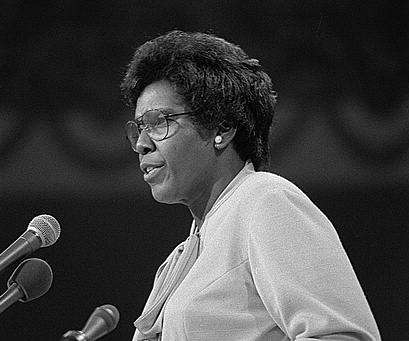
In preparation for the Democratic National Convention—in preparation for being an American—everyone must hear and read Congresswoman Barbara Jordan’s keynote address to the Democratic National Convention in 1976, “Who Then Will Speak for the Common Good?”

Even if Barbara Jordan (1936-1996) had not been an extraordinary woman with an extraordinary story, this speech would deserve regular listening and reading, and all the accolades it has received.

Her story is that of a girl raised in segregated Houston. A gifted student, she attended Texas Southern University instead of the University of Texas, which at the time was still segregated.  She was a national champion college debater, and went on to Boston University School of Law.

In 1966, she became the first African American woman elected to the Texas Senate. Then in 1972 she became the first African American woman from a southern state to serve in the House of Representatives. Her skill at pragmatic political compromise was matched by unyielding commitment to the Constitution and to the ideals of America.

(A movie about her life is in development, based on the biography Barbara Jordan: American Hero, starring Academy Award-nominee Viola Davis.)

Barbara Jordan was one of the great American orators of the 20th century. When Professors Stephen E. Lucas and Martin J. Medhurst asked 137 leading scholars to recommend speeches on the basis of social and political impact, Barbara Jordan’s keynote address  was near the top at number 5. In fact, of the top 13 American political speeches of the century, two were made by her. The only other speaker to appear that high on the list twice  is FDR:

1. Martin Luther King, Jr.      “I Have A Dream”
2, John Fitzgerald Kennedy    Inaugural Address
3. Franklin Delano Roosevelt    First Inaugural Address
4. Franklin Delano Roosevelt    Pearl Harbor Address to the Nation
5. Barbara Charline Jordan    1976 DNC Keynote Address
6. Richard Milhous Nixon    “Checkers”
7. Malcolm X    “The Ballot or the Bullet”
8. Ronald Wilson Reagan     Shuttle ”Challenger” Disaster Address
9. John Fitzgerald Kennedy    Houston Ministerial Association Speech
10. Lyndon Baines Johnson    “We Shall Overcome”
11. Mario Matthew Cuomo    1984 DNC Keynote Address
12. Jesse Louis Jackson    1984 DNC Address
13. Barbara Charline Jordan    Statement on the Articles of Impeachment

Her number 13 speech on the Articles of Impeachment against Richard Nixon came in 1974, two years after she took her seat in the House, two years before the keynote address. It is nearly the equal and a fitting companion to that later speech. In the wake of the Watergate revelations, as the impeachment of Richard Nixon moved forward, both Democrats and Republicans stood up to uphold the Constitution against this attempted subversion. America and the House Judiciary Committee had the good fortune to have at its service a very new Congresswoman from Texas:

Today I am an inquisitor. I believe hyperbole would not be fictional and would not overstate the solemnness that I feel right now. My faith in the Constitution is whole, it is complete, it is total. I am not going to sit here and be an idle spectator to the diminution, the subversion, the destruction of the Constitution….

James Madison again at the Constitutional Convention: “A president is impeachable if he attempts to subvert the Constitution.”

The Constitution charges the president with the task of taking care that the laws be faithfully executed, and yet the president has counseled his aides to commit perjury, willfully disregarded the secrecy of grand jury proceedings, concealed surreptitious entry, attempted to compromise a federal judge while publicly displaying his cooperation with the processes of criminal justice.

“A president is impeachable if he attempts to subvert the Constitution.”

If the impeachment provision in the Constitution of the United States will not reach the offenses charged here, then perhaps that eighteenth century Constitution should be abandoned to a twentieth-century paper shredder. Has the president committed offenses and planned and directed and acquiesced in a course of conduct which the Constitution will not tolerate? That is the question. We know that. We know the question. We should now forthwith proceed to answer the question. It is reason, and not passion, which must guide our deliberations, guide our debate, and guide our decision.”

America was at a crossroads in 1976, which by coincidence was the bicentennial year of our birth as a nation. Democracy had been threatened at the highest level from within, and democracy had prevailed. But democracy, we should have known, is always under threat, and when it is, the question is not only how to uphold it but what exactly we mean by democracy, that is, what exactly is it that we are defending?

In 1976, as the keynote speaker at the Democratic National Convention, Barbara Jordan spoke as eloquently as anyone has about our “national community.” She stood in front of an audience at Madison Square Garden in New York and explained the promise and challenge of the American Constitution and democracy in a way that has not been equaled since:

It was one hundred and forty-four years ago that members of the Democratic Party first met in convention to select a Presidential candidate. Since that time, Democrats have continued to convene once every four years and draft a party platform and nominate a Presidential candidate. And our meeting this week is a continuation of that tradition. But there is something different about tonight. There is something special about tonight. What is different? What is special?

I, Barbara Jordan, am a keynote speaker.

When — A lot of years passed since 1832, and during that time it would have been most unusual for any national political party to ask a Barbara Jordan to deliver a keynote address. But tonight, here I am. And I feel — I feel that notwithstanding the past that my presence here is one additional bit of evidence that the American Dream need not forever be deferred.

Now — Now that I have this grand distinction, what in the world am I supposed to say? I could easily spend this time praising the accomplishments of this party and attacking the Republicans — but I don’t choose to do that. I could list the many problems which Americans have. I could list the problems which cause people to feel cynical, angry, frustrated: problems which include lack of integrity in government; the feeling that the individual no longer counts; the reality of material and spiritual poverty; the feeling that the grand American experiment is failing or has failed. I could recite these problems, and then I could sit down and offer no solutions. But I don’t choose to do that either. The citizens of America expect more. They deserve and they want more than a recital of problems.

We are a people in a quandary about the present. We are a people in search of our future. We are a people in search of a national community. We are a people trying not only to solve the problems of the present, unemployment, inflation, but we are attempting on a larger scale to fulfill the promise of America. We are attempting to fulfill our national purpose, to create and sustain a society in which all of us are equal.

Throughout — Throughout our history, when people have looked for new ways to solve their problems and to uphold the principles of this nation, many times they have turned to political parties. They have often turned to the Democratic Party. What is it? What is it about the Democratic Party that makes it the instrument the people use when they search for ways to shape their future? Well I believe the answer to that question lies in our concept of governing. Our concept of governing is derived from our view of people. It is a concept deeply rooted in a set of beliefs firmly etched in the national conscience of all of us.

Now what are these beliefs? First, we believe in equality for all and privileges for none. This is a belief — This is a belief that each American, regardless of background, has equal standing in the public forum — all of us. Because — Because we believe this idea so firmly, we are an inclusive rather than an exclusive party. Let everybody come.

I think it no accident that most of those immigrating to America in the 19th century identified with the Democratic Party. We are a heterogeneous party made up of Americans of diverse backgrounds. We believe that the people are the source of all governmental power; that the authority of the people is to be extended, not restricted.

This — This can be accomplished only by providing each citizen with every opportunity to participate in the management of the government. They must have that, we believe. We believe that the government which represents the authority of all the people, not just one interest group, but all the people, has an obligation to actively — underscore actively — seek to remove those obstacles which would block individual achievement — obstacles emanating from race, sex, economic condition. The government must remove them, seek to remove them. We.

We are a party — We are a party of innovation. We do not reject our traditions, but we are willing to adapt to changing circumstances, when change we must. We are willing to suffer the discomfort of change in order to achieve a better future. We have a positive vision of the future founded on the belief that the gap between the promise and reality of America can one day be finally closed. We believe that.

This, my friends is the bedrock of our concept of governing. This is a part of the reason why Americans have turned to the Democratic Party. These are the foundations upon which a national community can be built. Let all understand that these guiding principles cannot be discarded for short-term political gains. They represent what this country is all about. They are indigenous to the American idea. And these are principles which are not negotiable.

In other times — In other times, I could stand here and give this kind of exposition on the beliefs of the Democratic Party and that would be enough. But today that is not enough. People want more. That is not sufficient reason for the majority of the people of this country to decide to vote Democratic. We have made mistakes. We realize that. We admit our mistakes. In our haste to do all things for all people, we did not foresee the full consequences of our actions. And when the people raised their voices, we didn’t hear. But our deafness was only a temporary condition, and not an irreversible condition.

Even as I stand here and admit that we have made mistakes, I still believe that as the people of America sit in judgment on each party, they will recognize that our mistakes were mistakes of the heart. They’ll recognize that.

And now — now we must look to the future. Let us heed the voice of the people and recognize their common sense. If we do not, we not only blaspheme our political heritage, we ignore the common ties that bind all Americans. Many fear the future. Many are distrustful of their leaders, and believe that their voices are never heard. Many seek only to satisfy their private work — wants; to satisfy their private interests. But this is the great danger America faces — that we will cease to be one nation and become instead a collection of interest groups: city against suburb, region against region, individual against individual; each seeking to satisfy private wants. If that happens, who then will speak for America? Who then will speak for the common good?

This is the question which must be answered in 1976: Are we to be one people bound together by common spirit, sharing in a common endeavor; or will we become a divided nation? For all of its uncertainty, we cannot flee the future. We must not become the “New Puritans” and reject our society. We must address and master the future together. It can be done if we restore the belief that we share a sense of national community, that we share a common national endeavor. It can be done.

There is no executive order; there is no law that can require the American people to form a national community. This we must do as individuals, and if we do it as individuals, there is no President of the United States who can veto that decision.

As a first step — As a first step, we must restore our belief in ourselves. We are a generous people, so why can’t we be generous with each other? We need to take to heart the words spoken by Thomas Jefferson:

Let us restore the social intercourse — “Let us restore to social intercourse that harmony and that affection without which liberty and even life are but dreary things.”

A nation is formed by the willingness of each of us to share in the responsibility for upholding the common good. A government is invigorated when each one of us is willing to participate in shaping the future of this nation. In this election year, we must define the “common good” and begin again to shape a common future. Let each person do his or her part. If one citizen is unwilling to participate, all of us are going to suffer. For the American idea, though it is shared by all of us, is realized in each one of us.

And now, what are those of us who are elected public officials supposed to do? We call ourselves “public servants” but I’ll tell you this: We as public servants must set an example for the rest of the nation. It is hypocritical for the public official to admonish and exhort the people to uphold the common good if we are derelict in upholding the common good. More is required — More is required of public officials than slogans and handshakes and press releases. More is required. We must hold ourselves strictly accountable. We must provide the people with a vision of the future.

If we promise as public officials, we must deliver. If — If we as public officials propose, we must produce. If we say to the American people, “It is time for you to be sacrificial” — sacrifice. If the public official says that, we [public officials] must be the first to give. We must be. And again, if we make mistakes, we must be willing to admit them. We have to do that. What we have to do is strike a balance between the idea that government should do everything and the idea, the belief, that government ought to do nothing. Strike a balance.

Let there be no illusions about the difficulty of forming this kind of a national community. It’s tough, difficult, not easy. But a spirit of harmony will survive in America only if each of us remembers that we share a common destiny; if each of us remembers, when self-interest and bitterness seem to prevail, that we share a common destiny.

I have confidence that we can form this kind of national community.

I have confidence that the Democratic Party can lead the way.

I have that confidence.

We cannot improve on the system of government handed down to us by the founders of the Republic. There is no way to improve upon that. But what we can do is to find new ways to implement that system and realize our destiny.

Now I began this speech by commenting to you on the uniqueness of a Barbara Jordan making a keynote address. Well I am going to close my speech by quoting a Republican President and I ask you that as you listen to these words of Abraham Lincoln, relate them to the concept of a national community in which every last one of us participates:

“As I would not be a slave, so I would not be a master.” This — This — “This expresses my idea of Democracy. Whatever differs from this, to the extent of the difference, is no Democracy.”

Thank you.

Paul Ryan and Ayn Rand


A postage stamp honoring Ayn Rand was issued in 1999; that’s the image used in the National Review cover above. It was issued in the usual way, following a roughly three-year process of being proposed, recommended by the Citizens’ Stamp Advisory Committee, and then approved by the Postmaster General.

The most famous controversy over any stamp concerned the Elvis Presley commemorative. There was disagreement about which Elvis to depict, the younger leaner one or the older heavier one, and disagreement about whether Elvis should have a stamp at all. In the end, the stamp was issued, and went on to become the bestselling in U.S. postal history. There is no record that there was disagreement about Ayn Rand, though there might well have been.

Paul Ryan honored Ayn Rand too, at least until recently. He stated that her books were the most pivotal in shaping his public life. He gave them to interns as gifts. He spoke frequently about how the decline in America looked increasingly like something out of an Ayn Rand novel.

He is not alone among public servants in his admiration for Ayn Rand. Politico reported last April on 7 Politicians Who Praised Ayn Rand.  Among these are Sen. Rand Paul (coincidentally named), Rep. Ron Paul (who should know about Rand Paul’s name), President Ronald Reagan, Sen. Ron Johnson, Gov. Gary Johnson, Sen. Mark Sanford and Supreme Court Justice Clarence Thomas. Justice Thomas has his new law clerks watch a screening of The Fountainhead (1949), starring Gary Cooper and Patricia Neal, an adaptation of Rand’s second most famous novel. Maybe the most famous acolyte of Ayn Rand is former Federal Reserve Chairman Alan Greenspan, who in the 1950s was part of her inner circle and a close confidant.

Rand’s novels are overlong, didactic, questionably artful embodiments of her very particular philosophy. It is a philosophy fed by her early experience as a child in Soviet Russia, a member of an intellectual and professional Jewish family that was reduced to dire circumstances by the forces of collectivism, Communism and totalitarianism.

She came to America and created her own ism. The Atlas Society,  one of the intellectual keepers of the Rand canon, summarizes:

Ayn Rand’s philosophy of Objectivism was set forth in such works as her epic novel Atlas Shrugged, and in her brilliant non-fiction essays. Objectivism is designed as a guide to life, and celebrates the remarkable potential and power of you, the individual. Objectivism also challenges the doctrines of irrationalism, self-sacrifice, brute force, and collectivism that have brought centuries of chaos and misery into the lives of millions of individuals. It provides fascinating insights into the world of politics, art, education, foreign policy, science, and more, rewarding you with a rich understanding of how ideas shape your world. Those who discover Objectivism often describe the experience as life-changing and liberating.

One problem with Objectivism, as with the isms Rand left behind and hated, is that pure systems work well on paper and in the mind, as long as you don’t have to wrestle with the complexities and consequences of the actual world. This is probably why Ayn Rand has always had an appeal to younger people, particularly teenage boys and young men, who are empowered by the idea of their individual greatness waiting to explode, ungoverned by the limitations that the world tries to place on them. The world is filled with people who want something from us, who are jealous of us, who don’t understand our specialness, and who will do anything to hold us back and keep us down.

This phenomenon was wryly captured by Michael Sean Winters in the National Catholic Reporter:

As one wag once said: “There are two novels that can change a bookish fourteen-year old’s life: The Lord of the Rings and Atlas Shrugged. One is a childish fantasy that often engenders a lifelong obsession with its unbelievable heroes, leading to an emotionally stunted, socially crippled adulthood, unable to deal with the real world. The other, of course, involves orcs.”

Winters was writing in the context of the Ryan Budget. Paul Ryan is devoted to the Catholic Church, which is founded on the sort of collectivism, anti-individualism, self-sacrifice and charity that Rand abhorred and rejected as immoral. This led in May 2011 to questions about how the Ryan Budget, with reductions in government help for the poor and others in need, squared with the teachings of the Church. Archbishop Timothy Dolan, who had previously been Bishop in Wisconsin, made clear in a letter to Ryan that the budget was completely in line with the Church’s mission. Winters wrote:

Ryan’s budget certainly reflects Rand’s weltanschauung more than it reflects the vision Pope Benedict XVI put forth in Caritas in Veritate. That is why I think it was a mistake for Archbishop Dolan to write a letter that, however unintentionally, gave political cover to policies that are antithetical to Catholic social teaching. And, whatever frustrations Ryan – or anyone else – has with the modern, social welfare state, I think it can be said that the social welfare state is to social justice what democracy is to government: The worst form of administration except every other form.

Ryan can assert that his budget is built upon Catholic concerns about human dignity, but there is no dignity in Rand’s crimped vision of humanity. There really is no need to wrestle with these so-called ideas.

Paul Ryan’s distancing from Ayn Rand began last spring when he said that his supposed embrace of the author and her philosophy was “urban legend.” (If so, it is the most high-minded and intellectual urban legend of all time, since those stories are usually sordid and lowlife, as in the flushing of baby alligators into the New York sewers.) Then just yesterday he explained that while he enjoyed the novels for a long time, it was only later that he became aware of her philosophy.

As mentioned earlier, Ayn Rand’s novels are not works of art that have to be savored and investigated so that their meaning can be coaxed out. They are pages and pages of speeches and ideas, with some plot and characters hung on them like ornaments on a tree. There are only two explanations for Ryan’s assertion: he is either dull-witted, which he isn’t, or he is…being disingenuous.

Why all this effort to run away from Ayn Rand anyway? Most people, meaning voters, have never read those novels, and all this fuss is not about to move them to throw away weeks of their lives trying to plow through them.

Here’s why.

First, Ayn Rand was an atheist. In her philosophy there is no higher power than man, no life other than the objective life in front of our faces, no morality other than the morality of rational self-interest. There are plenty of atheists who embrace the moral and ethical concepts at the heart of religious beliefs, such as the Golden Rule. Ayn Rand was not one of those. This is more than inconvenient for anyone, especially politicians, who base their lives and careers on their religious foundations.

But there is something deeper and more significant going on. In 2010 the National Review, America’s most respected conservative journal, published a cover story on Ayn Rand.  In it, Jason Lee Steorts writes about going back to reread Ayn Rand, given her renewed popularity following the election of Barack Obama:

Our president seems to have inspired — which is not quite the word — half the country to read Miss Rand, and I wanted to remind myself what she was teaching them. He finds that he can’t get through the books, because he sees the author for who she was and, therefore, what she espoused.

Steorts relates a scene from Atlas Shrugged. The prime movers, those who are literally the brains behind the success of the country, have gone on strike. This leaves the inferior, parasitic people to fend for themselves. In this scene, a train is stopped before an eight-mile unventilated tunnel. There are no diesel engines, no one to properly operate the train. But facing a demand to make it move, the station officials, writes Rand, “call in a coal engine, procure a drunken engineer, and condemn every passenger on the train to death by asphyxiation.”

The passengers comprise an array of losers, including a professor “who taught that individual ability is of no consequence” and a mother “whose husband held a government job enforcing directives.” They are, in essence, riding a train into a gas chamber. “But that isn’t why I stopped reading,” Steorts writes. “I stopped because Rand thinks they deserve it.”

That is at the heart of this running away from Rand. Rand’s world is not one where unbridled individualism can co-exist with a diversity of other moralities and abilities. It is either/or. There are producers, there are freeloaders, and the immoral role of government is to stifle the producers and reward the freeloaders with stolen spoils. As soon as government is gone, the producers will be free to shape the world in their image, and the others will learn how that world works or they will, ultimately, perish as their punishment.

If that sounds harsh and heartless, it is. If that sounds like an extreme version of some of the rhetoric we may have been hearing lately, it is. But even the softer version, tempered by compassion, still makes us uncomfortable. That is why, hopefully, Ryan and others will distance themselves from Ayn Rand—not just for political show, but for real.  That is why, when Sheorts in the National Review looked to find out why Obama-haters were reading Ayn Rand, he recoiled at what he found. He discovered a bloodless train, and he couldn’t bear to see where it was heading.

The VP Guessing Game: Too Much Is Never Enough


Come on, political junkies, admit it: You say you’ve had enough of the Republican VP speculation, but like that bag of barbecue potato chips, you kind of hope it never ends.

Character is destiny, and the character of this Republican nominating process has been so wacky that you would expect nothing less from the Vice Presidential selection.

We are beyond “you can’t tell the players without a program,” so if you haven’t kept up, here’s where we stand, as best as anyone can tell.

The supposed short list of possibilities includes Tim Pawlenty, Rob Portman and, lately talked about, Paul Ryan.

The list of those speculated about but almost certainly not to be picked is long, and even longer if you include never-going-to-happen-in-a-million-years names such as Newt Gingrich. This season, it’s not so much an insult not to be picked as it is not to be included in the longshot list. Herman Cain deserved to have somebody floating his name.

In between are those who have or had a colorable chance of being picked, though they aren’t on the short list. Chris Christie appears to be out, since he will be giving the keynote address at the convention. From a spectator’s perspective this is too bad: with Biden and Christie as the designated loyal-to-the-death hitmen, this could have been a battle for the ages.

Marco Rubio is a strange case. Some polls show him as the preference of Republican and Republican-leaning voters, though this probably has more to do with name-recognition than anything else. Rubio is viewed as flawed in terms of experience, maturity, baggage and positions, which overweigh any Latino advantage.

Back to the top three, every day brings a different leader—kind of like the much-missed days of the Republican primaries. Just within the past few days, Ryan is being pushed as the true conservative with some real public appeal. Portman is viewed as boring, but solid and from Ohio, two real pluses. Pawlenty has governing experience, but proved in his brief Presidential run that he may lack the right stuff, or even the just okay stuff.

Strategically, it is thought that the selection will come this week. The Romney campaign doesn’t so much need a game changer as a topic changer. It needs a second candidate who can start fighting right now. And it needs to end the polarizing that is now developing around the selection among Republicans, and particularly conservatives.

Everybody is never happy with the selection of a VP candidate. In close nominating contests, the second place finisher is a politically logical choice, so complaints are muted. That’s how we get Kennedy-Johnson and Reagan-Bush. (And when dynamics trump political logic, how we don’t get Obama-Clinton.)

But there is no mandated logic to this VP pick. The longer this goes on, the more the factions will feel free to push their own ideas about what’s best for the ticket and the party. And the more that goes on, the deeper will be the disappointment when the choice is actually, finally made.

Of the top three, any prediction is subject to change in fifteen minutes.

Portman is undynamic, and there is no proof that his selection will “deliver” Ohio. He is haunted by the ghost of an Administration and budgets past. It is an invitation to bring George W. Bush to the convention he is not attending. If Portman is asked whether prosecuting two wars while offering tax breaks is sound budgeting, and whether that contributed to economic instability, he is stuck. If he says yes, he puts into question his role as Bush’s budget chief; if no, his credibility is at stake, since even some Republicans have concluded that the Bush budget was a bad idea that made things worse.

Ryan is instead haunted by the ghost of budgets future, specifically the proposed budget that bears his name. Some Republican pundits have openly said this is a good thing, since the budget should be a central issue, and Ryan will do a better job than Mitt Romney explaining, defending and promoting that budget. That may be the case, given Romney’s unwillingness to be specific about budget issues, other than his general support for…the Ryan budget. Ryan, despite being the most dynamic and appealing of the three, also shares Portman’s lack of elected executive experience.

Pawlenty is more dynamic than Portman, less than Ryan. He has executive experience as governor of Minnesota. His brief run for the Republican nomination was far from stellar, especially given the strange lineup of competitors. Set aside the clichéd test of whether you can see the VP taking over if needed. Set aside all the political calculations, including those above. Just picture the team taking that stagecoach down the home stretch, Romney driving, someone else riding shotgun. For the moment, that someone else looks like Tim Pawlenty.

At least for the next fifteen minutes.

Note: The illustration above is a photo of Vice President Thomas Riley Marshall, who served President Woodrow Wilson from 1913-1921. As a matter of political and historical trivia (for junkies who use both), Marshall was the last President or Vice President with facial hair; the last such President was William Howard Taft, who preceded Wilson in office. Almost a hundred years without a mustache or beard in an Administration explains the real reason that Herman Cain did not go further in the process: it wasn’t Pokemon, it was his mustache.

Elizabeth Warren And Native American Lending

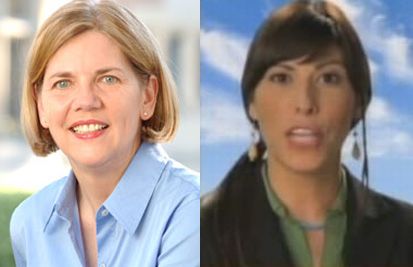
Elizabeth Warren is a figure of considerable talent and successful public service. On the heels of a controversy that has been dogging her, though, an irony has cropped up that is worth a note in passing.

Even in a political season where the bizarre has become the everyday, Elizabeth Warren’s run for a U.S. Senate seat from Massachusetts has taken some strange turns. While her claim to Native American heritage is entirely legitimate, her handling of the politics surrounding it has been less than smooth. And now there is an unremarked upon twist to it.

You’ve probably seen television ads for the Internet lender Western Sky Financial. A pretty woman in braids looks you straight in the eye and offers you a personal loan. “Yes, the money is expensive,” she admits, “but it is a lot cheaper than a payday advance.” All the while, the Western Sky three-tipi logo is emblazoned onscreen, as a drum beats softly in the background.

The Western Sky site explains:

Western Sky Financial is owned wholly by an individual Tribal Member of the Cheyenne River Sioux Tribe and is not owned or operated by the Cheyenne River Sioux Tribe or any of its political subdivisions. Western Sky Financial is a Native American business operating within the exterior boundaries of the Cheyenne River Sioux Reservation, a sovereign nation located within the United States of America.

In an earnest section on Responsible Lending, Western Sky outlines its philosophy:

Fair Dealing among people is a Lakota Tradition, and a concept that is fully embraced by Western Sky. Fair Dealing requires parties to be open and honest and to treat others with respect. Western Sky believes Fair Dealing to be an important aspect of being a responsible Lender.

Western Sky seeks to employ the concept of Fair Dealing at all levels of customer relations, from the application process to the details of loan repayment. This page outlines our approach and what we ask you in return. If you have any questions regarding our commitment to Fair Dealing or our expectations of you, please feel free to ask.

Here are some of the loan rates:

Loan Product Borrower Proceeds Loan Fee  APR   Number of Payments Payment Amount
$10,000 Loan      $9,925          $75   89.68%        84              $743.49
$5,075 Loan       $5,000          $75   116.73%       84              $486.58
$2,600 Loan       $2,525          $75   139.22%       47              $294.46
$1,500 Loan       $1,000          $500  234.25%       24              $198.19
$850 Loan         $500            $350  342.86%       12              $150.72

Demand for easy but high-interest loans has skyrocketed in these hard times. In response to possible overreaching, a number of states that had previously kept their legislative hands off have jumped in to try and set some limits.

It appears that hundreds of Native American-related lending companies, including Western Sky, have cropped up to meet consumer demand. Despite state efforts to weigh in on this development, tribal sovereignty in the face of state laws has prevailed. In 2011 the Native American Lending Alliance  was formed to establish best practices and to make sure that sovereignty in this area remains intact and unassaied.

The only entity empowered to take on any question of tribal-related lending is the federal government. In recent years the federal government did generally take on consumer lending and related  issues with the establishment of the Consumer Financial Protection Bureau. But Native American lending is a legally complex and sensitive matter, and neither the federal government nor the CFPB is currently addressing it as frontline cause.

And that’s where the irony comes in. The CFPB is to a great extent the creation of Elizabeth Warren. She conceived it and helped build it. So at a time when Native American interests are operating just outside the purview and the spirit of the CFPB, Elizabeth Warren’s own Native American heritage has become a bit of a campaign issue.

The two have no direct connection, and all we know tells us that Elizabeth Warren always stands squarely on the side of consumers. But it is ironic: not a big irony, but certainly a curious twist in an endlessly curious and twisted political season.

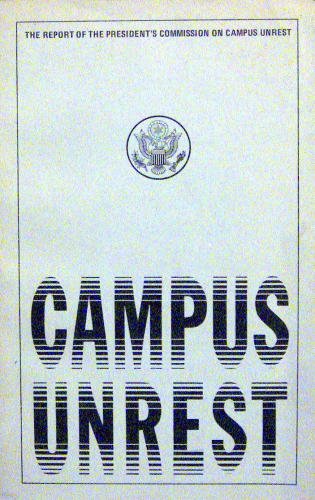
The President’s Commission on Campus Unrest: A 1970 Manifesto of Hope

These first weeks of May mark events in 1970 unlike any in American history. Along with the most tragic consequence, an almost forgotten document of that time offers an eloquent statement of hope—for then and for now.

On April 30, President Richard Nixon announced the U.S. bombing of Cambodia as an escalation of the Vietnam War. Student protests and strikes swept colleges across the country. On May 4, National Guard troops at Kent State University shot at students, killing four and wounding nine. Protests and demonstrations expanded, and within the week hundreds of campuses were affected or closed down. Then ten days after Kent State, on May14, black students and other demonstrators at Jackson State College in Mississippi engaged with city and state policemen. Two students were killed and at least twelve were wounded.

Only a few weeks later, President Nixon established the President’s Commission on Campus Unrest on June 13, 1970. The Commission was chaired by William Scranton, former Pennsylvania Governor, and issued its report in October 1970.

Defining events have a half-life. Time passes, people pass, and more immediate crises displace the old. There are round-number anniversaries, and these events did get a boost from the fortieth anniversary a couple of years ago. Even when they are remembered, the visceral actuality and meaning get lost. If the event is at all controversial, it may be better to avoid the reminders completely and not have to deal with still-unsettled topics and themes. An example of this was the virtual silence surrounding last year’s 150th anniversary of the start of the Civil War. That could have been a platform for discussing so many issues—race, state’s rights, etc.—but we were understandably too busy trying to fix a broken national and world economy.

Maybe it is not surprising then that the 1970 report on campus unrest is so little mentioned or sought and so hard to find, even in this age of digital archives. It is worth reading, and not just as an historical artifact. President Nixon and others in his circle believed that colleges had become the breeding ground not just for opposition to the Vietnam War but for virulent and violent un-Americanism/anti-Americanism.

He hoped that the Commission would support this view of America. He got some of that, with conclusions that there were a minority of strident academics and students who, well-meaning or not, had created an environment of intolerance where discord and violence were the inevitable outcomes.  This the report called a “Crisis of Violence.”

But the Commission also found what it called a “Crisis of Understanding.” This moderate and idealistic analysis was not what President Nixon had in mind. It is an unbearably eloquent statement of aspiration and progress that could be written today—not in spite of the specifics being so different, but in their being so much of the moment.

From the introduction:

The crisis on American campuses has no parallel in the history of the nation. This crisis has roots in divisions of American society as deep as any since the Civil War. The divisions are reflected in violent acts and harsh rhetoric, and in the enmity of those Americans who see themselves as occupying opposing camps. Campus unrest reflects and increases a more profound crisis in the nation as a whole. This crisis has two components: a crisis of violence and a crisis of understanding.…

Behind the student protest on these issues and the crisis of violence to which they have contributed lies the more basic crisis of understanding. Americans have never shared a single culture, a single philosophy, or a single religion. But in most periods of our history, we have shared many common values, common sympathies, and a common dedication to a system of government which protects our diversity. We are now in danger of losing what is common among us through growing intolerance of opposing views on issues and of diversity itself. A “new” culture is emerging primarily among students. Membership is often manifested by differences in dress and life style. Most of its members have high ideals and great fears. They stress the need for humanity, equality, and the sacredness of life. They fear that nuclear war will make them the last generation in history. They see their elders as entrapped by materialism and competition, and as prisoners of outdated social forms. They believe their own country has lost its sense of human purpose. They see the Indochina war as an onslaught by a technological giant upon the peasant people of a small, harmless, and backward nation. The war is seen as draining resources from the urgent needs of social and racial justice. They argue that we are the first nation with sufficient resources to create not only decent lives for some, but a decent society for all, and that we are failing to do so. They feel they must remake America in its own image….

At the same time, many Americans have reacted to this emerging culture with an intolerance of their own. They reject not only that which is impatient, unrestrained, and intolerant in the new culture of the young, but even that which is good. Worse, they reject the individual members of the student culture themselves. Distinctive dress alone is enough to draw insult and abuse. Increasing numbers of citizens believe that students who dissent or protest, even those who protest peacefully, deserve to be treated harshly. Some even say that when dissenters are killed, they have brought death upon themselves. A nation driven to use the weapons of war upon its youth is a nation on the edge of chaos. A nation that has lost the allegiance of part of its youth is a nation that has lost part of its future.

We urgently call for reconciliation. Tolerance and understanding on all sides must reemerge from the fundamental decency of Americans, from our shared aspirations as Americans, from our traditional tolerance of diversity, and from our common humanity. We must regain our compassion for one another and our mutual respect. There is a deep continuity between all Americans, young and old, a continuity that is being obscured in our growing polarization. Most dissenting youth are striving toward the ultimate values and dreams of their elders and their forefathers. In all Americans there has always been latent respect for the idealism of the young. The whole object of a free government is to allow the nation to redefine its purposes in the light of new needs without sacrificing the accumulated wisdom of its living traditions. We cannot do this without each other. Despite the differences among us, powerful values and sympathies unite us. The very motto of our nation calls for both unity and diversity: from many, one. Out of our divisions, we must now recreate understanding and respect for those different from ourselves. Violence must end. Understanding must be renewed. All Americans must come to see each other not as symbols or stereotypes but as human beings. Reconciliation must begin. We share the impatience of those who call for change. We believe there is still time and opportunity to achieve change. We believe we can still fulfill our shared national commitment to peace, justice, decency, equality, and the celebration of human life. We must start. All of us.

Breathing and Relaxing with the Department of Defense

The U.S. Department of Defense might seem an unlikely place to look for cutting edge technology to relieve stress and promote psychological well-being. That is exactly what you find at The National Center for Telehealth and Technology (T2):

Our mission is to lead the development of telehealth and technology solutions for psychological health and traumatic brain injury to improve the lives of the Nation’s Warriors, Veterans, and their Families. T2 seeks to identify, treat, and minimize or eliminate the short and long-term adverse effects of TBI and mental health conditions associated with military service.

Out of this work, T2 has developed some remarkable mobile apps , aimed at military communities, but available and valuable for anyone. Two of these will be of particular interest to those who believe that simple breathing techniques are a primary key to psychological health.

Tactical Breather and Breate2Relax are simple yet sophisticated tools for an instant, easy-to-follow exercise of breathing for stress reduction and relaxation.

Tactical Breather is the much simpler of the two apps and techniques, involving just a four-count system of inhale, hold, exhale, hold. Along with the onscreen prompts and guiding voice, there is an introduction and tutorial.

Breathe2Relax is more comprehensive in terms of supporting text, videos, and UI, offering a host of options for the interface: beautiful background images (including photos from NASA and NOAA),  relaxing background music (with titles such as Ambient Evenings and Evosolutions), and more. The deep breathing exercise is simply inhale/exhale, and you can change the length of each breath (default is 7 seconds) and the number of cycles for the exercise (default is 16). Coolest of all is a floating body scan animation about the effects of stress, showing a virtual human with highlights about organs and systems that are compromised by stress—with all the flash and special effects you would expect from the Pentagon.

At some points, the apps reflect their military origins and mission. In Breathe2Relax, a Wellness Tip suggests that “Problems with drinking and drugs can be tough to work through on your own. Talk to a chaplain or health care professional.” On the one hand, this gives a non-military user—no matter how beneficial the app is for everyone—the feeling of intruding someplace where civilians don’t belong. But then again, using the apps may be a strangely good reminder of a price we ask our military members to pay. These and the other interesting apps from T2 are twenty-first century ways of making their situations a little better. That others of us get to share in the benefit is a bonus.