Bob Schwartz

Category: Government

Return to the Four Freedoms
Four Freedoms

As we approach the holiday season, we might think about the big metaphorical American family gathering around the big metaphorical American table. One thing you notice, as with a lot of families and tables, is that there’s going to be a few disagreements, some pretty heated.

But at some point, in keeping with the spirit of the season, the family will be looking for common ground, those shared ideals that unite us. Unfortunately, we seem to be losing sight of those ideals because, to be honest, it isn’t always clear what they are.

In early 1941, while war was already raging in Europe, but almost a year before Pearl Harbor, FDR gave one of the most famous speeches of the era and of American history. It was the 1941 State of the Union address, but it will always be known as the Four Freedoms speech. To bolster American support for our almost inevitable involvement in the war, he enunciated the Four Freedoms we would be fighting for: Freedom of Speech, Freedom of Worship, Freedom from Want, Freedom from Fear:

In the future days, which we seek to make secure, we look forward to a world founded upon four essential human freedoms.

The first is freedom of speech and expression — everywhere in the world.

The second is freedom of every person to worship God in his own way — everywhere in the world.

The third is freedom from want, which, translated into world terms, means economic understandings which will secure to every nation a healthy peacetime life for its inhabitants — everywhere in the world.

The fourth is freedom from fear, which, translated into world terms, means a world-wide reduction of armaments to such a point and in such a thorough fashion that no nation will be in a position to commit an act of physical aggression against any neighbor — anywhere in the world.

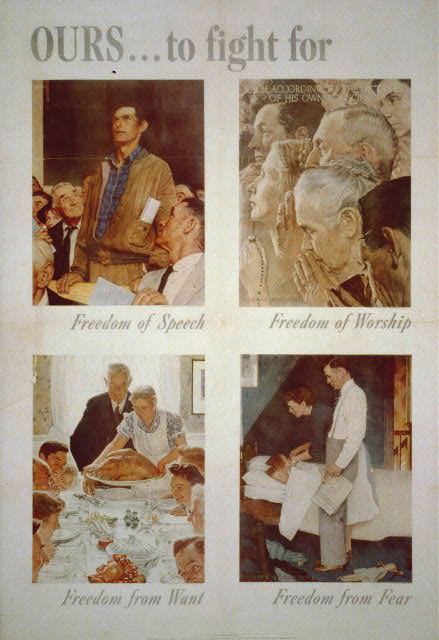
Art turned out to play an important role in keeping these ideals front and center, especially as the prospect of American sacrifice became a reality. The most famous example may be a series of paintings by Norman Rockwell (above), who was then and maybe still the greatest American illustrator. The Library of Congress explains:

Taken from Franklin Roosevelt’s 1941 speech to Congress, the “Four Freedoms” –Freedom of Speech, Freedom of Worship, Freedom from Want, and Freedom from Fear–became a rallying point for the United States during WWII. Artist Norman Rockwell created four vignettes to illustrate the concepts. Rockwell intended to donate the paintings to the War Department, but after receiving no response, the painter offered them to the Saturday Evening Post, where they were first published on February 20, 1943. Popular reaction was overwhelming, and more than 25,000 readers requested full-color reproductions suitable for framing.

Some will say that these Four Freedoms are today “controversial” because we don’t seem to be able as a nation—as an American family—to agree on the strategies to maintain and attain those ideals. Those disagreements are undeniable, as are the related invective, disparagement, and even hatefulness that goes with them. But those disagreements can’t make us give up. On the contrary, they should send us back to the words of FDR, getting past the ideologies and labels, and really look within and at the family of Americans.

Do you really believe that these ideals are exclusive to you, and not shared by others of good will? Are your principles and affiliations so very important that you would sacrifice those ideals to be “right?” Or can we come to the table, dig deeper, and not leave until we have given up a little of our own self-importance and focused instead on getting a little closer to the country and world envisioned in the shared Four Freedoms? And maybe just a little closer to each other?
Still Waiting for 21st Century American Politics

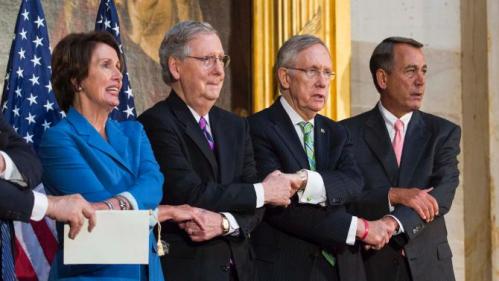
Pelosi McConnell Reid Boehner

We are still waiting for the emergence of 21st century politics in America.

The first part of this may seem simplistic and overgeneralized. The second part may seem silly. But this is about politics, so what can you expect?

1

Many Republicans seem to be stuck at some point in the 19th century—not just Robber Barons and the Gilded Age, but certainly that. Many Democrats seem to be stuck with some version of 20th century progressivism—not a bad thing, by any means, but constructed in a different world under different circumstances.

2

Forget the bourbon and beer political summits. The President, Mitch McConnell, Harry Reid, John Boehner, and Nancy Pelosi should take advantage of D.C.’s new legalized marijuana and share the peace pipe. The scripts would fall away, they would be channeling some different higher power. (Question: Which of these, besides Obama, has actually smoked pot before? Answer: All of them, even if it was just a puff, even if it was just a dare, even if they didn’t inhale.)

Music and food might be issues. Not knowing their individual tastes, and if the point is to get to a better and more creative, communal, and enlightening space, Bob Marley could do the trick. Shoulders swaying, spirits lifting, to the heavenly prayer of One Love.

Food? Whatever’s in the fridge.

3

As I said, simplistic, overgeneralized, and silly. But if politics keeps trying to recreate some ideal of a bygone era, country, or world, two centuries ago, one century ago, fifty years ago, it won’t work. Yes, of course there are timeless values that deserve our allegiance. But these are always set in temporal realities. Being current means more than just being “relevant” or using the latest technologies to drive your message home or appealing to ascendant populations. It means that however much you love the way it was, just inhale, exhale, and breathe the air of 2014, 2016, and beyond. Because, politicians, it’s not your parents’ air—it’s not even yours.

Ebola Stress Test

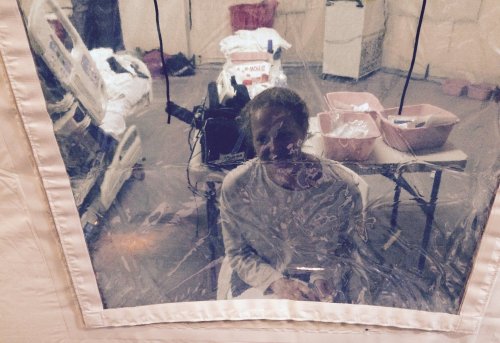
Kaci Hickox

Stress tests. We see them in medicine, in banking, in construction.

How well will the patient’s heart perform when he is on a treadmill? How sound are a bank’s finances in the worst case scenario? How will building materials stand up under maximum pressure?

Public crises are stress tests. So far, Ebola is the latest demonstration of the tendency for our civic infrastructure to crack—or show signs of it—under pressure.

Quietly, where no one can hear, some leaders and citizens are probably worried that if this was a real Ebola outbreak in the U.S., and not the thankfully tiny and so far isolated problem it is, we would fall apart. Utterly fail the test.

The latest episode concerns this weekend’s rapid response by multiple states to Craig Spencer, a doctor returning from West Africa and becoming sick with Ebola in New York City last week. In addition to New York and New Jersey, other states are now or may be requiring returning health care workers to be quarantined.

There is a problem: none of these states appear to have thought through any of it—most especially the practical aspects of whisking someone coming home from a heroic medical mission into isolation that is supposed to be comfortable, suitable, sensible, and sensitive under the circumstances. It now seems the scenario is act first, plan later.

Nurse Kaci Hickox is the first one caught in this trap. She is not sick and is showing no symptoms. Arriving at Newark Airport Friday night, she was taken to a tent behind a hospital, with a portable toilet, no shower, no television, and little cellphone reception. She castigated all involved, particularly Governor Chris Christie, who said she had symptoms and was sick, when she hadn’t and wasn’t. She plans a federal lawsuit challenging the quarantine.

“I also want to be treated with compassion and humanity, and I don’t feel I’ve been treated that way in the past three days. I think this is an extreme that is really unacceptable. I feel like my basic human rights have been violated.”

(Update: Governor Christie has relented, allowing her to return home to Maine, where, if you read between the lines, the message is that it will then be Maine’s problem to monitor her and where, if something goes wrong, it will be on their head.)

We seem to have forgotten how to solve problems, enthralled by our own voice either positing solutions, making points, or complaining. Or maybe it is that this is America, with a history of being bigger, stronger, smarter, and most of all, righter, in all circumstances. Even if that was ever true, politics—in the big sense of privileging positions over effective and thoughtful answers—has poisoned that well. Worthy questions and deliberate solutions are rejected out of hand because of the source, because they don’t fit some preconceived notion or program, or simply because they won’t help win or not lose elections.

Whether or not quarantine of heroic Ebola care givers returning from West Africa is a good idea, it is certainly a good idea to evaluate and plan exactly how you are going to practically handle it. Maybe, though, we shouldn’t be at all surprised. In recent years we did, after all, send hundreds of thousands of troops abroad, and when the promised rewards for their heroic service came due, we seemed unable to fulfill and, worse, were suddenly unenthusiastic about keeping the promise anyway.

If this is a war on Ebola, we better make sure we are committed to those who are sacrificing, part of which is actual planning and resourcing, not ignorant and reflexive pontificating and politicking. So far, this is looking too much like some of our other recent wars. Maybe we can use this as an opportunity to get better and be better at it.

Jonah, Yom Kippur, Iran and Irony

Mohsen Amir-Aslani

Sometimes coincidence is irony to the point of cruelty.

This week, the Book of Jonah is read as a part of the Yom Kippur service.

Last week, Iranian psychotherapist Mohsen Amir-Aslani was hanged for, among other things, insulting the prophet Jonah.

In a post last week, Jonah and the New Year, I gave free rein to biblical possibilities. I pointed out, “It is supposedly so simple a story that we tell it to the youngest children. It isn’t that simple.”

For many reasons, it is a good thing that I am not in Iran. It is also a good thing to be part of a faith and a country that not only tolerate interpretive iconoclasm but (theoretically) encourage and thrive on it. According to the report in The Guardian:

Mohsen Amir-Aslani was arrested nine years ago for his activities which the authorities deemed were heretical. He was engaged in psychotherapy but also led sessions reading and reciting the Qur’an and providing his own interpretations of the Islamic holy book, his family said….

According to the source, Iran’s ministry of intelligence was behind Amir-Aslani’s arrest. “He was initially held for making innovations in Islam and providing his own interpretations of the Qur’an but later he was accused of insulting prophet Jonah and also faced accusations of having sex outside marriage,”

This week, whether you read the Book of Jonah at Yom Kippur services or on your own, consider Amir-Aslani. We can do little directly about this aspect of Iranian life. And if we are not Muslims, there is little that we can do about the evolution of someone else’s religion, other than encouragement and modeling progressive behavior. The best we can do—and it is no small thing—is to honor openness in religion by demonstrating openness in our own religion. By supporting innovation, and making sure it is never tantamount to a capital crime.

Islamic State: Using Arithmetic to Solve Complex Equations

Riemann - Zeta Function

We are not playing three-dimensional chess in the Middle East—partly because all of us will go crazy if we hear that clichéd term one more time.

Instead, we are using arithmetic to solve very complex equations.

The Clay Mathematics Institute offers the famous Millennium Prizes, $1,000,000 each for solving their current list of unsolved mathematical problems.

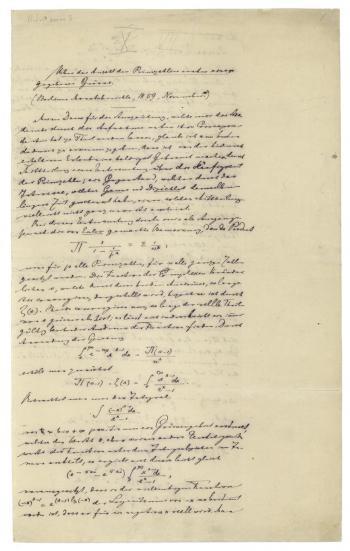
Here is description of the Riemann Hypothesis (a manuscript by Riemann of the Zeta function is pictured above):

Some numbers have the special property that they cannot be expressed as the product of two smaller numbers, e.g., 2, 3, 5, 7, etc. Such numbers are called prime numbers, and they play an important role, both in pure mathematics and its applications.

The distribution of such prime numbers among all natural numbers does not follow any regular pattern. However, the German mathematician G.F.B. Riemann (1826 – 1866) observed that the frequency of prime numbers is very closely related to the behavior of an elaborate function

ζ(s) = 1 + 1/2s + 1/3s + 1/4s + …

called the Riemann Zeta function. The Riemann hypothesis asserts that all interesting solutions of the equation

ζ(s) = 0

lie on a certain vertical straight line.

This has been checked for the first 10,000,000,000 solutions. A proof that it is true for every interesting solution would shed light on many of the mysteries surrounding the distribution of prime numbers.

Right now, in the early days of the campaign against the Islamic State, we are using arithmetic that goes something like this:

1 (U.S.) + x (number of participating nations with wildly different involvement and interests) – IS = conditional victory

The truth is much closer to complex mathematics, as complex as any we may have ever seen on the world stage. There are probably behind-the-scenes discussions that are more subtle, but here in the public we are somehow not supposed to bother our heads about that. The question of why we publicly don’t deal with it this way may be because our leaders can’t handle the truth or because they believe citizen/voters can’t handle the truth or, because of politics and wanting to be seen as doing something, a little of both.

Solving the problem is worth much more than a million dollars. But solving it will take more than simple addition, subtraction, multiplication, and division. There was a time when the world was like that, susceptible to those simple solutions. But those days and that world are gone. Our leaders don’t have to be able to attempt a solution to the Riemann Hypothesis. But they do have to recognize when grade school, old school strategies—when simple arithmetic—will no longer work.

The News and the Wheel

The Wheel - Jerry Garcia

The wheel is turning
and you can’t slow down
You can’t let go
and you can’t hold on
You can’t go back
and you can’t stand still
If the thunder don’t get you
then the lightning will

The Wheel
Jerry Garcia

If you are still listening to, watching, or reading the news, oh boy. If the world seems out of balance, that’s not just the news talking. That’s the way it is.

Thousands of U.S. troops sent to fight Ebola. No troops but planes and bombs to fight thuggish madmen disguised as religious fanatics whose organizational name we can’t keep straight. Honored gladiators beating their wives and children. Police shooting the people they are sworn to protect. The most powerful legislature in the world doing nothing when something is called for, something when nothing is called for, and blabbering on when silence is golden. Rampant use of destructive drugs, demonizing of less destructive drugs. Speaking of drugs, powerful pharmaceuticals interrupting your entertainment with the news that they can cure you, but may also kill you, harshly and slowly. And that’s just for starters.

Every time that wheel turn round
bound to cover just a little more ground

Won’t you try just a little bit harder
Couldn’t you try just a little bit more?
Won’t you try just a little bit harder?
Couldn’t you try just a little bit more?

Breathe. If it seems like madness, that’s because it is. But it’s our madness and we just have to live with it. Being strong and smart will move us forward, but it’s never enough. Being strong and smart will not, for example, cure our madness, and like those very high-tech pharmaceutical drugs, can do more harm than good. Misplaced confidence in our strength and our brains is like putting a thumb on the scale. Which is no way to get in balance.

We Are at War with ISIL but Not at War with ISIS

We are at war with ISIL, the White House has just announced. But only yesterday, Secretary of State John Kerry said we are not at war with ISIS.

As mentioned previously there seems to be some confusion about what to call this entity: ISIS, ISIL, or Islamic State.

And that explains it. President Obama is talking about one enemy. John Kerry is talking about another. That is, we are at war with one but not the other.

Seriously, not being able to decide on what to call an enemy is not unimportant. But it pales beside not being clear, within the administration, about whether this is war. And then trying to reconcile it by saying that whether you call it war or not is splitting semantic and legal hairs.

The White House would have been better off pleading confusion about which names the President and the Secretary of State were using.

There is something deeper in this talk about war. The explanation by the White House is that it is just like the “war” against al-Qaeda. There is no mention of the War on Terror, the War on Drugs, or other quasi-metaphorical wars. It isn’t that we haven’t had military conflicts with non-state actors. And Obama was clear in his big speech about the maybe-war: “ISIL is certainly not a state.” It’s just that whenever we do have stateless enemies, things get very confused and confusing.

If you don’t believe me, read our history. Or just watch and wait.

Obama Speech: Is It ISIS, ISIL or IS, and What is a True Religion?

Obama ISIS Speech

This is not a comprehensive review of last night’s speech by President Obama about ISIS/ISIL/IS. But if you asked me to join the millions of reviewers, descriptors that come to mind are lukewarm, vague, uninspiring, insufficiently informative, tactical (the speech, not the plan), and blah-blah-blah.

Here is one paragraph that stuck out, because it reflects two issues that may not get enough attention:

And one of those groups is ISIL — which calls itself the “Islamic State.”

Now let’s make two things clear: ISIL is not “Islamic.” No religion condones the killing of innocents. And the vast majority of ISIL’s victims have been Muslim. And ISIL is certainly not a state. It was formerly al Qaeda’s affiliate in Iraq, and has taken advantage of sectarian strife and Syria’s civil war to gain territory on both sides of the Iraq-Syrian border. It is recognized by no government, nor by the people it subjugates. ISIL is a terrorist organization, pure and simple. And it has no vision other than the slaughter of all who stand in its way.

What Is the Name of This Enterprise That We Are at War Against?

Is it ISIS, ISIL, or Islamic State? This is much more significant than whether the English transliteration of the name of the Egyptian President was Morsy, Morsi, or Mursi or the Libyan dictator was Gadhafi, Qaddafi, Kadafi, Gaddafi, or Gadafy. This is our new mortal enemy, and besides, all these IS names are in English.

Different nations and different news media have different approaches to this. The BBC, for example, has settled on Islamic State, apparently opting for whatever the organization chooses to call itself. What is totally strange about the “official” U.S. nomenclature is that at the highest levels, there is no consistency. The President prefers ISIL, while those in his cabinet regularly use ISIS.

One small matter about ISIL does deserve note. The full name is the Islamic State in Syria and the Levant. I challenge many in the administration, and many in Congress, and many in the media, to explain—without Google or cheat sheet—what the Levant is. For five hundred years or so it has described the land of the eastern Mediterranean, now roughly comprising Syria, Lebanon, Israel, and contiguous countries. The word comes from the French word for “rising”, as in the east where the sun rises. It isn’t much in use any more, outside of scholarly circles and, of course, in our latest war.

So please, President Obama, if you are gathering the support of dozens of nations and hundreds of millions of Americans, let’s all decide on what to call this organization that, in the words of Vice President Joe Biden, we will pursue to the Gates of Hell.

What is a True Religion?

“No religion condones the killing of innocents,” the President said. Without going into historic and contemporary detail, this is patently false. I believe the President knows better, but he didn’t want to get into a deep discussion, and instead just wanted to make a rhetorical flourish. If he doesn’t know, there are thousands of histories he can read and scholars he can consult, or even easier, news reports from the past few weeks, months, and years he can read.

If, however, he really did mean it, he has disqualified the majority of world religions from being classified as such. Which, by the way, plenty of critics of religion would applaud.

The President doesn’t have to be the Teacher in Chief, the Scholar in Chief, the Explainer in Chief, etc. Being Communicator in Chief is enough of a job, but if he just wants to say stuff for effect, without regard to its making sense or being true, we’ve already had plenty of that in years past, from those less smart or thoughtful than you. We get enough nonsense from many in Congress. Speak as if some of us are actually thinking about what you say. Because some of us are.

The Abstract Perpetual War Is Real

Rome

Consider this: If you have a child or grandchild age 12 or younger, they have lived their lives with America at war.

And this: In six years that child will be old enough for military service, but will not necessarily have to serve because we have no mandatory universal service. So even if we are still at war, that child is probably not at risk.

And this: Why don’t we have mandatory universal service, especially if we are in perpetual war? Do we have perpetual war because we don’t have mandatory universal service?

Michael Auslin, a Resident Scholar at the American Enterprise Institute, has a fascinating piece in Politico about the prospect of a perpetual war footing, Don’t Do As the Romans Did… His politics may not be yours, but his analysis is compelling and worth reading in its entirety:

For Washington, which has already spent at least $2 trillion on relatively limited wars in Iraq and Afghanistan, the prospect of decades more competition, deterrence and fighting at an unknown cost represents the greatest security challenge since the Cold War, and perhaps since World War II. It is just as much a domestic political issue, and will figure as prominently in the debates over the future direction of the country, as do the battles over Obamacare, the regulatory burden or the transformation of the economy. Yet so far, it does not seem that either the country’s political elites or ordinary citizens have fully appreciated both the scope and, more importantly, the nature of America’s new two-front conflict. They soon will, as the country’s economic health and domestic political stability will be directly affected by rising global risk. To quote Leon Trotsky, “You may not be interested in war, but war is interested in you.”

Americans must accept the fact that, while their country may not be engaged in daily fighting, neither will it know peace for the foreseeable future. The world will become far more insecure and unstable over the next decades, and the amorphous yet crucial idea of global “order” will be strained, perhaps to the breaking point.

America’s greatest strength is also its greatest weakness. The spirit of can-do, roll up your sleeves, and in the words of Larry the Cable Guy, “get ‘er done” is a model for the world. But a related failure to think things through, apply broad and deep vision, and act deliberately and more slowly, can neutralize or outweigh the benefits of that spirit.

Living in the moment, in the now, is a great way for people to not be mired in the mistakes of the past and not be intimidated by the hypothetical misfortunes of the future. That is, unfortunately, not a luxury that nations, particularly super powerful ones, have. When you can spend trillions of dollars of your citizens’ money, send thousands of citizens to their deaths, and have the potential to blow up cities and the whole world, we expect you to think twice or more before you roll up those sleeves and get ‘er done.

Do Something/Anything about ISIS? Would You Rather Have No Strategy or Bad Strategy?

Just Do It

President Obama candidly admitted that we have no strategy for dealing with ISIS, but that we are developing one.

Maybe too candid for the moment and his leadership position, but still a necessary truth. Necessary because no one on earth has a good strategy for dealing with that or the complex of situations around the world right now. For the religiously inclined, consider that Moses, Jesus, and Mohammed convening in the Situation Room would have a tough time figuring out what to do next, short of calling in the Big Gun and wiping the slate clean and starting again.

This hasn’t stopped Congress from urging a simple solution to this puzzle: do something/anything. This is an all-time irony, given that Congress is currently infamous for doing absolutely nothing, ever, no matter how important the problem and no matter how relatively simple the solution. If a number of the members had a sense of irony, we could all wryly laugh at this, except that their sense of irony is absent, along with a sense of duty, democracy, and Americanism (the real kind, not the fake). Some of these same members do seem to have a sense of justice, John Wayne frontier justice, which is unfortunately out of place in the liquid world of 2014 global politics and insurgency.

A few years ago, some thought that democracy would spread around the oppressed nations like an epidemic, like Arab Spring fever. But chaos is also an opportunistic contagion, and as those on one insurgent or imperialist front look at the other fronts multiplying, they see opportunity and seize it. It doesn’t help that the geography is claustrophobic. If you don’t know it, connect the dots from Iraq to Syria to Israel to Gaza to Egypt, Sudan, and Libya. And that’s just one pole of the current dynamic.

We have been tragically mistaken on strategy in the last three major American wars. One was an abject defeat, the other two—Iraq and Afghanistan—have sort of ended, with an indeterminate outcome, and withdrawal that may or may not last. Let’s pull back from partisan finger-pointing, and just admit that some situations—whether you choose to demur or however you choose to engage—may have outcomes, but may not have solutions.

You can be smart or stupid, fearless or timid, right or wrong, and you can still be overwhelmed by circumstances. That is, there is no “perfect” strategy, especially not with the way things are aligning. So no, you can’t wait for that perfect strategy. But you also shouldn’t rush in with the next idea that comes into your head, especially if that idea comes from some outdated playbook that has already proven itself ineffective in current realities.

“Just do it” sounds great, as long as you spend sufficient time really considering what “it” is and what the consequences and outcomes might be. Oh, and also, you might try being candid, as Obama has been, rather than making stuff up. Like about WMDs. Like about wars that will last weeks and cost nothing. Let’s leave that sort of unhelpful lying to fairy tale tellers like Vladimir Putin, who is not invading Ukraine, and to Putin’s admirers and portrait painters.