Bob Schwartz

Category: Food

Govern a nation as you would fry a small fish

Sardine

A message to candidates and voters from the Tao Te Ching. It is the first line of chapter 60, in various translations. Please read and feel free to interpret as you like. Comments are welcome.

If I were moderating a presidential debate, I would simply recite this line and ask Hillary Clinton and Donald Trump what this means to them. What illuminating fun that would be.

Govern a nation as you would fry a small fish.

Directing the flow of affairs of a large country
Is like cooking a small fresh fish.

Govern great nations
like frying small fish.

Ruling a large country is like cooking a small fish.

Taco Trucks on Every Corner. Pizza Shops Too.

Latinos for Trump founder Marco Gutierrez said yesterday “My culture is a very dominant culture. And it’s imposing, and it’s causing problems. If you don’t do something about it, you’re going to have taco trucks on every corner.”

This was meant as a comment on immigration, not food. Without going into the complexities of immigration or the bizarre backwardness/cluelessness/meanness of the Trump campaign, it does make you think about the connection.

If we had done something about the Italians (and we tried) maybe we wouldn’t have pizza shops on every block. Same for the Chinese and Chinese restaurants. Same for Eastern European Jews and bagel shops. And so on.

We do have pizza shops and/or Chinese restaurants and/or bagel shops on many blocks, even in the smallest towns. Taco and burrito shops too. We are better for it. This probably doesn’t tell us how to deal with the very difficult issue of immigration. But it does tell us something about America and American values and American culture. Just as the remark by Gutierrez tells us something hard to digest about Trump and some of his followers.

Stale Donuts: What I Share with Ted Cruz

Donut

This is a true and inconsequential story.

I may not be as smart as Ted Cruz. But he and I share something important.

Ted has said he loves donuts. I love donuts.

Donuts get stale, somewhat quickly. Donut lovers devise ways to freshen stale donuts.

On the campaign trail, Ted has talked about refreshing stale donuts (really). He says he puts them in a microwave for 12 seconds.

I also have a technique for refreshing stale donuts. I put them in a microwave for 10 seconds. (Too much microwaving can destroy their delicate texture.)

So while he and I share this love, we disagree slightly on this. We have bigger disagreements on other matters, of course.

I did not clerk for a Supreme Court Justice. I am not running for President. Etc. So maybe Ted’s 12 seconds are better than my 10 seconds. If you’d like, you can try it for yourself.

Matzo: Dealing with Eating the Bread of Affliction

Organic Spelt Matzo

Matzo is referred to as “the bread of affliction,” symbolizing the exodus of the Jews from Egypt, who didn’t have time to allow the bread to rise as they fled through the wilderness. Talk about flatbread, this is the ultimate.

If you are observing the Passover and avoiding bread for the next week, or even if you’re not, some thoughts about eating matzo.

  1. Put away the toaster. Save the counter space. You won’t need it for bread. And you can’t toast matzo. Even if you could, it would slip through the slot.
  1. Make matzo brei for breakfast. Matzo brei is kind of a cross between pancakes and French toast, made by soaking matzo in water, mixing it with eggs, and cooking it in a frying pan. Delicious all year round. You don’t have to Jewish and it doesn’t have to be Passover.
  1. Try all the varieties of matzo, or at least the ones that don’t seem a little extreme (Organic Spelt, I’m looking at you). Once upon a time there was only plain matzo, just like there used to be plain white bread. Now everything is mixed in: Egg, Yolk-Free, Egg and Onion, Spelt, Mediterranean, Whole Wheat, Garlic and Rosemary, and Everything (which actually doesn’t have everything, just garlic, onion and poppy seeds. Go figure.)
  1. Don’t try to make sandwiches. At the seder, the tradition is to eat a tiny sandwich of horseradish and haroset (a sweet paste representing the mortar of the building the Jews slaved on) between two pieces of matzo. The great sage Hillel supposedly created this sandwich, and his name is attached to it. Even this tiny sandwich throws matzo crumbs all over the place. A full-size matzo sandwich is not a good idea. No matter how wise Hillel was.

Happy Passover.

Outsmarting a Coffee Machine

Zen Tea

When I arrive at my hotel room, I find a very modern coffee machine. Very smart. It tells me to place the coffee pod in its holder. Close the lid. Another lid opens to accept water. Pour in water and close that lid. Place the cup on the pedestal, which it then knows is in place. Press the brew button. And in a matter of seconds, hot coffee.

But what if I just want hot water? Then I have to outsmart it. When it directs me to place the coffee pod in its holder, I don’t. I just pretend. I put the water in the tank, put the cup in place, and proceed as if what I want, what I am expecting, is a cup of coffee. What it gives me instead, what I want instead, is simply a cup of hot water. Which I can then use for any of the things you can do with hot water. Such as making a cup of tea with a teabag.

The machine is smart. Or I am smart. The machine is stupid. Or I am stupid.

Have a cup of tea.


Zhaozhou’s Cup of Tea
(Koan 233 of Zen Master Dogen’s Three Hundred Koans)

MAIN CASE

Zhaozhou asked a newly arrived monk, “Have you been here before?”

The monk said, “Yes, I have been here.”

Zhaozhou said, “Have a cup of tea.”

Later he asked another monk, “Have you been here before?”

The monk said, “No, I haven’t been here.”

Zhaozhou said, “Have a cup of tea.”

The monastery director then asked Zhaozhou, “Aside from the one who has been here, why did you say ‘Have a cup of tea’ to the one who had not been here?”

Zhaozhou said, “Director.”

The director responded, “Yes?”

Zhaozhou said, “Have a cup of tea.”

COMMENTARY

In the real truth, there is no other thing that is present. In worldly truth, the ten thousand things are always present. We should clearly understand that real truth and worldly truth are nondual and that this, in and of itself, is the highest meaning of the holy truths.

The monastery director was lost in the differences between the two monks, so Zhaozhou moved in all directions at once to help him see it. If you go to the words to understand this, you will miss it. If, however, you see into it directly, it will be like the bottom falling out of a bucket. Nothing remains. How do you see into it directly? Have a cup of tea.

Samsung’s Fruit Identity Crisis

Apple Banana

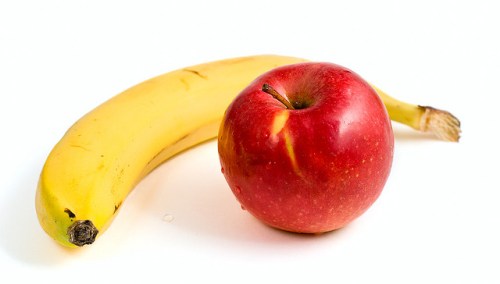
Samsung wants to be an apple. What it fails to understand is that it was on its way to being a banana: basic, useful, nutritious, delicious—and ultimately way more interesting and even sexier than an apple.

Instead, it tried to be a bunch of different fruits, bigger and smaller, adding and subtracting features and flavors. In the end, it’s like one of those odd and unusual fruits that you see in Whole Foods but don’t know the name of, and don’t care because you pretty much still prefer bananas.

Okay, that’s not their only problem. They developed durable devices that worked better than well and didn’t really need replacement very often. (Apple solved this problem by convincing its tribe to switch from Fuji to Golden Delicious to Jonathan, even though they were still and all just the same fruit. Samsung couldn’t get away with this.) Samsung eliminated core features that people really liked, such as slots for a memory card. On top of that, Samsung has to deal with having a mediated channel, where wireless providers are still the last marketer and last link between them and the consumer. The feelings of most digital consumers towards their digital service providers range from frustrated tolerance to outright disgust. So having those companies as your “salespeople” is never going to be ideal.

There may not be a good solution for Samsung, at least not one that will maintain their thwarted expectations of ever-increasing sales and profits. But one thing they might do is stop thinking about apples and start thinking about why and how much people really love bananas.

Honeywell Kitchen Computer and the Delights of Old Tech

Kitchen Computer - Menu Selection

Some people love old cars. Others of us delight in old digital tech.

We are not alone. The latest episode of Mad Men on AMC includes the installation of a computer at the agency. And the new AMC series Halt and Catch Fire is (coincidentally?) about the early days of personal computing. (Halt and Catch Fire is a real/apocryphal/funny code instruction that might send a computer into an endless loop, resulting in its ultimately stopping or bursting into flames.)

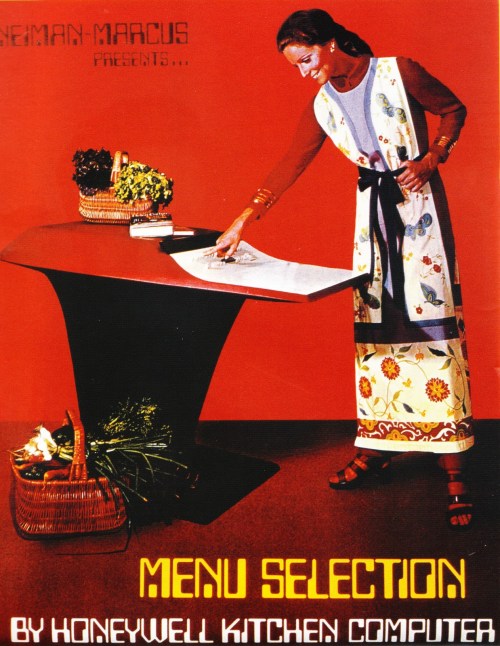
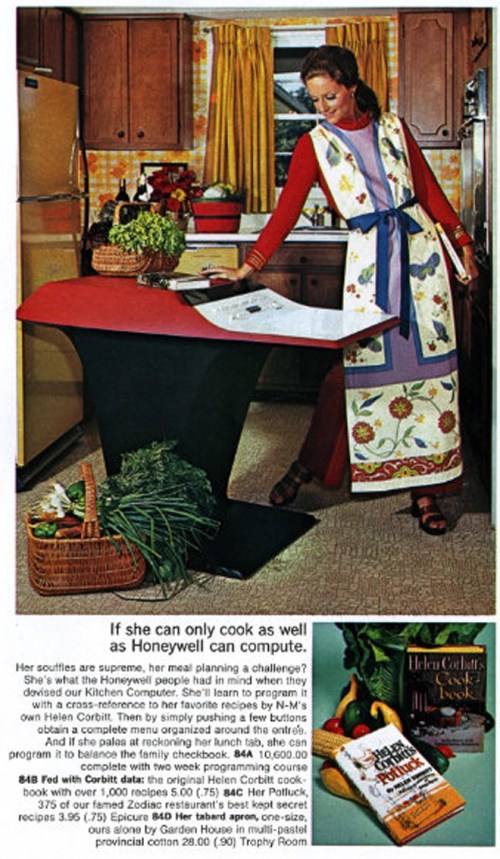
This is a page from the Neiman-Marcus Christmas 1969 catalog. The impeccably dressed N-M housewife is standing next to what appears to be an unusual table, but is actually the Honeywell Kitchen computer, which can be purchased for $10,000. (The apron will cost you another $28.) “If she can only cook as well as Honeywell can compute.” Indeed.

Kitchen Computer

Here is something completely different from the era, prophetic rather than silly. It is Isaac Asimov, a science fiction great, advertising Radio Shack’s TRS-80.

Asimov - TRS-80

Note that in the spirit of what goes around comes around, this is a pocket computer almost exactly the size of a smartphone—or is a smartphone a pocket computer exactly the size of a TRS-80? Either way, Neiman-Marcus and Honeywell were clueless, but Asimov and Radio Shack were not.

That would be a pretty good close for this post. Except that the following ad is irresistible, telling us something else about the early days of computing.

TSP Plotter

Just as cars were, and to some extent still are, sold by using sex, sometimes so were computers. This is an ad for a plotter, possibly the least sexy of all peripherals. The copy is mostly bone-dry and technical. But then there’s the trio of the model with her dress open to her navel, the headline “New, Fast, and Efficient!”, and the lead “The TSP-212 Plotting System is a real swinger.” $3,300 COMPLETE. Well, almost complete, as the model is presumably not included. But you know, that cool plotter just might attract one.

Thanksgiving and Hanukkah in America: A History

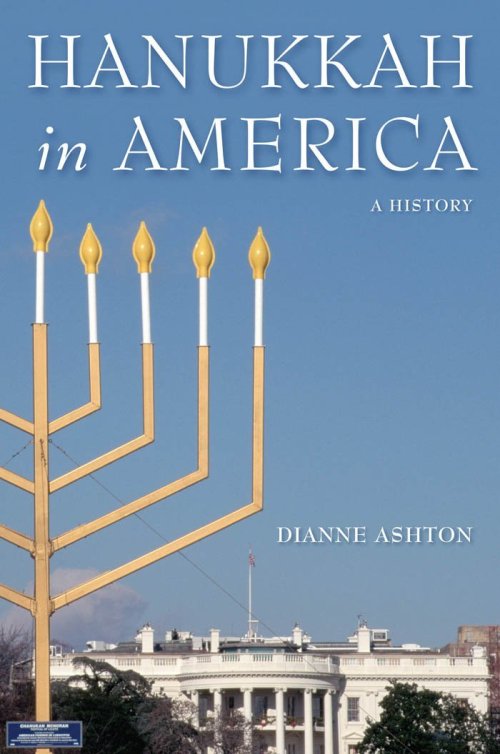
Hanukkah in America
Hanukkah is getting lots more attention this year than it usually does, because it starts on Thanksgiving, rather than on or about Christmas.

This is nearly unprecedented. Of course there’s lots of controversy about just how rare it is, partly because Thanksgiving has officially moved from the last Thursday in November to the fourth Thursday, partly because the Jewish calendar is a lunar calendar, partly because of some esoterica of interest to extreme calendar freaks. Some say it won’t happen again for 70,000 years, others say it will never, ever happen again. If you happen to be around when it does, if it does, please e-mail, post, tweet, or whatever sort of advanced messaging will be used then to communicate with the curious but departed.

Thanksgivingukkah, or whatever other ridiculous and ear-hurting names people are coming up with, is second only to Black Friday as a cultural meme this week. We will be seeing lots of turkeys with Hanukkah candles stuck in them—actual ones, not just Photoshopped ones, at actual Thanksgiving tables, with plenty of videos to prove it. Might even see some turkey selfies. On the food front, we will have combined cuisines, where things not usually seen on the Thanksgiving table make an appearance, such as latkes and sour cream. (Note: I am promoting latke stuffing as the best of all possible hybrids.)

There’s a lot to talk about when Hanukkah and Christmas collide and coincide, theologically, historically and socially. Both involve charismatic Jewish religious leaders taking on tyranny—though one battles on the military and political front, while the other wields an entirely different set of weapons. As a central theme, both at some point take on the profaning of the Temple, in one case made unholy by soldiers, in the other made unholy by turning sacred space into a commercial enterprise. Both involve miracles and miraculous lights challenging the darkness. Not to mention that at the time of Jesus, Jews knew and marked the events of the Maccabee revolution, which had taken place less than two hundred years earlier.

Whether you are Jewish, or just newly fascinated by Hanukkah because it is for once not getting lost in the Christmas mishegas (“craziness” in Yiddish), have I got a book for you. Hanukkah in America: A History by Dianne Ashton is more than just a review of how American Jews regarded and celebrated this once-minor holiday. It is the definitive and delightful book about how Hanukkah evolved to become a laboratory for what it means to be a Jew in America, and for that matter what it means to be Americans of any kind.

Here’s something Ashton writes about Thanksgiving and the “deluxe Hanukkah turkey dinner”:

Many Jews combined food products available in America with recipes they deemed appropriate for Hanukkah meals. Even with a simple meal at home, immigrants could imagine a different Hanukkah past than the one in Eastern Europe. They could envision a personal bond with Judah Maccabee by selecting Carmel wine, which claimed to be “what the Maccabees drank.” Local food shops such as Goldman’s Tea and Coffee Store held special sales in honor of Sabbath Hanukkah. Jewish restaurateurs sometimes targeted immigrants’ desires for American foods at special occasions. Perhaps no food is so identified with America as the turkey, an animal native to North America and the featured dish of the Thanksgiving dinners that take place across the country only a few weeks before Hanukkah. When Gorfein’s, a kosher restaurant, advertised a deluxe Hanukkah turkey dinner in the Forverts, it apologized in print the next day to “hundreds [who had to be] turned away” because the restaurant “had no space or food left for them.” Gorfein’s offered the same dinner a second night.

My usual Hanukkah post, sometime around Christmas, ends with a mention of a wonderful Comedy Central special, A Colbert Christmas: The Greatest Gift of All. Our comic saviors Jon Stewart and Stephen Colbert perform the song Can I Interest You In Hanukkah? with Stewart making the case for the Jewish holiday:

Jon: Can I interest you in Hanukkah? Maybe something in a Festival of Lights. It’s a sensible alternative to Christmas. And it lasts for seven – for you – eight nights.
Stephen: Hanukkah huh? I’ve never really thought about it.
Jon: Well, you could do worse.
Stephen: Is it merry?
Jon: It’s kind of merry.
Stephen: Is it cheery?
Jon: It’s got some cheer.
Stephen: Is it jolly?
Jon: Look, I wouldn’t know from jolly. But it’s not my least unfavorite time of year.
Stephen: When’s it start?
Jon: The 25th.
Stephen: Of December?
Jon: Kislev.
Stephen: Which is when exactly?
Jon: I will check
Stephen: Are there presents?
Jon: Yes, indeed eight days of presents. Which means one nice one, then a week of dreck.
Stephen: Does Hanukkah commemorate events profound and holy? A king who came to save the world?
Jon: No, oil that burned quite slowly.
Stephen: Well, it sounds fantastic!
Jon: There’s more. We have latkes.
Stephen: What are they?
Jon: Potato pancakes. We have dreidels.
Stephen: What are they?
Jon: Wooden tops. We have candles.
Stephen: What are they?
Jon: THEY ARE CANDLES! And when we light them, oh the fun it never stops. What do you say, Stephen, do you want to give Hanukkah a try?
Stephen: I’m trying see me as a Jew. I’m trying even harder. But I believe in Jesus Christ
So it’s a real non-starter.
Jon: I can’t interest you in Hanukkah? Just a little bit?
Stephen: No thanks I’ll pass. I’ll keep Jesus, you keep your potato pancakes. But I hope that you enjoy ‘em on behalf of all of the goyim.
Jon: Be sure to tell the Pontiff, my people say “good yontif”.
Stephen: That’s exactly what I’ll do.
Both: Happy holidays, you
Jon: too!
Stephen: Jew!
Jon: Too?

That’s it for this holiday mashup. Read the book; it’s great. Celebrate religious freedom by eating too much food. Spin the turkey. Light the candles. But whatever you do, don’t smoke the turkey, because it is impossible to keep that thing lit.

Happy holidays. Be safe.
Good Gadgets Cheap: Logitech S120 Speakers

Logitech S120
Thousand dollar computers. Five hundred dollar smartphones. Ten dollar speakers.

Sitting on the counter, framing the food processor, mixer, blender and coffee grinder, are a pair of Logitech S120 speakers. Ten bucks, more or less; these come off the shelf from Walmart. They fill the kitchen with decent sounding symphonies, and the sound isn’t too bad overheard in adjacent rooms either.

You could splurge and go for the Z130 and get 5 watts instead of 2.3 watts, at about twice the price. You may already have a more powerful audio setup, one that really offers mind-numbing volume and fidelity to satisfy the most discerning listener. Good. But in that space where you just want to plug your phone into something and happily listen, this can’t be beat.

The bigger point may be that happiness and satisfaction come in lots of packages, and they are not all precious and expensive. Just because it cost only ten dollars doesn’t mean it won’t turn making breakfast—and maybe your whole day—into something special.

In Praise of the Bialy

Bialys
Time for a little geo-chauvinism, at least as it concerns a particular food.

Living and travelling around the country and the world, you experience the delightful variety of foods that have been cultivated in all those different places. Some have spread nationally and globally, others have remained relatively local.

Bagels seem to be almost everywhere now, though the versions served are like the variety of things called pizza: some are special, some are seriously questionable. But growing up in New York, we ate the bagel’s eccentric sibling, a breakfast roll known as a bialy.

The bialy not only didn’t evangelize the world; the number of bialy bakeries in New York is actually shrinking. To understand what you and much of the world are missing, this description by Bell Bialys in Brooklyn:

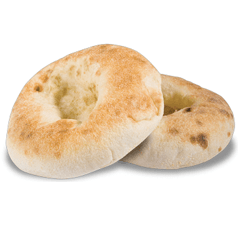
Named after Bialystock, Poland, which was made famous through the musical Fiddler on the Roof, a bialy combines the flavors of an English muffin and a bagel. This flat, round baked product is low in calories, fat and cholesterol, with no sugar or oil added. The texture of the top and the bottom of a bialy are distinctively different. The top is light and crunchy while the bottom is heavier and chewy.

The creation of a quality bialy takes great skill and consistency. Following over 50 years of tradition, the Bell Bialy is still “pulled” by hand with the middle indented by thumb, and freshly grated onion mixture spooned into the indentation before the bialy is placed into the oven.

Of course writing about bialys is like dancing about art. We are all adults here, so look at it this way: if a bagel is like satisfying but routine sex, a bialy is like the act or position so simple yet sublime that you wonder why you’ve never tasted it before—and wonder when you can do it again.

Flour, water, onions.Unlike bagels that are more dressed up than Barbie, you would no sooner put cranberries in a bialy than you would put them in a communion wafer. It’s not that it would violate any dietary laws, but it would be culinarily trayf—an affront to God and your taste buds.

Find a bialy. Eat a bialy. They are sold by Bell and other bakeries to distributors and retailers in the Northeast, Florida, California and elsewhere. If you don’t find it, ask, even if you have to explain what a bialy is—no small task if you yourself have never had one. It is worth it. Breakfast will never be the same. Once you’ve had bialy, well…