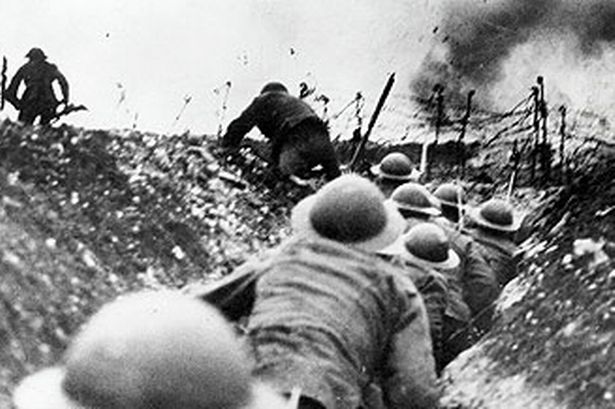
Today is Warriors Day. We call it Veterans Day, which intentionally or inadvertently distances it from a harsher reality. It began in 1919 to commemorate the Armistice that ended World War I, the War to End All Wars.
Who is a warrior?
In broad terms, all of us are warriors of some sort, battling for causes and ideals ranging from the personal to the cosmic, and everything in between. We fight for ourselves, our families, our nation, our ideologies, our traditions.
But the warriors of Warriors Day are something very specific. These are the people we delegate to fight for us, for causes that we deem significant enough to sacrifice their safety, their bodies, their lives. Under threat, current or prospective, real or perceived, we sacrifice them and peace so that we might ultimately have peace.
What should we do?
After the fact of war, we should keep whatever promises we make to warriors—without adjustment, equivocation, or renegotiation. World War I provided one of the most egregious instances of this. World War I veterans were not to receive full payment of their service bonus until 1945. But the Depression left many of them destitute. Thousands of them marched on Washington in 1932, seeking an advance of this payment. The letter of the law dictated waiting; the spirit of their sacrifice and hardship demanded payment. The Bonus Marchers were violently dispersed, though in 1936 Congress met the demands—over FDR’s veto.
Before the fact of war, we should consider everything involved. Really consider, not just blow hard self-righteously and politically. This is easier for those who have actually been warriors, though that number is decreasing as a proportion of our population, especially among our politicians and policy makers. Those veterans may or may not be able to sort through and articulate all the issues of our most complex geopolitics ever, but they can do something home front folks can’t—relive the experience of being a warrior.
Demand truth. Truth is said to be the first casualty of war, including pre-war and post-war. Right now, for example, Obama’s talk about “advisers only” in Iraq is making some veterans, particularly those of Vietnam, shake their heads. Col. Jack Jacobs, an NBC commentator, observed this morning that his experience as an “adviser” in Vietnam inevitably involved combat.
What about peace?
Peace, the absence of conflict at all levels, may not be a possibility. But that doesn’t mean it shouldn’t be our default position, the one from which all other circumstances are an aberration. For whatever reasons, conflict seems to be the default position for some, including those in positions of power and influence. There are things worth fighting for, but before moving forward, we need to be much surer of what those things are, how we are going about the fight, and how honest we can be. Most of all, if it is someone else doing the fighting at our command, we must realize that we are totally answerable for the consequences, as uncomfortable and costly as that might turn out to be.


