Bob Schwartz

Tag: Woody Guthrie

Woody Guthrie + Hanukkah = A wondrous musical miracle!

The story of the Hanukkah songs written by Woody Guthrie (1912-1967) is a wondrous musical miracle.

In more than 3,000 songs, including the true American national anthem This Land Is Your Land, Woody Guthrie chronicled the struggles of working-class Americans and championed labor rights, social justice, and resistance to oppression.

Then there is the story of Woody Guthrie and Hanukkah:


In 1942, Woody Guthrie moved to Brooklyn and married Marjorie Mazia, a Jewish dancer with the Martha Graham Dance Company. They lived across from Marjorie’s mother, Aliza Greenblatt, a respected Yiddish poet and activist. Through his close relationship with Greenblatt, Guthrie became acquainted with Judaism, studying Jewish texts and history and sharing songs with his mother-in-law.

In the late 1940s (primarily 1949-early 1950s), Guthrie wrote several Hanukkah songs, some for local Brooklyn community centers where he had bookings for children’s Hanukkah parties, and some for his own children. He identified the Jewish struggle with that of displaced Oklahomans and other oppressed peoples, filling notebooks with lyrics about Hanukkah, Jewish history, and spiritual life.

The remarkable twist came decades later. After Guthrie’s death in 1967, these songs sat forgotten in his archives for almost 30 years until his daughter Nora discovered the Hanukkah lyrics around 1998. Nora asked the Klezmatics, a Grammy-winning klezmer band, to compose new music for her father’s unpublished lyrics. The result was the 2006 album “Woody Guthrie’s Happy Joyous Hanukkah,” which blended klezmer with American folk and bluegrass.


If you don’t know much or enough about Woody Guthrie, Hanukkah or klezmer music, this is the perfect opportunity to listen and learn.

Election Day Music: This Land Is Your Land by Woody Guthrie

This land was made for you and me.

Poetry As Insurgent Art

3c13276r

Lawrence Ferlinghetti is celebrated as a poet, as founder of City Lights Books in San Francisco, and as a pioneer publisher of cutting-edge poets of the 1950s and 1960s (sometimes identified as Beat poets), most famously Allen Ginsberg. Ever a cultural and social activist, Ferlinghetti published in 2007 a tiny book called Poetry as Insurgent Art:

I am signaling you through the flames.

The North Pole is not where it used to be.

Manifest Destiny is no longer manifest.

Civilization self-destructs.

Nemesis is knocking at the door.

What are poets for, in such an age?
What is the use of poetry?

The state of the world calls out for poetry to save it.

If you would be a poet, create works capable of answering the challenge of apocalyptic times, even if this meaning sounds apocalyptic.

You are Whitman, you are Poe, you are Mark Twain, you are Emily Dickinson and Edna St. Vincent Millay, you are Neruda and Mayakovsky and Pasolini, you are an American or a non-American, you can conquer the conquerors with words….

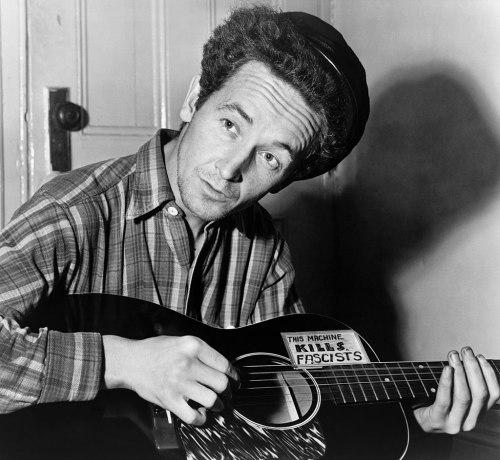
Woody Guthrie, godfather of modern protest music, was another artist who believed in the insurgent power of poetry and song. In 1941, he wrote and peformed Talking Hitler’s Head Off Blues. He followed that by adorning his guitar with this now iconic message, beloved by musical radicals everywhere: THIS MACHINE KILLS FASCISTS.

So the question arises for every creator. Can a poem be an instrument of insurgency? Can a guitar and song actually talk Hitler’s head off and kill fascists?

The targets of reactionary politics and authoritarian rule are your body, your mind and your heart. When any of the three are damaged, thoughtful and sincere resistance and progress are more difficult. When all three are healthy and vital and hopeful, all is possible. Ferlinghetti’s poetry and Guthrie’s fascist killing guitar and thousands of other creations can inspire and embolden us to sing and believe and wisely strategize together, like a chorus, like an army. If we listen and act.