Bob Schwartz

Tag: Ukraine

UN Security Council Meeting on Ukraine today: While Russia crudely and cruelly lies, Ukraine cites two Samuel Beckett plays

Waiting for Godot (not the UN Security Council)

Russia is a place of great and lasting culture. Russia has also been a place of great cruelty. This is going on right now, in their years-long war on Ukraine, and on the lies told today in the UN Security Council.

Right after the Russian representative spoke, it was the turn of Ukraine. It was one more of the courageous and articulate presentations of the desperate circumstances that Russia continues to inflict on Ukraine. It is a situation not helped by Trump’s Putin-inspired/Putin-demanded ambivalence that increasingly suggests he is willing to give up on Ukraine and Europe and let Russia have its way.

One of the many standout moments of the Ukraine presentation was framing it by reference to Samuel Beckett and two of his plays. If diplomats are regularly so spot-on erudite, I am not well aware of it.

A primer on Beckett and the plays:


Samuel Beckett (1906-1989) was an Irish playwright, novelist, and poet who became one of the most influential writers of the 20th century.

He initially wrote in English but later adopted French as his primary literary language, often translating his own works between the two.

Waiting for Godot (1953) made him internationally famous and established him as a leader of the Theatre of the Absurd movement. His work is characterized by dark humor, minimalism, repetition, and explorations of human suffering, meaninglessness, and the struggle to communicate.

He won the Nobel Prize in Literature in 1969. Despite his bleak themes, he was known personally as witty and kind. He spent most of his adult life in Paris, where he died at age 83.

Waiting for Godot (1953)

Two men, Vladimir and Estragon, wait by a tree for Godot, who never comes. They fill time with philosophical talk, vaudeville routines, and encounters with Pozzo (a master) and Lucky (his slave). A boy arrives each day saying Godot will come tomorrow. The play ends as it began—still waiting. It explores meaninglessness, the human need for purpose, and existence’s absurdity through circular, minimalist structure.

Endgame (1957)

Set in a post-apocalyptic bunker, blind and paralyzed Hamm dominates his servant Clov, who cannot sit. Hamm’s parents live in garbage bins. All four are trapped in bitter interdependence, performing ritualistic power games. Even bleaker than Godot, it examines dependency, cruelty, and the impossibility of escape. Despite threats to leave, no one does—the miserable cycle continues indefinitely.


The connection the Ukraine representative made is clear. What the UN has done so far about Ukraine, hampered by Russia and other Russophiles, including the U.S., is to keep waiting with little possibility of resolution (Waiting for Godot). What gestures the UN has made or not made amount to ritualistic power games that mean nothing, and won’t end the cycle (Endgame).

An appreciation of Zelensky

Volodymyr Zelesnky became president of Ukraine in 2019.

In that time, American civic and political leadership has gone from terrible to okay to even more terrible. Meanwhile, Zelensky has led a country besieged by an overwhelming malevolent force with unyielding courage, intelligence and—it seems a strange but true characteristic to include—style. Not unlike Churchill.

Zelensky has given his people courage under the worst circumstances and has impressed other hard-to-impress world leaders. On the flip side, if people are known by the enemies they make, both Putin and Trump hate him. Because of his courage, intelligence, and in the case of Trump, definitely style.

Whether or not America and its opposition party, the Democrats, have or can find a Zelensky, it would definitely help. Unyielding courage, intelligence and style in the face of overwhelming malevolent force. That’s the ticket.

Trump’s hollow deadlines

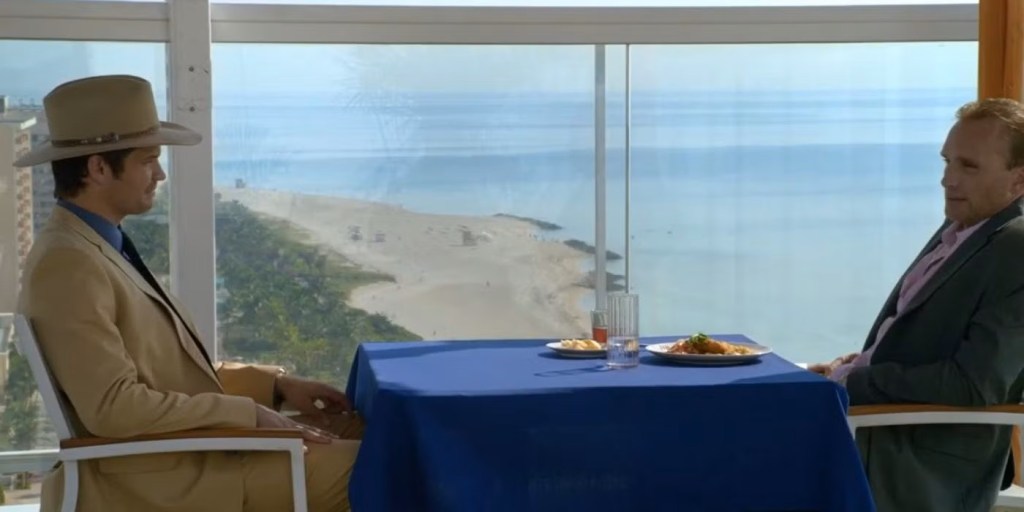
Raylan Givens and Tommy Bucks in Justified

The opening scene of the TV series Justified shows Deputy U.S. Marshal Raylan Givens sitting across from drug kingpin Tommy Bucks at a Miami restaurant.

Givens has given Bucks 24 hours to get out of Miami, a High Noon moment. But Givens has a history with Bucks, and changes the deadline to right now. Bucks tries to pull a gun, Givens kills him across the table.

It’s the deadline and the change of plan that is relevant here.

Trump’s latest deadline, in a change of position, is giving Russia 50 DAYS to do something about its war in Ukraine. It isn’t clear what and besides, the cliched TACO (Trump always chickens out) applies.

You need two things to move up a deadline like Givens did: courage and ability. And to some extent a developed sense of right and wrong, which for Givens and anybody is a tricky one. You have to be willing to take a risk and live with consequences.

If you don’t have courage, ability, a developed sense of right and wrong, and a willingness to take risks and live with consequences, you should stay away from being a Deputy U.S. Marshal or from any job with power and authority. And you should stay away from hollow deadlines.

Antisemitism in the Oval Office

The encounter in the White House was antisemitic….It was all there, in the Oval Office, in the shouting and in the interruptions, in the noises and in the silences. A courageous man seen as Jewish had to be brought down. When he said things that were simply true he was shouted down and called a propagandist. There was no acknowledgement of Zelens’kyi’s bravery in remaining in Kyiv.
Timothy Snyder, Antisemitism in the Oval Office

https://snyder.substack.com/p/antisemitism-in-the-oval-office

Timothy Snyder is one of the great contemporary historians, especially of the Holocaust. His books include Black Earth: The Holocaust as History and Warning, On Tyranny: Twenty Lessons from the Twentieth Century, The Road to Unfreedom, and more.

His post today, Antisemitism in the Oval Office, is about the inherent antisemitism of the recent confrontation between Zelensky and Trump in the Oval Office. It is Snyder’s view, and the view of other experts, that this was a clear example of public antisemitism. By the President of the United States.

Please read the post in its entirety. A brief excerpt below.


The attempt to humiliate Volodymyr Zelens’kyi in the Oval Office a week ago was an American strategic collapse. It heralded a new constellation of disorderly powers, obsessed with resources, seizing what they can. Inside that new disaster is something old and familiar that we might prefer not to see: antisemitism. The encounter in the White House was antisemitic.

I am historian of the Holocaust. I was trained by a survivor. Jerzy Jedlicki was nine years old when the Germans invaded, and fourteen when he emerged from hiding in Warsaw, and a prominent Polish historian by the time we met. He talked to me about antisemitism for decades, from the time of the breakup of the Soviet Union until his death in 2018. The way that I reacted to the scene in the Oval Office, and how I have pondered and considered it since, have to do with my research, but also with him….

To conclude that the scene in the White House was antisemitic, one does not need to know anything further. It’s all right there: the demand for deference, the obsession with money, the claims of corruption and dishonesty, the encirclement, the loud voices, the bizarre grievances, the underlying sense that a Jewish person does not fit and must be expelled. The context was evocative enough, and nothing more is really needed: those historical markers of antisemitism; Zelens’kyi’s Jewish origins; the particular way he was treated by non-Jews.

Timothy Snyder, Antisemitism in the Oval Office


The Ukrainian Favor

Ukrainian Contingent Ends Iraq Mission

Commander of the Ukrainian contingent in Diwaniya presents a certificate and gift to
a member of the Qadisiya Province Iraqi Police, during an end of mission ceremony
at Camp Echo, Dec. 9, 2008.

“Are you asking as a friend or calling in a chit? A friend would not ask me to do this.”
“A friend just won’t hold it against you if you don’t.”
Adapted from Suits, USA Network

In 2008, Ukrainian troops officially left the U.S.-instigated Iraq War. Since 2003, 5,000 Ukrainian troops had served there (the third largest contingent in the multinational force) and 18 soldiers had died. No service or sacrifice can be minimized, even if these numbers pale in comparison to the American investment. Ukraine answered the call with honor and valor, as it had in other international conflicts, presumably because there are principles at stake, including the principle that modern internationalism means a commitment to mutual trust and support.

At the ceremony marking the end of the Ukrainian mission, Maj. Gen. Michael Ferriter, deputy commanding general for operations, Multi-National Corps-Iraq, said:

We know that violence is at its lowest level in five years, and the Iraqi Security Forces, partnering with Coalition forces, will take the lead in defending their country. And soon, the Iraqi people will vote in the future of their country in the provincial elections. These changes were not brought about naturally, but were instead brought about by the dedication and the hard work of the men and women from the nations such as yours. You helped create the Iraqi Security Force and instilled in them a solid foundation of skills essential to the future security and prosperity of Iraq.

To Iraq’s benefit, and through Ukraine’s efforts, you have helped ensure a higher quality of life for the people of Iraq. Ukraine forces made contributions that enabled all Coalition partners to be successful here, but it has not been without cost. A precious 18 Ukrainian Soldiers have died here.

Ukraine is asking for help from anyone to hold their country together. Under the circumstances, that is going to be difficult and may not be possible.

Are they asking as a friend or calling in a chit? If we don’t provide adequate or effective help, will they hold it against us? Should they?

Putin and the Little Engine That Could

Vladimir Putin - Little Engine

The pro-Russian insurgency in eastern Ukraine, and the Russian warnings to stay away and out, are not surprising. A fifth-grader doing a Social Studies assignment (if there is still Social Studies) had this one figured out.

So obviously did the American intelligence and foreign policy experts. They can’t tell us they know because that would give something away, even if that fifth-grader has already guessed. The other reason it isn’t officially talked about is that, officially, few are sure what to do next.

Vladimir Putin is well set up, for something. He can take little bites out of the region, or if Ukraine should erupt in instigated civil war, he can enter on the pretext of assuring the stability and security of a neighboring country. There is plenty of historical precedent for this strategy, and for this strategy working.

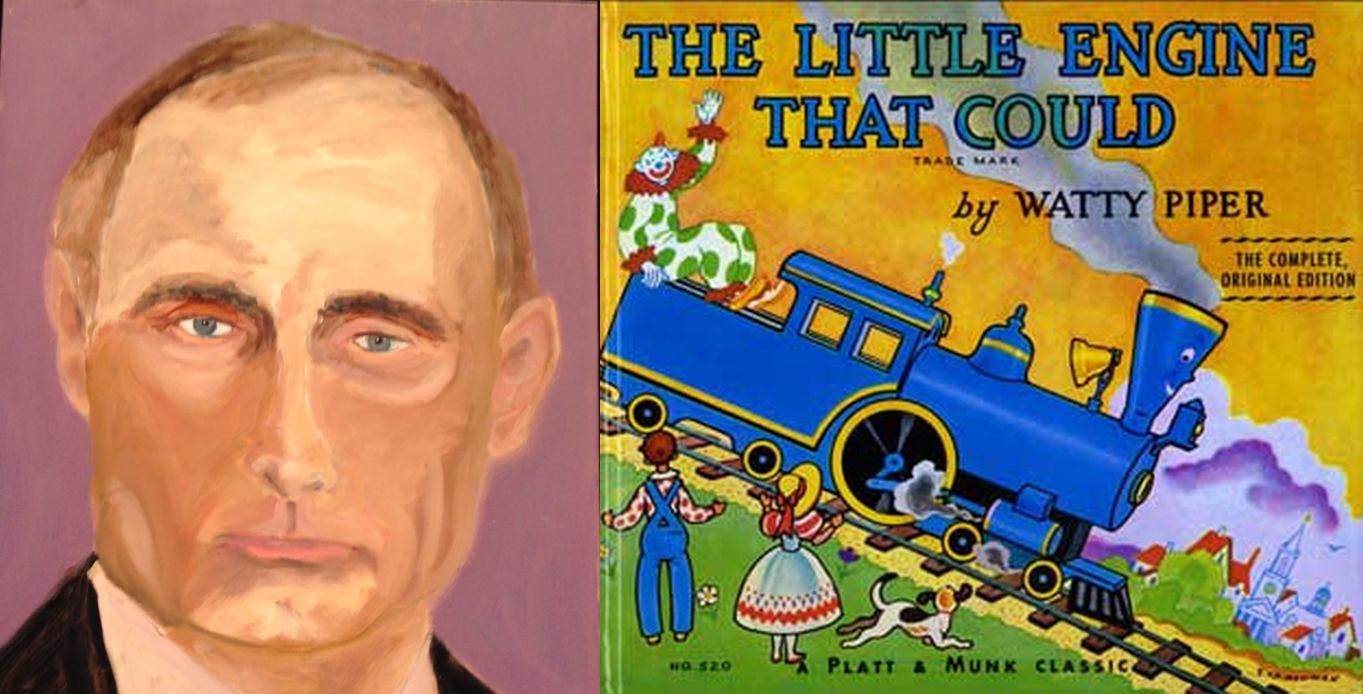
We—and this includes those who claim to know him—are not sure exactly who Putin is: cunning statesman, cowboy, sociopath? Whether he has himself killed people, up close, is a matter of conjecture, but many have no trouble believing it. German Chancellor Angela Merkel, who grew up in Communist East Germany and knows him, suggests that he is out of touch with the realities of the situation. Former U.S. President George W. Bush just displayed his painting of Putin, which picture says as much about W. as an artist as it does about the Russian President.

Putin is not out of touch with reality, any more than those people who believe that visualizing an outcome will ultimately make it so. He is under no delusion that realizing his reality will be cost free. He is just willing to pay the price, or allow others to chip in, maybe profoundly.

The U.S. may have the most distorted view of war in history. It isn’t that great sacrifice or valiant service haven’t been made. The U.S. didn’t just participate in some of the most significant defenses of human freedom; it helped freedom prevail. But for a few generations, there has been a lot of blood and treasure sacrificed in a sometimes well-meaning, sometimes self-serving fog. The source of the confusion is that for more than 150 years, the U.S. has not experienced national war on its soil. Regional conflicts and shocking, fleet- and building-destroying hostilities, but not a national war, inside or on our borders.

Whatever the list of solutions to international problems and provocations, war shouldn’t just be at the bottom of the list. It should be in some strategic sub-basement, below the last resort. At this moment, war in Europe is where it should be: unthinkable. But if something is unthinkable, then everything else has to be more thinkable, more discussed. Right now, the U.S. body politic is fascinated with other matters major and minor, because we need a break.

But trust this: Putin doesn’t give a care for what happened to a plane that has been at the bottom of the Indian Ocean for weeks. He is single-mindedly like that favorite American children’s book The Little Engine That Could, chugging along: I think I can, I think I can.

We don’t have to be concerned about Ukraine or we can be concerned. We don’t have to take action or we can take action. We don’t have to go to war or we can go to war. What isn’t optional is talking about it in the public square, in a conversation led by the President and others. This is not jumping the gun. It is a sensible prelude to an emerging situation, which could at any moment escalate from blah-blah-blah to something more active and serious.

The U.S. has not been very good at sensible preludes. The run-ups to recent wars have been filled with hyper-drama, fueled by the occasional exaggeration or lie. Ukraine, Europe, and the world need something else. Putin thinks he can. Who knows what we think?

Afghanistan Loves Russia

Hamid Karzai - Congress

Karzai and Putin sitting in a tree
K-I-S-S-I-N-G

In 1979, Russia invaded Afghanistan. The U.S. supported the insurgents who eventually chased Russia out of Afghanistan. In 1989, Russia left Afghanistan.

In 2001, al-Queda attacked the U.S on September 11. That same year, the U.S. sent troops to Afghanistan to remove the Taliban from power and to eliminate their safe haven for Osama bin Laden and al-Qaeda.

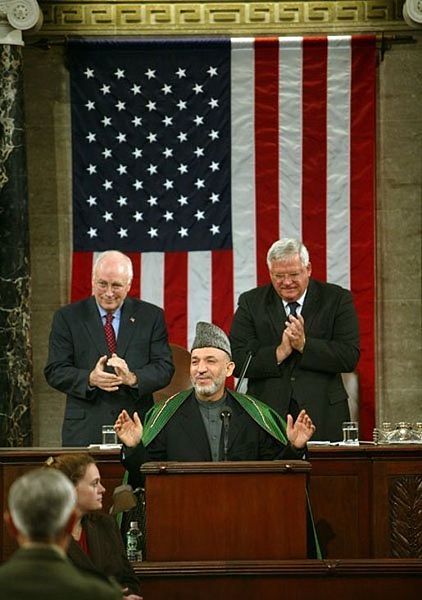
In 2004, Hamid Karzai was elected President of Afghanistan. That image above shows him addressing a joint session of Congress on June 15, 2004, with Vice President Dick Cheney and Speaker of the House Dennis Hastert applauding.

In 2011, the U.S. found and killed Osama bin Laden. Plans were made to withdraw U.S. troops from Afghanistan, but not before thousands of U.S. and other allied troops died, in the longest war in U.S. history.

In 2013, negotiations began with President Karzai for an agreement that would allow some U.S. troops to remain in Afghanistan in a support role after withdrawal. President Karzai, not wanting to appear to be in friendly partnership with the U.S., has so far failed to reach such an agreement.

Today, President Karzai announced that he supports the Russian position in Crimea, putting him in the same league as Syria, North Korea, Iran, and Venezuela. We still have troops in Afghanistan. The troops who died on behalf of President Karzai are still dead. The Afghans who died at the hands of the Russians are still dead. There are no reports yet about whether Dick Cheney or Dennis Hastert are still applauding.

There are no words to make sense of this. So instead, here is the Afghan flag, along with an explanation of the flag from the ever-authoritative CIA Factbook. Note especially the part about the Afghan flag having more changes in it than any other national flag in the 20th century. As always, a funny old world.

Afghanistan Flag

Three equal vertical bands of black (hoist side), red, and green, with the national emblem in white centered on the red band and slightly overlapping the other two bands; the center of the emblem features a mosque with pulpit and flags on either side, below the mosque are numerals for the solar year 1298 (1919 in the Gregorian calendar, the year of Afghan independence from the UK); this central image is circled by a border consisting of sheaves of wheat on the left and right, in the upper-center is an Arabic inscription of the Shahada (Muslim creed) below which are rays of the rising sun over the Takbir (Arabic expression meaning “God is great”), and at bottom center is a scroll bearing the name Afghanistan; black signifies the past, red is for the blood shed for independence, and green can represent either hope for the future, agricultural prosperity, or Islam Afghanistan had more changes to its national flag in the 20th century than any other country; the colors black, red, and green appeared on most of them.

Ukraine: Adolf Hitler and William Faulkner

Adolf Hitler - William Faulkner
The term lingua franca means a language that is understood across cultures. It literally means “Frankish language,” referring to a hybrid language that was used for commerce and diplomacy during the Renaissance. Today, one might call English a lingua franca, since unofficially and officially (as in air transport), it is the one universally used and understood.

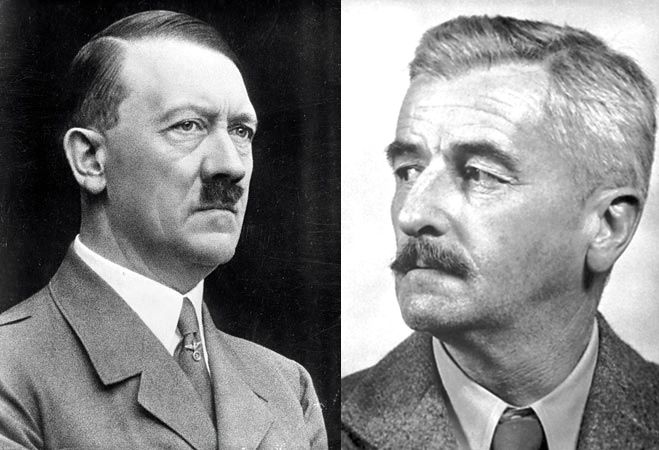
In contemporary history, the person who comes up most often as an historical analogy is Adolf Hitler. For good reason. Others may have killed more. Others may have conquered more territory. But Hitler did it all, ignited world war, and did it in our times, in living memory, and in ways that shaped the world—and thus shaped our thinking and conversation now and for generations to come. He is the historical persona franca.

A previous post pointed out that Putin’s post-Olympics invasion of Ukraine bested Hitler’s annexation of Austria in March 1938. Hitler waited almost two years after his self-promotional 1936 Berlin Olympics before the Anschluss; somewhat bizarrely, even though Putin politely waited for two days after the Paralympics in Sochi closed, the annexation of Crimea was effectively done while the Olympics were still being held.

When Hillary Clinton mentioned in a speech that Putin’s actions were reminiscent of Hitler, she was shushed up by her supporters and her detractors. Talk like that was deemed premature, alarmist, undiplomatic, and, in Hillary’s case, unpresidential. And yet as events have sped along, the mentions increase. Just today, the former U.S. Ambassador to Russia had to admit that we have not seen an event like the annexation of Crimea since…the 1930s. And whether Hitler is a persona franca or a trump card, Putin uses it himself, claiming that the Ukrainian ouster of Yanakovych was orchestrated by Nazi thugs who are now in power.

History matters, and Hitler matters in history, whatever use he may be in thinking about the critical issues developing in Ukraine. This year is the centennial of World War I (also known as THE World War and the War to End All Wars, before there was a second one). So maybe take a little time to learn a little more about Europe in the period from 1914 to 1945—a mere thirty years or so in which there were two world wars, one of the most evil men in history, an attempt to eliminate an entire people from the earth, and the development of an apocalyptic weapon that gives God a run for his money.

Why learn this history? Because literally everything that is in the news about Russia and the Ukraine is joined with it. Because history never goes away, particularly in Europe. Or anywhere. As William Faulkner wrote, having lived in the American South where history never goes away, where understanding history is the only way to understand today, “The past is never dead. It’s not even past.”

Ukraine: What’s Happening on the Weak Side?

Basketball
The weak side in basketball does not suggest weakness. It is the part of the court away from the ball. This doesn’t mean that the players there are weak or that the action there is unimportant. On the best teams, there can be almost as much happening on the weak side as there is on the strong side. Players may be running around, positioning themselves to take advantage, either by scoring or by taking away the ball. On the lesser teams, weak side players sometimes seem to drift aimlessly, or just stand around, depending on someone else to somehow work it out. If you don’t have the ball, what else is there to do?

We know exactly where the ball is in the current Ukraine crisis. And we know exactly who has the ball. The question is what the players on the weak side are doing. Are there plays carefully diagramed by the coach, practiced for just such a situation? Is there a player away from the ball, away from the basket, just waiting to heroically steal and drive all the way down court? Or are the weak side players drifting, trying to remember plays they once learned or improvise new ones?

The shot clock is running.

Ukraine Sanctions: Who Is Poking Which Bear

Bear
The most interesting message about this morning’s U.S. sanctions to protest Russian actions came from one of those sanctioned. The travel bans and freezing of U.S. assets are aimed at a handful of Putin advisers and others complicit in the Crimean takeover, but not at the highest level (including Putin) or at any businesspeople.

Russian Deputy Prime Minister Dmitry Rogozin, who is being sanctioned, tweeted this:

“Comrade Obama, and what will you do with those who have neither accounts nor property abroad? Or didn’t you think of that?”

On this day when a prominent Russian television journalist, with an atomic mushroom cloud as background, pointed out—correctly—that Russia is the only country that can reduce the U.S. to “radioactive ash,” the tweet from Comrade Rogozin is most telling.

The U.S., even more than our allies, is being poked. Taunted. “Is that the best you’ve got? You can do better than that!” The U.S. and Europe can of course do better (meaning: more severe) than that, from big business sanctions to military intervention, all of which threaten global instability.

This is the point in every fight when power has to be harnessed in the service of strategy. Russia wants nothing more than any excuse to throw away the rulebook they don’t believe in anyway. They aren’t so much bringing guns to a knife fight as brandishing guns to bring out the other guns and look like the victim. The aggressor victim.

Let’s hope or pray for our leaders to be strong, wise, unselfish, non-partisan, and honest (with us and with themselves), who can interpret the language of pokes, and can act appropriately.