Bob Schwartz
Tag: U.S. Senate
 Q: Why is there a picture of a chicken on this post about gun violence legislation?
September 28, 2012
What Must Todd Akin Think of Sarah Palin?

What must Todd Akin think of Sarah Palin?
Todd Akin has lots of opinions about the ladies, inside and out. As for the inside, he has apparently been graced with some sort of revelation—dare we call him a prophet?—about a previously undiscovered physiological process whereby a woman’s body “knows” whether a rape is the kind that should or should not allow a resulting pregnancy. He has been asked to write a monograph about this process, profusely illustrated, but he has been otherwise occupied with his race against Senator Claire McCaskill in Missouri. It is a loss for medical science, but maybe he will have lots more time after the election. Citizens and gynecologists can only hope.
His views about the outside of women came clear after his debate with Sen. McCaskill, when he said:
“I think we have a very clear path to victory, and apparently Claire McCaskill thinks we do, too, because she was very aggressive at the debate, which was quite different than it was when she ran against Jim Talent,” Akin said. “She had a confidence and was much more ladylike, but in the debate on Friday she came out swinging, and I think that’s because she feels threatened.”
A review of Sen. McCaskill’s debate performance shows that she was thoughtful, firm, politely aggressive, and unrelenting—which is exactly what you would expect and hope for from a former prosecutor and current United States Senator.
When it comes to men dealing with women in politics—as candidates and voters—there are two ways of looking at it. One is external and pragmatic. Whether those men are saintly idealists or craven devils, women can play a role in their obtaining and maintaining power—given that women have had the vote for almost a century, and have held public office even longer.
The second and more fascinating view involves what’s going on inside—inside the heads of those men. This political season, something that got touched on in the 2008 campaign is now even clearer. It’s something that can be said about some small number of men who have been complicit, as actors or fellow travelers, in what for a while this cycle was called the “war on women”:
They don’t understand women.
They can’t control women, at least not easily.
They fear women, because they don’t understand them and can’t control them.
Keep these in mind and much will make sense.
What doesn’t make sense is what Todd Akin must think of Sarah Palin.
There are a thousand things to say about Sarah Palin, and particularly about her controversial role in the 2008 election. One thing is certain: she does not fit Todd Akin’s idea of “ladylike.” She is happy to be the pitbull with lipstick. Think of a political woman who is ambitious, confident, outspoken, and likely to dismember the man or moose who crosses her. Quick: Is that Sarah Palin or Hillary Clinton? Exactly.
In America, women have failed to reach their deserved heights and presence in many fields. Elective politics, particularly at the national level, is one of them. By definition, the U.S. Senate can’t be the world’s greatest deliberative body, overstuffed as it is with men. And it certainly won’t be enhanced by Todd Akin’s membership; just ask most Republicans who nearly killed him over his “legitimate rape” remarks.
Conservatives worship Margaret Thatcher. Some of them no doubt hold out hope for the love that dared not speak its name, the hope that the obvious affection between Thatcher and Ronald Reagan went all the way, and that one day, not long from now, the offspring of that union will arrive in our political life as a savior.
If it’s a son, that is. If it’s a daughter, we might still have a problem.
While we are playing with ridiculous fantasies, here’s another one. Suppose that instead of Claire McCaskill on an open stage, Todd Akin had to face Maggie Thatcher, Hillary Clinton and Sarah Palin behind closed doors to explain his visionary, man-centric thinking.
It wouldn’t be ladylike, and it would be worth paying to see.
June 19, 2012
Elizabeth Warren And Native American Lending
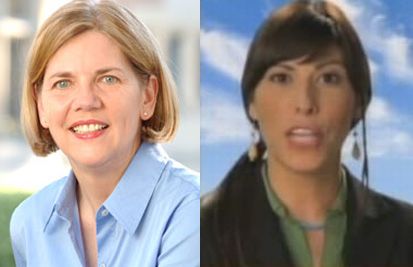
Elizabeth Warren is a figure of considerable talent and successful public service. On the heels of a controversy that has been dogging her, though, an irony has cropped up that is worth a note in passing.
Even in a political season where the bizarre has become the everyday, Elizabeth Warren’s run for a U.S. Senate seat from Massachusetts has taken some strange turns. While her claim to Native American heritage is entirely legitimate, her handling of the politics surrounding it has been less than smooth. And now there is an unremarked upon twist to it.
You’ve probably seen television ads for the Internet lender Western Sky Financial. A pretty woman in braids looks you straight in the eye and offers you a personal loan. “Yes, the money is expensive,” she admits, “but it is a lot cheaper than a payday advance.” All the while, the Western Sky three-tipi logo is emblazoned onscreen, as a drum beats softly in the background.
The Western Sky site explains:
Western Sky Financial is owned wholly by an individual Tribal Member of the Cheyenne River Sioux Tribe and is not owned or operated by the Cheyenne River Sioux Tribe or any of its political subdivisions. Western Sky Financial is a Native American business operating within the exterior boundaries of the Cheyenne River Sioux Reservation, a sovereign nation located within the United States of America.
In an earnest section on Responsible Lending, Western Sky outlines its philosophy:
Fair Dealing among people is a Lakota Tradition, and a concept that is fully embraced by Western Sky. Fair Dealing requires parties to be open and honest and to treat others with respect. Western Sky believes Fair Dealing to be an important aspect of being a responsible Lender.
Western Sky seeks to employ the concept of Fair Dealing at all levels of customer relations, from the application process to the details of loan repayment. This page outlines our approach and what we ask you in return. If you have any questions regarding our commitment to Fair Dealing or our expectations of you, please feel free to ask.
Here are some of the loan rates:
Loan Product Borrower Proceeds Loan Fee  APR   Number of Payments Payment Amount
$10,000 Loan      $9,925          $75   89.68%        84              $743.49
$5,075 Loan       $5,000          $75   116.73%       84              $486.58
$2,600 Loan       $2,525          $75   139.22%       47              $294.46
$1,500 Loan       $1,000          $500  234.25%       24              $198.19
$850 Loan         $500            $350  342.86%       12              $150.72
Demand for easy but high-interest loans has skyrocketed in these hard times. In response to possible overreaching, a number of states that had previously kept their legislative hands off have jumped in to try and set some limits.
It appears that hundreds of Native American-related lending companies, including Western Sky, have cropped up to meet consumer demand. Despite state efforts to weigh in on this development, tribal sovereignty in the face of state laws has prevailed. In 2011 the Native American Lending Alliance was formed to establish best practices and to make sure that sovereignty in this area remains intact and unassaied.
The only entity empowered to take on any question of tribal-related lending is the federal government. In recent years the federal government did generally take on consumer lending and related issues with the establishment of the Consumer Financial Protection Bureau. But Native American lending is a legally complex and sensitive matter, and neither the federal government nor the CFPB is currently addressing it as frontline cause.
And that’s where the irony comes in. The CFPB is to a great extent the creation of Elizabeth Warren. She conceived it and helped build it. So at a time when Native American interests are operating just outside the purview and the spirit of the CFPB, Elizabeth Warren’s own Native American heritage has become a bit of a campaign issue.
The two have no direct connection, and all we know tells us that Elizabeth Warren always stands squarely on the side of consumers. But it is ironic: not a big irony, but certainly a curious twist in an endlessly curious and twisted political season.
 Bob Schwartz