Bob Schwartz

Tag: Thanksgiving

Happy Bright Friday

Please pull back for a moment from thinking about what bargains we might find on Black Friday.

Black Friday used to be the one day after Thanksgiving, but is now an entire season of deals that seems to begin in October.

If you step back from bargain hunting, you might wonder why it is called “Black Friday”.


The term “Black Friday” has an interesting history. While widespread retail sales on this day began in the mid-20th century, the name itself has contested origins:
The most commonly cited explanation is that it refers to retailers moving from being “in the red” (operating at a loss) to being “in the black” (turning a profit) due to the surge in sales. However, this explanation appears to be a later rebranding.

The term actually originated in Philadelphia in the 1960s, where police used it to describe the chaos of heavy pedestrian and vehicle traffic that flooded the city the day after Thanksgiving. The crowds came for the Army-Navy football game held on Saturday and began their holiday shopping on Friday. Police had to work long shifts dealing with traffic and crowds, which they found unpleasant—hence the “black” descriptor.

Retailers initially disliked the negative connotation and tried to rebrand it as “Big Friday,” but the name Black Friday stuck. By the 1980s, retailers embraced the term, reframing it with the more positive “red to black” accounting narrative.


Just for a moment—the deals will wait—let’s change colors. Yesterday, at Thanksgiving, we may have been able to share company and a table with family and friends. In the coming weeks, we will be celebrating holidays that have light as a theme.

So let’s set aside the black and feature the light. This, the day after Thanksgiving, is Bright Friday. Are there light Bright Friday things waiting to be grabbed? Sure, if you know what they are and can find them.

Happy Bright Friday!

© 2025 Bob Schwartz
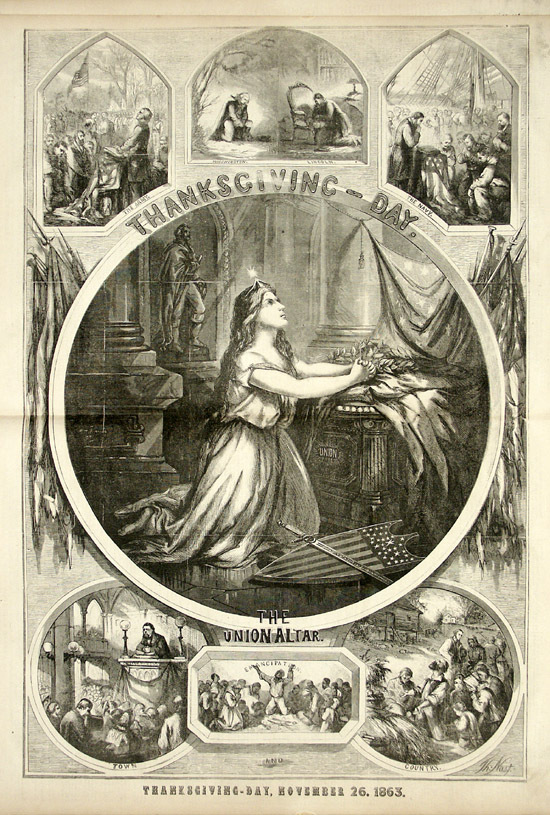
Lincoln Proclaims Thanksgiving: “Penitence for our national perverseness”

“Thanksgiving-Day,” by Thomas Nast, Harper’s Weekly, December 5, 1863.

“Thanksgiving-Day,” by Thomas Nast, Harper’s Weekly, December 5, 1863.

The modern Thanksgiving holiday begins with Abraham Lincoln issuing a Thanksgiving Day proclamation on October 3, 1863, at the height of the Civil War.

At that point, America was a country of two cultures; in fact, of two nations at war. Even history was the subject of dispute. The North traced our national origin to the Puritans of New England, thus Thanksgiving was their American holiday. The South believed America began with the settlement of Jamestown, Virginia.

In his proclamation, Lincoln calls for healing and for “peace, harmony, tranquillity, and union.” In terms of union, however, it isn’t clear who Lincoln refers to when he asks for “humble penitence for our national perverseness and disobedience.” Exactly who has been perverse and disobedient?

One thing is clear. Even with all his divine pleas, Lincoln calls this conflict of principles and cultures inevitable—“the lamentable civil strife in which we are unavoidably engaged.”

Lincoln held a famously and understandably dark view of his American times, shaded by realities and by his own depressive personality. We can and should take a brighter view this Thanksgiving, having come so far from the America of 1863, and having much to be thankful for. But just as we repeat his call for “peace, harmony, tranquillity” we are remiss to ignore the realities of 2016. Like Lincoln, we should be big, open and wise enough to see things as they are, and to change them as needed, always being painfully aware of the cost.

From his proclamation:

It has seemed to me fit and proper that they should be solemnly, reverently, and gratefully acknowledged as with one heart and one voice by the whole American people. I do, therefore, invite my fellow-citizens in every part of the United States, and also those who are at sea, and those who are sojourning in foreign lands, to set apart and observe the last Thursday of November next as a Day of Thanksgiving and Prayer to our beneficent Father who dwelleth in the heavens. And I recommend to them that, while offering up the ascriptions justly due to Him for such singular deliverances and blessings, they do also, with humble penitence for our national perverseness and disobedience, commend to His tender care all those who have become widows, orphans, mourners, or sufferers in the lamentable civil strife in which we are unavoidably engaged, and fervently implore the interposition of the Almighty hand to heal the wounds of the nation, and to restore it, as soon as may be consistent with the Divine purposes, to the full enjoyment of peace, harmony, tranquillity, and union.

© 2025 Bob Schwartz

Thanksgiving: Simple Gifts

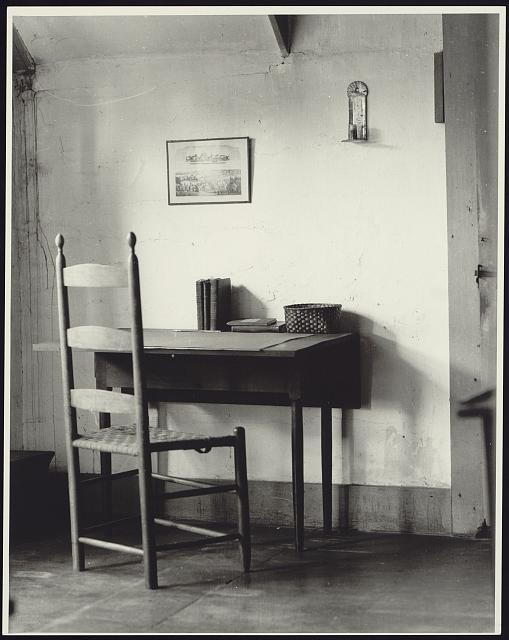
Shaker Sewing Table

The Shaker dance song Simple Gifts (Joseph Brackett, 1848) is the ultimate Thanksgiving song. It is also the ultimate American song, provided we recognize that in America, the most religious and richest nation on earth, simplicity and humility are ideals worth aspiring to and striving for.

Ken Burns writes this about his documentary The Shakers:

They called themselves the United Society of Believers in Christ’s Second Appearing, but because of their ecstatic dancing, the world called them Shakers. Though they were celibate, they are the most enduring religious experiment in American history. They believed in pacifism, natural health and hygiene, and for more than 200 years insisted that their followers should strive for simplicity and perfection in everything they did.

Shaker design, including furniture and baskets, may be familiar to you. So may the melody of Simple Gifts. It is frequently used in pop culture, and is most famous musically in Aaron Copland’s orchestral masterpiece, Appalachian Spring. And while the tune is often heard, the lyrics are not as frequently sung. Here is an appropriately unadorned version by Judy Collins.

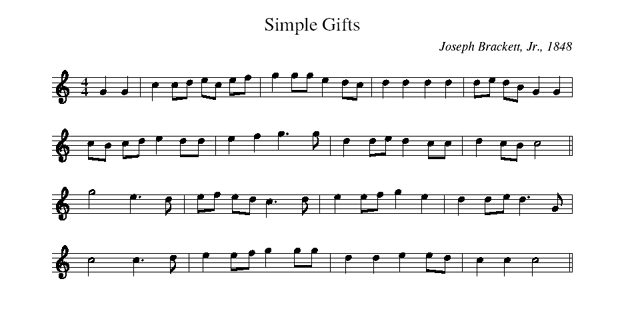
Even if you can’t read music, you can look at the musical score and see how very simple this song is:

Here are the lyrics. Happy Thanksgiving.

‘Tis the gift to be simple, ’tis the gift to be free
‘Tis the gift to come down where we ought to be,
And when we find ourselves in the place just right,
‘Twill be in the valley of love and delight.

When true simplicity is gain’d,
To bow and to bend we shan’t be asham’d,
To turn, turn will be our delight,
Till by turning, turning we come ’round right.

Peyote Pilgrims

“Imaginatione and historie are a fine paire.”
Made up old-fashioned quote

Some believe that the accounts of the first Thanksgiving feast in 1621 have been sanitized to leave out an extraordinary detail. Somehow, it is thought by some, the Native Americans at Plymouth had traded for peyote from Southwestern tribes and shared it with the colonists at that famous three-day meal.

First, here’s the version we have, from Edward Winslow in Mourt’s Relation, published in 1622:

Our harvest being gotten in, our governor sent four men on fowling, that so we might after a special manner rejoice together after we had gathered the fruits of our labor. They four in one day killed as much fowl as, with a little help beside, served the company almost a week. At which time, amongst other recreations, we exercised our arms, many of the Indians coming amongst us, and among the rest their greatest king Massasoit, with some ninety men, whom for three days we entertained and feasted, and they went out and killed five deer, which we brought to the plantation and bestowed on our governor, and upon the captain and others. And although it be not always so plentiful as it was at this time with us, yet by the goodness of God, we are so far from want that we often wish you partakers of our plenty.

The omitted mention of psychedelics explains much. For example, the outlandish hats and clothing we associate with the pilgrims in fact did not exist in that community. Instead, it is possible that those in the midst of an experience began sketching the ridiculous fashions they thought they saw. “Tall hats with buckles,” William Bradford said. “Oh wow, such hats reflect our reaching to heaven.” “Awesome!” the others who were still capable of speaking might have exclaimed.

Happy Thanksgiving (yes, we all still call the holiday that).

© 2025 Bob Schwartz

Black Friday: The American Holiday Exclusively Devoted to Buying Things

Note: #GivingTuesday is next week.

Many holidays have been commercialized. But almost all of them struggle to maintain some semblance of their higher purpose and original meaning. Thanksgiving is still about diverse and somewhat antagonistic neighbors and strangers peacefully getting together for a big meal. Christmas is still about the arrival of someone who brings goodness and light to the world. The same abiding of meaning goes for Founding Fathers (July 4th) and mothers (Mother’s Day)

Black Friday is different. It is exclusively about commerce. The dark name signifies the start of the shopping season that determines whether retailers have a profitable year (be “in the black”). You can look behind the commercial for the true meaning of other holidays. The only thing behind Black Friday is buying. The only way to celebrate Black Friday is to buy things—hopefully at deep discounts.

Some will say this misses the point. Buying on Black Friday is only the preliminary step to gifting on Christmas. Buying cheaper means being able to buy more gifts for more people. That’s what the spirit of Christmas is really about.

Here is a thought for those who participated in Black Friday, in stores or, as is now common, online. Add up all the money you saved by getting Black Firday deals. Donate that amount to the charity of your choice. (Given that Black Friday is the day after Thanksgiving, food banks are one suggestion).

Next Tuesday is #GivingTuesday, a holiday more attuned to the spirit of the season. Americans are expected to spend $90 billion shopping on Black Friday and on the newer holiday of Cyber Monday. If you conservatively guess that shoppers saved just 10% on their purchases, that adds up to savings of $10 billion for those shoppers. So if Black Friday shoppers donated their $10 billion in savings on #GivingTuesday, the meaning of Black Friday would be radically transformed

Thanksgiving: How to Respond to Grateful and Ungrateful People

We have arrived at a holiday about gratitude, an element of so many traditions. Gratitude helps put us in our place—not so much a place below or beholden to others as a place connected to others.

The historic Huayan school of Buddhism is based on a very long (1200 pages in English translation) and very extravagant text known as the Flower Ornament Sutra. The text and its insights have contributed to the development of many current Buddhist streams.

Taigen Dan Leighton writes:

Among the Huayan tools for bringing the universal into our everyday experience are gathas, or verses, which include many practice instructions to be used as enlightening reminders in all kinds of everyday situations. Specifically, the eleventh chapter of the Flower Ornament Sutra, titled “Purifying Practice,” includes 140 distinct verses to encourage mindfulness in particular circumstances. Some of the following situations are cited: awakening from sleep; before, during, and after eating; seeing a large tree, flowing water, flowers blooming, a lake, or a bridge; entering a house; giving or receiving a gift; meeting teachers, or various other kinds of people; and proceeding on straight, winding, or hilly roads.

All the verses use the situations mentioned to encourage mindfulness and as reminders of the fundamental intention to help ourselves and others more fully express compassion and wisdom.

Among the verses are these two involving grateful and ungrateful people:

Seeing grateful people
They [enlightened beings] should wish that all beings
Be able to know the blessings
Of the Buddhas and enlightening beings.

Seeing ungrateful people
They should wish that all beings
Not increase the punishment
Of those who are bad.

The Flower Ornament Scripture: A Translation of the Avatamsaka Sutra by Thomas Cleary

The first of these verses is straightforward and positive: You see grateful people (you will see many of them at Thanksgiving) and you are reminded to wish that all people know the ways of enlightenment. Everybody feels good, and it all begins with witnessing gratitude.

The second situation might appear to be less positive. You see ungrateful people (you will not see many of them at Thanksgiving, at least not at your table), which may not make you feel good or feel good about them. But instead of feeling bad, you are advised to remember compassion and mercy—“wish that all beings not increase the punishment of those who are bad.”

Hard as it seems, along with giving and getting thanks, you might set aside those “punishments” you have in mind for “those who are bad.” That isn’t exactly gratitude, but it’s a close companion quality. On any Thanksgiving, and maybe on this one in particular.

Lincoln Proclaims Thanksgiving: “Penitence for our national perverseness”

“Thanksgiving-Day,” by Thomas Nast, Harper’s Weekly, December 5, 1863.

“Thanksgiving-Day,” by Thomas Nast, Harper’s Weekly, December 5, 1863.

The modern Thanksgiving holiday begins with Abraham Lincoln issuing a Thanksgiving Day proclamation on October 3, 1863, at the height of the Civil War.

At that point, America was a country of two cultures; in fact, of two nations at war. Even history was the subject of dispute. The North traced our national origin to the Puritans of New England, thus Thanksgiving was their American holiday. The South believed America began with the settlement of Jamestown, Virginia.

In his proclamation, Lincoln calls for healing and for “peace, harmony, tranquillity, and union.” In terms of union, however, it isn’t clear who Lincoln refers to when he asks for “humble penitence for our national perverseness and disobedience.” Exactly who has been perverse and disobedient?

One thing is clear. Even with all his divine pleas, Lincoln calls this conflict of principles and cultures inevitable—“the lamentable civil strife in which we are unavoidably engaged.”

Lincoln held a famously and understandably dark view of his American times, shaded by realities and by his own depressive personality. We can and should take a brighter view this Thanksgiving, having come so far from the America of 1863, and having much to be thankful for. But just as we repeat his call for “peace, harmony, tranquillity” we are remiss to ignore the realities of 2016. Like Lincoln, we should be big, open and wise enough to see things as they are, and to change them as needed, always being painfully aware of the cost.

From his proclamation:

It has seemed to me fit and proper that they should be solemnly, reverently, and gratefully acknowledged as with one heart and one voice by the whole American people. I do, therefore, invite my fellow-citizens in every part of the United States, and also those who are at sea, and those who are sojourning in foreign lands, to set apart and observe the last Thursday of November next as a Day of Thanksgiving and Prayer to our beneficent Father who dwelleth in the heavens. And I recommend to them that, while offering up the ascriptions justly due to Him for such singular deliverances and blessings, they do also, with humble penitence for our national perverseness and disobedience, commend to His tender care all those who have become widows, orphans, mourners, or sufferers in the lamentable civil strife in which we are unavoidably engaged, and fervently implore the interposition of the Almighty hand to heal the wounds of the nation, and to restore it, as soon as may be consistent with the Divine purposes, to the full enjoyment of peace, harmony, tranquillity, and union.

Thanksgiving for Refugees

No discussion of why millions of people find themselves displaced from home and country. No discussion of where they might go or who will welcome them or who won’t. No discussion of whether there might be terrorists hiding among them or whether circumstances will transform some of them into terrorists.

It is Thanksgiving. You might be thankful that you are not one of them. You might remind yourself that whatever your position and ideology, all the political stuff, nonsense and blah-blah-blah won’t ease a moment of suffering and uncertainty for these refugees.

It is Thanksgiving. Give to the UN Refugee Agency.

Thanksgiving: Simple Gifts

Shaker Sewing Table

The Shaker dance song Simple Gifts (Joseph Brackett, 1848) is the ultimate Thanksgiving song. It is also the ultimate American song, provided we recognize that in America, the most religious and richest nation on earth, simplicity and humility are ideals worth aspiring to and striving for.

Ken Burns writes this about his documentary The Shakers:

They called themselves the United Society of Believers in Christ’s Second Appearing, but because of their ecstatic dancing, the world called them Shakers. Though they were celibate, they are the most enduring religious experiment in American history. They believed in pacifism, natural health and hygiene, and for more than 200 years insisted that their followers should strive for simplicity and perfection in everything they did.

Shaker design, including furniture and baskets, may be familiar to you. So may the melody of Simple Gifts. It is frequently used in pop culture, and is most famous musically in Aaron Copland’s orchestral masterpiece, Appalachian Spring. And while the tune is often heard, the lyrics are not as frequently sung. Here is an appropriately unadorned version by Judy Collins.

Even if you can’t read music, you can look at the musical score and see how very simple this song is:

SimpleGifts

Here are the lyrics. Happy Thanksgiving.

‘Tis the gift to be simple, ’tis the gift to be free
‘Tis the gift to come down where we ought to be,
And when we find ourselves in the place just right,
‘Twill be in the valley of love and delight.

When true simplicity is gain’d,
To bow and to bend we shan’t be asham’d,
To turn, turn will be our delight,
Till by turning, turning we come ’round right.

Return to the Four Freedoms

Four Freedoms

As we approach the holiday season, we might think about the big metaphorical American family gathering around the big metaphorical American table. One thing you notice, as with a lot of families and tables, is that there’s going to be a few disagreements, some pretty heated.

But at some point, in keeping with the spirit of the season, the family will be looking for common ground, those shared ideals that unite us. Unfortunately, we seem to be losing sight of those ideals because, to be honest, it isn’t always clear what they are.

In early 1941, while war was already raging in Europe, but almost a year before Pearl Harbor, FDR gave one of the most famous speeches of the era and of American history. It was the 1941 State of the Union address, but it will always be known as the Four Freedoms speech. To bolster American support for our almost inevitable involvement in the war, he enunciated the Four Freedoms we would be fighting for: Freedom of Speech, Freedom of Worship, Freedom from Want, Freedom from Fear:

In the future days, which we seek to make secure, we look forward to a world founded upon four essential human freedoms.

The first is freedom of speech and expression — everywhere in the world.

The second is freedom of every person to worship God in his own way — everywhere in the world.

The third is freedom from want, which, translated into world terms, means economic understandings which will secure to every nation a healthy peacetime life for its inhabitants — everywhere in the world.

The fourth is freedom from fear, which, translated into world terms, means a world-wide reduction of armaments to such a point and in such a thorough fashion that no nation will be in a position to commit an act of physical aggression against any neighbor — anywhere in the world.

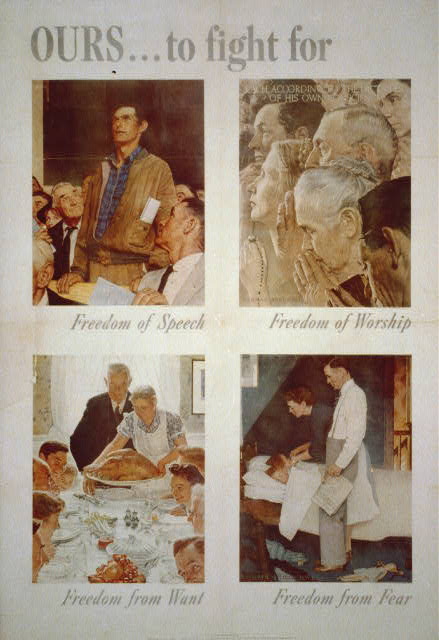
Art turned out to play an important role in keeping these ideals front and center, especially as the prospect of American sacrifice became a reality. The most famous example may be a series of paintings by Norman Rockwell (above), who was then and maybe still the greatest American illustrator. The Library of Congress explains:

Taken from Franklin Roosevelt’s 1941 speech to Congress, the “Four Freedoms” –Freedom of Speech, Freedom of Worship, Freedom from Want, and Freedom from Fear–became a rallying point for the United States during WWII. Artist Norman Rockwell created four vignettes to illustrate the concepts. Rockwell intended to donate the paintings to the War Department, but after receiving no response, the painter offered them to the Saturday Evening Post, where they were first published on February 20, 1943. Popular reaction was overwhelming, and more than 25,000 readers requested full-color reproductions suitable for framing.

Some will say that these Four Freedoms are today “controversial” because we don’t seem to be able as a nation—as an American family—to agree on the strategies to maintain and attain those ideals. Those disagreements are undeniable, as are the related invective, disparagement, and even hatefulness that goes with them. But those disagreements can’t make us give up. On the contrary, they should send us back to the words of FDR, getting past the ideologies and labels, and really look within and at the family of Americans.

Do you really believe that these ideals are exclusive to you, and not shared by others of good will? Are your principles and affiliations so very important that you would sacrifice those ideals to be “right?” Or can we come to the table, dig deeper, and not leave until we have given up a little of our own self-importance and focused instead on getting a little closer to the country and world envisioned in the shared Four Freedoms? And maybe just a little closer to each other?