Bob Schwartz

Tag: Talmud

Reimagining Hanukkah: More light tonight!

Hanukkah, which begins on the evening of December 25, is known as the Festival of Lights. It might also be called the Festival of Light—more light.

Each night the light of the candles increases (but see note below). Just as each day after the winter solstice the sunlight increases.

If you light the candles to celebrate the storied rededication of the Temple, you might also recognize the miracle of each of us bringing more light into the world—one candle at a time.

So this Hanukkah, you might add this to the blessings:

יותר אור הלילה
yoter or halila
More light tonight!

Happy Hanukkkah!

Notes:

1

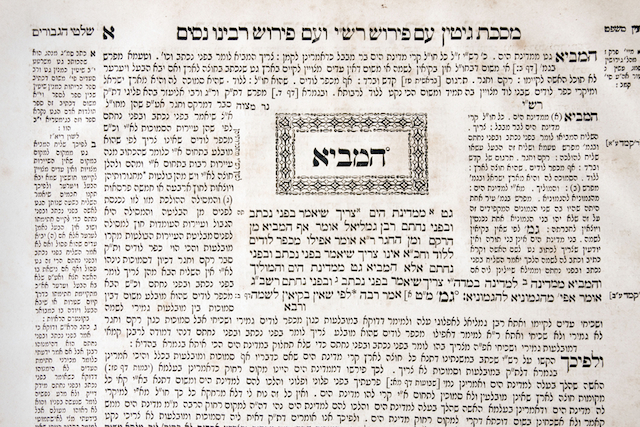
The Talmud (Shabbat 21b:5) reports that there was disagreement among the rabinnic schools about whether to add or subtract candles each night:

“Beit Shammai and Beit Hillel disagree as to the nature of that adjustment. Beit Shammai say: On the first day one kindles eight lights and, from there on, gradually decreases the number of lights until, on the last day of Hanukkah, he kindles one light. And Beit Hillel say: On the first day one kindles one light, and from there on, gradually increases the number of lights until, on the last day, he kindles eight lights.”

Even though the School of Hillel won the argument, you should feel free to follow the School of Shammai. If anyone complains, just tell them you read it in the Talmud.

2

As for the freedom to reimagine Hanukkah, the following is from an essay on Hanukkah in the Apocrypha by Rabbi Aaron D. Panken, of blessed memory:

“The eight-day Jewish holiday of Hanukkah (“Dedication” or “Initiation”) is remarkable in a number of ways. According to the Jewish conception of scripture, it is decidedly postbiblical, the earliest significant holiday with no basis in the Tanakh. It is unambiguously political, commemorating both a staunch uprising against a Syrian-Greek tyrant and a spirited attack on those Jews sympathetic to the Greek way of life. It is unrelentingly religious, valorizing the struggles of priestly leaders who protect a particular interpretation of their faith at all costs under the grimmest of circumstances. It is also unceasingly interpreted, as scholars, communal leaders, and practicing Jews have applied many innovative new frames (including economic, territorial, military, consumerist, and Zionist) to the holiday, allowing it to evolve with the times while retaining its relevance and remaining one of the most widely observed Jewish celebrations.”

Sane Space

Sane Space

Ben Zoma wise renegade
Among the Talmudists
Contemplated the space between
Creation’s waters gathered above and below
And went crazy.
Contemplate the space between
The demands of Israel and Gaza
You will go crazy too except
Long before Ben Zoma
On the second day
God called that space sky.


Ben Zoma sat at the Temple Mount, lost in thought. His rebbe Yehoshua ben Chananya came by, but Ben Zoma did not notice or rise in respect. R. Yehoshua roused him from his reverie and asked what he was doing. Gazing at the space between the upper and lower waters, he replied. R. Yehoshua explained to his disciples: Ben Zoma is still outside.

© 2023 by Bob Schwartz

The binary and the infinite: What we learn from computers, the I Ching, the Bible and breathing.

We live today and have long lived in what seems to us, at first glance, a binary world. So it seems.

At their most basic, computers are binary machines. Countless combinations of yes/no, on/off decision circuits, adding up, as speed and the number of decisions increase exponentially, to processes that mimic (or exceed) human thought.

The I Ching begins its panoramic presentation of world with a simple binary calculation: either a solid yang line or a broken yin line, combined into eight trigrams and sixty-four hexagrams, from which the entire nature of life and time is profiled, if not actually predicted.

Traditions, such as Taoism, Zen and others, suggest non-duality. That reality exists between those choices we are so attached to. That it is not either/or, not neither/nor. Computers agree. Reduced to each of the billions of digital decisions, binary means nothing. The I Ching reduced to a single line means little. The meanings, all of them, are in the matrix of combinations.

The Bible agrees. It would seem, in its rules and lists, to promote binary behavior. The Ten Commandments are a prime example. But at the literal first moment, if we immerse ourselves in the question of what is between existence and non-existence at creation (contemplation that according to one legendary interpretation drove the Talmudist Ben Zoma crazy), the answer may be everything. The Book of Ecclesiastes, famous for saying that all is ephemeral vapor and listing the binary poles (a time to laugh, a time to weep…), is telling us we live now and ever in the changes in between. Not unlike the I Ching.

Physics has also given up on the binary. Simplistic analysis has given way to acknowledgement that as much as we would like to hold on to a concept of this or that, now or then, the physical world at a foundational level exists in simultaneous multiple states.

Not everything about our organic human lives is binary, but plenty of it is. Ten has its place (fingers, toes), but a distinct second place to two. Two arms and hands, legs and feet, eyes, ears, lungs.

Lungs bring us to breathing, the penultimate binary. Inhale, exhale. There is nothing in between. The failure of that binary leads to the ultimate: life, death. Some do posit an alternative to that binary, a third option. But if we just stick to life/death, what do we learn about either one from this discussion of binary?

Things as they are are not exactly binary, except we make them so. This doesn’t mean that one can think away breathing or death. No inhale/exhale, no life happens. But the values in between—the digital fabric, the I Ching, the space between existence and non-existence, the time between laughing and weeping, the quantum states—are where it is at.

Poem: My Night with the Sages

Talmud

My Night with the Sages

I found their numbers
Six, sixty-three.
Dispensing wisdom
Demanding action
Citing authority.
Talking
And talking
And talking.
How could they possibly
Help with the night?
Lost in loud logic
Where is the comfort or distraction?
But I called anyway
And they came.
To uneasy free floating
In the bleak
They added gravity
And light
Not quite
In reach
But there.
To sleep.