Bob Schwartz

Tag: speech

The Importance of Pleasant Speech

Nagarjuna

“If you can’t say something nice about somebody, don’t say anything.”

This bit of Mom’s advice is frequently hard to follow. Harder than ever now that the ways of communicating have grown exponentially. What was once a limited circle of talk is now literally global. When we call it “social media” it means that one voice can potentially be heard by all of society—billions of people. Unkind words can reach very far.

Here is some wise advice. Just like the advice to thank your enemies and the worst people, it isn’t always easy to speak nicely about them. This blog in these times is an example of that tension. But there are good reasons to speak the best and withhold the worst.


The Importance of Pleasant Speech
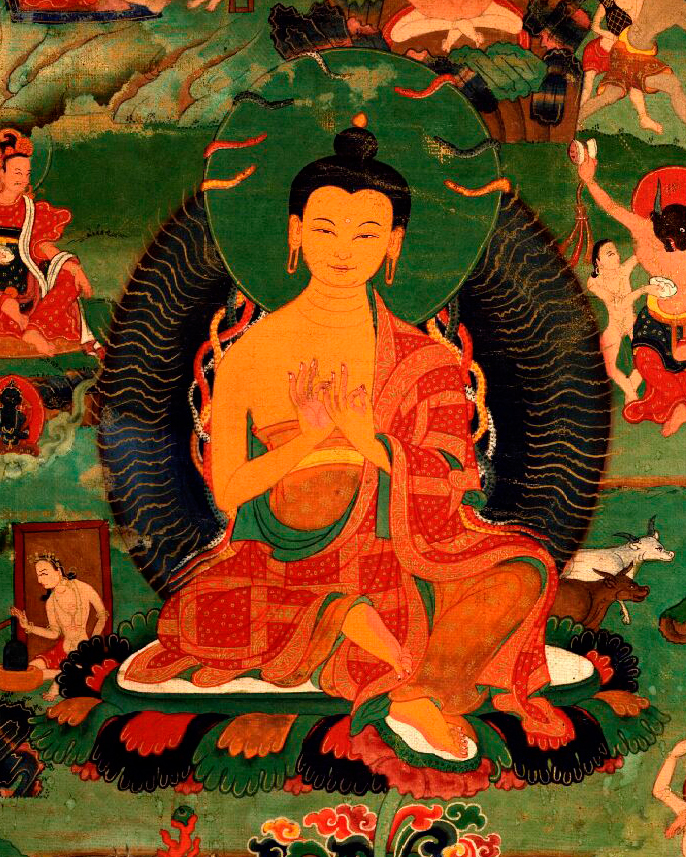
The Buddha declared that pleasant, truthful, and wrong
Are three kinds of speech.
Words are like honey, flowers, and filth.
Abandon the last one.

This verse deals with the notion of speech. Three different kinds of speech are discussed: pleasant speech, truthful speech, and wrongful speech. We have to learn to speak properly. We have spoken about the mind in terms of how we should make use of it in terms of its flexibility or its inflexible nature. How human beings interact with others is based upon communication and the primary form of communication is conducted through the use of speech. Although we make many different kinds of use of speech, according to the teachings they are grouped into three.

The first one is called pleasant speech, which means saying encouraging things that others would like to hear. For example, trying to inspire others or saying things that are supportive of somebody. That is something that one should do. Pleasant speech has the impact of making others happy so what one has said makes somebody happy. In the teachings this is compared to a taste of honey.

The second one is truthful speech, which means to say something with sincerity. “Truthful” means something that is said not in terms of words but in terms of sincere speech and that means being sincere about what one is saying. When saying something pleasant to somebody, one should say it with sincerity. For example, flattery may not be considered pleasant speech even though it may be seen as something that is pleasant for somebody to hear. Sincere speech is said to be very beautiful—there is some kind of beauty in what is said with sincerity and it moves people. It has a very beneficial impact on others.

Wrongful speech is the opposite of these two. It is saying things in order to hurt others or to make them feel upset, to demean them or to put them down, or it is saying things without sincerity to deceive and manipulate. Nagarjuna says that the third form of speech is something that one should avoid and one should try to practice the other two forms of speech as much as possible.

Whatever is said makes an impact on the minds of others. Others will remember if one has said something nice to them. Therefore, even in terms of practicality one will receive a positive response or positive feedback from others. If we have said something very hurtful or demeaning, then others will respond in a similar fashion and one would then feel angered or demeaned or humiliated. From the Buddhist point of view, we have to look at this in terms of interpersonal impact: how what one says impacts upon others and how that then impacts upon us. We should then think about the migratory nature of sentient creatures.

Letter to a Friend* by Nagarjuna, commentary by Traleg Kyabgon

*Letter to a Friend is a brief philosophical poem by Nagarjuna, the influential 2nd-century Buddhist monk and Madhyamaka school founder. Written as advice to a royal patron, it presents core Buddhist teachings in accessible verse form.

A Benefit of Observing Hateful Speech: Patience and Compassion

shodoka-3

A conventional reason for promoting free speech, even if hateful, is that it brings the hate out in the open, where it can be exposed and counteracted.

Here is another benefit, found in a verse from The Song of Realizing the Way (Shodoka) by Zen Master Yongjia Xuanjue (665-713):

There is benefit to observing hateful speech;
it makes you a good guiding teacher.
If you don’t hold a grudge against those who slander,
you don’t need to express patience and compassion.
(Translated by Peter Levitt and the Kazuaki Tanahashi)

Another translation:

When I consider the virtue of abusive words,
I find the scandal-monger is my good teacher.
If we do not become angry at gossip,
We have no need for powerful endurance and compassion.
(Translated by Robert Aitken)

Return to the Four Freedoms

Four Freedoms

As we approach the holiday season, we might think about the big metaphorical American family gathering around the big metaphorical American table. One thing you notice, as with a lot of families and tables, is that there’s going to be a few disagreements, some pretty heated.

But at some point, in keeping with the spirit of the season, the family will be looking for common ground, those shared ideals that unite us. Unfortunately, we seem to be losing sight of those ideals because, to be honest, it isn’t always clear what they are.

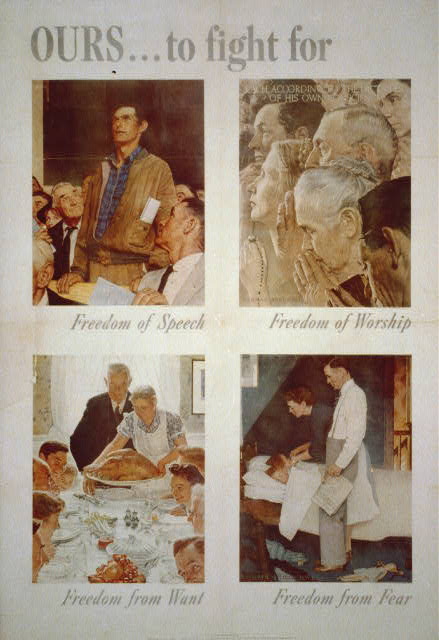
In early 1941, while war was already raging in Europe, but almost a year before Pearl Harbor, FDR gave one of the most famous speeches of the era and of American history. It was the 1941 State of the Union address, but it will always be known as the Four Freedoms speech. To bolster American support for our almost inevitable involvement in the war, he enunciated the Four Freedoms we would be fighting for: Freedom of Speech, Freedom of Worship, Freedom from Want, Freedom from Fear:

In the future days, which we seek to make secure, we look forward to a world founded upon four essential human freedoms.

The first is freedom of speech and expression — everywhere in the world.

The second is freedom of every person to worship God in his own way — everywhere in the world.

The third is freedom from want, which, translated into world terms, means economic understandings which will secure to every nation a healthy peacetime life for its inhabitants — everywhere in the world.

The fourth is freedom from fear, which, translated into world terms, means a world-wide reduction of armaments to such a point and in such a thorough fashion that no nation will be in a position to commit an act of physical aggression against any neighbor — anywhere in the world.

Art turned out to play an important role in keeping these ideals front and center, especially as the prospect of American sacrifice became a reality. The most famous example may be a series of paintings by Norman Rockwell (above), who was then and maybe still the greatest American illustrator. The Library of Congress explains:

Taken from Franklin Roosevelt’s 1941 speech to Congress, the “Four Freedoms” –Freedom of Speech, Freedom of Worship, Freedom from Want, and Freedom from Fear–became a rallying point for the United States during WWII. Artist Norman Rockwell created four vignettes to illustrate the concepts. Rockwell intended to donate the paintings to the War Department, but after receiving no response, the painter offered them to the Saturday Evening Post, where they were first published on February 20, 1943. Popular reaction was overwhelming, and more than 25,000 readers requested full-color reproductions suitable for framing.

Some will say that these Four Freedoms are today “controversial” because we don’t seem to be able as a nation—as an American family—to agree on the strategies to maintain and attain those ideals. Those disagreements are undeniable, as are the related invective, disparagement, and even hatefulness that goes with them. But those disagreements can’t make us give up. On the contrary, they should send us back to the words of FDR, getting past the ideologies and labels, and really look within and at the family of Americans.

Do you really believe that these ideals are exclusive to you, and not shared by others of good will? Are your principles and affiliations so very important that you would sacrifice those ideals to be “right?” Or can we come to the table, dig deeper, and not leave until we have given up a little of our own self-importance and focused instead on getting a little closer to the country and world envisioned in the shared Four Freedoms? And maybe just a little closer to each other?