Bob Schwartz

Tag: quantum physics

World Quantum Day

“I think I can safely say that no one understands quantum mechanics.”
Richard Feynman, winner of Nobel Prize in Physics for his work on quantum mechanics

“God does not play dice with the universe”
Albert Einstein

Today is World Quantum Day, a celebration of quantum science.

Understanding quantum science is a tall task for most of us. Richard Feynman said, “I think I can safely say that no one understands quantum mechanics.” Feynman won a Nobel Prize in Physics for his work on quantum mechanics. If he and his colleagues didn’t understand it, what chance do we have?

Understand we should try to, because quantum science is as important as any of our particular developments and achievements, including AI. Understanding AI, particularly the future possibilities of AI, is best done through a quantum lens. On just one point, the question of whether we can “control” the future of AI, a quantum answer could be “of course not.”

Einstein was not a fan of quantum science. “God does not play dice with the universe,” he said. A mechanistic universe might be challenging to describe—who better than Einstein to know that—but mechanistic it would appear to be. Or not. If everything is, or at least some things are, indeterminate, how can we talk about a unified reality? Unless there is no unified reality, at least not in a conventional sense.

Quantum science as a formal study is a recent development. But students of religion know that quantum thinking was long ago developed in various traditions, particularly but not solely in Buddhism. Jewish non-Buddhists, for example, can turn to the Book of Ecclesiastes/Kohelet for the perspective that everything changes and in fact may be illusory. Deal with everything as it comes and changes, and while you do, have a good time.

Roll some dice today. Consider that God might indeed play dice with the universe. Or that the universe plays dice with itself.

For quantum soundtrack, I am inclined to go with minimalist or ambient music. For edgier, maybe avant garde. Erik Satie, Philip Glass, Brian Eno, John Cage.

© 2026 Bob Schwartz

Pairs of atoms observed existing in two places at once for the first time

Quantum entanglement is a phenomenon where two or more particles become correlated such that measuring one instantly determines the state of the other, regardless of the distance between them.

“There are more things in heaven and earth, Horatio,
Than are dreamt of in your philosophy [science]”
Hamlet, Act 1, Scene 5


Pairs of atoms observed existing in two places at once for the first time
by Australian National University

Quantum physicists at ANU have observed atoms entangled in motion. “It’s really weird for us to think that this is how the universe works,” says Dr. Sean Hodgman from the ANU Research School of Physics. “You can read about it in a textbook, but it’s really weird to think that a particle can be in two places at once.”

Their experiment using helium atoms represents a major advancement over similar experiments using photons, which are particles of light. Unlike photons, helium atoms are massive particles that can be held, cooled, and manipulated in gravitational fields. The research is published in Nature Communications.

“Experimentally, it’s extremely hard to demonstrate this,” says lead author and Ph.D. researcher, Yogesh Sridhar Arthreya. “Several people have tried in the past to show these effects, and they have always come short.”

The development enables new ways to examine one of the biggest unanswered questions about the universe: How does the small-scale physics of quantum mechanics interact with gravity and general relativity at the universal scale?

“This result confirms the predictions of over a century ago that matter can be in two locations at once, and it can interfere with itself even in those locations,” says Dr. Sean Hodgman.

By observing quantum entanglement in atoms for the first time, are we one small step closer to finding out whether the “theory of everything” is not just hot air?


You may be familiar with the concept of interdependence represented by Indra’s Net:


“In the heaven of the great god Indra is said to be a vast and shimmering net, finer than a spider’s web, stretching to the outermost reaches of space. Strung at each intersection of its diaphanous threads is a reflecting pearl. Since the net is infinite in extent, the pearls are infinite in number. In the glistening surface of each pearl are reflected all the other pearls, even those in the furthest corners of the heavens. In each reflection, again are reflected all the infinitely many other pearls, so that by this process, reflections of reflections continue without end.”


Is everything possible, such that the answer to every claim can be yes or no or possibly? Is a Buddhist claim that everything is empty of existence and is also existent unreasonable? Can we be open to everything without endorsing everything?

The claim “that matter can be in two locations at once, and it can interfere with itself even in those locations” would for most of history have been categorized as metaphysics, not physics, yet here we are.

Beautiful Quantum Scribbles


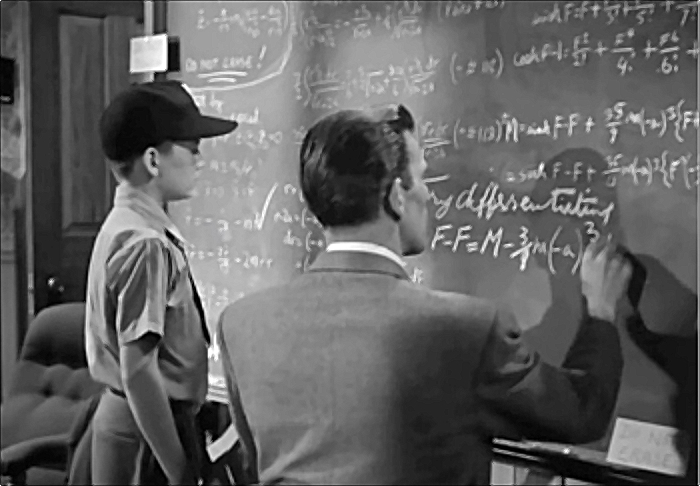
In Robert Wise’s classic sci-fi movie The Day The Earth Stood Still (1951), Klaatu (Michael Rennie), a visitor from distant space, has come to earth to warn world leaders that their conflicts endanger universal order and must end. To enlist the help of the smartest scientist, Dr. Barnhardt (a fictionalized Albert Einstein played by Sam Jaffe), Klaatu visits the professor’s house. He finds an unsolved problem in celestial mechanics on the blackboard, and quickly corrects the equations. He is interrupted by the housekeeper Hilda:


HILDA
How dare you write on that blackboard! Do you realize the Professor has been working on that problem for weeks?

KLAATU
He’ll catch on to it in no time now.

HILDA
How did you get in here? And what do you want?

KLAATU
We came to see Professor Barnhardt.

HILDA
Well, he’s not here. And he won’t be back till this evening.
(Klaatu scribbles a note and hands it to Hilda.)

KLAATU
You might keep this. I think the professor will want to get in touch with me.

Hilda’s glance wanders to the blackboard and she picks up an eraser, debating whether to erase Klaatu’s corrections.

KLAATU
I wouldn’t erase that. The Professor needs it very badly.


Even if you are not a physicist, and are simply intrigued by the arcana that only geniuses and space aliens understand, this is a memorable moment.

People who are comfortable living in the old high school classroom picture of a determinate universe full of atoms and their constituent protons, neutrons and electrons have another think coming. In the quantum world beyond simple particles, anything is possible and nothing is certain, if certainty itself exists. In the view of some, in quantum physics are hints of rough sketches of the face of God, as well solutions to practical matters such as how to teleport information across the universe beyond light speed. Those of us of lesser minds struggle to grasp even the most basic concepts, while the greater minds solve puzzles beautiful in their incomprehensibility.

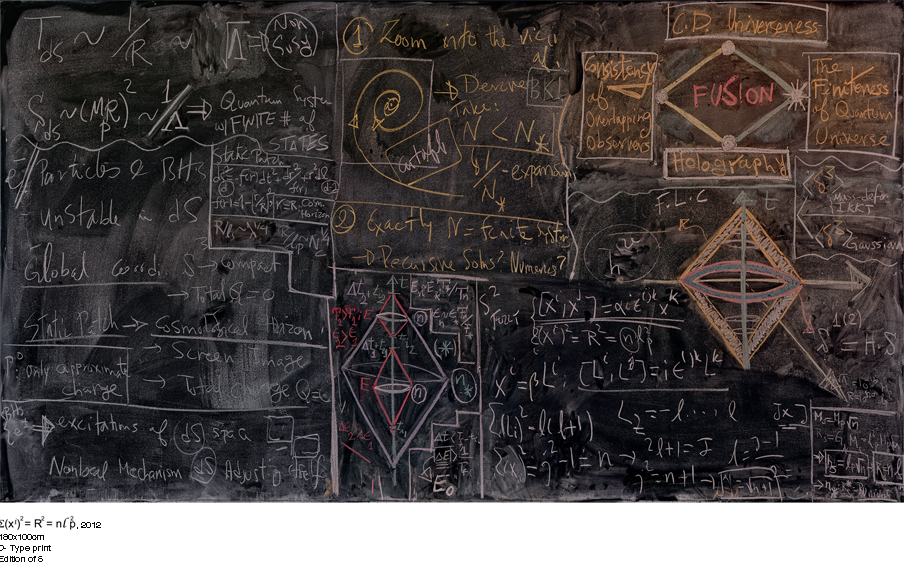
Spanish artist Alejandro Guijarro has combined two things at polar ends of research and education. On one end he has taken detailed photos of blackboards, a thinking and teaching tool so primitive that some are surprised to find them still around, and others have never seen one. On the far end, these particular blackboards belong to some of the world’s leading quantum thinkers. Guijarro traveled to institutes and laboratories around the world to record the smudged, chalk-streaked evidence of some of the world’s most sublime calculations…and erasures.

The Quantum Physics of You

You are quantum physics.
Deeply important and essential.
Deeply complex and puzzling.
There is no sense, no rhyme or reason
To be angry with quantum physics
Even if it is sometimes frustrating to fathom.
The only appropriate response
Is fascination and appreciation
And thanks for making the universe possible.

Beautiful Quantum Scribbles


In Robert Wise’s classic sci-fi movie The Day The Earth Stood Still, Klaatu (Michael Rennie), a visitor from distant space, has come to earth to warn world leaders that their conflicts endanger universal order and must end. To enlist the help of the smartest scientist, Dr. Barnhardt (a fictionalized Albert Einstein played by Sam Jaffe), Klaatu visits the professor’s house. He finds an unsolved problem in celestial mechanics on the blackboard, and quickly corrects the equations. He is interrupted by the housekeeper Hilda:

HILDA
How dare you write on that blackboard! Do you realize the Professor has been working on that problem for weeks?

KLAATU
He’ll catch on to it in no time now.

HILDA
How did you get in here? And what do you want?

KLAATU
We came to see Professor Barnhardt.

HILDA
Well, he’s not here. And he won’t be back till this evening.
(Klaatu scribbles a note and hands it to Hilda.)

KLAATU
You might keep this. I think the professor will want to get in touch with me.

Hilda’s glance wanders to the blackboard and she picks up an eraser, debating whether to erase Klaatu’s corrections.

KLAATU
I wouldn’t erase that. The Professor needs it very badly.

Even if you are not a physicist, and are simply intrigued by the arcana that only geniuses and space aliens understand, this is a memorable moment.

People who are comfortable living in the old high school classroom picture of a determinate universe full of atoms and their constituent protons, neutrons and electrons have another think coming. In the quantum world beyond simple particles, anything is possible and nothing is certain, if certainty itself exists. In the view of some, in quantum physics are hints of rough sketches of the face of God, as well solutions to practical matters such as how to teleport information across the universe beyond light speed. Those of us of lesser minds struggle to grasp even the most basic concepts, while the greater minds solve puzzles beautiful in their incomprehensibility.

Spanish artist Alejandro Guijarro has combined two things at polar ends of research and education. On one end he has taken detailed photos of blackboards, a thinking and teaching tool so primitive that some are surprised to find them still around, and others have never seen one. On the far end, these particular blackboards belong to some of the world’s leading quantum thinkers. Guijarro traveled to institutes and laboratories around the world to record the smudged, chalk-streaked evidence of some of the world’s most sublime calculations…and erasures.