Bob Schwartz

Tag: Psychology

Cigarette Ads Circa 1960: Size Matters

TV Guide - July 9 1960

Above is an ad from the back cover of TV Guide from July 9, 1960. It is for Parliament cigarettes. The image shows a man (judging by the hands) measuring a cigarette with a ruler, while a woman looks on with a mysterious, Mona Lisa-like expression. Is she thinking about taste? About how “your lips and tongue never touch” the filter? She is also holding a cigarette. Hers is lit and smoking.

In 1957, journalist and social critic Vance Packard published his groundbreaking bestseller The Hidden Persuaders, “the first book to expose the hidden world of “motivation research,” the psychological technique that advertisers use to probe our minds in order to control our actions as consumers.” Chapter 8 is entitled The Built-in Sexual Overtone.

Since then, discussions about the role of psychology in advertising have continued unabated. Setting aside those discussions, it can be said that sometimes a cigarette is just a cigarette, a ruler is just a ruler, etc. On the other hand, every picture tells a story. So what’s the story here?

Political Insanity Defense

People have watched enough criminal trials on TV to know about the insanity defense—or actually defenses, since it differs state to state:

THE INSANITY DEFENSE

  • What are the legal standards for insanity?

Each state, and the District of Columbia, has its own statute setting out the standard for determining whether a defendant was legally insane, and therefore not responsible, at the time his crime was committed. In general, the standards fall into two categories.

About half of the states follow the “M’Naughten” rule, based on the 1843 British case of Daniel M’Naughten, a deranged woodcutter who attempted to assassinate the prime minister. He was acquitted, and the resulting standard is still used in 26 states in the U.S.: A defendant may be found not guilty by reason of insanity if “at the time of committing the act, he was laboring under such a defect of reason from disease of the mind as not to know the nature and quality of the act he was doing, or if he did know it, that he did not know what he was doing was wrong.” (emphasis added) This test is also commonly referred to as the “right/wrong” test.

Twenty-two jurisdictions use some variation of the Model Standard set out by the American Law Institute (A.L.I.) in 1962. Under the A.L.I. rule, a defendant is not held criminally responsible “if at the time of his conduct as a result of mental disease or defect he lacks substantial capacity either to appreciate the criminality (wrongfulness) of his conduct or to conform his conduct to the requirements of law.” (emphasis added) The A.L.I. rule is generally considered to be less restrictive than the M’Naughten rule.

Some states that use the M’Naughten rule have modified it to include a provision for a defendant suffering under “an irresistible impulse” which prevents him from being able to stop himself from committing an act that he knows is wrong.

Three states — Montana, Idaho, and Utah — do not allow the insanity defense at all.

PBS Frontline: A Crime of Insanity

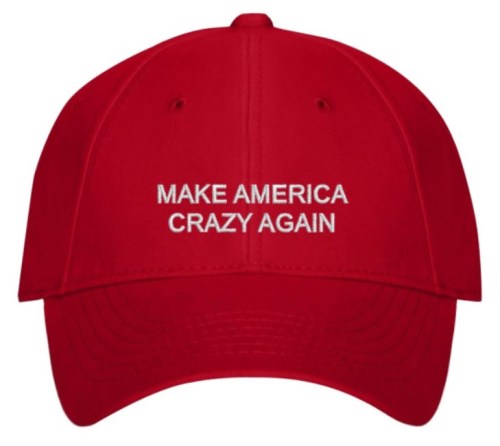
What if—and I know this is far-fetched and fantastical—some political candidate was suffering from what some of the states call “mental disease or defect”? Could that candidate claim no responsibility for behavior on or off the campaign trail? No responsibility for behavior in office, if by some chance elected?

Such a candidate might claim—and again, far-fetched and fantastical—that ISIS will be taking over the United States if he is not elected. That Speaker of the House Paul Ryan is part of a “secret deal” and a vast conspiracy to defeat him. That he, the candidate, is a savior, and that he and he alone in all the world is capable of saving the nation.

This is fertile territory for legal, psychological and political scholars, as far-fetched and fantastical as it may be.

Respected Political Journalist John Heilemann Calls Trump a Lunatic

Eclipse

You lock the door
And throw away the key
There’s someone in my head but it’s not me

John Heilemann is one of the most respected, talented and fair-minded political journalists in America.

He and his partner Mark Halperin  have written two of the most insightful and entertaining presidential campaign books of all time: Game Change: Obama and the Clintons, McCain and Palin, and the Race of a Lifetime  and Double Down: Game Change 2012. They are the Managing Editors of Bloomberg Politics. They have a weekly show about the campaign on Showtime called The Circus: Inside the Greatest Political Show on Earth. They have a daily show for Bloomberg Politics that airs on MSNBC called With All Due Respect.

It was on that show that something extraordinary happened yesterday. It was a tiny moment, one that could go unnoticed and unremarked. Talking about Donald Trump and the week he has had, Heilemann called Trump a lunatic.

One possibility is that despite the overwhelming evidence of a career marked by even-handed reporting, Heilemann has all along been a substandard journalist with a secret partisan agenda. The other possibility is that Heilemann is a great professional journalist who just finally had enough and could not avoid speaking the obvious.

In the event, hearing the word brought to mind the song I think about any time the word lunatic pops up, Pink Floyd’s Brain Damage from Dark Side of the Moon. It is the penultimate track on the album, leading into the closing Eclipse. The song is inspired in part by the tragic story of original Pink Floyd member Syd Barrett, whose genius was paired with and compromised by mental illness.

This may have absolutely nothing to do with the presidential campaign and election. Then again…

The lunatic is on the grass
Remembering games and daisy chains and laughs
Got to keep the loonies on the path

The lunatic is in the hall
The lunatics are in my hall
The paper holds their folded faces to the floor
And every day the paper boy brings more

And if the dam breaks open many years too soon
And if there is no room upon the hill
And if your head explodes with dark forebodings too
I’ll see you on the dark side of the moon

The lunatic is in my head
You raise the blade, you make the change
You re-arrange me ’til I’m sane
You lock the door
And throw away the key
There’s someone in my head but it’s not me

And if the cloud bursts, thunder in your ear
You shout and no one seems to hear
And if the band you’re in starts playing different tunes
I’ll see you on the dark side of the moon