Bob Schwartz

Tag: Pope Francis

Is Pope Francis the Leader of the World?
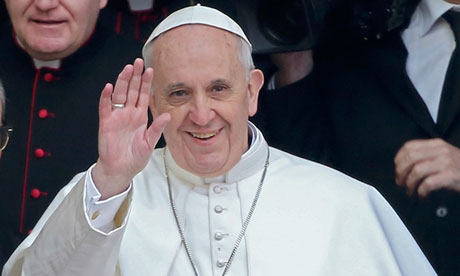
Pope Francis
The Dalai Lama is the most famous Buddhist in the world. His message is powerful, positive and universal. Even with the huge platform he has, his brand of Tibetan Buddhism is a bit exotic for many people, so still somewhat limited. He is also one of the coolest people on the planet. So as much as a basic Buddhist message would be great for the world at large to take to heart, it isn’t about to happen.

Pope Francis is also an outsized moral leader. He is the head of a church with more than a billion followers. And while there are hundreds of millions of Protestant Christians who question whether that church and its Pope can claim Christian legitimacy—and who find the Catholic Church plenty exotic too—you can’t deny the size and scope of the Pope’s Christian community. And if the Dalai Lama is cool, so is Pope Francis; he was once a bar bouncer, which is something the Dalai Lama can never claim.

The biggest argument for the supreme leadership role of Pope Francis is that he is exactly the right person for the right time, acting and speaking on a very big stage. Two of the major characteristics of the moment are that materialism seems to be failing or failing us and that our changing social universe requires some tricky balance between the old and the new, the absolute and the relative.

Pope Francis gets this and sells this from the very foundations of his faith. He has just had to deny that his is a not a Marxist, but proceeded in the same breath to appreciate the work of those who sincerely act in the name of Marxist ideals. It is not just that he seems to have a vision that synthesizes the original Christian communities with the complicated world two millennia later. He sees in the very institution he is charged with running the embodiment of the problems. If the institutional church, the church membership and the world have lost their way, it is not his job to order them around. Instead he just points to a playbook that is to be taken seriously, not selectively and strategically, and advises to live by and as its example. It’s a choice, one he has made, one he hopes others, from the church hierarchy on out, will make.

Whether the Catholic Church straightens out its affairs, whether disaffected Catholics return, whether new Catholics arrive, whether we are Catholic or Protestant or Jewish or Buddhist is beside the point and beside the Pope’s point. It is about being better and getting better. Pope Francis is not the first to say that, not even the first Pope to say it. But his walking the walk in the world of 2013 is different. These are the times that try people’s souls. We seem to have a world leader willing to make that reality both an ancient and modern quest, a quest that may, in the real and not theological sense, save us all.

What the GOP Can Learn from Pope Francis

Pope Francis
Pope Francis has turned out to be everything his most idealistic supporters hoped for, and then some. For a bonus trick, he may be able to save the Republican Party—politically speaking.

If you’ve only seen the top-line coverage of his interview with the magazine America, or read some quotes, do read the whole thing. It is a multi-dimensional view of a simultaneously simple and complex leader of an enormous—and enormously controversial—enterprise. We are apparently just beginning to see his skills.

For one thing, he is trying to navigate a sea of reformist and conservative elements, a dynamic that has left the Church in turmoil. He is doing this by something outrageously unlike most of what we see in the “sophisticated” twenty-first century. He is leading by staying true to a bedrock of belief, in word and action, but doing it in a way that is learned, thoughtful, humble and realistic. He is stripping away an accretion of institutional and self-interest extras, genuinely trying to get back to the core that made him a priest and a Pope, that brought so many to the Church, and that so many now see forgotten and hypocritized away.

This is a near miracle, and he may be on his way to doing just that. As a bonus, if the Republican Party is paying attention, it can learn something too. It turns out that unalloyed, unconditioned ideals can be both appealing and moral, including love, compassion, humility, tolerance (see the Beatitudes for a complete list). It isn’t easy to make this work in the real world, and it will be controversial and unpleasing to some, particularly those with extreme views.

The Republican Party is in the same position as the Church. There are some core beliefs that are eminently worthy but are being lost and forgotten in layers of maneuvering, narrow-mindedness, arrogance and hypocrisy. Catholics didn’t like that in the Church, and citizens, including some Republicans, don’t like it in the party.

Right at this moment, there is no Pope Francis on the horizon for the Republicans. This may become more apparent in the next few weeks, as some Republicans continue to exhibit a thoughtless, heartless and unproductive stubbornness that flies in the face of everything the party once stood for. Then again, nobody saw Pope Francis coming either. Let’s hope, for the sake of the nation as an economic, political and moral enterprise, that the Republican Pope Francis comes along very soon.

The Saints Francis

St. Francis of Assisi
Right now, there are millions of words being written and spoken about who Pope Francis is and what kind of Pope he will be. Read and listen with care and a bit of skepticism, knowing that some (but not all) have an agenda or a bit of rosy vision, and knowing that almost all of the “experts” got this papal selection wrong. The fact is that predictions are all we have at the moment, but they will fade in the shadow of what the Pope actually does or doesn’t do and accomplish.

Instead or in addition, spend some time with the saints, particularly the various Saints Francis. Even for us non-Catholics and non-Christians, the saints are an enormously interesting, educational and in some cases enlightening phenomenon. If you don’t have some appreciation for the saints, whether or not you believe the intrinsic or underlying theology, you cannot understand the Catholic Church. Besides that, in the world of religion, not just Catholicism, the lives of the saints are just plain entertaining and their teachings often edifying and inspiring.

Here is the list of Saint Francis variations, taken from the SPQN site, a go-to location for summary saint information and references:

Francis Gil de Frederich
Francis Isidore Gagelin
Francis Jaccard
Francis Jerome
Francis Johnson
Francis Man
Francis Mary Paul Libermann
Francis Page
Francis Palau y Quer
Francis Patrizzi
Francis Pontillo
Francis Possenti
Francis Regis Clet
Francis Rogaczewski
Francis Seelos
Francis Solano
Francis Solanus
Francis Trung Von Tran
Francis Webb
Francis Xavier
Francis Xavier Bianchi
Francis Xavier Can Nguyen
Francis Xavier Mau
Francis Xavier Seelos
Francis de Capillas
Francis de Geronimo
Francis de Hieronymo
Francis de Montmorency Laval
Francis de Sales
Francis di Girolamo
Francis of Assisi
Francis of Girolamo
Francis of Nagasaki
Francis of Paola
Francis of Saint Michael
Francis of Sales
Francis, Caius
Francis, Gaius
Francisca Aviat
Francisca de Ambrosia
Francisca Salesia
Francisca Salesia Aviat
Francisco Castells Brenuy
Francisco Ferro, Ambrosio
Francisco José López-Caamaño García-Pérez
Francisco Marto
Francisco of the Child Jesus
Francisco Palau y Quer
Francisco Pascual Sánchez
Francisco Shoyemon
Franciscus de Hieronymo

The most-discussed and obvious of the lives behind Cardinal Bergoglio’s groundbreaking choice of name (he is the first Pope Francis) is Francis of Assisi. His turning from a worldly life to a mission of simplicity, service, peace and, of course, living with nature led to his founding of one of the Church’s most significant orders (the Franciscans) and indirectly to the founding of another by his star student (the Poor Clares). He is also a patron saint of dozens of occupations, causes and places, including

against dying alone
against fire
animal welfare societies
animals
birds
ecologists
ecology
environment
environmentalism
environmentalists
families
lace makers
lace workers
merchants
needle workers
peace
tapestry workers
zoos
Italy
Colorado
Ahuacatlán, Mexico
Assisi, Italy
Freising, Germany
Massa, Italy
Nambe Indian Pueblo
Quibdo, Choco, Colombia
San Pawl il-Bahar, Malta
Sante Fe, New Mexico
Sorbo, Italy
Denver, Colorado, archdiocese of
Kottapuram, India, diocese of
Lancaster, England, diocese of
Metuchen, New Jersey, diocese of
Salina, Kansas, diocese of
San Francisco, California, archdiocese of
Sante Fe, New Mexico, archdiocese of
Viana, Angola, diocese of

But he is not the only Saint Francis with a substantial presence in the Church. Saint Francis de Sales, for example, is the namesake of schools worldwide, founder of his own order (the Salesians), and in 1923 was named patron saint of writers and journalists (and presumably bloggers) by Pope Pius XI.

However you are celebrating the upcoming St. Patrick’s Day—if you are—you might start your study of the saints with him.  But don’t stop there. Take this opportunity of a new Pope to learn about the Saints Francis, from the big names to the lesser known but still worthy ones. You’ll find it a special experience, no matter what your spiritual perspective, and maybe much more fun and useful than listening to the earnest babble of certain media talking heads.