Bob Schwartz

Tag: philosophy

Politely Ask Trump to Resign

The majority of Americans think that Trump is a threat to civility, to honesty, to American values, democracy and institutions, and to American and global peace and progress. As one new and untried tactic, we should simply, politely and plainly ask him to resign.

This is not a replacement for any of the other ongoing approaches, including investigation of his wrongdoing, ridicule, humor, and calls for impeachment or action under the 25th amendment. And of course, voting.

It is, however, a civilized way of doing something it is increasingly hard to do: be a better and more civilized person than Trump himself. It is hard not to fall into the sinkhole of being as terrible as our worst nemesis—that is an ancient theme. The pragmatic fact is that it is sometimes unavoidable, if the better is to triumph over the lesser. But when that happens, we are in danger of being just as bad, and our remaining upright and our job of healing and recovering is made that much more difficult.

So let us ask Trump to resign, politely explaining the many reasons it is best for America and Americans, and for the world. Of course he will not do it or consider it, and will mock it, since in his mind any show of decency and quiet reason is a show of weakness. Instead, though, it is a small demonstration that we still believe that decency is a show of strength. Which is something we are understandably starting to forget.

Note:

As is my practice, I asked the I Ching about this proposal. It is appropriate to do that for two reasons. The I Ching itself is in part a philosophical response to centuries of national political changes in China, cataclysms that make a few years of Trump look like a picnic. Second, China itself in 2018 still uses the I Ching for guidance. So why shouldn’t we?

The I Ching says (Alfred Huang translation):

59
Huan • Dispersing

NAME AND STRUCTURE

Originally Huan meant ice breaks, melts, and vanishes. Later on, it came to mean to separate and scatter.

Sequence of the Gua: After happiness and joyfulness, there comes dispersing. Thus, after Joyful, Dispersing follows.

The ideograph of Huan expresses its original meaning. The image on the left represents water. It resembles the primary gua for Water, turned vertically. On the top right is a knife, and on the bottom are two hands with fingers and arms. In the middle are two pieces of ice. Taken as a whole, this ideograph pictures a knife used to break up the ice, with two hands separating the pieces of ice. The ice melts and becomes water, at last dispersing and vanishing. The structure of the gua is Wind   above, Water   below. The wind blows over the water and disperses the waves. The inner gua is Water; its attribute is danger. It symbolizes one’s vital energy blocked within. The outer gua is Wind; its attribute is penetration. Penetrating and breaking the blockage leads to dispersion.

Decision

Dispersing.
Prosperous and smooth.
The king arrives at the temple.
Favorable to cross great rivers.
Favorable to be steadfast and upright.

Commentary on the Decision

Dispersing.
Prosperous and smooth.
The firm comes without hindrance.
The yielding is at the proper place.
It goes out to meet its similarity above.
The king arrives at the temple.
He is in the central place.
Favorable to cross great rivers.
The merit comes from mounting on the wood.

Commentary on the Symbol

The wind moves over the water.
An image of Dispersing.
In correspondence with this,
The ancient king offers sacrifice to the Lord of Heaven
And establishes temples.

SIGNIFICANCE

The gua takes the image of the wind moving over the water to demonstrate the act of dispersing people’s resentment. During the time of dispersing, having a leader with wisdom and foresight is crucial. The king approaching his temple gives us an image of his connection with the spiritual world. Crossing great rivers signifies the hardship and difficulty of the work. Steadfastness and uprightness should be the virtue of a great leader. He has self-confidence, so he is able to live and work in peace. The host of the gua is the solid line at the fifth place. This line represents the king who approaches his temple to connect himself with the Lord of Heaven. During the time of dispersing he is the only one who, in the honored place, is able to establish order throughout his nation. The fourth line represents the king’s minister, while the second line is his officer. They faithfully assist the king to unite the people in the time of dispersing.

During King Wen’s sitting in stillness he meditated upon joyfulness and dispersion. After people had been joyful, their energy dispersed, and their focus was scattered. At such a time, a leader with wisdom and foresight was needed. He arrived at his temple and communicated with the deity. His sincerity and trustworthiness encouraged people to work in full cooperation and with unity of purpose. The Duke of Zhou narrates that to be of help at such a time, one should have the speed of a strong horse. Dispersing self-serving groups led to a union as solid as a mound.
Heschel on Politicians

“I consider the heart of the problem of human existence is to fight against mendacity, against lying. I would like to use a word which may be too often used, but it’s still the most important word—and that is “honesty,” or “sincerity,” or “trust.””

“I am against the word “politician.” I have great respect for the word “statesman.” It’s very interesting, the word “statesman” is not used. “Politician” is used. “Statesman” is a great word….The task of a statesman is to be a leader, to be an educator, and not to cater to what people desire almost against their own interests. To be a leader.”

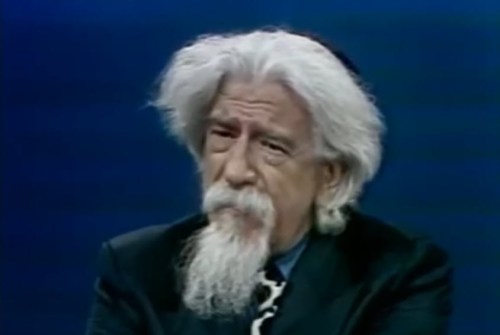
From an interview with Abraham Joshua Heschel at the University of Notre Dame in 1967, published in Moral Grandeur and Spiritual Audacity, essays by Heschel.

Q: Your esteem for religious colleagues is greater than your esteem for politicians. I think you once said that the most depressing word in the English language is “politician.” Politicians are necessary, aren’t they? Why disparage them?

A: No, I’m not against politicians in their vocation. I’m against politicians in their tactics. Against the very meaning, the semantic meaning of the word “politician.”

Now let me elaborate. It may take me two minutes to explain it to you. I consider the heart of the problem of human existence is to fight against mendacity, against lying. I would like to use a word which may be too often used, but it’s still the most important word—and that is “honesty,” or “sincerity,” or “trust.”

The tragedy of our time is, we don’t trust each other. The Golden Rule today is not “Love thy neighbor as thyself” but “Suspect thy neighbor as thyself.” We suspect all politicians because we know in advance they don’t mean what they say and they don’t say what they mean.

Q: Is that justified? That suspicion?

A: Ask the people in the country. You’re asking me? I’m only one citizen. I have only one vote.

If you go to the country and ask them, “What do you think of politicians?,” they’ll say a politician is a synonym for a person who is not necessarily truthful. Right? Do you mind my elegant way of speaking?

We have a type of politician today—I suppose we’ve always had, and I don’t want to identify anyone—who tells us that he is doing what the peoples want. And, in fact, that may be so. Of course, that doesn’t reach to the question of leadership. Should our leaders give us what we want, or is there some other role?

I think there is another role. By the way, I am against the word “politician.” I have great respect for the word “statesman.” It’s very interesting, the word “statesman” is not used. “Politician” is used. “Statesman” is a great word.

Now, about doing what the people want—I’ll tell you what the people want. One of the major inclinations in every human being is a desire to be deceived. Self-deception is a major disease.

Q: To be told what one wants to hear?

A: Yes. You want to be deceived.

The task of a statesman is to be a leader, to be an educator, and not to cater to what people desire almost against their own interests. To be a leader.

The great question of today is mendacity. We live in a world full of lies. And the tragedy that our young people—or maybe it’s good—the young people have discovered how many lies are uttered daily and every moment. They can’t stand it. If there’s anything they despise, it’s someone who is phony, false rhetoric. We call it “credibility gap”—what we mean really is lying.

“In the biographies of men and nations, success often arrives in a mask of failure.”

This isn’t about baseball, though the quote is from a baseball writer. Bill James is not just a superb writer; he is a thinker whose analysis of the game has changed baseball more than any other thinker has ever changed any game. You can look it up.

This is about optimism and hope. I was reading The New Bill James Historical Baseball Abstract (a 998-page volume whose title alone should tell you just how thoughtful Bill James is). He describes Robin Yount, who as of the time of publication James considered the Number 4 shortstop in baseball history:

Robin Yount (1974–1993, 2856 G, 251 1406 .285)

Robin Yount was a major league regular when he was 18 years old. We always wondered how good he would be, how much he would improve. In 1978, after Yount had been in the major leagues four years, he held out in the spring, mulling over whether he wanted to be a baseball player, or whether he really wanted to be a professional golfer.

When that happened, I wrote him off as a player who would never become a star. If he can’t even figure out whether he wants to be a baseball player or a golfer, I reasoned, he’s never going to be an outstanding player.

Yount was unhappy about suggestions that the Brewers would move him to the outfield. According to Dan Okrent in Nine Innings, “Yount didn’t merely reject the suggestion; he brooded about it, resented it, and lost himself in self-doubt. Members of the front office… saw Yount’s reaction as immature sulking.”

But as soon as he returned to baseball, Yount became a better player than he had been before; his career got traction from the moment he returned. What I didn’t see at the time was that Yount was in the process of making a commitment to baseball. Before he had his golf holiday, he was there every day, he was playing baseball every day, but on a certain level he wasn’t participating; he was wondering whether this was really the sport that he should be playing. What looked like indecision or sulking was really the process of making a decision.

This is often true. What Watergate was about was not the corruption of government, as most people thought, but rather, the establishment of new and higher standards of ethical conduct. Almost all scandals, I think, result not from the invention of new evils, but from the imposition of new ethical standards. Same thing with Yount; he wasn’t backing away from baseball; he was just putting the bit in his teeth, accepting new responsibilities. In the biographies of men and nations, success often arrives in a mask of failure. (emphasis added)

To Understand America 2018, Read Alice’s Adventures in Wonderland

We had the best education. We went to school every day. I only took the regular course. Reeling and Writhing to begin with. Then the different branches of Arithmetic—Ambition, Distraction, Uglification, and Derision.
Alice’s Adventures in Wonderland

Read Alice’s Adventures in Wonderland now. Again if it’s been a while, and definitely now if for the first time.

Lewis Carroll (born Charles Dodgson, 1832-1898) was famously creative as a mathematician and logician. He wove puzzles and tortured logic all through his book Alice’s Adventures in Wonderland.

Puzzles and tortured logic seem likely to be a major component of America in 2018, as they were in 2017.

The leadership and the citizens of Wonderland are variously tyrannical, illogical, stupid, or just plain bizarre. Alice literally does not fit in. While she is only a child, she has more sense than everyone she meets combined.

If I had a news network like CNN, I’d interrupt the futile attempts to understand and explain what’s going on by having different news anchors read aloud one chapter from Alice in Wonderland every day. It would actually be more constructive—and more fun—than just listening to their trying to making sense of the nonsensical.

If Trump’s tweets were taken from Alice in Wonderland, would we know the difference? Would he?

Some Trump/Alice tweets:

We must have a trial. Really this morning I have nothing to do. With no jury or judge I’ll be Judge. I’ll be jury. I’ll try the whole cause and condemn you to death.

We’re all mad here. I’m mad. You’re mad. A dog growls when it’s angry and wags its tail when it’s pleased. Now I growl when I’m pleased and wag my tail when I’m angry. Therefore I’m mad.

Be what you would seem to be. Never imagine yourself not to be otherwise than what it might appear to others that what you were or might have been was not otherwise than what you had been would have appeared to them to be otherwise.

You have no right to think. Just about as much right as pigs have to fly. I give you fair warning either you or your head must be off. Take your choice!

We had the best education. We went to school every day. I only took the regular course. Reeling and Writhing to begin with. Then the different branches of Arithmetic—Ambition, Distraction, Uglification, and Derision.

Civilization

Inscribed on the winding sidewalk of the park:

The true test of civilization is not the census, nor the size of cities, nor the crops, but the kind of man that the country turns out.
—Ralph Waldo Emerson, Society and Solitude, 1870

Between the rational and irrational and between the religious and the irreligious

Between the rational and the irrational is the place that so many traditions point us to, though not all who follow want to go. It is not in the middle, in the sense of being halfway in between, or to applying each one half the time. It is the entire space, with the wholly rational and irrational merely on the outside borders, a thin outline.

This does not sit well with many, who want to have it one way or another. Extreme rationalists frequently work hard to make ordered sense from evidence, rejecting the rest, and particularly vexed by those apparently too lazy or heedless to see how essential the rational way is. Extreme irrationalists may be driven by visions that may be delusions, or by personal preferences, and may indeed avoid the rational because it is hard work or because it may not suit their needs.

This plays out on a bigger social scale. With increasing frequency, the irreligious base their perspective on a loosely rationalist view, not only because there is no evidence of and for the religious, but because the religious seem to discard or ignore the rational in a disordered and possibly self serving way.

No one is right or wrong here, in the sense of winning an ultimately unwinnable argument. Instead consider the field where all things grow, neither rational nor irrational. The place, if we listen to the best of the traditions, where we are born and where we die.

Ex Nihilo

Ex Nihilo

When once was nothing
Was something?
Where once was nothing
Was nowhere?
Know everything
Believe in what you know
And nothing else?
Believe everything
And know nothing?
Aleph to tav
Alpha to omega
Awwal to akkir.
Is this the emet
The truth?

© Bob Schwartz 2017

Brain Fiction: Self-Deception and the Riddle of Confabulation

What if someone lies in the face of overwhelming contrary evidence? What if that person really believes what he is saying?

Confabulation is the construction of false answers to a question while genuinely believing that you are telling the truth.

This mysterious phenomenon usually accompanies neurological or cognitive disorders, and the puzzle of it has been the subject of some study among researchers. In his book Brain Fiction: Self-Deception and the Riddle of Confabulation, William Hirstein takes this study further than it has gone before:

“Both a neuroscientist and a philosopher, William Hirstein writes from his unique vantage point with great scholarship, precision, and clarity to tackle some of the deeper mysteries of the human mind. Brain Fiction is full of profound insights, and I recommend it to all who wish to better understand our human nature.”

—Fredric Schiffer, M.D., Harvard Medical School, author of Of Two Minds

Here is a description of the book:

Some neurological patients exhibit a striking tendency to confabulate—to construct false answers to a question while genuinely believing that they are telling the truth. A stroke victim, for example, will describe in detail a conference he attended over the weekend when in fact he has not left the hospital. Normal people, too, sometimes have a tendency to confabulate; rather than admitting “I don’t know,” some people will make up an answer or an explanation and express it with complete conviction. In Brain Fiction, William Hirstein examines confabulation and argues that its causes are not merely technical issues in neurology or cognitive science but deeply revealing about the structure of the human intellect.

Hirstein describes confabulation as the failure of a normal checking or censoring process in the brain—the failure to recognize that a false answer is fantasy, not reality. Thus, he argues, the creative ability to construct a plausible-sounding response and some ability to check that response are separate in the human brain. Hirstein sees the dialectic between the creative and checking processes—”the inner dialogue”—as an important part of our mental life. In constructing a theory of confabulation, Hirstein integrates perspectives from different fields, including philosophy, neuroscience, and psychology to achieve a natural mix of conceptual issues usually treated by philosophers with purely empirical issues; information about the distribution of certain blood vessels in the prefrontal lobes of the brain, for example, or the behavior of split-brain patients can shed light on the classic questions of philosophy of mind, including questions about the function of consciousness. This first book-length study of confabulation breaks ground in both philosophy and cognitive science.

A sample chapter can be read here. A couple of brief excerpts:

Why then does confabulation happen? Confabulation seems to involve two sorts of errors. First, a false response is created. Second, having thought of or spoken the false response, the patient fails to check, examine it and recognize its falsity. A normal person, we want to say, would notice the falsity or absurdity of such claims. The patient should have either not created the false response or, having created it, should have censored or corrected it. We do this sort of censoring in our normal lives. If I ask you whether you have ever been to Siberia, for instance, an image might appear in your mind of you wearing a thick fur coat and hat and braving a snowy storm, but you know that this is fantasy, not reality. In very general terms, the confabulating patient lacks the ability to assess his or her situation, and to either answer correctly, or respond that he or she does not know. Apparently, admitting ignorance in response to a question, rather than being an indication of glibness and a low level of function, is a high-level cognitive ability, one that confabulators have lost. ‘‘I don’t know,’’ can be an intelligent answer to a question, or at least an answer indicative of good cognitive health….

Young children sometimes confabulate when asked to recall events. Ackil and Zaragoza (1998) showed first-graders a segment of a film depicting a boy and his experiences at summer camp. Afterward the children were asked questions about it, including questions about events that did not happen in the film. One such question was, ‘‘What did the boy say Sullivan had stolen?’’ when in fact no thefts had taken place in the film. The children were pressed to give some sort of answer, and the experimenters often suggested an answer. When the children were interviewed a week later, the false events as well as the suggested answers had been incorporated into their recollections of the movie.

“there is some shit I will not eat”

It may not be my favorite E. E. Cummings poem, but i sing of Olaf glad and big is a special one. It is about someone who suffers for his moral beliefs (in this case, about war and mindless patriotism), and who is punished by a range of Americans, from fellow soldiers to the president. Someone, writes Cummings, who is “more brave than me:more blond than you.” It contains the one line of poetry I probably recite the most in non-poetry contexts, to epitomize those who take a stand.

i sing of Olaf glad and big
whose warmest heart recoiled at war:
a conscientious object-or

his wellbelovéd colonel(trig
westpointer most succinctly bred)
took erring Olaf soon in hand;
but–though an host of overjoyed
noncoms(first knocking on the head
him)do through icy waters roll
that helplessness which others stroke
with brushes recently employed
anent this muddy toiletbowl,
while kindred intellects evoke
allegiance per blunt instruments–
Olaf(being to all intents
a corpse and wanting any rag
upon what God unto him gave)
responds,without getting annoyed
“I will not kiss your fucking flag”

straightway the silver bird looked grave
(departing hurriedly to shave)

but–though all kinds of officers
(a yearning nation’s blueeyed pride)
their passive prey did kick and curse
until for wear their clarion
voices and boots were much the worse,
and egged the firstclassprivates on
his rectum wickedly to tease
by means of skilfully applied
bayonets roasted hot with heat–
Olaf(upon what were once knees)
does almost ceaselessly repeat
“there is some shit I will not eat”

our president,being of which
assertions duly notified
threw the yellowsonofabitch
into a dungeon,where he died

Christ(of His mercy infinite)
i pray to see;and Olaf,too

preponderatingly because
unless statistics lie he was
more brave than me:more blond than you.

The Age of Enlightenment Has Left the Building (At Least in America)

Age of Enlightenment: an intellectual and scientific movement of 18th century Europe which was characterized by a rational and scientific approach to religious, social, political, and economic issues.

It was great while it lasted. At times difficult, but fun too. The Age of Enlightenment gave us, for example, the American Revolution. Helpful.

If more evidence is needed that the “rational and scientific approach” is going or gone, here is the new EPA Administrator Scott Pruitt on the role of carbon dioxide in global warming:

“There’s tremendous disagreement about the degree of impact…So, no, I would not agree that carbon dioxide is a primary contributor to the global warming that we see.”

The United Nations Intergovernmental Panel on Climate Change disagrees with him. Almost all scientists disagree with him. The current EPA website disagrees with him (though that will be fixed). Many junior high school students disagree with him (though our new Secretary of Education should be able to fix that too).

The Age of Enlightenment doesn’t have a special holiday, because it is already embedded in so much we do (see, for example, the Fourth of July). But maybe we should at least recognize its passing. We’ll miss it, more than we know.