Bob Schwartz

Tag: philosophy

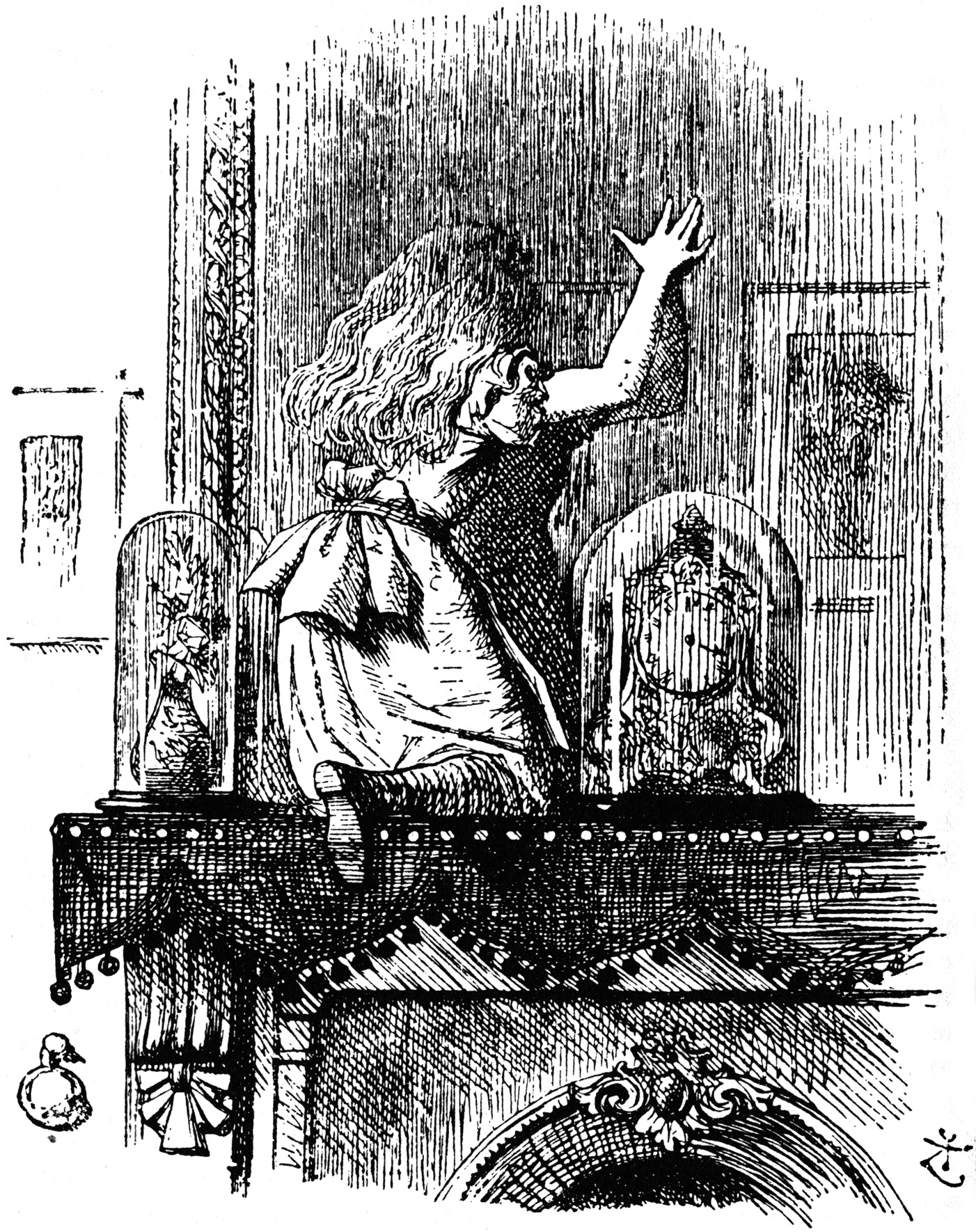
To Understand America 2025, Read Alice’s Adventures in Wonderland

We had the best education. We went to school every day. I only took the regular course. Reeling and Writhing to begin with. Then the different branches of Arithmetic—Ambition, Distraction, Uglification, and Derision.
Alice’s Adventures in Wonderland

Read Alice’s Adventures in Wonderland now. Again if it’s been a while, and definitely now if for the first time.

Lewis Carroll (born Charles Dodgson, 1832-1898) was famously creative as a mathematician and logician. He wove puzzles and tortured logic all through his book Alice’s Adventures in Wonderland.

Puzzles and tortured logic are a major component of America in 2025.

The leadership and the citizens of Wonderland are variously tyrannical, illogical, stupid, or just plain bizarre. Alice literally does not fit in. While she is only a child, she has more sense than everyone she meets combined.

If I had a news network I’d suspend the futile attempts to explain what’s going on and would instead read aloud one chapter from Alice in Wonderland every day. It would be more constructive and more fun than listening to their trying to make sense of the nonsensical.

Trump’s posts and speeches seem to be taken straight from Alice in Wonderland:

For example:

We must have a trial. Really this morning I have nothing to do. With no jury or judge I’ll be Judge. I’ll be jury. I’ll try the whole cause and condemn you to death.

We’re all mad here. I’m mad. You’re mad. A dog growls when it’s angry and wags its tail when it’s pleased. Now I growl when I’m pleased and wag my tail when I’m angry. Therefore I’m mad.

Be what you would seem to be. Never imagine yourself not to be otherwise than what it might appear to others that what you were or might have been was not otherwise than what you had been would have appeared to them to be otherwise.

You have no right to think. Just about as much right as pigs have to fly. I give you fair warning either you or your head must be off. Take your choice!

We had the best education. We went to school every day. I only took the regular course. Reeling and Writhing to begin with. Then the different branches of Arithmetic—Ambition, Distraction, Uglification, and Derision.

Road House: “Pain don’t hurt”

Road House is one of my favorite movies. Ever.

The category “guilty pleasure” is kind of silly. It’s supposed to mean movies that “real” film people disrespect, that you love, and therefore that you feel guilty about loving. There’s no reason to feel guilty about movies you love. If that was a thing, many of our relationships would qualify as guilty pleasures, which mostly they are not.

By critical standards, Road House is not on any best of lists. But besides its entertainment value, it also contains a helpful dose of philosophy.

Dalton—one name only—is a world class cooler. One step above bouncers, who work for him, he maintains peace in rowdy clubs. Just the mention of his name elicits gasps from the staff at the Double Deuce, an out-of-control club in Missouri that Dalton is hired to straighten out.

Too many plot points here will spoil the movie for you (you are going to watch it, aren’t you?). Just know that Dalton has a cute meeting with a beautiful doctor in an emergency room, after he has been knifed.


DOC
How’d this happen?

DALTON
Natural causes.

DOC
(peers at cut)
Looks like a knife wound.

DALTON
Like I said.

(reaches down, hands the doctor a file from his case. The doctor scans the pages of extensive medical records.)

DOC
You’re a bouncer?

DALTON
Uh-huh.

DOC
Well, Mr. Dalton, you may add eighteen stitches to your dossier of thirty-one broken bones, two bullet wounds, eight puncture wounds and four stainless steel screws. That’s an estimate of course.
(prepares to suture)
I’ll give you a local.

DALTON
No thanks.

DOC
Do you enjoy pain?

DALTON
Pain don’t hurt.

DOC
(peers at folder)
Says you’ve got a degree from New York University.

DALTON
That’s right.

DOC
What in?

DALTON
Philosophy. Psychology.

DOC
Yeah?

DALTON
Uh-huh.

(doctor continues stitching)

DOC
What’d you study?

DALTON
Little of everything. Man’s search for faith. That sort of shit.


Even if you love the movie, you have to chuckle at Patrick Swayze’s ridiculous answer about his studies: “Little of everything. Man’s search for faith. That sort of shit.”

But the real key is his refusing a local anesthetic: “Pain don’t hurt.”

Besides knowing how to clean up a club, Dalton’s experiences and studies have made him wise.

According to some philosophies, in one sense, pain don’t hurt. That doesn’t mean there isn’t severe and excruciating pain, far beyond getting stitches in an emergency room. Pain you can’t pretend isn’t there or that you can think away. I don’t want to give Dalton (who has studied “that sort of shit”) or the scriptwriters too much credit, but they are on to something that various traditions teach. Besides the blessings of unabused painkillers, some degrees of over-attachment to pain or pleasure can keep us off balance. And while I don’t like disagreeing with Dalton, who was trying to impress a gorgeous doctor, it’s not that pain don’t hurt, but that pain can hurt differently.

“Pain can hurt differently” isn’t much of a movie line. Especially in one of the greats.

© 2024 by Bob Schwartz

2024 is the Year of __? The absurd? Philosophers? Buddhism and Taoism?

A year ago, I declared 2023 the Year of Poetry. All the arts are valuable, but you can’t go wrong with poetry, whether reading it or writing it.

A new year, a new declaration. Nothing official has been decided, but I thought some of the candidates deserved mention.

Year of Buddhism and Taoism. For convenient classification, Buddhism and Taoism are often categorized as religions, though they don’t look like the others. We might better call them traditions. Anyway, as we approach a year that is certain to include much that goes sideways or turns upside down, it will be helpful to learn how to go with it. These are excellent for that. Other religious traditions are about keeping us steady and grounded by anchoring us in truths. B&T at their best acknowledge the ground but remind us that there is more than the ground, that whatever is propounded can be followed by “…and yet.”

Year of Philosophers. Ideally, philosophers don’t tell us what to see or think—though there’s plenty of that. They tell us how to see and think, for ourselves. That’s why I have been pleading with philosophers to take a more visible and audible place in our popular public conversations. Way too many talking heads offering conclusions and certainties in the face of complex or insoluble situations. Which tends to confirm or antagonize the conclusions and certainties of listeners and viewers. Instead, we need more people who teach us how to gather, distill and process knowledge and how to live with a little—or a lot—of uncertainty.

Year of the Absurd. This is currently at the top of my list. At some other point, I’ll deep dive into this topic. For now, know that when things don’t seem to make sense, it may be because they don’t make sense, and our futile job is not to make sense of them, though we feel compelled to try. Our real job is to learn how to live with it, not be discouraged or dispirited by it, crushed or drowned by it. If you think that 2024 won’t constantly offer us absurdities, you are mistaken. These may make you laugh or cry, or both, which is understandable and fine. It’s just absurd.

© 2024 by Bob Schwartz

Israel/Gaza War: Philosophers Wanted

“This is why people hate moral philosophy professors.”
The Good Place TV series

The Good Place TV series, created by Michael Schur, is probably the only show to even mention moral philosophy professors, let alone feature one as a main character. Or to be expressly about education in moral philosophy.

The show suggests that maybe the antipathy toward moral philosophy professors is because they don’t offer decisive answers—on the one hand, on the other hand, on the third hand.

I suggest a different perspective. People don’t actually hate moral philosophy professors because they don’t actually know any. Also, the moral questions philosophers raise can be troublesome, inconvenient and uncomfortable. Difficult situations are hard enough as practical matters without adding the burden of philosophical investigation.

I have long thought that philosophers should aggressively take a forward position in our popular public conversations. News channels should regularly feature them on their constant panels of experts. Why? Because so many news issues contain an essential moral element—an element that is glossed over or completely ignored.

The latest issue that begs—screams—for that treatment is the current Israel/Gaza war. From the combatants to the those suffering to those cheering or booing from the sidelines, every choice is saturated with undiscussed moral questions. Raising those questions doesn’t mean actions or minds will be changed. It means that those choices will be beneficially couched in a bigger context.

So, philosophers, please answer the call. Push your way into the public conversation, not just in the classroom, not just in your writing, not just in social media posts, but on the biggest platforms you can find. You may not have a network TV show like Michael Schur, but you can find your stage.

Explaining the explanation

This is it
Ah but what is this?
This is it
Ah but what is this?
This is it
Ah but what is this?
Sweet silly fool
Stay silent.

Why would tinkering with Zen bring me to Wittgenstein? Why not?

Mine the treasures of mind deep enough through the earth and, as the old nostrum goes, you will end up in China. Ha!

Kidding. Mine the treasures of mind deep enough and you will find something that is nothing. When you try to describe or picture it, it will look and sound like…everything?

As a younger philosopher Wittgenstein wrote Tractatus Logico-Philosophicus. The final section is much quoted and interpreted:


7
Whereof one cannot speak, thereof one must be silent.


Wittgenstein claimed at the time that he had answered all the questions of philosophy. Later and older, he changed his mind, repudiating some of the things he had said before.

No matter. His endorsement of silent surrender remains.

Except. It is not conventional surrender. Boshan prescribes great doubt through questions. But those who arrogantly pretend to have answers and those who earnestly work for answers both fall short. The final answer is not enough and so not final. Surrender and go on.

What is this?

© 2023 by Bob Schwartz

Chuang Tzu and Dreams

Once upon a time, I, Chuang Tzu, dreamt that I was a butterfly, flitting around and enjoying myself. I had no idea I was Chuang Tzu. Then suddenly I woke up and was Chuang Tzu again. But I could not tell, had I been Chuang Tzu dreaming I was a butterfly, or a butterfly dreaming I was now Chuang Tzu? However, there must be some sort of difference between Chuang Tzu and a butterfly! We call this the transformation of things.

Chuang Tzu (Zhuangzi) (c. 369 BCE – c. 286 BCE) is one of two renowned sages of Taoism. The other, Lao Tzu (Laozi), is the reputed author of the Tao Te Ching, but is thought not to be an actual person. Though the details of the life of Chuang Tzu are murky, he is thought to be very real, though not all the writings bearing his name may actually be his.

The adventurous and challenging words of Chuang Tzu are unlike any in global literature, religion or philosophy. Above is his most famous story, repeated and pondered for centuries.

For a slightly bigger picture, following is an excerpt from Chuang Tzu in which the story of the butterfly is found.

Only fools think that they are now awake and that they really know what is going on, playing the prince and then playing the servant. What fools! The Master and you are both living in a dream. When I say a dream, I am also dreaming. This very saying is a deception. If after ten thousand years we could once meet a truly great sage, one who understands, it would seem as if it had only been a morning.


From The Book of Chuang Tzu
Translated by Martin Palmer

Chapter 2
Working Everything Out Evenly

‘How do I know that the love of life is not a delusion? Or that the fear of death is not like a young person running away from home and unable to find his way back? The Lady Li Chi was the daughter of a border warden, Ai. When the state of Chin captured her, she wept until she had drenched her robes; then she came to the King’s palace, shared the King’s bed, ate his food, and repented of her tears. How do I know whether the dead now repent for their former clinging to life?

‘Come the morning, those who dream of the drunken feast may weep and moan; when the morning comes, those who dream of weeping and moaning go hunting in the fields. When they dream, they don’t know it is a dream. Indeed, in their dreams they may think they are interpreting dreams, only when they awake do they know it was a dream. Eventually there comes the day of reckoning and awakening, and then we shall know that it was all a great dream. Only fools think that they are now awake and that they really know what is going on, playing the prince and then playing the servant. What fools! The Master and you are both living in a dream. When I say a dream, I am also dreaming. This very saying is a deception. If after ten thousand years we could once meet a truly great sage, one who understands, it would seem as if it had only been a morning.

‘Imagine that you and I have a disagreement, and you get the better of me, rather than me getting the better of you, does this mean that you are automatically right and I am automatically wrong? Suppose I get the better of you, does it follow that I am automatically right and you are therefore wrong? Is it really that one of us is right and the other wrong? Or are we both right and both wrong? Neither you nor I can really know and other people are even more in the dark. So who can we ask to give us the right answer? Should you ask someone who thinks you are right? But how then can that person give a fair answer? Should we ask someone who thinks I am right? But then if he agrees with me, how can he make a fair judgement? Then again, should we ask someone who agrees with both of us? But again, if he agrees with both of us, how can he make a true judgement? Should we ask someone who disagrees with both of us? But here again, if he disagrees with both of us, how can he make an honest judgement? It is clear that neither you, I nor anyone else can make decisions like this amongst ourselves. So should we wait for someone else to turn up?

‘To wait for one voice to bring it all together is as pointless as waiting for no one. Bring all things together under the Equality of Heaven, allow their process of change to go on unimpeded, and learn to grow old. What do I mean by bringing everything together under the Equality of Heaven? With regard to what is right and wrong, I say not being is being and being is not being. But let us not get caught up in discussing this. Forget about life, forget about worrying about right and wrong. Plunge into the unknown and the endless and find your place there!’

The Outline said to the Shadow, ‘First you are on the move, then you are standing still; you sit down and then you stand up. Why can’t you make up your mind?’

Shadow replied, ‘Do I have to look to something else to be what I am? Does this something else itself not have to rely upon yet another something? Do I have to depend upon the scales of a snake or the wings of a cicada? How can I tell how things are? How can I tell how things are not?’

Once upon a time, I, Chuang Tzu, dreamt that I was a butterfly, flitting around and enjoying myself. I had no idea I was Chuang Tzu. Then suddenly I woke up and was Chuang Tzu again. But I could not tell, had I been Chuang Tzu dreaming I was a butterfly, or a butterfly dreaming I was now Chuang Tzu? However, there must be some sort of difference between Chuang Tzu and a butterfly! We call this the transformation of things.

“Dear God, Are You There? We are in a deep spiritual crisis that can’t be relieved by politics, or philosophy.”

This is excerpted from the New York Times. Please read it in its entirety.


Dear God, Are You There?

We are in a deep spiritual crisis that can’t be relieved by politics, or philosophy.

By George Yancy

George Yancy is professor of philosophy at Emory University. His latest book is “Backlash: What Happens When We Talk Honestly About Racism in America.”

Aug. 7, 2019

Dear God,

This letter was prompted by the 22 precious lives taken in El Paso on August 3, 2019, by a 21-year-old white supremacist gunman. He told investigators that he wanted to kill as many Mexicans as possible — people who Donald Trump, in his campaign for the office of president, described as criminals “bringing drugs” and “bringing crime,” and as “rapists.”

Just hours after I sat down to write, I heard about the horrible killings of nine more people, this time in Dayton, Ohio, carried out by a 22-year-old white male gunman. How much can any of us take? We are failing ourselves. We are not asking the right questions; we are failing to use truthful and courageous discourse to describe the suffering from human violence, the sort that is nationally and globally predicated upon forms of white nationalism.

Regarding those killed in El Paso, President Trump said, “God be with you all.” Personally, I’ve had enough of empty rhetoric and religious hypocrisy when it comes to naming white supremacy.

I have no idea what Trump means when he utters those words, or what they amount to, other than an effort at mass distraction and obfuscation. To sow seeds of white racist divisiveness, hatred and xenophobia, and then cynically use the words of a healing spiritual message stinks of religious duplicity; it is discourse steeped in denial….

I’m tempted to say that for Trump and his vast evangelical following enough is never enough. And if this is so, something has gone theologically awry. We have not become more loving as a nation. As James Baldwin writes, “If the concept of God has any validity or any use, it can only be to make us larger, freer and more loving. If God cannot do this, then it is time we got rid of Him.” Baldwin doesn’t mean to offend; he is, I’m certain, a prophet of love.

So, why write this letter? Ralph Waldo Emerson argues: “Our age is retrospective. It builds the sepulchers of the fathers. It writes biographies, histories, and criticisms. The foregoing generations beheld God face to face; we through their eyes. Why should not we also have an original relation to the universe?” Emerson emboldens a legitimate question, though one with a theological inflection: Why can’t I have an original relation to You, God? There is nothing about our universe that proves a priori that this letter will not be heard by You. So, I’ll just take the leap.

I realize that the act of writing such a letter is itself hasty as it assumes that You exist. Of course, if You don’t, and there is no absolute, faultless proof that You do, then this letter speaks to nothing at all. The salutation is perhaps a bit silly. Yet, that is the risk that I take. In fact, it is a risk worth taking….

This letter is not meant to proselytize, to convert. Rather, the letter is meant to entreat that which is perhaps beyond all of the major religions and yet inclusive of all of them, hoping that perhaps each one has something to say partially about You. I say all of this even as I define myself as a hopeful Christian theist, the kind who hopes, without any certainty, that You exist and that the strength of agape, Christian love, is possible and liberating in a world filled with so much existential, social and political catastrophe, where anguished parents cry long into the night because their children have been taken too soon by acts of mass violence.

This letter is a lamentation; it speaks to our human pain and suffering, but it also speaks to this philosopher’s dread in the face of apparent silence. Rabbi Abraham Joshua Heschel said, “It is not just that we are in search of God, but that God is in search of us, in need of us.” That is not a philosophical argument, but I eagerly respond: I am here!…

The weight of myopic fanaticism and dreams of white national purity takes its toll. I’m thinking of the nine who were killed at Emanuel African Methodist Episcopal Church in Charleston, S.C., on June 17, 2015; the 11 who were killed at the Tree of Life synagogue in Pittsburgh on Oct. 27, 2018; the 51 who were killed at the mosque in Christchurch, New Zealand, on March 15, 2019.

So, it is with this letter that I seek You, that I ask for something more than we seem to be capable of, more than the routine prayers that are said in response to tragedy and sorrow. I don’t want to simply repeat clichés and recall platitudes. I am a philosopher who weeps; I am a human being who suffers.

This letter is not for me alone. It can’t be. The suffering of others is too great not to be moved by it, not to feel somehow partially responsible for it. So, it is with this letter that I seek an original relation, one that seeks our collective liberation, one that desires to speak especially on behalf of children and to free them from our miserable failure as adults to honor their lives more than we honor flags, rhetorical mass distraction, political myopia, party line politics, white nationalistic fanaticism and religious vacuity.

Four Reliances: How to Discern the Real Thing

When it comes to teachings and texts, when it comes to our own thoughts and conclusions, how can we tell the authentic from the inauthentic, the worthy from the unworthy?

The Buddha spoke and taught, and many of those discourses were recorded or remembered by those close to him. But over the centuries, as those discourses were passed along, changes were inevitably made. Later others spoke in the Buddha’s name, and still others spoke on their own, with the Buddha as guide and inspiration. The same can be said within other traditions.

How are we determine what is the real thing—not just in Buddhism, not just in religion, but in all facets of our lives?

Buddhism developed the universally useful Four Reliances to help in this quest and questioning. Whether you are reading a scripture from different traditions, or texts of any kind on any subject, or are hearing the news of current events, these are valuable guidelines.

Here is the succinct formulation from Red Pine, found in his translation and commentary on the Heart Sutra.

Rely on the teaching and not the author
Rely on the meaning and not the letter
Rely on the truth and not the convention
Rely on the knowledge and not the information

They wanted a postmodern president (though they didn’t know it). They got him.

Postmodernism (aka pomo), a wide-ranging and pervasive intellectual concept and movement, is hard to talk about precisely. Many minds have contributed to its complexity, many others have transformed it into a pop culture referent. Its usage grew vague, as it came to try to mean whatever anyone wants to say it means: everything to everyone, nothing to no one. What’s more confounding is that in many quarters, it has now been left behind as an old-fashioned and uncool intellectual fad, even though it is only a few decades old.

Nevertheless, it may turn out to be a useful analytical tool, as we are increasingly drowning in two questions: Where are we and how did we get here?

One attempt at a succinct definition of postmodernism:

A general and wide-ranging term which is applied to literature, art, philosophy, architecture, fiction, and cultural and literary criticism, among others. Postmodernism is largely a reaction to the assumed certainty of scientific, or objective, efforts to explain reality. In essence, it stems from a recognition that reality is not simply mirrored in human understanding of it, but rather, is constructed as the mind tried to understand its own particular and personal reality. For this reason, postmodernism is highly skeptical of explanations which claim to be valid for all groups, cultures, traditions, or races, and instead focuses on the relative truths of each person. In the postmodern understanding, interpretation is everything; reality only comes into being through our interpretations of what the world means to us individually. Postmodernism relies on concrete experience over abstract principles, knowing always that the outcome of one’s own experience will necessarily be fallible and relative, rather than certain and universal.

Postmodernism is “post” because it is denies the existence of any ultimate principles, and it lacks the optimism of there being a scientific, philosophical, or religious truth which will explain everything for everybody – a characteristic of the so-called “modern” mind.

From the PBS show Faith & Reason

Did some people “want” a pomo president? In some ways, yes. Let’s assume we can’t stand still, as individuals, as nations, as societies. Which we can’t. Whatever modern moment we reached, it turned out to be unsatisfying for a lot of people, for a lot of different reasons. One reaction is to want to “get back” to an earlier point. But that is impossible; there is never going back. If you can’t go back, and refuse to continue on the current path, why not, essentially, throw it all away—all the “modern” thinking and principles that got you where you didn’t want to be.

And so, pomo Trump. Defying objective truth, defying explanation, defying principles. The intellectuals who gave us postmodernism believed it to be a way of looking at the world. They also knew that, like existentialism, its wholesale adoption as practice rather than theory was problematic. Like a tree without roots, a house without foundation.

In contemplating those questions—where are we and how did we get here—we are through the postmodern looking glass. The other even more important question—how do we get out of here—is the most important question of the age.

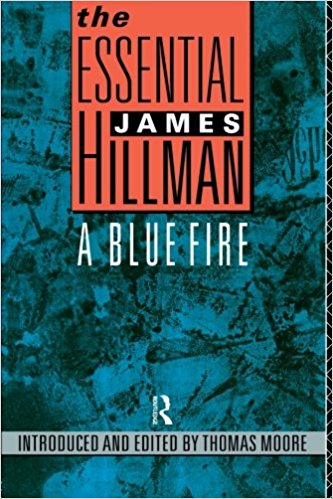
The Essential James Hillman: A Blue Fire

I cannot fully explain James Hillman in this space, not briefly, not at all. If there is a badge, it might say psychologist, or Jungian psychologist, but that would be misleading, limiting and wrong. Thomas Moore, in his Prologue to The Essential James Hillman: A Blue Fire, begins with this:

James Hillman is an artist of psychology. If it sounds odd to call a psychologist an artist, then you, the reader, know your task as you take up this anthology. You will be challenged all along the way to rethink, to re-vision, and to reimagine. The difficulty in reading Hillman is not to learn a new bag of techniques or a new conceptual system. Hillman demands nothing short of a new way of thinking. He takes psychoanalysis out of the context of medicine and health, not only in the obvious ways, rejecting the medical model, but in subtle ways: asking us to give up fantasies of cure, repair, growth, self-improvement, understanding, and well-being as primary motives for psychological work. He is more a painter than a physician, more a musician than a social scientist, and more an alchemist than a traditional philosopher.

Hillman has written many books and articles, but A Blue Fire, made up of short passages from many works, is what to read to get the essence. Choosing a representative excerpt is impossible, since it is bound to miss most other points Hillman makes. But the excerpt below, covering the nature of illiteracy, silence and imagination, is close to my heart, and to some of our life in 2018: “An education that in any way neglects imagination is an education into psychopathy. It is an education that results in a sociopathic society of manipulations. We learn how to deal with others and become a society of dealers.”


Why have we as a nation become more and more illiterate? We blame television and the computer, but they are not causes. They are results of a prior condition that invited them in. They arrived to fill a gap. When imaginative ability declines, other ways to communicate appear. These ways work even though they too are dyslexic in structure: simultaneity of bits, odd juxtapositions, messages that do not move linearly from left to right. Yet television and personal computers communicate.

Evidently, reading does not depend solely on the ordering of words or the ordering of letters in the words. Indeed, poets use dyslexic structures deliberately. Reading depends on the psyche’s capacity to enter imagination. Reading is more like dreaming, which, too, goes on in silence. Our illiteracy reflects our educative process away from the silent grounds of reading: silent study halls and quiet periods, solitary homework, learning by heart, listening through a whole class without interruptions, writing an essay exam in longhand, drawing from nature instead of lab experiments. This long neglect of imaginational conditions that foster reading—Sputnik and the new math; social problems and social relatedness; mecentered motivation; the confusion of information with knowledge, of opinion with judgment, and trivia with sources; communications as messages by telephone calls and answering machines rather than as letter writing in silence; learning to speak up without first having something learned to say; multiple choice and scoring as a test of comprehension—has produced illiteracy.

The human person as a data bank does not need to read more than functionally. A data bank deciding yes or no on the basis of feedback (i.e., reinforcement) need not imagine beyond getting, storing, and spending. Just get the instructions right; never mind the content. Learn the how rather than the what with its qualities, values, and subtleties. Then the human agent becomes an incarnated credit card performing the religious rituals of consumerism. You need only be able to sign your name in the space marked Xy like an immigrant, like a slave, or a …

Or a psychopath. Descriptions of psychopathy, or sociopathic personalities, speak of their inability to imagine the other. Psychopaths are well able to size up situations and charm people. They perceive, assess, and relate, making use of any opportunity. Hence their successful manipulations of others. But the psychopath is far less able to imagine the other beyond a fantasy of usefulness, the other as a true interiority with his or her own needs, intentions, and feelings. An education that in any way neglects imagination is an education into psychopathy. It is an education that results in a sociopathic society of manipulations. We learn how to deal with others and become a society of dealers.

James Hillman
“Right to Remain Silent”
Journal of Humanistic Education and Development (1988)