As I walk on through this wicked world, Searching for light in the darkness of insanity, I ask myself, is all hope lost? Is there only pain, and hatred, and misery?
And each time I feel like this inside, There’s one thing I wanna know, What’s so funny ’bout peace, love, and understanding? What’s so funny ’bout peace, love, and understanding?
And as I walked on through troubled times, My spirit gets so downhearted sometimes, So where are the strong? And who are the trusted? And where is the harmony? Sweet harmony
‘Cause each time I feel it slipping away, just makes me wanna cry, What’s so funny ’bout peace, love, and understanding? What’s so funny ’bout peace, love, and understanding?
(What’s So Funny ‘Bout) Peace Love and Understanding?, written by Nick Lowe, performed by Elvis Costello
The Virginia Indian peace medal was produced by order of Governor Thomas Jefferson in 1780. The obverse side reads: Rebellion to Tyrants is Obedience to God. The reverse side reads: Happy While United
The Colonial Williamsburg Foundation says:
This extremely rare Virginia Indian peace medal was produced by order of Governor Thomas Jefferson in 1780. Matchless in the history of relations between the independent Commonwealth of Virginia and the region’s native tribes, the “Happy While United” peace medal was cast in bronze by Robert Scot—later chief engraver at the U.S. Mint— in Williamsburg or Richmond while Jefferson was governor.
Commemorating an unidentified Revolutionary-era alliance between native tribes and the Commonwealth, silver medals were presented to important tribal members, while bronze versions were cast for non-native recipients. None of the twelve silver medals originally produced survive as they were likely traded in for later Presidential Indian peace medals or buried with the native recipients upon their deaths.
At nearly three inches in diameter and more than 2.5 ounces in weight, the medal is based on designs by noted artist Pierre Eugene du Simitiere and New York silversmith Daniel Christian Feuter. A bronze medal, identical to the one acquired by Colonial Williamsburg, was recorded as a gift from Isaac Zane of the Marlboro Iron Works—a patriot munitions factory in Frederick County during the American Revolution—to du Simitiere prior to May 1781.
The medal uses one the earliest versions of the fledgling Commonwealth’s official seal depicting the goddess Virtue standing triumphant over a fallen tyrant—most certainly meant to represent King George III—surrounded by the inscription “Rebellion to Tyrants is Obedience to God.”
The reverse side of the medal incorporates a scene from an earlier medal made in New York during the 1760s and depicts a European-American and a Native American seated on a bench sharing a “peace pipe.” To the right is a tree, shading the two figures, and behind them is a waterfront scene with three vessels under sail. The over-arching inscription reads “Happy While United” with “1780” below the scene.
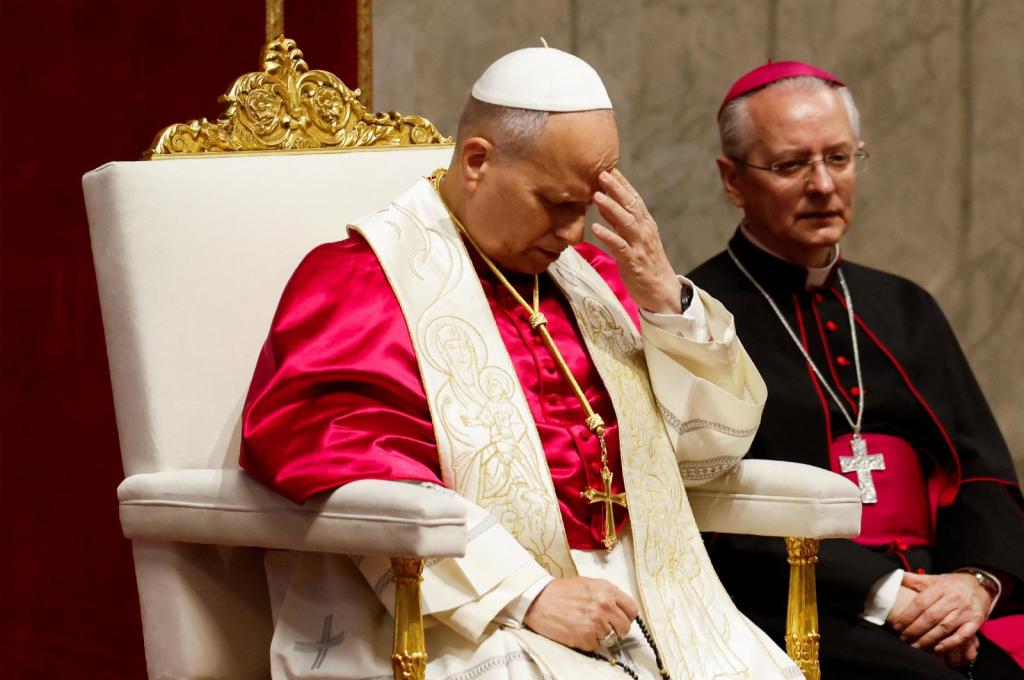
Dear brothers and sisters, your prayer is an expression of that faith which, according to the words of Jesus, moves mountains. Thank you for accepting this invitation to gather here at the tomb of St. Peter and in so many other places around the world to pray for peace.
War divides; hope unites. Arrogance trembles upon others; love lifts up. Idolatry blinds us; the living God enlightens.
My dearest friends, all it takes is a little faith — a mere crumb of faith — in order to face this dramatic hour in history together as humanity and alongside humanity. Prayer is not a refuge in which to hide from our responsibilities, nor an anesthetic to numb the pain provoked by so much injustice. Rather, it is the most selfless, universal, and transformative response to death. We are a people who are already risen. Within each of us, within every human being, the interior teacher teaches peace, urges us towards encounter, and inspires us to make supplication.
Let us rise from the rubble. Nothing can confine us to a predetermined fate — not even in this world where there never seem to be enough graves, for people continue to crucify one another and eliminate life with no regard to justice and mercy.
In the context of the 2003 Iraq war crisis, St. John Paul II, a tireless advocate for peace, said with deep emotion: “I belong to that generation that lived through World War II and, thanks be to God, survived it. I have the duty to say to all young people, to those who are younger than I, who have not had this experience: no more war.” As Paul VI said during his first visit to the United Nations: “We must do everything possible. We know well that peace is not possible at any price, but we all know how great is this responsibility.” I make his appeal my own this evening, relevant as it is today.
Prayer teaches us how to act. In prayer, our limited human possibilities are joined to the infinite possibilities of God. Thoughts, words, and deeds then break the demonic cycle of evil and are placed at the service of the kingdom of God — a kingdom in which there is no sword, no drone, no vengeance, no trivialization of evil, no unjust profit, but only dignity, understanding, and forgiveness.
We are surrounded by a delusion of omnipotence that is becoming increasingly unpredictable and aggressive. The balance within the human family has been severely destabilized. Even the holy name of God, the God of life, is being dragged into discourses of death. A world of brothers and sisters with a heavenly father vanishes as in a nightmare, giving way to a reality populated by enemies. We are met by threats rather than the invitation to listen and to come together.
Brothers and sisters, those who pray are aware of their own limitations. They do not kill or threaten with death. Instead, death enslaves those who have turned their backs on the living God, turning themselves and their own power into a mute, blind, and deaf idol — to which they sacrifice every value, demanding that the whole world bend its knee. Enough of the idolatry of self and money! Enough of the display of power! Enough of war! True strength is shown in serving life.”
With evangelical simplicity, St. John XXIII once wrote: “The benefit of peace will be felt everywhere — by individuals, by families, by nations, by the whole human race.” And echoing the incisive words of Pius XII, he added: “Nothing is lost by peace; everything may be lost by war.”
Let us therefore unite the moral and spiritual strength of the millions and billions of men and women, young and old, who today choose to believe in peace — caring for the wounds and repairing the damage left behind by the madness of war.
I receive countless letters from children in areas of conflict. In reading them, one perceives, through the lens of innocence, all the horror and inhumanity — actions that some adults boast of with pride. Let us listen to the voices of children.
Dear brothers and sisters, there are certainly binding responsibilities that fall to the leaders of nations. To them we cry out: stop! It is time for peace! Sit at the table of dialogue and mediation — not at the table where rearmament is planned and deadly actions are decided.
Yet there is no less significant responsibility that falls to all of us — men and women from all over the world. We are an immense multitude that rejects war, not only in word but also in deed. Faith calls us to leave behind whatever violence remains in our hearts and minds — and to turn to a kingdom of peace that is built up day by day in our homes, schools, neighborhoods, and civil and religious communities. A kingdom that counters polemics and resignation through friendship and a culture of encounter.
Let us believe once again in love, moderation, and good politics. We must form ourselves and get personally involved, each following our calling. Everyone has a place in the mosaic of peace.
The Rosary, like other ancient forms of prayer, has united us this evening in its steady rhythm built on repetition. Peace gains ground in the same way — word by word, deed by deed — just as a rock is hollowed out drop by drop, or fabric woven stitch by stitch. These are the slow rhythms of life, a sign of God’s patience.
We must not allow ourselves to be overwhelmed by the pace of a world that does not know what it is chasing. Rather, we must return to serving the rhythm of life — the harmony of creation and healing its wounds.
As Pope Francis taught us, there is also a need for peacemakers — men and women prepared to work boldly and creatively to initiate processes of healing and renewed encounter. There is indeed an architecture of peace to which different institutions of society contribute, each according to its own area of expertise. But there is also an art of peace that involves us all.
Dear brothers and sisters, let us return home having made a commitment to pray without ceasing and without growing weary — a commitment to a profound conversion of peace. The Church is a great people at the service of reconciliation and peace. She advances without hesitation. Even when rejecting the logic of war may lead to misunderstanding and scorn, she proclaims the gospel of peace and instills obedience to God rather than any human authority — especially when the inherent dignity of other human beings is threatened by continuous violations of international law.
Throughout the world, it is to be hoped that every community become a house of peace — where one learns how to diffuse hostility through dialogue, where justice is practiced and forgiveness is cherished.
Now more than ever, we must show that peace is not a utopia.
Brothers and sisters of every language, people, and nation: we are one family that weeps, hopes, and rises again. No more war — a journey with no return. No more war — a vicious cycle of grief and violence.
Pope Leo XIV, Prayer Vigil for Peace, April 11, 2026
Above is the Penn Quaker mascot. That isn’t Trump in that costume, though we don’t know what other cosplay he dabbles in. You can tell it isn’t him because however silly this costume is, that Quaker is in good shape.
Trump brags about his successful student career at the Wharton School, claiming to have finished first in his class, though the University of Pennsylvania will neither confirm nor deny anything about his time there. What we know is that he arrived at Penn for his junior year, after two undistinguished years at Fordham, and is remembered for not being engaged in class and leaving for New York every weekend.
He is, however, a Quaker, as in the nickname for Penn students. William Penn was famously a Quaker, while Benjamin Franklin, credited as founder of the university, was famously not. The curious thing is that Trump loves Ben Franklin, recently putting up a statue of him in the former Rose Garden, probably because it is supposed to remind us that he is a stellar Penn grad (“the best student ever at Wharton”) and because Franklin is pictured on the $100 bill. However, Trump never mentions that he is a Quaker, perhaps because he doesn’t actually know that is the Penn nickname or because he really, really doesn’t like oatmeal. Or peace.
Life is much too short and precious To spend fighting wars each day War can’t give life It can only take it away
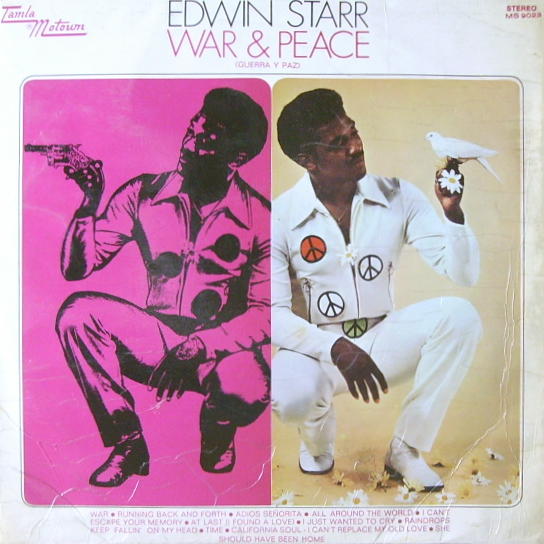
War What is it good for? Absolutely nothing
War, I despise ‘Cause it means destruction of innocent lives War means tears to thousands of mother’s eyes When their sons go off to fight And lose their lives
It ain’t nothing but a heart-breaker Friend only to the undertaker
Oh, war it’s an enemy to all mankind The thought of war blows my mind War has caused unrest Within the younger generation Induction then destruction Who wants to die?
Oh, war, has shattered many a young man’s dreams Made him disabled, bitter and mean Life is much too short and precious To spend fighting wars each day War can’t give life It can only take it away
Peace, love and understanding, tell me Is there no place for them today? They say we must fight to keep our freedom But Lord knows there’s got to be a better way
Veterans of the Battle of Gettysburg, Union and Confederate, meet in 1913 on the 50th anniversary of the battle.
Today, November 11, is Veterans Day in America. It honors all military veterans, living and dead, who have served in the Armed Forces.
It is also a reminder of peace. It originated as Armistice Day, marking the end of World War I on November 11, 1918.
Of Peaceful Intent For the Fallen By Marc A. Crowley
I was in the Navy in 1968-69, and the only action I saw was the war games we played in the Pacific somewhere between San Diego and Hawaii. But I have walked many battlefields— like Yorktown, for example, Gettysburg, Little Big Horn, and Mountain Meadows. They are broad fields of memories, often with their own cemeteries of countless headstones for the known and the unknown.
When in those places, I have to stop walking, stop talking, close my eyes, and stand in silence.
The blood and clamor, the wild screams of mangled bodies, the masses of armies running headlong into each other’s blast of cannon and gunfire, and the treachery and murder of men, women, and children at Mountain Meadows. All anyone wished for was to survive and go home.
Terror still inhabits the landscapes, protected by nature’s eternal allies. And in the quest for redemption, nowhere in the world is untouched. The fallen are not to be forgotten.
When the smoke and dust settle and the roar in my ears quiets, I open my eyes and everything remains serene and sanctified.
With quiet steps of gratitude, I walk with peaceful intent.
They shall beat their swords into plowshares, and their spears into pruning hooks; nation shall not lift up sword against nation, neither shall they learn war any more. — Isaiah 2:3–4
The Hamas massacre in Israel and the subsequent war in Gaza took place just two weeks after last Yom Kippur. I have already put away the High Holy Days liturgy until next year, but I am now revisiting it.
I may detail what I find in coming messages. Maybe not. Here is a general thought.
I listed my sins in the past year and asked for forgiveness—not just of God, but first of those down-to-earth people wronged. We did the same as a community and as a people. The Book of Life had been open for ten days and then closed, supposedly sealing our fate for the coming year. Whether or not there is such a book, whether God or angels are writing in it, we don’t know. We do know that our thoughts and actions lead to consequences. Those consequences are our book.
Now, here, weeks after Yom Kippur, you can still hear the blasts of the shofar. May you write for good in your own book.




 Bob Schwartz