Life is much too short and precious To spend fighting wars each day War can’t give life It can only take it away
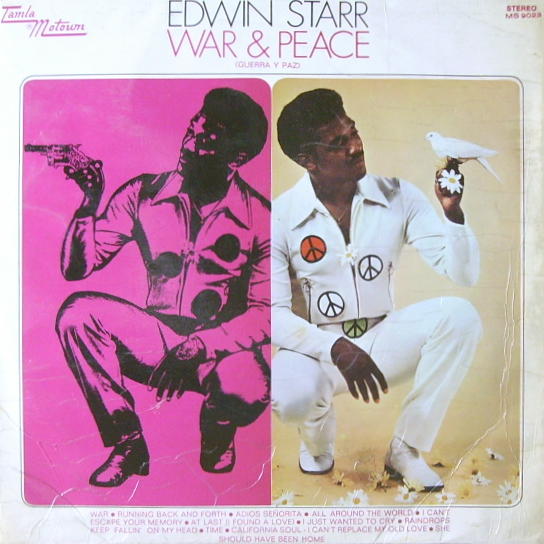
War What is it good for? Absolutely nothing
War, I despise ‘Cause it means destruction of innocent lives War means tears to thousands of mother’s eyes When their sons go off to fight And lose their lives
It ain’t nothing but a heart-breaker Friend only to the undertaker
Oh, war it’s an enemy to all mankind The thought of war blows my mind War has caused unrest Within the younger generation Induction then destruction Who wants to die?
Oh, war, has shattered many a young man’s dreams Made him disabled, bitter and mean Life is much too short and precious To spend fighting wars each day War can’t give life It can only take it away
Peace, love and understanding, tell me Is there no place for them today? They say we must fight to keep our freedom But Lord knows there’s got to be a better way
Veterans of the Battle of Gettysburg, Union and Confederate, meet in 1913 on the 50th anniversary of the battle.
Today, November 11, is Veterans Day in America. It honors all military veterans, living and dead, who have served in the Armed Forces.
It is also a reminder of peace. It originated as Armistice Day, marking the end of World War I on November 11, 1918.
Of Peaceful Intent For the Fallen By Marc A. Crowley
I was in the Navy in 1968-69, and the only action I saw was the war games we played in the Pacific somewhere between San Diego and Hawaii. But I have walked many battlefields— like Yorktown, for example, Gettysburg, Little Big Horn, and Mountain Meadows. They are broad fields of memories, often with their own cemeteries of countless headstones for the known and the unknown.
When in those places, I have to stop walking, stop talking, close my eyes, and stand in silence.
The blood and clamor, the wild screams of mangled bodies, the masses of armies running headlong into each other’s blast of cannon and gunfire, and the treachery and murder of men, women, and children at Mountain Meadows. All anyone wished for was to survive and go home.
Terror still inhabits the landscapes, protected by nature’s eternal allies. And in the quest for redemption, nowhere in the world is untouched. The fallen are not to be forgotten.
When the smoke and dust settle and the roar in my ears quiets, I open my eyes and everything remains serene and sanctified.
With quiet steps of gratitude, I walk with peaceful intent.
They shall beat their swords into plowshares, and their spears into pruning hooks; nation shall not lift up sword against nation, neither shall they learn war any more. — Isaiah 2:3–4
The Hamas massacre in Israel and the subsequent war in Gaza took place just two weeks after last Yom Kippur. I have already put away the High Holy Days liturgy until next year, but I am now revisiting it.
I may detail what I find in coming messages. Maybe not. Here is a general thought.
I listed my sins in the past year and asked for forgiveness—not just of God, but first of those down-to-earth people wronged. We did the same as a community and as a people. The Book of Life had been open for ten days and then closed, supposedly sealing our fate for the coming year. Whether or not there is such a book, whether God or angels are writing in it, we don’t know. We do know that our thoughts and actions lead to consequences. Those consequences are our book.
Now, here, weeks after Yom Kippur, you can still hear the blasts of the shofar. May you write for good in your own book.
Too long have I dwelt with those who hate peace. I am all peace; but when I speak, they are for war.
Psalm 120:6-7
I am not a pacifist.
There are many definitions of pacifist, including:
A person who opposes war or violence as a means of settling disputes. A person who believes that war and violence are unjustifiable.
Up until now, I hadn’t thought about whether I would classify myself as or be considered a pacifist. The short answer is ‘no”. During the wars I’ve lived through or for those I know from recent or ancient history, I can say that some of the wars and violence pursued were justified. Others were not, or were pursued in ways that were not justified, or for objectives that were not justified, or were pursued without trying other means, or were just stupid or evil.
But I am for peace. Peace should never be a secondary or tertiary objective once the other objectives have been achieved or not, once all the destructive and deadly means have been tried. Peace should have co-equal status at the top of the list.
During the ongoing war in Gaza, I’ve discovered that all the divergent thinking and rhetoric, from me and so many others, from just plain folks up to world leaders, is having little effect on the course of hostilities. Wars are about action, well-chosen or ill-chosen, and stubborn actors convinced of their rightness can be deaf.
Then I realized that if I am going to be using my words to little practical effect, I might as well use them to promote the possibility of peace.
Which is how I came to find a verse in Psalm 120. The standout Hebrew phrase is “Ani shalom”, literally the words are “I” and “peace”. Lacking a verb, it is variously translated as “I am peace”, “I am all peace”, “I am for peace”.
God of Moses God of Jesus God of Mohammed God of infinite names Sitting by the desert sea Pained and grieved. This is madness. These people Every inclination Is only evil All the time.* They take our names In vile vain.** There is the water Let us drive them in And start again Just like days of old Do better next time. But how would they learn? Hard hearts may soften Dissolved in blood and tears. We won’t abandon We don’t approve.
Whether you are living through war directly, living with its aftermath, or just thinking about it at a distance, peace is or should never be far from mind.
Here at a distance, thinking and talking about the Israel/Gaza war has been non-stop and contentious. Peace, however elusive and immediately unlikely, is not far from mind. In fact, having little influence on the course of the conflict, studying peace seems a good occupation. Just in case.
Until last week, I had never heard of the United States Institute of Peace (USIP) https://www.usip.org/ , let alone that it was established and funded by Congress.
The United States Institute of Peace is a national, nonpartisan, independent institute, founded by Congress and dedicated to the proposition that a world without violent conflict is possible, practical and essential for U.S. and global security. In conflict zones abroad, the Institute works with local partners to prevent, mitigate, and resolve violent conflict. To reduce future crises and the need for costly interventions, USIP works with governments and civil societies to build local capacities to manage conflict peacefully. The Institute pursues its mission by linking research, policy, training, analysis and direct action to support those who are working to build a more peaceful, inclusive world….
Congress established the U.S. Institute of Peace in 1984 following years of proposals for the creation of a national “peace academy,” notably from a nationwide grassroots movement and from World War II combat veterans elected to legislative office.
Among its many initiatives, the USIP has developed the Gandhi-King Global Academy, which includes a Global Campus with hours of tuition-free online course about peace and the process of peacemaking.
I hope to take some of these courses, and I hope to encourage others to do the same. I have never served in war, as have others of my family and friends, but even from a distance I’ve learned much about war. Too much. So have so many others.
That’s why Isaiah 2.4:
And they shall grind their swords into plowshares and their spears into pruning hooks. Nation shall not raise sword against nation nor shall they learn war anymore.
That’s why Down By the Riverside:
I’m gonna lay down my sword and shield down by the riverside ain’t gonna study war no more.
We don’t have the luxury of not studying the war right now. But we do have the opportunity, right now, of studying peace.
Handy lists of ways to think and behave are found in every tradition. Buddhism has plenty, including the Four Noble Truths and the Eightfold Path.
The Eight Awarenesses, also known as the Eight Realizations or Eight Awakenings, comprise an effective and easy to understand list. The list is notable for being part of the Buddha’s final teaching in the Mahaparinirvana Sutra, spoken before his death. It was also the subject of the final writing by Dogen Zenji, founder of the Soto Zen tradition, before his death.
The Eight Awarenesses
1. Having few desires
2. Knowing how to be satisfied
3. Enjoying serenity and tranquility
4. Exerting meticulous effort
5. Not forgetting right thought
6. Practicing samadhi [one-pointed attention]
7. Cultivating wisdom
8. Avoiding idle talk
“The Awarenesses are indeed the awarenesses of the enlightened person. A buddha, finding no separation between herself and other beings, very naturally acts in this way. Feeling no separation from others, a buddha naturally has few desires. Feeling no separation from others, from our surroundings, from what is happening right now, of course we can’t help but be satisfied, enjoying the serenity of life as it is. When we know the oneness of ourselves and others, effort becomes right effort, our activity becomes the embodiment of wisdom, and no talk is idle talk.”
Taizan Maezumi Roshi, The Hazy Moon of Enlightenment
I pay particular attention to avoiding idle talk (more successfully sometimes than others), given how much I talk and write, and given how much of it is easily categorized as idle.
In the Qu’ran, this is one of the descriptions of paradise:
They shall hear no idle talk therein, but only “Peace!” (19:62)
The place that Solomon made to worship in,
called the Far Mosque, is not built of earth
and water and stone, but of intention and wisdom
and mystical conversation and compassionate action.
Every part of it is intelligent and responsive
to every other. The carpet bows to the broom.
The door knocker and the door swing together
like musicians. This heart sanctuary
does exist, though it cannot be described.
Solomon goes there every morning
and gives guidance with words,
with musical harmonies, and in actions,
which are the deepest teaching.
A prince is just a conceit,
until he does something with his generosity.



 Handy lists of ways to think and behave are found in every tradition. Buddhism has plenty, including the Four Noble Truths and the Eightfold Path.
 Bob Schwartz