Bob Schwartz

Tag: Paul Ryan

Politics and People of Conscience

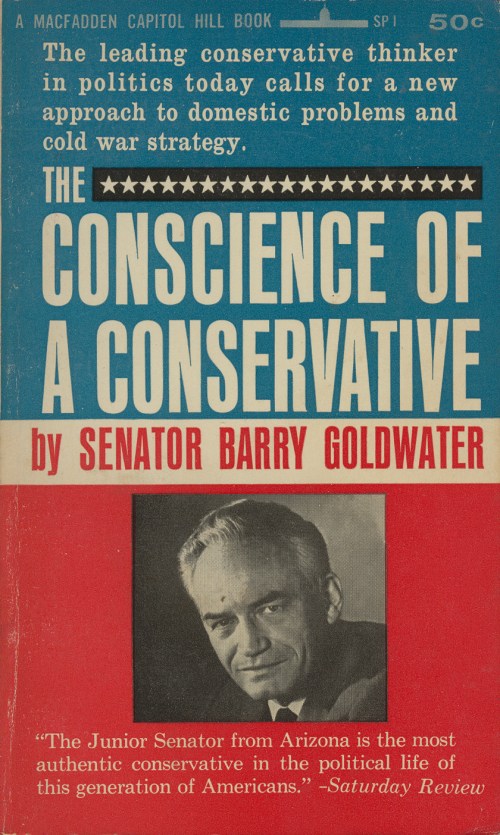
Conscience of Conservative

There’s talk of Barry Goldwater in the context of the current election cycle. I’ve written about him before—as it turns out, a few times, here, here, and here. It’s not that I’m a fan of conservative politics; it’s that I’m a fan of conscience.

Goldwater’s unlikely and iconoclastic nomination for President at the Republican National Convention in 1964 was predicted to be a disaster. It was, as he was crushed by Lyndon Johnson in the election. On the other hand, his political philosophy lived on in the party—coming into full flower with Ronald Reagan and, more than fifty years later, is still the touchstone of conservative Republican politics.

Goldwater’s famous book was a manifesto called The Conscience of a Conservative. Focus on that word “conscience.” It means principles that are grounded in the deepest part of your beliefs, principles that are often difficult to stand by. On one side is the temptation of expedience. On the other is being criticized for standing in the way and being outcast. Or in Goldwater’s case, for leading the party into a (temporary) black hole.

In both parties right now, conscience is being tested.

Paul Ryan and others are speaking their mind about Donald Trump, even in the face of calls for unity over conscience, for party above principle. Other Republicans, seeing the same candidate, admit he is flawed in ways they have trouble abiding, but a unified party has a shot a victory, while a splintered one has none.

Among Democrats, even some Hillary Clinton supporters, in candid moments, admit that they have deep reservations about her on fundamental grounds of honesty, integrity, and transparency, but say that winning is everything, and that she is the path to victory—whatever her shortcomings.

We shouldn’t indict those who compromise their conscience, in politics or elsewhere. Each of us does it or has done it, and we live with it. Maybe sleeplessly sometimes, but we live with it. What we should do is praise those who manage to know their conscience and follow it, often at a price. This is what we try to teach our children. This is what we should suggest to our politicians.

The Iraq War and the Ryan Budget: A Modest Proposal

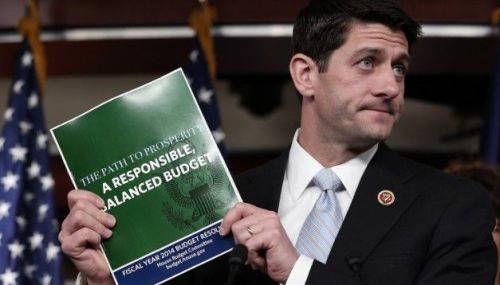
Paul Ryan Budget
We have two budget crises. One is the budget itself, which is clearly in need of work to make concrete our priorities and the willingness of citizens to support those priorities in the form of taxes. The second crisis is political dysfunction, where real and constructive talk about those priorities and that support is transformed and devolved into useless politalk. One way that uselessness is hidden is by obfuscation and throwing around lots of numbers, details, and core American principles.

Simplify, simplify.

We just marked the 10th anniversary of the Iraq War. There is going to be disagreement about many aspects of that war for generations.

But there is consensus on two things.

The war was financially expensive. How expensive is another matter of contention. The Costs of War Project pegs it at a few trillion dollars, give or take. So how expensive? Very expensive.

The war was not paid for. More precisely, the war was paid for by debt, not by taxes. The United States had never done this before. There are two perfectly good reasons to ask Americans to pay for and sacrifice for wars. Wars are expensive. And taxing for war asks all citizens at all economic levels to make real sacrifice, even if they or their loved ones are not in harm’s way. As a political matter, when the sacrifice outweighs support for the war, there may be pressure to question or even end the war.

It is uncontested that George W. Bush and Congress did not ask for that sacrifice. Without arguing about how that happened, it is the fact. There is no argument about the result. In the midst of this massive borrowing to pay for the war, the economy fell down, and is still having trouble getting up.

With a sense of humility, and standing in the shadow of today’s esteemed Congress, here is a simple and modest proposal.

1. Agree on the financial cost of the Iraq War. For purposes of discussion, let’s say $3 trillion, though it is certainly more.

2. Agree to taxes that will generate that amount of revenue, not a cent more or less. That revenue would then be spent on all the important things that would otherwise be underfunded or unfunded, including every possible entitlement for veterans.

3. Once that money is raised and spent, taxes will revert to the earlier levels, and some members of Congress can go back to babbling, bickering and posturing.

Simple, maybe even naïve. Certainly too naive for the sophisticated politicians who are busy building a budgetary hall of mirrors that only they can navigate, where they think they can hide themselves and some simple, inconvenient truths.

Mitt Romney Doesn’t Believe He Is Running Against A President

A political conundrum has been solved, and the solution is a startling answer to what has been going wrong so far for the Romney-Ryan ticket.

Both candidates spent the first 24 hours of the current foreign crisis injudiciously and recklessly criticizing the President, in the face of being chastised by both Democrats and Republicans for their amateurish efforts.

The obvious question to ask both of them is what foreign policy expertise or experience informs their criticism. This would be their likely answer: well, what foreign policy expertise or experience did Barack Obama have when he took office in 2009?

Exactly. Precisely. Except for one thing. This isn’t candidate Obama they are running against. This is a man who has for four years been negotiating the wild waters of global politics, and in the view of many, though clearly not all, he isn’t doing a bad job.

That’s where the revelation came in. In a nearly literal sense, they don’t believe Barack Obama has been President for these four years. They may not subscribe to “birther” notions that would legally disqualify Obama from holding the office, though we aren’t sure of that. But functionally, they seem to believe that the smart but shallow and inexperienced young Senator who took office in 2009 is the same man they face now.

They believe they are running against young Senator Obama—or maybe even younger community organizer Obama, law student Obama, pot-smoking college student Obama. The only thing they have to do is run a better campaign than the unsuccessful John McCain did. Maybe this isn’t a clinical break from reality, enough to put their mental stability in doubt, but the effect has been to raise real questions about their political stability.

The President has tried to help them. In his speech at the Democratic National Convention, he announced loudly, plainly and unequivocally, “I am the President.” Mitt Romney and Paul Ryan apparently weren’t listening, and even if they heard, they still don’t believe.

Paul Ryan and Ayn Rand


A postage stamp honoring Ayn Rand was issued in 1999; that’s the image used in the National Review cover above. It was issued in the usual way, following a roughly three-year process of being proposed, recommended by the Citizens’ Stamp Advisory Committee, and then approved by the Postmaster General.

The most famous controversy over any stamp concerned the Elvis Presley commemorative. There was disagreement about which Elvis to depict, the younger leaner one or the older heavier one, and disagreement about whether Elvis should have a stamp at all. In the end, the stamp was issued, and went on to become the bestselling in U.S. postal history. There is no record that there was disagreement about Ayn Rand, though there might well have been.

Paul Ryan honored Ayn Rand too, at least until recently. He stated that her books were the most pivotal in shaping his public life. He gave them to interns as gifts. He spoke frequently about how the decline in America looked increasingly like something out of an Ayn Rand novel.

He is not alone among public servants in his admiration for Ayn Rand. Politico reported last April on 7 Politicians Who Praised Ayn Rand.  Among these are Sen. Rand Paul (coincidentally named), Rep. Ron Paul (who should know about Rand Paul’s name), President Ronald Reagan, Sen. Ron Johnson, Gov. Gary Johnson, Sen. Mark Sanford and Supreme Court Justice Clarence Thomas. Justice Thomas has his new law clerks watch a screening of The Fountainhead (1949), starring Gary Cooper and Patricia Neal, an adaptation of Rand’s second most famous novel. Maybe the most famous acolyte of Ayn Rand is former Federal Reserve Chairman Alan Greenspan, who in the 1950s was part of her inner circle and a close confidant.

Rand’s novels are overlong, didactic, questionably artful embodiments of her very particular philosophy. It is a philosophy fed by her early experience as a child in Soviet Russia, a member of an intellectual and professional Jewish family that was reduced to dire circumstances by the forces of collectivism, Communism and totalitarianism.

She came to America and created her own ism. The Atlas Society,  one of the intellectual keepers of the Rand canon, summarizes:

Ayn Rand’s philosophy of Objectivism was set forth in such works as her epic novel Atlas Shrugged, and in her brilliant non-fiction essays. Objectivism is designed as a guide to life, and celebrates the remarkable potential and power of you, the individual. Objectivism also challenges the doctrines of irrationalism, self-sacrifice, brute force, and collectivism that have brought centuries of chaos and misery into the lives of millions of individuals. It provides fascinating insights into the world of politics, art, education, foreign policy, science, and more, rewarding you with a rich understanding of how ideas shape your world. Those who discover Objectivism often describe the experience as life-changing and liberating.

One problem with Objectivism, as with the isms Rand left behind and hated, is that pure systems work well on paper and in the mind, as long as you don’t have to wrestle with the complexities and consequences of the actual world. This is probably why Ayn Rand has always had an appeal to younger people, particularly teenage boys and young men, who are empowered by the idea of their individual greatness waiting to explode, ungoverned by the limitations that the world tries to place on them. The world is filled with people who want something from us, who are jealous of us, who don’t understand our specialness, and who will do anything to hold us back and keep us down.

This phenomenon was wryly captured by Michael Sean Winters in the National Catholic Reporter:

As one wag once said: “There are two novels that can change a bookish fourteen-year old’s life: The Lord of the Rings and Atlas Shrugged. One is a childish fantasy that often engenders a lifelong obsession with its unbelievable heroes, leading to an emotionally stunted, socially crippled adulthood, unable to deal with the real world. The other, of course, involves orcs.”

Winters was writing in the context of the Ryan Budget. Paul Ryan is devoted to the Catholic Church, which is founded on the sort of collectivism, anti-individualism, self-sacrifice and charity that Rand abhorred and rejected as immoral. This led in May 2011 to questions about how the Ryan Budget, with reductions in government help for the poor and others in need, squared with the teachings of the Church. Archbishop Timothy Dolan, who had previously been Bishop in Wisconsin, made clear in a letter to Ryan that the budget was completely in line with the Church’s mission. Winters wrote:

Ryan’s budget certainly reflects Rand’s weltanschauung more than it reflects the vision Pope Benedict XVI put forth in Caritas in Veritate. That is why I think it was a mistake for Archbishop Dolan to write a letter that, however unintentionally, gave political cover to policies that are antithetical to Catholic social teaching. And, whatever frustrations Ryan – or anyone else – has with the modern, social welfare state, I think it can be said that the social welfare state is to social justice what democracy is to government: The worst form of administration except every other form.

Ryan can assert that his budget is built upon Catholic concerns about human dignity, but there is no dignity in Rand’s crimped vision of humanity. There really is no need to wrestle with these so-called ideas.

Paul Ryan’s distancing from Ayn Rand began last spring when he said that his supposed embrace of the author and her philosophy was “urban legend.” (If so, it is the most high-minded and intellectual urban legend of all time, since those stories are usually sordid and lowlife, as in the flushing of baby alligators into the New York sewers.) Then just yesterday he explained that while he enjoyed the novels for a long time, it was only later that he became aware of her philosophy.

As mentioned earlier, Ayn Rand’s novels are not works of art that have to be savored and investigated so that their meaning can be coaxed out. They are pages and pages of speeches and ideas, with some plot and characters hung on them like ornaments on a tree. There are only two explanations for Ryan’s assertion: he is either dull-witted, which he isn’t, or he is…being disingenuous.

Why all this effort to run away from Ayn Rand anyway? Most people, meaning voters, have never read those novels, and all this fuss is not about to move them to throw away weeks of their lives trying to plow through them.

Here’s why.

First, Ayn Rand was an atheist. In her philosophy there is no higher power than man, no life other than the objective life in front of our faces, no morality other than the morality of rational self-interest. There are plenty of atheists who embrace the moral and ethical concepts at the heart of religious beliefs, such as the Golden Rule. Ayn Rand was not one of those. This is more than inconvenient for anyone, especially politicians, who base their lives and careers on their religious foundations.

But there is something deeper and more significant going on. In 2010 the National Review, America’s most respected conservative journal, published a cover story on Ayn Rand.  In it, Jason Lee Steorts writes about going back to reread Ayn Rand, given her renewed popularity following the election of Barack Obama:

Our president seems to have inspired — which is not quite the word — half the country to read Miss Rand, and I wanted to remind myself what she was teaching them. He finds that he can’t get through the books, because he sees the author for who she was and, therefore, what she espoused.

Steorts relates a scene from Atlas Shrugged. The prime movers, those who are literally the brains behind the success of the country, have gone on strike. This leaves the inferior, parasitic people to fend for themselves. In this scene, a train is stopped before an eight-mile unventilated tunnel. There are no diesel engines, no one to properly operate the train. But facing a demand to make it move, the station officials, writes Rand, “call in a coal engine, procure a drunken engineer, and condemn every passenger on the train to death by asphyxiation.”

The passengers comprise an array of losers, including a professor “who taught that individual ability is of no consequence” and a mother “whose husband held a government job enforcing directives.” They are, in essence, riding a train into a gas chamber. “But that isn’t why I stopped reading,” Steorts writes. “I stopped because Rand thinks they deserve it.”

That is at the heart of this running away from Rand. Rand’s world is not one where unbridled individualism can co-exist with a diversity of other moralities and abilities. It is either/or. There are producers, there are freeloaders, and the immoral role of government is to stifle the producers and reward the freeloaders with stolen spoils. As soon as government is gone, the producers will be free to shape the world in their image, and the others will learn how that world works or they will, ultimately, perish as their punishment.

If that sounds harsh and heartless, it is. If that sounds like an extreme version of some of the rhetoric we may have been hearing lately, it is. But even the softer version, tempered by compassion, still makes us uncomfortable. That is why, hopefully, Ryan and others will distance themselves from Ayn Rand—not just for political show, but for real.  That is why, when Sheorts in the National Review looked to find out why Obama-haters were reading Ayn Rand, he recoiled at what he found. He discovered a bloodless train, and he couldn’t bear to see where it was heading.
Romney v. Goldwater


There are many things to say about Barry Goldwater. Agree with him or disagree vehemently, he knew what he believed and told you what he believed, in detail. He was capable of now-famous rhetoric—“ I would remind you that extremism in the defense of liberty is no vice! And let me remind you also that moderation in the pursuit of justice is no virtue!”—but he backed his words up with specific plans, which did seem extreme to many. He was compelled to tell you because he knew that without that detail, you would not know where he stood nor how to reach the America he envisioned.

That’s what still makes the Presidential election of 1964 so interesting. When pundits talk about competing visions between candidates, that is the model. LBJ was just as clear about his beliefs, especially since he had been an unapologetic architect of mid-century America. There’s nobody then or now who doesn’t know where Goldwater and LBJ stood and the size of the gap between them. Goldwater’s extremism may have been successfully overstated and caricatured, as in Tony Schwartz’s infamous, shown-only-once Daisy ad, but the differences between them could not be overstated. American voters had a choice, and they overwhelmingly chose LBJ.

In the endless talk about what Paul Ryan’s selection as Mitt Romney’s VP candidate means, one of the touted benefits is that we will now—finally—have a clear-cut discussion about competing visions because we will have a clear, executable vision from the Romney ticket. This may be. Ryan is no Goldwater, if for no other reason than American politics has only produced one Barry Goldwater. But Ryan does seem to have a vision, even if it’s not as fully-formed as that of his hero and mentor Jack Kemp (whose political career began, not so coincidentally, as a Goldwater volunteer).

When it comes to detailed vision from Mitt Romney himself, even in the wake of the Ryan pick, expectations remain low. Romney is not only not Barry Goldwater, he is the anti-Goldwater. Besides being one of the most ardent “true believers” to ever be nominated in modern times, Goldwater was a notoriously plain-spoken Arizonan, as in plainly profane, taking no prisoners. If today he came back and got Mitt Romney in the back room, his very vocal thoughts on the candidate and the campaign might leave Romney afraid to come out of the room, assuming he survived.

For better or worse, Barry Goldwater wasn’t afraid of much of anything. And when it came to the measure of truly believing and backing up what he believed, Goldwater was just the right height.

The VP Guessing Game: Too Much Is Never Enough


Come on, political junkies, admit it: You say you’ve had enough of the Republican VP speculation, but like that bag of barbecue potato chips, you kind of hope it never ends.

Character is destiny, and the character of this Republican nominating process has been so wacky that you would expect nothing less from the Vice Presidential selection.

We are beyond “you can’t tell the players without a program,” so if you haven’t kept up, here’s where we stand, as best as anyone can tell.

The supposed short list of possibilities includes Tim Pawlenty, Rob Portman and, lately talked about, Paul Ryan.

The list of those speculated about but almost certainly not to be picked is long, and even longer if you include never-going-to-happen-in-a-million-years names such as Newt Gingrich. This season, it’s not so much an insult not to be picked as it is not to be included in the longshot list. Herman Cain deserved to have somebody floating his name.

In between are those who have or had a colorable chance of being picked, though they aren’t on the short list. Chris Christie appears to be out, since he will be giving the keynote address at the convention. From a spectator’s perspective this is too bad: with Biden and Christie as the designated loyal-to-the-death hitmen, this could have been a battle for the ages.

Marco Rubio is a strange case. Some polls show him as the preference of Republican and Republican-leaning voters, though this probably has more to do with name-recognition than anything else. Rubio is viewed as flawed in terms of experience, maturity, baggage and positions, which overweigh any Latino advantage.

Back to the top three, every day brings a different leader—kind of like the much-missed days of the Republican primaries. Just within the past few days, Ryan is being pushed as the true conservative with some real public appeal. Portman is viewed as boring, but solid and from Ohio, two real pluses. Pawlenty has governing experience, but proved in his brief Presidential run that he may lack the right stuff, or even the just okay stuff.

Strategically, it is thought that the selection will come this week. The Romney campaign doesn’t so much need a game changer as a topic changer. It needs a second candidate who can start fighting right now. And it needs to end the polarizing that is now developing around the selection among Republicans, and particularly conservatives.

Everybody is never happy with the selection of a VP candidate. In close nominating contests, the second place finisher is a politically logical choice, so complaints are muted. That’s how we get Kennedy-Johnson and Reagan-Bush. (And when dynamics trump political logic, how we don’t get Obama-Clinton.)

But there is no mandated logic to this VP pick. The longer this goes on, the more the factions will feel free to push their own ideas about what’s best for the ticket and the party. And the more that goes on, the deeper will be the disappointment when the choice is actually, finally made.

Of the top three, any prediction is subject to change in fifteen minutes.

Portman is undynamic, and there is no proof that his selection will “deliver” Ohio. He is haunted by the ghost of an Administration and budgets past. It is an invitation to bring George W. Bush to the convention he is not attending. If Portman is asked whether prosecuting two wars while offering tax breaks is sound budgeting, and whether that contributed to economic instability, he is stuck. If he says yes, he puts into question his role as Bush’s budget chief; if no, his credibility is at stake, since even some Republicans have concluded that the Bush budget was a bad idea that made things worse.

Ryan is instead haunted by the ghost of budgets future, specifically the proposed budget that bears his name. Some Republican pundits have openly said this is a good thing, since the budget should be a central issue, and Ryan will do a better job than Mitt Romney explaining, defending and promoting that budget. That may be the case, given Romney’s unwillingness to be specific about budget issues, other than his general support for…the Ryan budget. Ryan, despite being the most dynamic and appealing of the three, also shares Portman’s lack of elected executive experience.

Pawlenty is more dynamic than Portman, less than Ryan. He has executive experience as governor of Minnesota. His brief run for the Republican nomination was far from stellar, especially given the strange lineup of competitors. Set aside the clichéd test of whether you can see the VP taking over if needed. Set aside all the political calculations, including those above. Just picture the team taking that stagecoach down the home stretch, Romney driving, someone else riding shotgun. For the moment, that someone else looks like Tim Pawlenty.

At least for the next fifteen minutes.

Note: The illustration above is a photo of Vice President Thomas Riley Marshall, who served President Woodrow Wilson from 1913-1921. As a matter of political and historical trivia (for junkies who use both), Marshall was the last President or Vice President with facial hair; the last such President was William Howard Taft, who preceded Wilson in office. Almost a hundred years without a mustache or beard in an Administration explains the real reason that Herman Cain did not go further in the process: it wasn’t Pokemon, it was his mustache.