Bob Schwartz

Tag: nuclear weapons

Presidential adviser on breeding America after nuclear war: Ten females to each male!
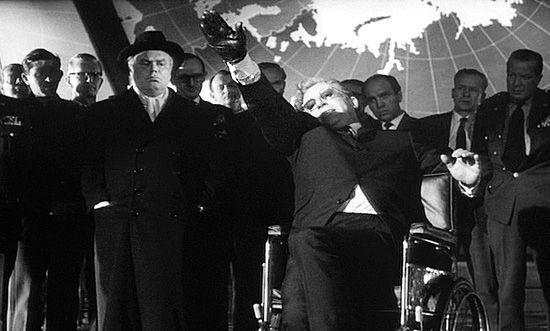
PRESIDENTIAL ADVISER
Mr. President, I would not rule out the chance to preserve a nucleus of human specimens. It would be quite easy… heh heh…

At the bottom of ah… some of our deeper mineshafts. The radioactivity would never penetrate a mine some thousands of feet deep. And in a matter of weeks, sufficient improvements in dwelling space could easily be provided.

PRESIDENT
How long would you have to stay down there?

PRESIDENTIAL ADVISER
Well let’s see now ah… cobalt thorium G… aa… nn… Radioactive halflife of uh,… hmm. I would think that uh… possibly uh… one hundred years.

PRESIDENT
You mean, people could actually stay down there for a hundred years?

PRESIDENTIAL ADVISER
It would not be difficult mein Fuhrer! Nuclear reactors could, heh… I’m sorry. Mr. President. Nuclear reactors could provide power almost indefinitely. Greenhouses could maintain plantlife. Animals could be bred and slaughtered. A quick survey would have to be made of all the available mine sites in the country. But I would guess… that ah, dwelling space for several hundred thousands of our people could easily be provided.

PRESIDENT
Well I… I would hate to have to decide.. who stays up and.. who goes down.

PRESIDENTIAL ADVISER
Well, that would not be necessary Mr. President. It could easily be accomplished with a computer. And a computer could be set and programmed to accept factors from youth, health, sexual fertility, intelligence, and a cross section of necessary skills. Of course it would be absolutely vital that our top government and military men be included to foster and impart the required principles of leadership and tradition.

(Slams down left fist. Right arm rises in stiff Nazi salute.)

Arrrrr!

(restrains right arm with left)

Naturally, they would breed prodigiously, eh? There would be much time, and little to do. But ah with the proper breeding techniques and a ratio of say, ten females to each male, I would guess that they could then work their way back to the present gross national product within say, twenty years.

PRESIDENT
But look here doctor, wouldn’t this nucleus of survivors be so grief stricken and anguished that they’d, well, envy the dead and not want to go on living?

PRESIDENTIAL ADVISER
No sir… Also when… when they go down into the mine everyone would still be alive. There would be no shocking memories, and the prevailing emotion will be one of nostalgia for those left behind, combined with a spirit of bold curiosity for the adventure ahead! Ahhhh!

(Right arm reflexes into Nazi salute. He pulls it back into his lap and beats it again.)

GENERAL
Doctor, you mentioned the ratio of ten women to each man. Now, wouldn’t that necessitate the abandonment of the so called monogamous sexual relationship, I mean, as far as men were concerned?

PRESIDENTIAL ADVISER
Regrettably, yes. But it is, you know, a sacrifice required for the future of the human race. I hasten to add that since each man will be required to do prodigious… service along these lines, the women will have to be selected for their sexual characteristics which will have to be of a highly stimulating nature.

Adapted from Dr. Strangelove by Stanley Kubrick and Terry Southern
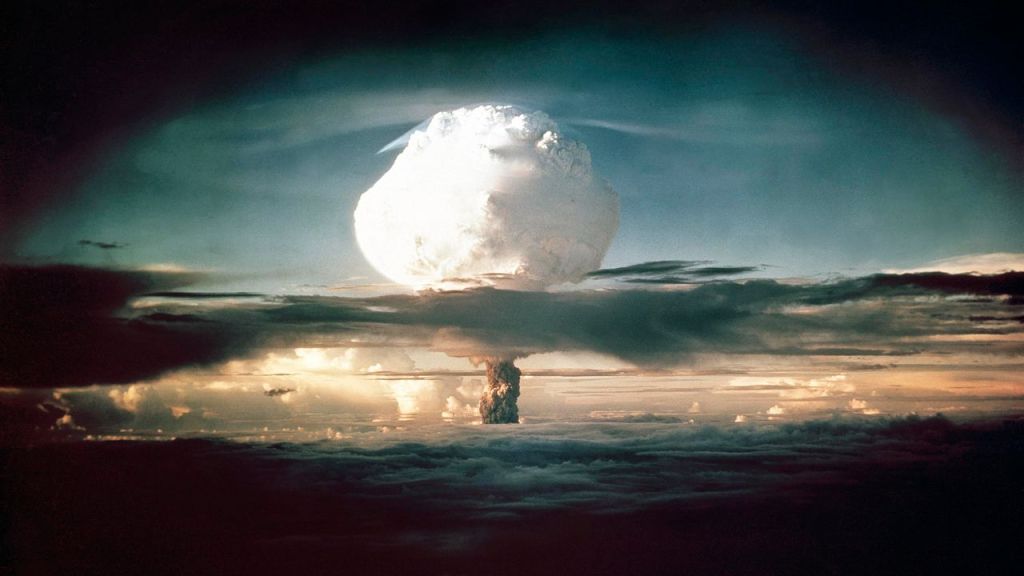
Thinking and learning about The Bomb now—and its essential and existential relevance to this moment

“I know not with what weapons World War III will be fought, but World War IV will be fought with sticks and stones.”
― Albert Einstein

“If in the first act you have hung a pistol on the wall, then in the following one it should be fired. Otherwise don’t put it there.”
—attributed to Anton Chekhov (a dramatic principle known as Chekhov’s Gun)

The Netflix documentary series, Turning Point: The Bomb and the Cold War, is recommended.

Nine nations have an estimated 13,000 nuclear weapons. According to the principle of Chekhov’s Gun, if you have hung 13,000 guns on stage, in the ensuing global drama, one of those weapons will be used. As one expert notes in the series, that we haven’t experienced nuclear Armageddon is not because we are smart, but because we are lucky.

We are either living in a new Cold War or never left the first one. Either way, as dark as it may be, we need to learn and contemplate exactly what a Cold War equipped with so many available nuclear weapons means.

That is the theme of the series. It covers the histories, up to the present, of the Cold War and The Bomb, which are inextricably linked. The world after World War II cleaved into two mighty factions, both convinced the other was an existential threat and must be defeated or removed. The difference from every other fight before in history is that those powers posed a literal existential threat—and still do.

Daniel Ellsberg is famous for his Vietnam War-era whistle-blowing, with his leaking of the so-called Pentagon Papers, revealing that the war was a costly and unwinnable lost cause. But years before that, Ellsberg was one of the brains at the Rand think tank, which was asked in the 1950s to evaluate the possible outcome of a thermonuclear war. Ellsberg relates his shock then and now. The estimate was that 600 million people might be killed—20% of the world’s population at the time.

© 2025 by Bob M. Schwartz

Hiroshima: The Year 70 AH and I Ching Heaven

Flag of Hiroshima City

How special is the atomic bomb? So special that many nations want one, many nations have more than one, and yet despite how crazy and desperate some nations have been in the past decades, only one nation has ever used one. A hoarded treasure so dark that it is displayed and demonstrated but not deployed.

So special that it should be the zero of a standard human calendar. Just as Jews measure time from the creation of the world, Christians from the birth of Jesus, Muslims from the hijra from Mecca to Medina, we might all measure time from August 6, 1945.

The U.S. did drop atomic bombs. Twice in three days (August 6 on Hiroshima, August 9 on Nagasaki). And divided history in half, before and after. Before, things might be brutal, tens of millions might be slaughtered, but it would take superhuman effort, and would be followed by an opportunity, however arduous, to rebuild and repopulate. After, in these times, our times, there is a theoretical prospect of erasing some, most, or all of the world and its people. Not easily, but not that hard either, leaving behind a wasteland the size of a city or country or continent.

Above is a picture of the Hiroshima municipal flag, adopted by the city in 1896, almost fifty years before the weapon that destroyed and damaged so many lives. Historians still debate the effect and necessity of the Bomb in hastening the end of the war with Japan, an argument heightened when talking about the second bomb.

On this 70th anniversary, 70 After Hiroshima, let us focus on the flag.

Brief research doesn’t reveal much about the flag’s design. But students of Asian culture might see in it one of the eight I Ching trigrams, since the Chinese oracle has been widely used across Asian nations for thousands of years.

This particular trigram, composed of three unbroken lines, is Qian. When doubled it forms Hexagram 1 of the I Ching, also known as Qian. Heaven. The Creative. Sublime success.

I Ching Hexagram 1

 
John Minford explains in his recent translation:

Heaven above Heaven. Pure Yang. This is the first of eight Hexagrams formed by doubling a Trigram of the same Name. The word chosen for the Trigram/Hexagram Name, Qian, whatever its original meaning may have been (and there are many understandings of this), came in later times to be used more and more as a shorthand for Heaven, emblem of Yang Energy and Creativity.

The classic Wilhelm/Baynes translation notes:

The first hexagram is made up of six unbroken lines. These unbroken lines stand for the primal power, which is lightgiving, active, strong, and of the spirit. The hexagram is consistently strong in character, and since it is without weakness, its essence is power or energy. Its image is heaven. Its energy is represented as unrestricted by any fixed conditions in space and is therefore conceived of as motion. Time is regarded as the basis of this motion. Thus the hexagram includes also the power of time and the power of persisting in time, that is, duration.

The power represented by the hexagram is to be interpreted in a dual sense—in terms of its action on the universe and of its action on the world of men. In relation to the universe, the hexagram expresses the strong, creative action of the Deity. In relation to the human world, it denotes the creative action of the holy man or sage, of the ruler or leader of men, who through his power awakens and develops their higher nature.

THE JUDGMENT

THE CREATIVE works sublime success,
Furthering through perseverance.

We have come a long way in 70 years, and whether or not that trajectory is to everyone’s liking, here we are. That we have managed not to drop any more nuclear bombs or fire any nuclear missiles might be a miracle, or might just be a sign of self-interest in survival coming before everything else.

That we did drop those bombs was a high price to pay for learning just how much damage the “good guys” were capable of and might feel compelled to perpetrate when dire circumstances seemed to call for it. It’s a lesson in self-awareness that we are still learning, more or less studiously. It’s a lesson that the traditions try to help us with. The devil, for example, is not an arm’s length third party who bargains and cajoles. The devil is in us, and handling it is one of our missions. The I Ching is clear on the fluid dynamics of our lives and the world, knowing that we and it flow this way and that, and heaven can be hell for a while, maybe deep and for a long while, but not forever.

Why We Should Not Give Up on Global Nuclear Disarmament

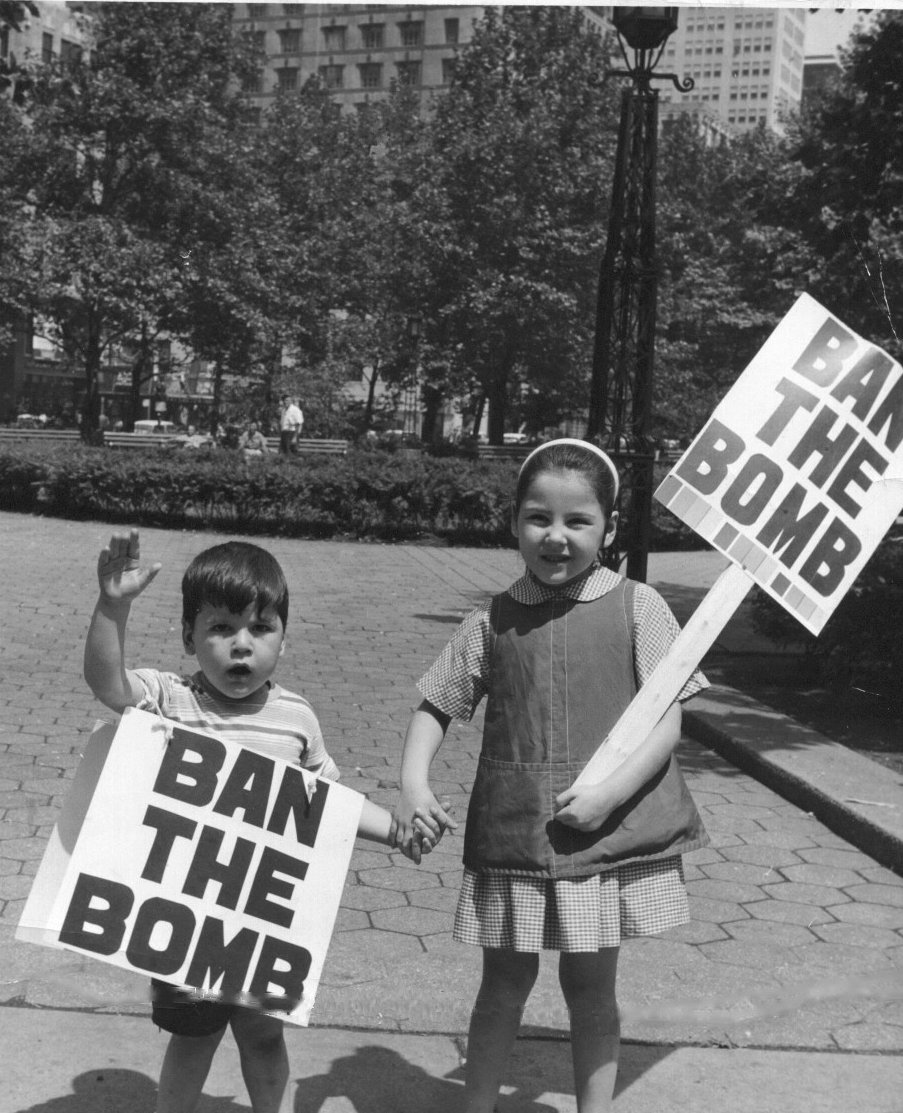
Ban the Bomb

It is picture as quaint as someone dialing a telephone: protestors in the 1950s and 1960s marching around with signs that say “Ban the Bomb.”

Quaint because so many countries now have nuclear weapons that getting rid of them all borders on the ridiculous. And it’s not just major powers; smaller nations who have developed nuclear weapons consider themselves “major” for having done so. (It sure beats the trouble of developing a sustainable, healthy economy and democracy.) Speaking of democracy, nuclear armament is all so complex that one of the bright lights of a hyperdangerous region refuses to acknowledge even having a nuclear stockpile, pretending to maintain the worst kept geopolitical secret in the world.

And yet: Blessed are the peacemakers. According to someone or other, they will be called children of God. This doesn’t mean that warmakers and hoarders of nuclear weapons aren’t children of God. It just means that the billions who live in the shadows of those bombs and missile warheads might not feel particularly blessed. That’s why we, and our children and our generations, shouldn’t give up on global nuclear disarmament, no matter how naïve or impossible it seems.

What Would Truman Do?

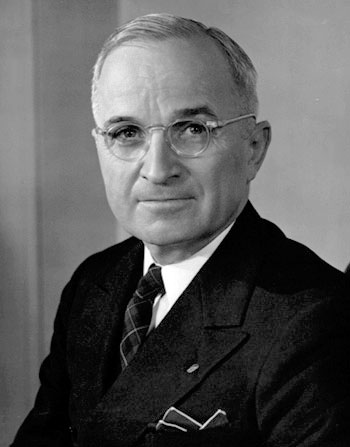
Harry Truman
Harry Truman is maybe the most interesting American President of the twentieth century, and maybe the most significant.

He held a power that no one had held in human history and he took the decision to use it. He had no precedent to guide him—except maybe God in the Bible. He dropped atomic bombs on Hiroshima and Nagasaki. From that point forward, everyone who uses nuclear weapons will be the second or third to do it.

He is also the only President in the twentieth century without a college degree, and one of the relatively few in American history. Grover Cleveland was the last before him. But there are some before that who did manage to stand out without college, such as George Washington and Abraham Lincoln.

Obama shares some things with Truman, and on other scores couldn’t be more unlike. Truman was an unabashed though pragmatic reformer: he used executive power to desegregate the military, but his Fair Deal liberal agenda failed in the face of a recalcitrant Republican Congress. Truman’s second term was the model for all other second term disasters, marked by a war that was both unpopular and unsuccessful and by a President whose effectiveness was a constant question.

Unlike Obama, Truman was not a spell-binding orator or a scholar. He had come up through politics and to the Senate the old back room way, and his ascension to the 1944 presidential ticket was a matter of political manipulation and happenstance. The legendary 1948 election pitted him against the dapper, smooth talking, hard-nosed, well-educated federal prosecutor and New York Governor. It was considered no contest for Thomas E. Dewey. Truman won.

The reasons that Truman has risen to the top ten on nearly all lists of great American Presidents (he is number 5 on a few) are many. This puts him in the range of both Roosevelts, TR and FDR, both of whom went to Harvard, both of them charismatic patricians with colorful histories and silver tongues. Among Truman’s gifts, the one most associated with him was a plain-spoken decisiveness in word and deed, even if the decision turned out troublesome or wrong.

There were reasons to like Truman at the time of his presidency, and a number of reasons not to. But there was a sense—even those who were his enemies at the time acknowledge it and historians have come to treasure it—that underneath it all was a man who had fought in a world war (only a few Presidents have), a man who had lived a modest life, a man who knew how to practice politics, a man who could surprise by analyzing deeply, a man who faced with the prospect of killing hundreds of thousands of people in a moment gave the order to do it.

Plain speaking. Decisive action. Truman was not the ideal President because there is no such thing. But at every critical juncture, it can’t hurt to ask: what would Truman do?

There Is No MAD In Politics


The Supreme Court decision in American Tradition Partnership, Inc. v. Bullock confirms that states like Montana must follow the rule of Citizens United and allow corporations the same political speech rights as individuals, including speaking money in elections.

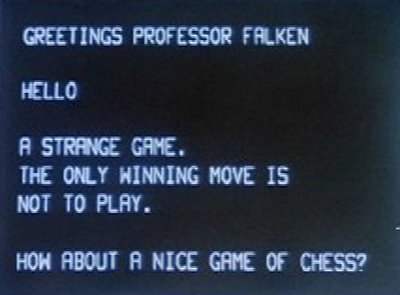
War Games (1983) is a charming movie with a serious message. The charming comes from a young Matthew Broderick, playing a computer geek whose gaming nearly starts a global thermonuclear war. He is able to avert it, and the serious message for everyone is spoken by the computer: “The only winning move is not to play.”

When nuclear weapons were used for the first and only time in 1945, and it was obvious that portions of the world could be destroyed in an instant, responses followed.  There were moves to keep them out of the hands of “bad guys”, there were demonstrations to “ban the bomb” from everyone, there were attempts to limit and reduce the weapons that everyone eventually got.

And then there was the idea of Mutually Assured Destruction (MAD). It was simple: If anyone with those weapons could as easily be destroyed as they could destroy, it would be “madness” for them to strike. And as much as our deepest humanity wants to deny it, MAD is the reigning paradigm that has prevented nuclear weapons from being used even once in the almost seventy years since Hiroshima and Nagasaki.

In post-Citizens United politics, there is no MAD. There is worthwhile talk of disclosure, transparency and constitutional amendments to at least moderate the influence of corporate money in elections. But there is also a realpolitik sense that in the meantime those with the biggest weapons may well win. And the prospective winners have no worries about being destroyed by any opposing arsenal. That is why, understandably, the Obama campaign very quickly pivoted on the issue of Super Pacs. It was a matter of political survival.

MAD has saved us from blowing ourselves up. It is not available to save the politics of democracy. It is time for the most creative minds to figure out something beyond the virtuously obvious but ineffective. Whatever that might be.