This time of year, the male cicadas emerge to call out to potential mates. They are loud. Loud. So loud that the droning outside can be heard inside. The females may find this appealing. Others may not.
Early in the morning I go out to listen to the birds. Lately the birds are singing with the loud cicada drone almost overwhelming the sound. Imagine going to an orchestra concert and having the person in the next seat talking incessantly on the phone through the entire performance.
Yet the birds keep singing. I keep listening. The cicadas will stop at some time. The birds will still be singing and will keep singing. I will keep listening.
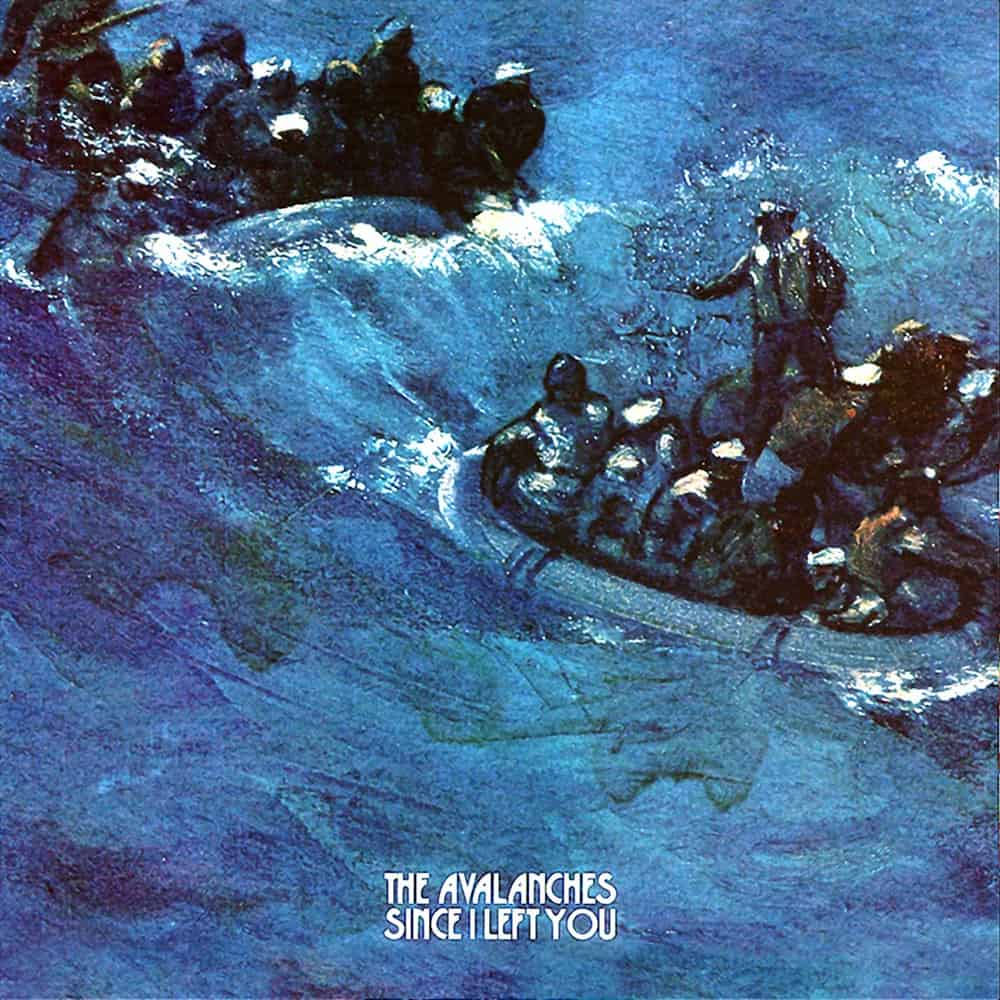
The Avalanches are bent on filtering their all-encompassing record collections through sampling and original instrumentation that owes most to hip-hop. The Australian group truly arrived in 2000 with Since I Left You. An expansive suite in the lineage of sample-based landmarks such as Public Enemy’s It Takes a Nation of Millions to Hold Us Back, the Beastie Boys’ Paul’s Boutique, and DJ Shadow’s Endtroducing….., the album distinguished itself with an unbridled sense of joy — exemplified not only by the sound of whinnying horses — and minimal original vocal content, left to ingeniously recontextualized voices from disparate sources. Even in the wake of numerous awards, sales certifications, and the attainment of a global following, its stature continued to heighten through the release of the group’s long-anticipated 2016 follow-up, Wildflower, a more collaborative effort that offered new shades of psychedelia and topped the Australian album chart. We Will Always Love You, another wide-ranging set filled with imaginative pairings of featured artists, returned the group to the Top Ten. They reappeared in 2026 with “Together,” an ecstatic dancefloor collaboration with Nikki Nair, Jessy Lanza, and Prentiss.
Before the Avalanches took shape in 1997, core members Robbie Chater and Toni Di Blasi, along with fellow founding member Darren Seltmann, were in the Melbourne-based noise-punk band Alarm 115. The deportation of drummer Manabu Etoh prompted a new project, the making of a sample-based demo — utilizing scores of used records…
In the works for over two years, a period lengthened by sample clearances and other business matters, Since I Left You, the Avalanches’ first album, was issued first in Australia in November 2000. A continuous hour-long collage pieced together with thousands of samples, it received a response from critics and the public similar to its glowing quality. The group even had the blessing of Madonna, who allowed them to use the bass line from her early hit “Holiday.” Beggars Banquet offshoot XL issued the album in the U.K. in May 2001, and a U.S. edition on Sire followed that November. “Frontier Psychiatrist” and the title track charted in Australia and were Top 20 hits in the U.K., where the album reached number eight. Remixes from the select likes of formative inspiration Prince Paul, Stereolab, and Cornelius enhanced the Avalanches’ image. The album led to four ARIA awards and was eventually certified platinum in Australia.
Admiration for Since I Left You seemed to intensify with each year that passed without a follow-up. What early supporters and converts got instead was a handful of scattered remixes for the likes of Belle and Sebastian, Wolfmother, and Franz Ferdinand until 2007, when the group seemed to disappear entirely, leaving only rumors of a potential second album. In truth, they had started banking material that over time grew to 40 songs. Nothing resembling an album was ever finished, though, as the Avalanches devoted surplus energy to other projects, like scoring a King Kong musical and working on an animated film that never saw the light of day.
The silence ended in July 2016 when the Avalanches — essentially Chater, Di Blasi, and De La Cruz — made their proper return with Wildflower. The trippy album drew from their interim projects, and while it boasted its own lengthy list of sample sources, it also featured numerous guest instrumentalists and vocalists across the fields of left-field rap and underground rock, from MF Doom and Danny Brown to Jennifer Herrema and David Berman. Warmly received by listeners and critics, Wildflower topped the Australian chart, went Top Ten in the U.K., and entered the Billboard 200 at number 27….We Will Always Love You, was released in December 2020 and entered the Australian chart in 2020.
It is never too late to discover previously unknown-to-you creators and creations, whether you’ve missed them for decades or centuries. Where there’s life there’s listening.
I just discovered The Avalanches, their first album released twenty-six years ago. It is like unwrapping a gift that has been under the tree all this time.
Above is a good description, though reading about music you haven’t heard is a poor substitute, especially when it is a kind of music you have little reference for. When The Avalanches music emerged, not just using samples but mostly composed of samples, the term “plunderphonics” was used. (However, the samples are all cleared, not stolen.) Like creating a mosaic out of found objects, it could be a mess, but if you are artists, it could be a masterpiece.
I know this music is good, not just because I like it or because of the reviews and regard, but because when it was playing this morning, a very discriminating and picky listener passed by and said, “good music.” It is. Up. Lifting. Listen.
Jesus, Dogen and Donovan each have something to say about mountains. In some ways the same thing.
Jesus says that faith can move mountains, by which he may mean that understanding the nature of things, including mountains, will allow us to see that mountains are always moving, if we will see it. Jesus is all about what we don’t see that is right in front of us.
Dogen says that mountains are mountains and mountains are walking. If you can walk, mountains can walk. Those without eyes to see mountains cannot notice, understand, see, or hear this reality.
Donovan sings about this reality of mountains appearing, disappearing, appearing.
Jesus
He answered, ‘Because you have so little faith. In truth I tell you, if your faith is the size of a mustard seed you will say to this mountain, “Move from here to there,” and it will move; nothing will be impossible for you.’ (Matthew 17:20, New Jerusalem Bible)
Dogen Zenji
Priest Daokai of Mount Furong said to the assembly, “The green mountains are always walking; a stone woman gives birth to a child at night.”
Mountains do not lack the characteristics of mountains. Therefore, they always abide in ease and always walk. Examine in detail the characteristic of the mountains’ walking.
Mountains’ walking is just like human walking. Accordingly, do not doubt mountains’ walking even though it does not look the same as human walking. The buddha ancestor’s words point to walking. This is fundamental understanding. Penetrate these words.
Because green mountains walk, they are permanent. Although they walk more swiftly than the wind, someone in the mountains does not notice or understand it. “In the mountains” means the blossoming of the entire world. People outside the mountains do not notice or understand the mountains’ walking. Those without eyes to see mountains cannot notice, understand, see, or hear this reality.
If you doubt mountains’ walking, you do not know your own walking; it is not that you do not walk, but that you do not know or understand your own walking. Since you do know your own walking, you should fully know the green mountains’ walking.
Green mountains are neither sentient nor insentient. You are neither sentient nor insentient. At this moment, you cannot doubt the green mountains’ walking.
From Mountains and Waters Sutra, Shobo Genzo, Fascicle 15 (1240)
Donovan
The caterpillar sheds his skin to find a butterfly within
Caterpillar sheds his skin to find a butterfly within
First there is a mountain, then there is no mountain, then there is
First there is a mountain, then there is no mountain, then there is
Record Store Day was conceived in 2007 at a gathering of independent record store owners and employees as a way to celebrate and spread the word about the unique culture surrounding nearly 1400 independently-owned record stores in the US and thousands of similar stores internationally. The first Record Store Day took place on April 19, 2008. Today, Record Store Day is celebrated at independently-owned brick-and-mortar record stores around the world.
For many years I posted about Record Store Day, but not recently.
I should feature it every year.
I would not be who I am without the hours spent in record stores, chain stores and independents. If you go to a concert, you are surrounded by people who love particular artists or particular types of music. In all those record stores, big or small, you are surrounded by people who love music.
The record stores of my youngest years included two different record buying experiences.
One was in the next town. The stores on the avenue began with a Woolworth’s on the north side and a tiny record store on the south side. The Woolworth’s was where I bought albums, the other was where I bought singles.
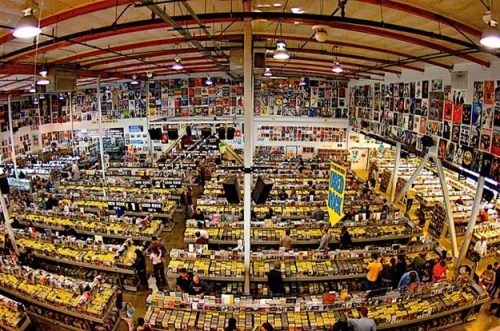
The other experience was the cavernous Sam Goody’s store at our local mall. Sam Goody’s still has mall stores, though these are mere storefronts. I am talking about huge. It wasn’t a store. It was a world of records. It wasn’t about what I had heard on the radio. It was about whatever was playing and whatever I could hear, what these dozens of other people knew about and were listening to. That was the formative lesson internalized. Music was legion and, in the words of the much later George Michael album title, I learned to listen without prejudice.
Back to Record Store Day 2026. Visit a record store today, talk to other music freaks, buy something. I hear that following the resurgence of vinyl, CDs are coming back too.
Music is good for us. Different kinds of music are good for us. Another back in the day music reference is to David Crosby. The first track on his If I Could Only Remember My Name album says “Everybody’s saying that music is love.” It is.
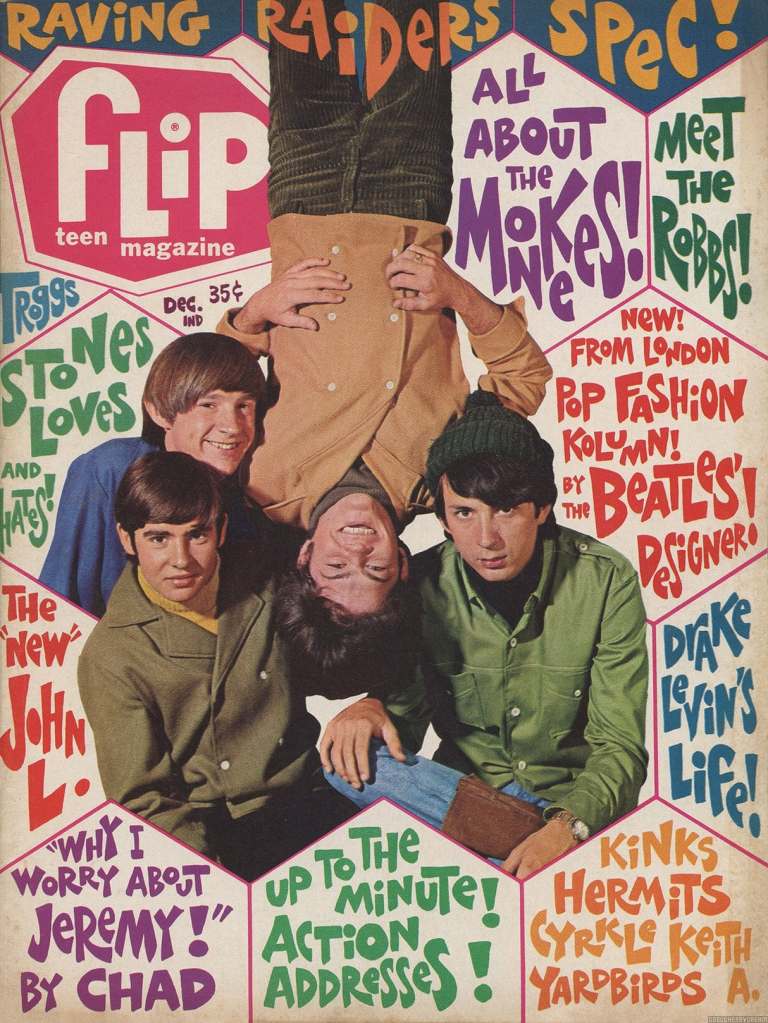
FLIP’s GROOVY GUIDE TO THE GROOPS! happened because you asked for it.
It’s an outasite one-of-a-kind book!
FLIP’s entire staff in New York, London and Hollywood contributed to this book, but two people must be especially mentioned. Carol Deck, FLIP’s Hollywood Editor, served as the book’s supervising editor, and Tracy Thomas spent weeks tracking down most of the groups for the last and largest section of the book—the Groovy Groups.
And you had the most important part of all: You told us which 100 great groups to squeeze into the 240 picture-popping pages of this boss book!
STEPHEN KAHN Publisher FLIP Magazine
December 1966
Some will think that featuring a “groovy” book from 1968 is some sort of nostalgia trip. It is anything but.
Cultural perspective has two dimensions, breadth and depth. Broad, as in covering more than a little piece of your world. Deep, as in covering time before the time you were born or just a few years before that.
At college, I often researched at a huge university library. This was before digital conversion, so the stacks were overstuffed with bound volumes of newspapers and magazines that went far back into the previous century. I wasn’t “nostalgic” for cultural items from decades earlier. I was, and still am, trying to gain perspective on how things were, how we got here, and where we might go.
Jimmy Kimmel features a segment where people walking down Hollywood Boulevard, young and old, are asked basic questions about current events, geography, history, etc. Some might shake their head and laugh at ridiculous responses, maybe calling some of these people ignorant.
I prefer thinking of them as culturally provincial, with knowledge and perspective narrowing more and more into a small circle and the last thing that happened.
That’s why Flip’s Groovy Guide and other artifacts from different times and different places are so important, as an antidote to cultural provincialism. Plus, a lot of fun!
One more thing.
If you think this book reflects a frivolous time, here are other books that were advertised on the back page:
THE NEW YORK TIMES ELECTION HANDBOOK, 1968 edited by Harold Faber. The political experts of The New York Times provide an authoritative, informative manual designed to help the public sort out the facts at work in a controversial election.
HOW TO GET OUT OF VIETNAM: A Workable Solution to the Worst Problem of Our Time by John Kenneth Galbraith. The distinguished economist, political theorist, and bestselling author offers a practical plan for U. S. withdrawal from “a war we cannot win, should not wish to win, are not winning, and which our people do not support.”
THE HIPPIES by Burton Wolfe. At once highly critical and deeply sympathetic, this is an in-depth examination of the hippie kingdom—its “government,” its organizing principle, its leaders and members, the drug scene, the communes, the poverty, the disease.
BEST CAMPUS HUMOR OF THE SWINGING 60’s edited by Bill Adler. A unique tribute to the freshness and diversity of college humor, ranging in subject from Vietnam to college exams, from LSD to campus sex.
THE SECOND CIVIL WAR: ARMING FOR ARMAGEDDON by Garry Wills. An eye-witness account of the explosive racial crises that occurred in New York, Albany, and Detroit dur ing the summer of 1967.
THE HIPPIE PAPERS edited by Jerry Hopkins. An eye-opening collection of outspoken articles from the nation’s underground press on subjects ranging from LSD to free love, from Vietnam to police brutality.
The Shaker dance song Simple Gifts (Joseph Brackett, 1848) is the ultimate Thanksgiving song. It is also the ultimate American song, provided we recognize that in America, the most religious and richest nation on earth, simplicity and humility are ideals worth aspiring to and striving for.
Ken Burns writes this about his documentary The Shakers:
They called themselves the United Society of Believers in Christ’s Second Appearing, but because of their ecstatic dancing, the world called them Shakers. Though they were celibate, they are the most enduring religious experiment in American history. They believed in pacifism, natural health and hygiene, and for more than 200 years insisted that their followers should strive for simplicity and perfection in everything they did.
Shaker design, including furniture and baskets, may be familiar to you. So may the melody of Simple Gifts. It is frequently used in pop culture, and is most famous musically in Aaron Copland’s orchestral masterpiece, Appalachian Spring. And while the tune is often heard, the lyrics are not as frequently sung. Here is an appropriately unadorned version by Judy Collins.
Even if you can’t read music, you can look at the musical score and see how very simple this song is:
Here are the lyrics. Happy Thanksgiving.
‘Tis the gift to be simple, ’tis the gift to be free
‘Tis the gift to come down where we ought to be,
And when we find ourselves in the place just right,
‘Twill be in the valley of love and delight.
When true simplicity is gain’d,
To bow and to bend we shan’t be asham’d,
To turn, turn will be our delight,
Till by turning, turning we come ’round right.
Among the treasures recorded by k.d. lang is Hymns of the 49th Parallel, an album of covers of songs by her fellow Canadians—the artistry of Neil Young, Joni Mitchell, Leonard Cohen, and others. And of course k.d. herself.
This should give you a clue to just how important Canadians have been to popular music and other arts. If Canada was represented by just one of these extraordinary artists, it would be enough. Taken together (need I add The Band, The Guess Who, Arcade Fire, Celine Dion, Alanis Morrisette, The Weeknd, Shania Twain, Drake, Rush and more?) it is a banquet of music. (See Rolling Stone’s 50 Greatest Canadian Artists of All Time. No surprise that Joni is #1, Neil #2, Rush #3, Leonard #4. Okay, maybe I’d move Leonard Cohen up a notch, but that’s quibbling.)
Listening to just Canadian artists until this madness is over is asking too much. Listening to lots of Canadian artists, maybe having one Canada-only day each week, is not punishment and would be a joy.
Since I often include one video track in my music posts, I have a quandary. Look at the list above. Just the ones named add up to hundreds of tracks. So if I offer just one or two, that doesn’t take away from the mountain of song. O Canada!
I listen to music on speakers or earbuds. Occasionally on a four-speaker tablet. Rarely on a phone speaker.
When Phil Spector created his “wall of sound” recordings in the 1960s, they were intended to be played by AM stations broadcasting to transistor or car radios. The definition of lo-fi. He believed that the right kind of layered big production could overcome these limitations. He is legendary for that music.
These days, it is the limitations of Spector’s productions that show up on high-tech equipment. And yet…
To simulate what it was like to hear the records on a tiny radio speaker, I played the tracks on a phone speaker. Do you know what? The sound is rough around the edges. But what Spector wanted was to give a new generation of pop music listeners an experience they never had before. It works. Try it. Turn it up.
My first portable music device was a transistor radio. AM radio, tuner dial, 2-inch speaker, audio jack. It may amaze you to know that you can still buy a similar radio from Sony, Panasonic and others (see above), relatively cheap, now including AM and FM.
Today I listen to music on a tablet, millions of tracks on demand instead of a dozen stations, touch screen, pictures of artists and albums, quad speakers, infinite information.
The thought I had this morning is that with all the significant differences, the tablet is just a transistor radio. Or to be precise, it is and it isn’t. If you don’t understand that, you might.






 Bob Schwartz