I am not going to try to explain the movie Hundreds of Beavers, available on Prime and elsewhere.
There are plenty of positive reviews online and it made plenty of best of lists, as possibly the funniest and funnest movie of the year. I read one of those praise-filled reviews. It included a description, which barely made sense, which is why I was compelled to actually watch it.
Now that I have watched it, I cannot describe it, as I said, but I can recommend it. Bigly.
It is imagination that is going to help save us.
This movie, by creators Mike Cheslik and Ryland Tews, is bursting, overflowing with imagination.
Therefore, this movie is going to help save us. And help save you, should you agree.
Here is the very brief description from the movie’s official website, which description tells you little about the actual movie:
In this 19th century, supernatural winter epic, a drunken applejack salesman must go from zero to hero and become North America’s greatest fur trapper by defeating hundreds of beavers.
Yeah, well, kind of. As I said, you just gotta see it for yourself.
The category “guilty pleasure” is kind of silly. It’s supposed to mean movies that “real” film people disrespect, that you love, and therefore that you feel guilty about loving. There’s no reason to feel guilty about movies you love. If that was a thing, many of our relationships would qualify as guilty pleasures, which mostly they are not.
By critical standards, Road House is not on any best of lists. But besides its entertainment value, it also contains a helpful dose of philosophy.
Dalton—one name only—is a world class cooler. One step above bouncers, who work for him, he maintains peace in rowdy clubs. Just the mention of his name elicits gasps from the staff at the Double Deuce, an out-of-control club in Missouri that Dalton is hired to straighten out.
Too many plot points here will spoil the movie for you (you are going to watch it, aren’t you?). Just know that Dalton has a cute meeting with a beautiful doctor in an emergency room, after he has been knifed.
DOC How’d this happen?
DALTON Natural causes.
DOC (peers at cut) Looks like a knife wound.
DALTON Like I said.
(reaches down, hands the doctor a file from his case. The doctor scans the pages of extensive medical records.)
DOC You’re a bouncer?
DALTON Uh-huh.
DOC Well, Mr. Dalton, you may add eighteen stitches to your dossier of thirty-one broken bones, two bullet wounds, eight puncture wounds and four stainless steel screws. That’s an estimate of course. (prepares to suture) I’ll give you a local.
DALTON No thanks.
DOC Do you enjoy pain?
DALTON Pain don’t hurt.
DOC (peers at folder) Says you’ve got a degree from New York University.
DALTON That’s right.
DOC What in?
DALTON Philosophy. Psychology.
DOC Yeah?
DALTON Uh-huh.
(doctor continues stitching)
DOC What’d you study?
DALTON Little of everything. Man’s search for faith. That sort of shit.
Even if you love the movie, you have to chuckle at Patrick Swayze’s ridiculous answer about his studies: “Little of everything. Man’s search for faith. That sort of shit.”
But the real key is his refusing a local anesthetic: “Pain don’t hurt.”
Besides knowing how to clean up a club, Dalton’s experiences and studies have made him wise.
According to some philosophies, in one sense, pain don’t hurt. That doesn’t mean there isn’t severe and excruciating pain, far beyond getting stitches in an emergency room. Pain you can’t pretend isn’t there or that you can think away. I don’t want to give Dalton (who has studied “that sort of shit”) or the scriptwriters too much credit, but they are on to something that various traditions teach. Besides the blessings of unabused painkillers, some degrees of over-attachment to pain or pleasure can keep us off balance. And while I don’t like disagreeing with Dalton, who was trying to impress a gorgeous doctor, it’s not that pain don’t hurt, but that pain can hurt differently.
“Pain can hurt differently” isn’t much of a movie line. Especially in one of the greats.
Out of the Past (1947) is the best of all American film noir movies. It contains dozens of lines memorable and quotable, dialogue suffused with fatalistic wisdom.
Jeff and Kathie are at a roulette table. She is losing.
JEFF: That isn’t the way to play it.
KATHIE: Why not?
JEFF: Because it isn’t the way to win.
KATHIE: Is there a way to win?
JEFF: Well, there’s a way to lose more slowly.
The lives of Americans are in the hands of a loser. At this point in response to the pandemic, it isn’t clear exactly what “winning” means, but it is for the moment out of reach. What remains is for the man at the roulette table to figure out is how to lose more slowly.
Spoiler alert: At the end of Out of the Past, both Jeff and Kathie are dead. It is after all film noir.
Ooh child
Things are gonna get easier
Ooh child
Things’ll get brighter
Ooh child
Things are gonna get easier
Ooh child
Things’ll get brighter
Some day
We’ll put it together and we’ll get it undone
Some day
When your head is much lighter
Some day
We’ll walk in the rays of a beautiful sun
Some day
When the world is much brighter
“Those morons out there? Shucks, I could take chicken fertilizer and sell it to them as caviar. I could make them eat dog food and think it was steak.”
“This whole country’s just like my flock of sheep! They’re mine! I own ’em! They think like I do. Only they’re even more stupid than I am, so I gotta think for ’em.”
“Good night you stupid idiots. Good night, you miserable slobs. They’re a lot of trained seals. I toss them a dead fish and they’ll flap their flippers.”
A Face in the Crowd (1957) is a movie about an unlikely backwoods media star, a drifter named Lonesome Rhodes, who becomes a national populist icon. He believes he can sell his followers on anything, including who the next president should be.
The demagogic scheme falls apart when his real beliefs are broadcast on an open microphone.
***
ACTOR ON RHODES’ SHOW: You really sell that stiff [Senator Fuller] as a man among men?
LONESOME RHODES: Those morons out there? Shucks, I could take chicken fertilizer and sell it to them as caviar. I could make them eat dog food and think it was steak. Sure, I got ’em like this… You know what the public’s like? A cage of guinea pigs. Good night you stupid idiots. Good night, you miserable slobs. They’re a lot of trained seals. I toss them a dead fish and they’ll flap their flippers.
***
LONESOME RHODES: This whole country’s just like my flock of sheep!
MARCIA JEFFRIES: Sheep?
LONESOME RHODES: Rednecks, crackers, hillbillies, hausfraus, shut-ins, pea-pickers – everybody that’s got to jump when somebody else blows the whistle. They don’t know it yet, but they’re all gonna be ‘Fighters for Fuller’. They’re mine! I own ’em! They think like I do. Only they’re even more stupid than I am, so I gotta think for ’em.
Searching for Bobby Fischer is a movie about a real life chess prodigy. In a memorable scene, his teacher sweeps the pieces off the chessboard, so the child can better concentrate on the actual state of play, undistracted by the apparent state of play.
Meditation and related attention practices are all about clearing the chessboard. What comes next depends on the context, whether it’s a way to relax or a search for enlightenment. The point is that the apparent state of play, the pieces on the chessboard, are distractions and may become obsessions. Only by focusing on the empty chessboard can you see the game for what it is.
“Many people I know in Los Angeles believe that the Sixties ended abruptly on August 9, 1969, at the exact moment when word of the murders on Cielo Drive traveled like brushfire through the community, and in a sense this is true. The tension broke that day. The paranoia was fulfilled.” Joan Didion, The White Album
Joan Didion is one of the great essayists, and The White Album may be her finest essay. It gave title to a superb collection published in 1979. The White Album is about the entwinement of her life and life in Los Angeles in the late 1960s and early 1970s, both of which she reflects on as being strange and even surreal.
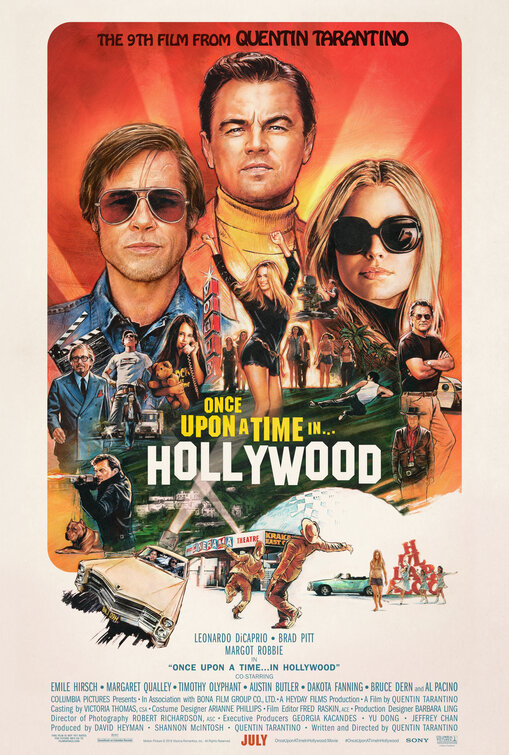
Los Angeles in the late 1960s is also the subject of Quentin Tarantino’s new movie Once Up a Time…In Hollywood. The center of the film is the event mentioned in Didion’s quote above: the murders of Sharon Tate Polanski, Abigail Folger, Jay Sebring, Voytek Frykowski, Steven Parent, and Rosemary and Leno LaBianca in the Hollywood Hills by members of the Manson Family. But is about much more than that.
The title of Once Upon a Time gives away just what kind of story this is. It is a fairy tale. Fairy tales are not either absolutely light or dark. As modern scholars now regularly say, fairy tales are meant to reflect something about ourselves—who we are, what we need—and in that sense could not be just light or dark. They are merely true.
The opening paragraph of The White Album is one of the best explanations of story ever written:
We tell ourselves stories in order to live. The princess is caged in the consulate. The man with the candy will lead the children into the sea. The naked woman on the ledge outside the window on the sixteenth floor is a victim of accidie, or the naked woman is an exhibitionist, and it would be “interesting” to know which. We tell ourselves that it makes some difference whether the naked woman is about to commit a mortal sin or is about to register a political protest or is about to be, the Aristophanic view, snatched back to the human condition by the fireman in priest’s clothing just visible in the window behind her, the one smiling at the telephoto lens. We look for the sermon in the suicide, for the social or moral lesson in the murder of five. We interpret what we see, select the most workable of the multiple choices. We live entirely, especially if we are writers, by the imposition of a narrative line upon disparate images, by the “ideas” with which we have learned to freeze the shifting phantasmagoria which is our actual experience.
If you are a fan of some or all of Tarantino’s movies, you are already planning to see Once Upon a Time. If you are not a fan, or affirmatively dislike Tarantino, you should consider seeing it anyway. As with other movies that play with Hollywood as story (Robert Altman’s The Player is an excellent example), the inescapable point is that Hollywood makes things up, even as the movies may attempt to reflect actuality, because that is what they do. They tell and sell fairy tales. Light and dark. As long as we appreciate the subtle differences and similarities between actuality and story, we can be entertained and the better for it. We do, as Didion writes, tell ourselves stories in order to live.
WASHINGTON (AP) — In President Donald Trump’s view, even the inadequate air conditioning at the White House is Barack Obama’s fault.
Trump offered the new gripe about his predecessor as he explained in the Oval Office Friday why he’ll be spending some time at his New Jersey resort in August.
The president says “it’s never a vacation” when he goes to Bedminster, New Jersey, and that he would rather be at the White House.
He says that some of his time away from the White House gives crews time to do maintenance work.
He says, for example, “The Obama administration worked out a brand new air conditioning system for the West Wing. It was so good before they did the system. Now that they did this system, it’s freezing or hot.”
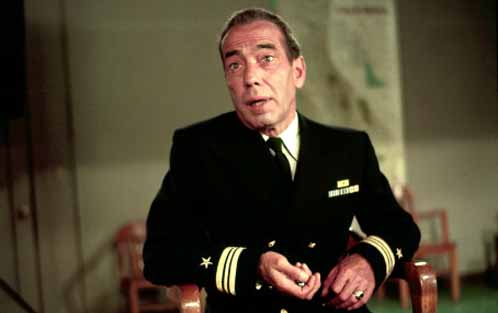
In the movie The Caine Mutiny, officers of the USS Caine determined that the conduct of their captain is so erratic that they must attempt to take over command of the ship. In one incident, Captain Queeg becomes obsessed with a missing container of strawberries. At the court martial of an officer charged with mutiny, Queeg testifies—and famously reveals just how psychologically disturbed he is:
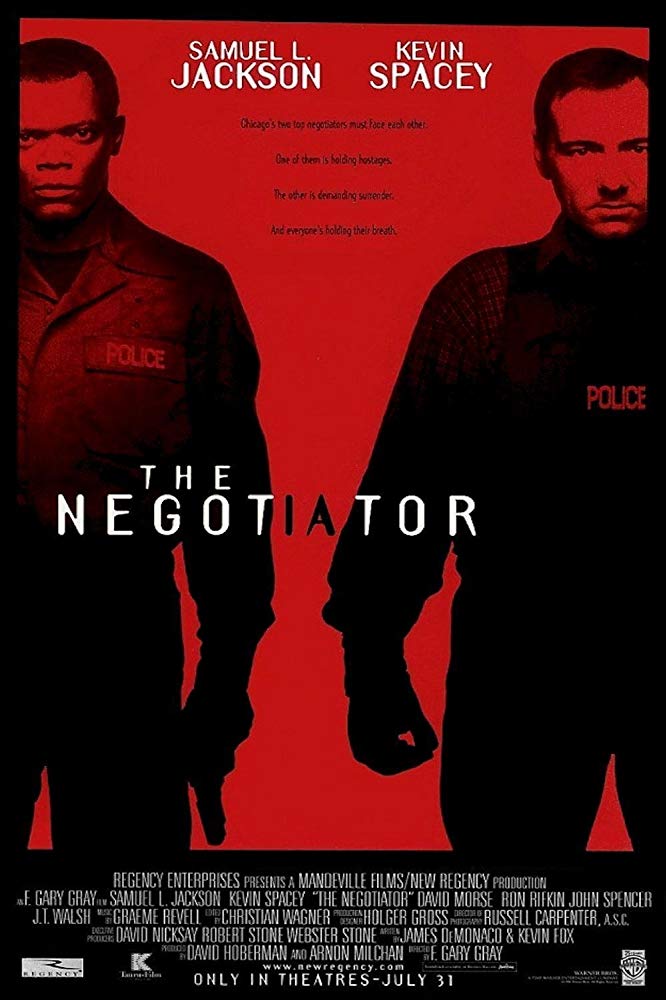
Today seems like a good day to watch The Negotiator (1998), available on Netflix.
(Yes, one of the heroes and stars is Kevin Spacey. But the bigger hero and star is Samuel L. Jackson, and there’s no reason to be protesting him.)
It’s about corrupt officials, sworn to uphold the law, lying and trying to lay off blame on others. It’s about a handful of smart and talented people trying to negotiate a way out of dangerous situations. And its about a lot of innocent people caught in the middle, unaware of how bad it is and how bad it can get.
“As a writer I believe that all the basic human truths are known. And what we try to do as best we can is come at those truths from our own unique angle, to reilluminate those truths in a hopefully different way.” William Goldman, Adventures in the Screen Trade
William Goldman, who won Academy Awards for his screenplays for “Butch Cassidy and the Sundance Kid” and “All the President’s Men” and who, despite being one of Hollywood’s most successful screenwriters, was an outspoken critic of the movie industry, died on Friday in Manhattan. He was 87.
In his long career, which began in the 1960s and lasted into the 21st century, Mr. Goldman also wrote the screenplays for popular films like “Misery,” “A Bridge Too Far,” “The Stepford Wives” and “Chaplin.” He was a prolific novelist as well, and several of his screenplays were adapted from his own novels, notably “The Princess Bride” and “Marathon Man.”
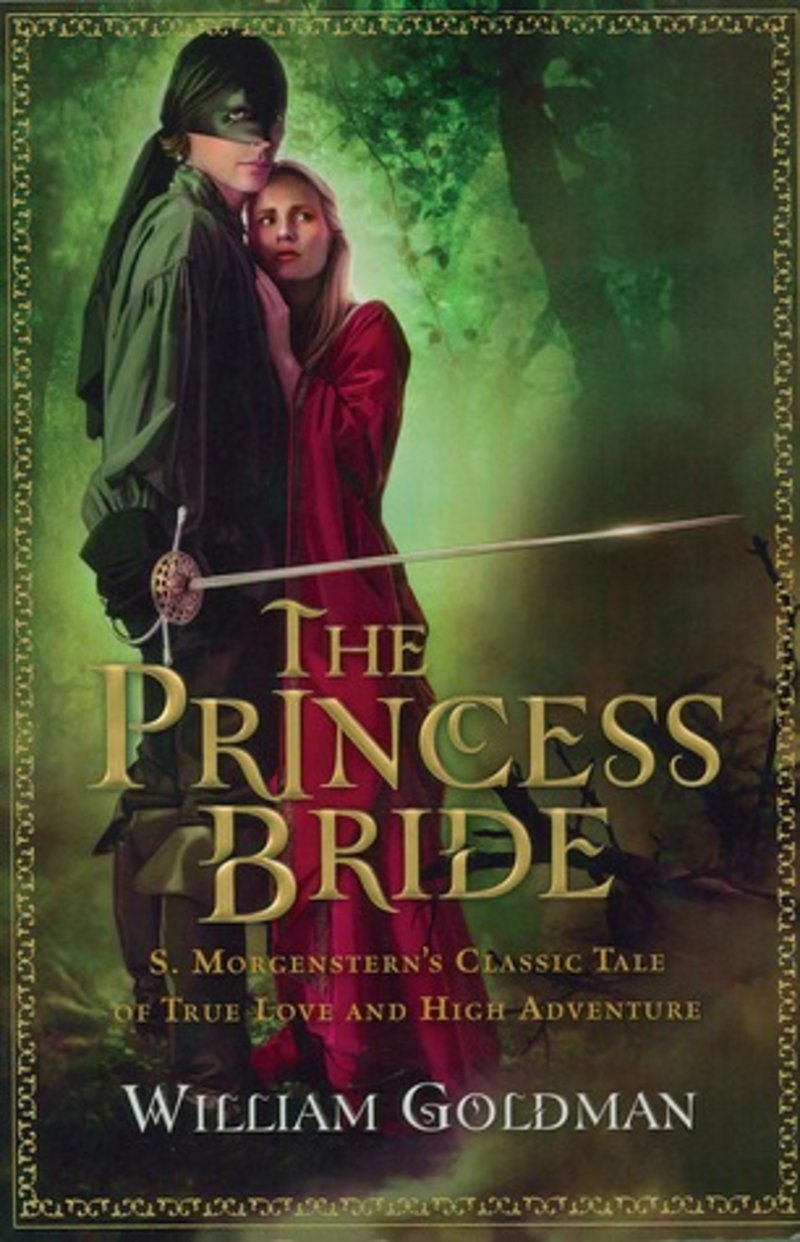
There are plenty of reasons to admire William Goldman—as a writer and as a writer who cast a realistic light on writing—but nothing is higher than The Princess Bride.
The movie, written by Goldman and directed by Rob Reiner, is a gem, worth watching at least once a year. But in its own way, his novel from which he adapted the screenplay, is even better.
If you know the movie, it is a comic romance and adventure set in a fantasy kingdom, framed by a grandfather reading this story to his grandson. But the novel is much more meta. Goldman places himself in the novel, as a writer with a fictionalized family, condensing and adapting a book by S. Morgenstern that his father had read to him, which adaptation is…The Princess Bride. The trick that Goldman pulls off is that you come away believing that everything he has told you—about his career, his family, the non-existent book by the non-existent S. Morgenstern—are all true.
The bigger trick—the bigger truth—is that everything he wrote in The Princess Bride is absolutely true. Even though he made it all up. If you are a writer or a reader, and don’t fully understand that, read William Goldman, starting with The Princess Bride.


 Bob Schwartz