Bob Schwartz

Tag: mind training

Judging and projection

Gomo Tulku (1922-1985)

One of the most famous quotes about judging is from the Gospels:


Do not judge, so that you may not be judged.
Matthew 7:1


Despite that wisdom, Christians and others often tend to forget or ignore it. A lot of judging goes on.

Another similar perspective is taken in Buddhism, which is not to say that Buddhists don’t indulge in judging also.

A maxim from the classic 59 maxims of mind-training (lojong):


  1. Don’t reflect on others’ shortcomings.

We should train our minds to see others as pure by thinking that when we see a fault in someone, it’s because we project imaginary faults onto others due to things appearing to be impure from our own side. Practicing in this way, we will be able to protect ourselves from the tendency to judge others.
Gomo Tulku (1922-1985), Seven Steps to Train Your Mind


This goes farther than the Christian message that we shouldn’t judge others because we might get judged back. We don’t judge because whatever the other is doing, we are looking in a mirror. We are pure, though our self-importance keeps us from knowing it. The other is pure, but is also kept from knowing it. Our role is not to judge, but to help them see it and help ourselves see it.

Note that no one suggests that we put our critical thinking in neutral. If we find that what we or others do, say or think might be better, we can point it out, provided our motivation is making things better, and not proving ourselves better and smarter.
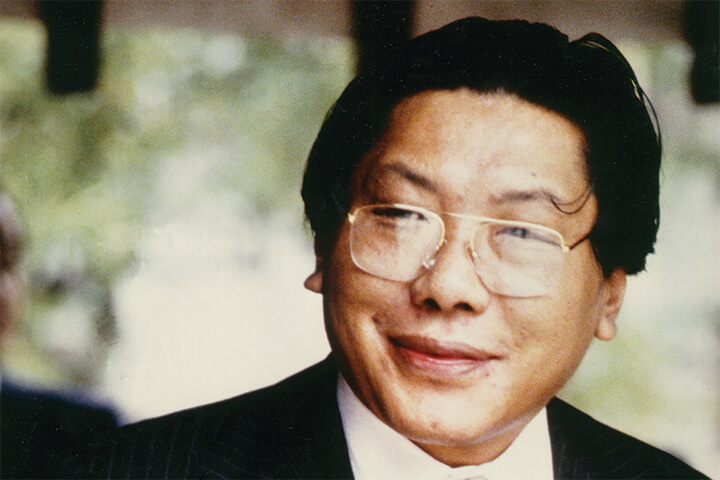
“If somebody doesn’t begin to provide some kind of harmony, we will not be able to develop sanity in this world at all.”

“If somebody doesn’t begin to provide some kind of harmony, we will not be able to develop sanity in this world at all. Somebody has to plant the seed so that sanity can happen on this earth.”
Chogyam Trungpa Rinpoche


Always maintain only a joyful mind.

If someone punches you in the mouth and says, “You are terrible,” you should be grateful that such a person has actually acknowledged you and said so. You could, in fact, respond with tremendous dignity by saying, “Thank you, I appreciate your concern.” In that way his neurosis is taken over by you, taken into you, much as is done in tonglen practice. There is an immense sacrifice taking place here. If you think this is ridiculously trippy, you are right. In some sense the whole thing is ridiculously trippy. But if somebody doesn’t begin to provide some kind of harmony, we will not be able to develop sanity in this world at all. Somebody has to plant the seed so that sanity can happen on this earth.

Training the Mind and Cultivating Loving-Kindness – Chogyam Trungpa


An opportunity to feature the song Make the Madness Stop (1968) by The Free Design.


The Free Design were one of the most inventive pop vocal groups of the late ’60s and early ’70s, transcending run-of-the-mill AM radio fare with intricate harmonies and arrangements that called on expanded instrumentation, uncommon time signatures, and advanced compositional touches. From 1967 to 1973, the band produced seven albums of their specific brand of pop sounds, one that appeared naïve and light on the surface, but held depth in its layers of precise production and emotionally unguarded musical themes. Perhaps too advanced for mainstream tastes, the Free Design would linger in commercial obscurity for their initial period of activity, producing only one charting single in their time while contemporaries like the Beach Boys and the Association dominated the airwaves and the charts. The group’s legacy would live on, however, as new generations of fans were blown over by their complex musicality and fearless sincerity. Artists like Beck, Stereolab, Belle and Sebastian, and Cornelius all cited the Free Design’s influence on their music, and the renewed interest in the band was enough for them to reconvene in 2001 for the album Cosmic Peekaboo.

Jason Ankeny, Rovi


Make the Madness Stop by The Free Design

Follow the way that leads between madness and madness
Flowers on both sides, each side has weeds and gladness and sadness

Pathways are green and black and white and yellow and crimson
Walk on the rainbow flooded by both sides’ truths and opinion

Deplete we must the store of hate immense
And grouping groping nonsense

Honesty and purity, beauty and sincerity
Doesn’t that sound corny?
Wish that I were corny

Walk the way of love, eyes open
Fly the skies above with hope and heart and sense
Blow your mind but not completely
Make the madness stop

Spiritual masters in disguise

“Always try to be authentic and modest. At the same time, we should not be too judgmental or disapproving of the excessive displays of other people. It is impossible to know what may be inspiring them. The Buddha himself said that there were many hidden enlightened beings in this world and anyone we meet could be a spiritual master.”
Mind Training by Ringu Tulku

The past has gone and the future is not yet here: Meditation


We are not used to staying in the present but there is nowhere else to be. The past has gone and the future is not yet here. It is that simple: only now exists. The present cannot be controlled. If we hold this moment back, it becomes the past. If we try to make the moment last, we are sending it into the future.

All meditation methods have the same purpose: to keep us in the present and to introduce us to the mind. We are not trying to stop our thoughts but to feel less trapped by them. The earlier we can catch ourselves from falling in with habitual patterns and getting entangled the better, and one of the most dependable techniques for preventing this is awareness of the breath.

Usually we breathe without taking any notice but in this technique we watch the breath, following it as it flows in and out of the body. We keep calm. We are not trying to accomplish anything. We just allow the mind to use the breath to settle. We do not have to supervise our senses or our thoughts. If something distracts or interrupts us, we let it pass. Staying mildly aware of our breath, we observe it without getting too absorbed by it.

Meditation is like taking a holiday. We have permission to give up planning and worrying. We are off duty. It is time to relax and slow down. Too much effort with our practice makes us tight and that is no use, but allowing the mind to go completely flat is not the answer either. If we are not alert, we will fall asleep or our attention will wander without us knowing it. We are trying to find a balance, neither too tense nor too sluggish.

When we are not wound up or straying between the past and the future, the meditation gradually brings us into the present moment—grounded in our body.

Ringu Tulku, Mind Training