Bob Schwartz

Tag: life

The Day the Buddha Woke Up
Buddha Comic Bodhi

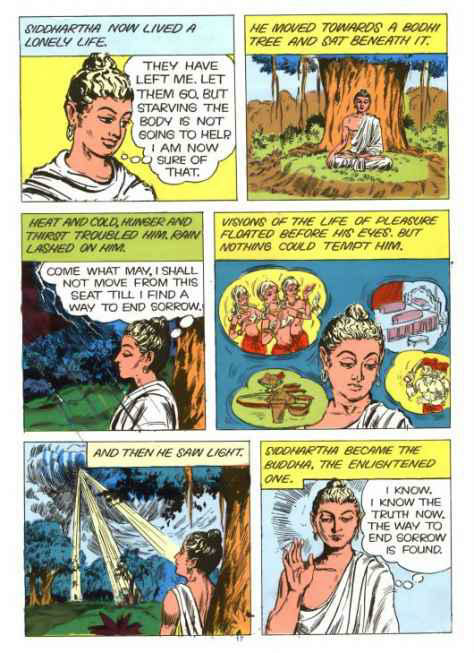
December 8 is Bodhi Day, the day on which the Buddha’s enlightenment is traditionally celebrated.

The English word “enlightenment” is so packed with meaning that it might be better to just go back to what the Buddha is reported to have said: I am awake.

This is useful because it leads to the two questions: woke up from what and woke up to what?

The Buddha, sitting there under the Bodhi tree, woke up from a journey. Born a royal son, he had fled a life of accidental privilege to answer ultimate questions about suffering and death—the very same questions that consume religious lives of all kinds. He believed that if he tried a, b, and c (such as extreme asceticism), he would discover some secret x, y, and z. There was some kind of magic formula, and all he had to do was learn it. That sort of magic is still at the heart of much of our religion.

He woke up to discover that there was no magic, not in such an instrumental sense. Nothing was different. Suffering and death would not go away, no matter what efforts we make. The best and worst aspects of life would go on, with and without us. Great fortunes would be made and lost. Great structures would be built and then destroyed, by cataclysms natural and human. Love would be here and gone.

But this: He could see something in all of that that made sense of all of that. There is no big plan in which we are players, active or passive, though we could and do make and execute our own little plans. There are just things, relationships between those things, and change, and of all those of a singular piece. We can and do overlay that with all of our very complicated details and distinctions, which is after all a definition of the life we live. But if we discover that underlying existence, we just might choose to live differently. And in that living differently, make change and wake others up. And on and on.

None of that eliminated suffering and death for the Buddha, as it won’t for anyone. He grew old and tired and, legend has it, died from being given spoiled food. He had told his followers what he had discovered, none of which involved magic. It was all about the infinite depth of the ordinary. For him, there was no more a kingdom in the clouds than the kingdom he had left behind when he started his journey. There was just what is. Strive on with diligence, he told those followers at the last.

© 2025 Bob Schwartz

Eclipse and the death/life instincts: Why are so many interested in seeing the sun extinguished?

Gustav Klimt, Death and Life

Among Freud’s most controversial and often rejected concepts is what he termed Todestrieb—death drive—also fashioned as Thanatos—death instinct. Death drive or instinct, he proposes that as people we aim to reduce psychic tension to the lowest possible point, that is, death. Supposedly the drive is first directed inward as a self-destructive tendency and later turned outward in the form of the aggressive behavior. It stands opposed to the life instinct, Eros.

A total solar eclipse is a rare and spectacular event that has fascinated and enraptured humankind forever. The rarity of the spectacle is alone enough to explain the interest. Images won’t do. Just like attending a concert by a favorite performer is so much more than remotely listening and watching. Being there in the flesh as a participant is needed. The difference between pornography and sex.

But maybe more is at play. Maybe watching the sun go out, even for minutes, means something, or everything. Maybe, as R.E.M. sings, “It’s the end of the world as we know it and I feel fine.” Maybe we want to see it and, if possible, be there when it happens.

Freud can no longer help us with this because, death drive or not, he succumbed to the death reality eighty-five years ago in 1939. (Note that he missed seeing a total eclipse that happened just a couple of weeks later.)

There is another more uplifting explanation. Maybe we want to experience the sun going out so we can experience the sun coming back to life. People don’t want to watch the eclipse—they want to watch the eclipse ending. They want the victory of eros. They want to be there for that. Who can blame them?

© 2024 by Bob Schwartz

Life Out of Balance

“A tormenting thought: as of a certain point, history was no longer real. Without noticing it, all mankind suddenly left reality.”
– Elias Canetti

The latest reality is a mass shooting in San Bernardino. Ridiculous people have a chance to become the most powerful leader in the world—and insist on tormenting us along the way. Then there was Chicago. And Paris. And on and on.

The world and our lives are not just one thing or one way. They are all directions and colors, in and out of our control. As simplistic as it seems, what we aim for is balance. That might take time, and under some circumstances, such as times of war or grievous loss, maybe a long time. But over time, balance is our aspiration.

Whatever your personal situation—and that is what matters most—our greater social and public life is out of balance. This isn’t the same as things being either mostly good or mostly bad. That, as noted, is the way things always are at any given moment.

What we need is not a singular center point, which is what so many traditions and ideologies peddle as an answer. If anything, running to “the one answer” can actually add to the imbalance. Instead, what we need is to have a sense of a center being available and possible. Because that goes beyond the acknowledgment that life is out of balance (most of us agree on that) to an earnest search for balance. The power of the search is not that you find a center point, but that you are active in turning towards the things that enhance balance, and away from those that don’t.

Birdman

Birdman

There are too many movies, good bad and ugly, so it is hard to keep up. Even with the good ones. So just yesterday I finally got to see last year’s Academy Award winner Birdman.

It is all it is supposed to be. It is what you ask for from popular art, that it be entertaining and that it be…art. It is as satisfying and memorable as a great novel. And just about as indescribable.

When it was released, and later when it was praised, there were attempts to describe the plot and, for PR purposes, the unusual production technique (it was filmed in a series of very long takes, tracking shots that lasted many minutes, so that if anything went wrong in a take—a missed line of dialogue—the entire scene had to be reshot, start to finish). Also discussed was the parallel between the story (an actor who walks away from a billion dollar comic book film franchise) and the film’s lead actor Michael Keaton (who walked away from the billion dollar Batman franchise). This point turns out to be less than inconsequential.

What is consequential is how Birdman manages to treat big topics like “life” and “art” in so fascinating a way. There is a Broadway play within the film, a drama adapted from Raymond Carver’s unusual, influential and iconic book of stories, What We Talk About When We Talk About Love. But actually, it is the film that is sort of a Carver adaptation, fooling around with form to try saying something significant in a way that can be heard through the clutter of our expectations.

Birdman is the unexpected. The full title of the move hints at this: Birdman or (The Unexpected Virtue of Ignorance). Without giving much away, assuming you have seen or will see it, the movie asks you to root for a happy ending. Except you can’t see, exactly, how there could possibly be a happy ending that is true to the rest of the movie. Yet there is an unexpected ending that is entirely true to the movie, and to life and art.

I could put a quote from Ray Carver’s writing here. God knows there are hundreds of them that would be appropriate and make for good reading. It would be kind of meta, since the play-within-the-movie obviously includes some. But it would also be kind of cheesy and clichéd, and I can hear the voice of Carver laughing or at least chiding me. So just see the movie, if you haven’t. And definitely read Carver if you haven’t.

And remember that a man really can fly.

The Day the Buddha Woke Up

Buddha Comic Bodhi

December 8 is Bodhi Day, the day on which the Buddha’s enlightenment is traditionally celebrated.

The English word “enlightenment” is so packed with meaning that it might be better to just go back to what the Buddha is reported to have said: I am awake.

This is useful because it leads to the two questions: woke up from what and woke up to what?

The Buddha, sitting there under the Bodhi tree, woke up from a journey. Born a royal son, he had fled a life of accidental privilege to answer ultimate questions about suffering and death—the very same questions that consume religious lives of all kinds. He believed that if he tried a, b, and c (such as extreme asceticism), he would discover some secret x, y, and z. There was some kind of magic formula, and all he had to do was learn it. That sort of magic is still at the heart of much of our religion.

He woke up to discover that there was no magic, not in such an instrumental sense. Nothing was different. Suffering and death would not go away, no matter what efforts we make. The best and worst aspects of life would go on, with and without us. Great fortunes would be made and lost. Great structures would be built and then destroyed, by cataclysms natural and human. Love would be here and gone.

But this: He could see something in all of that that made sense of all of that. There is no big plan in which we are players, active or passive, though we could and do make and execute our own little plans. There are just things, relationships between those things, and change, and of all those of a singular piece. We can and do overlay that with all of our very complicated details and distinctions, which is after all a definition of the life we live. But if we discover that underlying existence, we just might choose to live differently. And in that living differently, make change and wake others up. And on and on.

None of that eliminated suffering and death for the Buddha, as it won’t for anyone. He grew old and tired and, legend has it, died from being given spoiled food. He had told his followers what he had discovered, none of which involved magic. It was all about the infinite depth of the ordinary. For him, there was no more a kingdom in the clouds than the kingdom he had left behind when he started his journey. There was just what is. Strive on with diligence, he told those followers at the last.