Bob Schwartz

Tag: Islam

Books: It’s Ramadan, Curious George

It's Ramadan, Curious George

Something can be significant and cute. It’s Ramadan, Curious George is that.

Published this past May, the book is a way to introduce little ones to the possibility that others believe differently, that there are other religious and cultural traditions than their own. In this case, a Muslim holiday is introduced through the antics of that famous playful monkey. (George distracts his hungry friend by playing checkers with him.)

Day of Fasting

H.A. and Margret Rey, the creators of Curious George, were German Jews living in Paris when the Nazis invaded in 1940:

Knowing that they must escape before the Nazis took power, Hans cobbled together two bicycles out of spare parts. Early in the morning of June 14, 1940, the Reys set off on their bicycles. They brought very little with them on their predawn flight — only warm coats, a bit of food, and five manuscripts, one of which was Curious George.

The Reys made it to New York with the manuscript. The first Curious George book was published in 1941 (this is the 75th anniversary). The rest is history, and a part of the lives of millions of kids (and their parents).

It is possible to help make the world better one book, and one monkey, at a time.

The Revival of Enlightened and Transformative Politics

Talking about the revival of enlightened and transformative politics is bound to be imprecise.

That concept has never actually been dead. Looking at Christianity, a recent post about Jim Wallis and Sojourners highlights just one instance. A bigger and much more famous current example is Pope Francis. And it is nothing new. The Social Gospel movement, which is still represented (though not always appreciated), aimed to see the realization of the highest Christian principles in everyday practical society.

Keeping with the Christian theme, this is not about what Jesus would say about abortion or gay marriage or prayer in schools or any of these specific arguments—though all have a certain significance. It is about politics as a tool of overall transformation, beyond sectarian concerns.

This is not limited to Christianity. Every one of the traditions has a core of enlightenment and large scale transformation. But each of those traditions has found a way to occasionally devolve that mission into movements and policies and tactics that diverge and even contradict the higher principles and aspirations. It isn’t necessary to point out the wrong turns that, for example, Judaism and Islam have taken along the way to supposedly establish heaven on earth.

In the era of what was affectionately, or for some derisively, known as the New Age movement, this concept of politics as a transformative tool was central. There was the idea that if we kept our eyes on the prize—not just a country but a world elevated above our baser selves—we could together create something better. Politics was one of the tools that would serve that end, instead of enabling smaller personal ambitions and selfish, possibly pernicious, goals.

So here we are. Enlightened and transformative politics is not dead. But it may be missing in action. Each political choice we make—each donation, each tweet, each vote and, yes, each post—might help us find it. Or kill it. It’s up to us.

One God Two God

One Fish Two Fish

One God
Two God
Red God
Blue God
(apologies to Dr. Seuss)

A professor at Wheaton College may be dismissed for saying that Christian and Muslims worship the same God.

There is so much that could be said about this.

About the history of American evangelicalism, of which Wheaton is a part. How it began as an open and activist socially liberal Christian movement and has ended up in some instances a radically conservative and strictly exclusivist movement.

About theology as complex as any machine ever built, and just as incomprehensible to those who are not religion mechanics and engineers. How even though the God of the Jews was absolutely the God of Jesus, and the God of the Jews and Jesus was absolutely the God of Muhammed, that isn’t so according to people who may think themselves smarter and more important than Jesus or Muhammed.

The concept of one God was a revolution in civilization. The earlier belief in an entourage of gods, greater and lesser, has been mostly replaced by the one. (Whether that one might be three-in-one goes back to the theology complexities mentioned above, so let’s leave that for now.)

It is no wonder that after thousands of years with religion as a standard way of life, more people are rejecting it than ever. Because if there is a God, and if religions have sprung up on his behalf (with or without his blessing), that God and those religions can look spectacularly ridiculous in the eyes of good people who want nothing but good for people. And because if God really cares about all this very human nonsense, a growing number of people want nothing to do with him or his religions. And who can blame them?

Bacon and Ribs Illegal in America When Jews and Muslims Take Over

When Orthodox Jews or Muslims are in charge, bacon, ribs, and all sorts of other things will be made illegal.

Of course, that will never happen. Not because Orthodox Jews or Muslims will never take control of American democracy (anything’s possible). But because the U.S. Constitution—that imperfectly perfect protector of individual rights—would not permit it.

In the secular sphere, there is no higher law than the Constitution. Beyond being the law of the land, it is the law of the law of the land. Those who study it in the context of world history and politics recognize that it is a one-of-a-kind, no-other-time-or-place achievement.

Those who say there is some kind of higher law than that in the civic arena are misinformed, or in some cases, such as Ted Cruz who should know better, strategically mistaken. The question those folks have to answer is this: If there is higher law than the Constitution, whose law is it? If it’s “God’s” law, recall that God talks to lots of people in lots of religious traditions, and apparently isn’t always heard to say the same thing to everyone. It will shock some Christians to learn that God has been speaking to Jews for thousands more years, and while there seemed to have been plenty of talk about a messiah, nothing to indicate that one actually arrived. Or asked county clerks in Kentucky to stop issuing marriage licenses. Or told presidential candidates who claim to believe in law and order to defy the law of the law of the land. In his name. Amen.

Why I Read the Qur’an This Yom Kippur

Qur'an

There comes a time on Yom Kippur, the holiest day on the Jewish calendar, when the official proceedings pause. In the space between morning and afternoon services, lunch on a fast day not being an option, some people engage in group discussions of matters biblical and theological. A sort of hungry High Holy Days Torah study.

This year, I read the Qur’an.

At Yom Kippur services, the Book of Jonah is read. I made that the topic of my High Holy Days blog post, writing that Jonah is a tale we tell to the youngest children, as if, literally, a five-year-old would get it. In fact, Jonah is unique among all Old Testament prophetic books, and may be one of the most variously interpreted texts in the Hebrew Bible. So if you or that five-year-old think it is the simple story of obedience to God and the power of repentance, you might think twice.

Then a few days later, it was reported that an Iranian psychotherapist had just been hanged for, among other things, misinterpreting the Qur’an and insulting the prophet Jonah. For those unfamiliar with the Qur’an, many of the major figures of the Bible—Abraham, Noah, Moses, Jesus, and others—make appearances there. Sometimes it is a quick mention, but they are important links in the chain leading to Mohammed. Jonah among them.

This then became for me the Yom Kippur of Jonah. The Book of Jonah is so short, four brief chapters, that it can be read in minutes. While I have read many of the suras (chapters) in the Qur’an, I had never focused on the role of Jonah.

My interest in Qur’an began years ago with an extraordinary 3-volume set, Judaism, Christianity, and Islam by Professor F. E. Peters. Peters is one of the leading scholars on the shared foundations of these faiths, and this work offers parallel scriptural excerpts from each on a range of themes. I was well-versed in the Bible, Jewish and Christian, but had never read a single word of Qur’an. This began my still-ongoing attempt to fill that gap.

Literacy and familiarity with Abrahamic scriptures—reading them, being aware of structure and content, knowing some of the theological and interpretive issues—might run from 0 (no knowledge) to 10 (comprehensive knowledge). On that scale, many if not most Jews would probably score a 2 for the Hebrew Bible (maybe higher if limited to Torah and assorted familiar books of the Tanach), 0 for the New Testament, and a negative number for the Qur’an, that is, a studied and sometimes antagonistic ignorance. No blame for any of that, though we hope that those who engage in discussion or offer opinions about them might do it with some measure of knowledge.

The sura Jonah (Yonus) in the Qur’an is not what a non-Muslim might expect. Jonah is mentioned only once in it at verse 98:

If only a single town had believed and benefited from its belief! Only Jonah’s people did so, and when they believed, We relieved them of the punishment of disgrace in the life of this world, and let them enjoy life for a time.

The next verse of the sura encourages the Prophet (Mohammed) to be patient in waiting for unbelievers to come around:

Had your Lord willed, all the people on earth would have believed. So can you [Prophet] compel people to believe?

The more familiar biblical story is found at verse 139 of the sura Al-Saffat (37). As with many of the Qur’an’s recaps of these stories, it is very condensed:

Jonah too was one of the messengers. He fled to the overloaded ship. They cast lots, he suffered defeat, and a great fish swallowed him, for he had committed blameworthy acts. If he had not been one of those who glorified God, he would have stayed in its belly until the Day when all are raised up, but We cast him out, sick, on to a barren shore, and made a gourd tree grow above him. We sent him to a hundred thousand people or more. They believed, so We let them live out their lives.

It isn’t clear from the reports how the psychotherapist, who was leading a Qur’an study, insulted Jonah. It is true that much of official Islam “discourages” unorthodox translation and interpretation (in some cases with fatwas, imprisonment, and death). It is also true that translators, scholars, and teachers have continued to push the boundaries anyway, shaking up the tradition and risking it all.

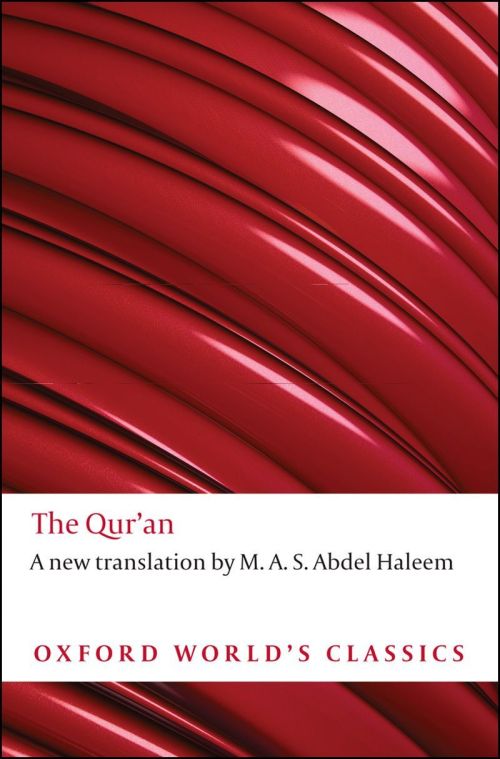
If you have an interest in seeing what the modern generation of Qur’an translations reads like, see M.A.S. Abdel Haleem’s The Qur’an: A New Translation (2005)
(from which the above excerpts are taken).

Don’t wait until next Yom Kippur. You don’t even need a holiday, Jewish or Christian. If you are of the non-Muslim Abrahamic persuasion, or even if you’re not persuaded at all, have a look at the Qur’an. You may believe in many respects besides religious—historical, social, cultural—that the Bible is one of the most important books in the world. You may also have to admit that in its impact, the Qur’an is its equal.

We hear regularly about how there are people killing for the Qur’an, or at least for their often misguided interpretations of it. Remember that there are also those trying to correct those interpretations, and they are dying for it.

Jonah, Yom Kippur, Iran and Irony

Mohsen Amir-Aslani

Sometimes coincidence is irony to the point of cruelty.

This week, the Book of Jonah is read as a part of the Yom Kippur service.

Last week, Iranian psychotherapist Mohsen Amir-Aslani was hanged for, among other things, insulting the prophet Jonah.

In a post last week, Jonah and the New Year, I gave free rein to biblical possibilities. I pointed out, “It is supposedly so simple a story that we tell it to the youngest children. It isn’t that simple.”

For many reasons, it is a good thing that I am not in Iran. It is also a good thing to be part of a faith and a country that not only tolerate interpretive iconoclasm but (theoretically) encourage and thrive on it. According to the report in The Guardian:

Mohsen Amir-Aslani was arrested nine years ago for his activities which the authorities deemed were heretical. He was engaged in psychotherapy but also led sessions reading and reciting the Qur’an and providing his own interpretations of the Islamic holy book, his family said….

According to the source, Iran’s ministry of intelligence was behind Amir-Aslani’s arrest. “He was initially held for making innovations in Islam and providing his own interpretations of the Qur’an but later he was accused of insulting prophet Jonah and also faced accusations of having sex outside marriage,”

This week, whether you read the Book of Jonah at Yom Kippur services or on your own, consider Amir-Aslani. We can do little directly about this aspect of Iranian life. And if we are not Muslims, there is little that we can do about the evolution of someone else’s religion, other than encouragement and modeling progressive behavior. The best we can do—and it is no small thing—is to honor openness in religion by demonstrating openness in our own religion. By supporting innovation, and making sure it is never tantamount to a capital crime.

Analogies to Egypt

Rosetta Stone

Who doesn’t love analytical analogies—situations past that bear a resemblance to current circumstances and might offer at least a little usable insight.

The current state of Egypt, like many situations in the new global age, is a bit sui generis—a unique thing of its own that we neither know how to classify or handle. For some, it is like going to watch a sports competition where you don’t exactly understand the game, don’t know nearly enough about the teams, and yet are being expected to choose sides—to root for somebody.

Here are a few of what we might call impressionistic analogies: examples from recent history that won’t withstand close scrutiny as directly related scenarios, but do have a certain similarity that at least gives us food for thought.

Iran – The impending release of Mubarek by the military government—ostensibly because the fraud case leading to his arrest would not hold up—brings to mind Iran and the last Shah. The Iranian Revolution of 1979 deposed the Shah and ended the West-friendly dynasty that the U.S. had long supported. One of the small but historically high-profile early incidents was President Jimmy Carter allowing the very ill Shah to seek medical help here in 1980—a factor in the subsequent hostage-taking, that in turn was (just one) of the reasons that Carter was not re-elected.

The U.S. is not alone in having to bet on somebody in turbulent times. Leaders are both real and symbolic in these contests. In Iran, our betting on the Shah—who was like us, who we understood, and who wss not like “them”—has proven disastrous. In the case of Mubarek in Egypt, what we wanted with him all those years was stability and moderation, but when it became apparent during the Arab Spring that we were looking decidedly anti-democratic, we opted to cut him loose and hope for democracy to follow. When that democracy started looking theocratic, possibly militantly so (Muslim Brotherhood), we were very confused and concerned—and so were the remnants of Mubarekism still in or near power. Military and stability or democracy and “adventure”. The Egyptian military made their decision, but we seem unable to decide. Will the military try to re-install Mubarek, or just leave him as a symbol of better days. Do we wish that we had handled Iran better, maybe helping to ease out the Shah and autocratic rule? It probably would not have prevented theocracy, but we didn’t try.

Iraq – Iraq, like Egypt, is another example of wanting to act strategically, while looking like the “good guy” and trying to figure out what a good guy looks like or acts like in these times. We supported Saddam Hussein, we refused to topple him, we toppled him, we executed him. All hell broke loose, and that fire may burn for generations. Whatever our skill at playing a real-world version of Risk globally, our track record in the Middle East is atrocious. At this point, we may want to consider where we stand relative to the historic record of the British and the French. (Note: We seem to have a bizarre predilection for following in their footsteps with little more, or even less, success than they had. See, e.g, Vietnam, Afghanistan, etc.)

Latin America – Our experiences in Latin America may serve as the most interesting of these tenuous analogies. The policy and history is easy to understand. We feared (still do) the incursion of Communism into the continent. We would support just about anybody who promised to keep the threat of socialism/Communism down. This put us in bed with a very bad lot, alliances that have had two lasting impacts. American fingerprints are all over the legacy of some despicable regimes. And now that many of those regimes are in the dustbin of history, residual anti-Americanism lingers on.

None of these alone, or even taken together, may offer much guidance in figuring out what to do in Egypt. Maybe a general lesson is that being powerful is not the same as being smart or being right. Maybe it’s that America is not as powerful as it thinks—back then, or even more so now—in a world it does not fully understand (again, ask the British and the French).

Egypt today is not that different from Egypt two years ago, or Syria now, or Iran or Iraq or Latin America. America has to expressly define and transparently decide how to stack our values and principles. Do we want American-style democracy or are we willing to settle for one of its other versions? Do we want democracy no matter what the results, or are we willing to trade democracy for authoritarian rule? Is authoritarian rule better than democratic or quasi-democratic Islamism, socialism or Communism? What is regional or global stability worth? What is peace worth? What is a Syrian or Egyptian or American life worth? Could billions in Egyptian aid, aside from whether or not we continue or suspend it, be better used to help Americans in an age of sequestration and austerity?

Grown up questions for grownups at the table.

Stamping Eid al-Adha


The relationship between American society and Islam is complicated.

At this point in history, there are few sentences that could be more absurdly understated. In so many spheres, that relationship is, to be polite, messed up beyond all reason.

There is a long and growing list of events and phenomena that contribute to and reflect those complications. How the world’s largest or second-largest religion (depending on accounting) became so toxic in the world’s most tolerant democracy is a story still being written. No doubt having a black President whose father was a Muslim, who spent part of his youth in the world’s most Muslim country, and whose middle name is Hussein is the latest part of that.

The Postal Service, out of a sense of decency and diversity and political realities, rushes in where others fear to tread. This is itself a complicated thing.

October 26 is Eid al-Adha (“Feast of the Sacrifice”), the major holiday on the Muslim calendar.

Islam shares many stories with its Abrahamic precursors, Judaism and Christianity, though some of the scripture is added to or modified. So it is with the story of Ibrahim (Abraham) and his son Ishmael (Isaac). Ibrahim and Ishmael are said to have built the Kaaba, the building in Mecca that is the centerpiece of the commanded pilgrimage—the hajj. Ibrahim was also told in a dream to sacrifice his son as a sign of obedience to Allah and, as in the Old Testament, was stopped only at the last moment when Ishmael was replaced by a sacrificial sheep.

Eid al-Adha marks the end of the annual pilgrimage and Ibrahim’s faithful near-sacrifice of his son. (For discussion elsewhere, the question of how this deep and fascinating father-son sacrifice in the Old Testament—see, e.g., Kierkegaard’s Fear and Trembling—is not on the Jewish calendar, but became such a central event of the Christian and Muslim calendars.)

Some think that the Postal Service should not be in the business of commemorating religious holidays and people, given the wall—the admittedly porous wall—between church and state. The Mother Teresa stamp issued in 2010 is just one of those flash points. The Postal Service explains:

Following the announcement of the Mother Teresa stamp, groups such as the Freedom from Religion Foundation objected to the Postal Service’s seeming violation of its own guidelines.

“We received numerous letters saying that we should not be doing religious stamps,” says Terry McCaffrey, manager of stamp development. “But we are honoring her for her humanitarian work, not for being a member of a religious order.”

After all, McCaffrey asks, to what extent should religious inspiration disqualify an otherwise worthy subject?

Over the years, many religious figures have been depicted on stamps in recognition of their contributions to society, independent of their personal motivations or beliefs. Stamp honorees have included Dr. Martin Luther King, Jr., for leading the struggle for civil rights, Father Edward Joseph Flanagan for his work with delinquent and homeless boys, and Padre Félix Varela for his advocacy for the immigrant poor.

Still, the signs of protest for Mother Teresa were stronger than with most stamps.

As for minority religions, the Postal Service shies away (but see Hanukkah below). No Buddhism, for example. Interestingly and somewhat surprisingly, the Postal Service did dip its toe in Mormon waters. In December 2005, it gave a nod to the 200th anniversary of Joseph Smith’s birth, not with a stamp, but with the much less substantial cancellation mark. Note below that the Postal Service did not issue this postcard; that is privately produced. The only government involvement is the cancellation mark. Also notable is that given it was holiday season, this postcard includes a Madonna stamp to go along with the Joseph Smith cancellation.

Holidays provide a little bit of cover for the Postal Service. Instead of unacceptably eliminating Christmas, the Postal Service went to religious inclusiveness and diversity. So we have a Hanukkah stamp for Judaism—even though Hannukah is a relatively minor holiday on the Jewish calendar.

A few years ago, we were offered a Muslim stamp for the Eid feasts:

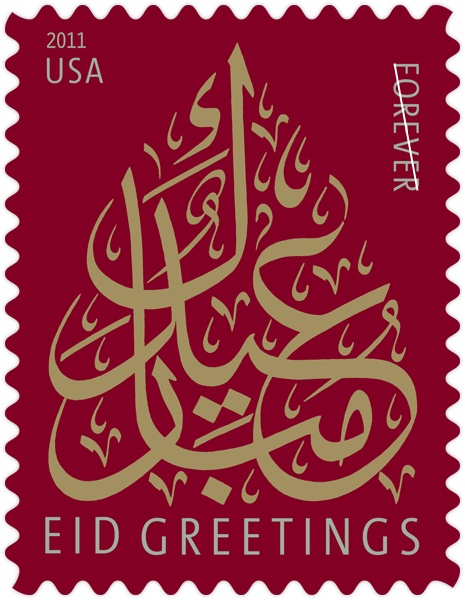
This stamp commemorates the two most important festivals — or eids — in the Islamic calendar: Eid al-Fitr and Eid al-Adha, and features the Arabic phrase “Eid mubarak” in gold calligraphy on a blue background. Eid mubarak translates literally as “blessed festival,” and can be paraphrased “May your religious holiday be blessed.”

Employing traditional methods and instruments to create this design, calligrapher Mohamed Zakariya of Arlington, VA, working under the direction of Phil Jordan of Falls Church, VA, chose a script known in Arabic as “thuluth” and in Turkish as “sulus.”

As shown above, the Postal Service modified the Eid stamp in 2011, keeping the exquisite calligraphy, changing the color from blue to red, and issuing it as a Forever® stamp:

The U.S. Postal Service® commemorates the two most important festivals — or eids — in the Islamic calendar: Eid al-Fitr and Eid al-Adha. On these days, Muslims wish each other Eid Mubarak, the phrase shown in calligraphy on the stamp. Eid Mubarak translates literally as “blessed festival” and can be paraphrased “May your religious holiday be blessed.” This Eid stamp features gold calligraphy against a reddish background.

Saying that the original Eid stamp was issued “a few years ago” is imprecise. It was actually issued on September 1, 2001—ten days before 9/11. It seems that this small step in the direction of recognition and tolerance got lost in some twisted history that as a country we are still trying to straighten out.

The stamp is available for purchase from the Postal Service. And even if you are not among the 1.7 billion people celebrating Eid al-Adha next week, it is still a beautiful addition to any piece of mail—and a beautiful statement.