Bob Schwartz

Tag: I Ching

Oreo I Ching

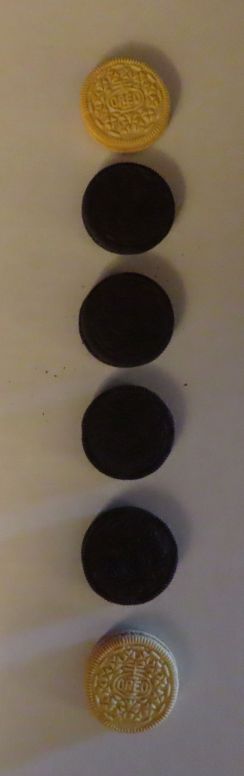
On the plate I saw my usual desert of four Oreos, two chocolate, two golden.

Binary, I thought. Dark and light. The digital universe is binary: zero and one. Morse code is binary: dot and dash.

The I Ching is binary: broken line (yin, dark) and solid line (yang, light). Six lines stacked, sixty-four combinations (hexagrams).

Instead of broken and solid lines, what if we stack six chocolate and golden Oreos? Oreo I Ching.

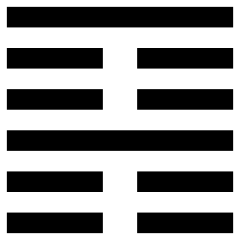
Which I did. The above picture represents Hexagram 27, Nourishing.


27
Yi • Nourishing

DECISION

Nourishing.
Being steadfast and upright: good fortune.
Watch your nourishment;
Pay attention to what is in your mouth.

SIGNIFICANCE

This gua outlines the principle of nourishing. In ancient times, the Chinese concept of nourishing included nurturing, especially nurturing one’s virtue. To the ancient Chinese, nourishing without nurturing was the way of animals. The revered sage Mencius says,

Filling with food,
Warming with clothes,
Living leisurely without learning,
It is little short of animals.


If you consult the I Ching, occasionally or regularly, consider using Oreos, or the cookies of your choice, to represent your hexagram. When you are done, you can enjoy a sweet treat along with the valuable advice.

© 2025 by Bob Schwartz

A new Passover tradition: Matzah oracle

On the first morning of Passover, I came across a book on using the letters of the Hebrew Bible as an oracle.

To be clear, oracles—the I Ching is a well-known example—don’t foretell particular outcomes in a detailed way, though that is one perspective. Instead, they open your mind to deeper visions of the questions you ask and the situations you are confronting.

The first morning of Passover is also a time to think about matzah, as in: What am I going to have for breakfast that includes matzah rather than bread?

That is the origin of the matzah oracle. The steps:

1. Put a sheet of matzah in a one-galloon storage bag.

2. Place the storage bag with the matzah on a hard surface, a table or the floor.

3. Ask your question or seek some insight.

4. Drop a heavy object on the storage bag. For my first oracle, I used a book, a 700-page commentary on the Torah. But it doesn’t have to be a book and it doesn’t have to relevant. Just something that will break the matzah into pieces but won’t obliterate it to total crumbs.

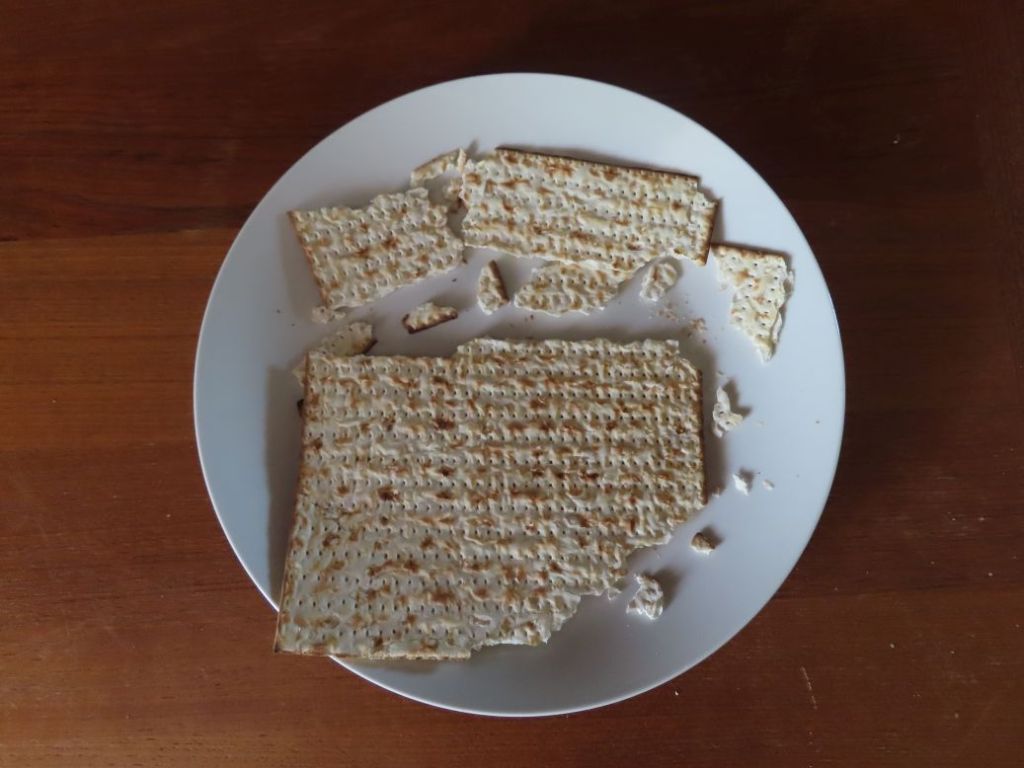
5. Remove the pieces to a plate so you can count them. The difference between a small piece and a crumb can be hard to determine. Don’t worry. Remember that this is an oracle to deepen your thinking, not a predictor, so it won’t matter.

6. Count the pieces. My first matzah oracle contained ten pieces, which corresponds to the letter Yud.

7. Find the Hebrew letter or combination of letters corresponding to that number. Here is a list:


א (Aleph)
1

ב (Bet)
2

ג (Gimel)
3

ד (Dalet)
4

ה (Heh)
5

ו (Vav)

6

ז (Zayin)
7

ח (Cheth)
8

ט (Teth)
9

י (Yud)
10

כ (Kaf)
20

ל (Lamed)
30

מ (Mem)
40

נ (Nun)
50

ס (Samech)
60

ע (Ayin)
70

פ (Peh)
80

צ (Tzaddi)
90

ק (Qof)
100

ר (Resh)
200

ש (Shin)

300

ת (Tav)
400


A number greater than ten requires a combination of letters, e.g., 12=Yud (10)+Bet (2).

This oracle is a work in progress, and I have a few ideas about how to deal with letter combinations. The simplest suggestion is to consider both letters. In the example above, consider both Yud and Bet.

Also, it is unlikely that the matzah oracle will generate all the letters. A piece of matzah that breaks into 400 pieces is likely a pile of crumbs. Maybe there are those committed enough to count all the crumbs.

8. Once you have a letter or letters, there are a number of books and countless websites devoted to the meaning of Hebrew letters—some more valuable than others.

Here are two books that offer thoughtful insights:

A New Oracle of Kabbalah: Mystical Teachings of the Hebrew Letters by Richard Seidman

The Wisdom in the Hebrew Alphabet by Michael Munk

Once you are done with the oracle, the matzah is available for eating. My suggestion, since the matzah is already in pieces, is to soak them in water, combine them with a beaten egg, and fry them into matzah brei, the best of all Passover breakfast dishes.

© 2025 by Bob Schwartz

I Ching about Trump tariffs on China

The I Ching, the venerable Book of Changes, is estimated to have first been composed around 1000 BCE. About 3,000 years ago.

The point is that China and its constituent states have been managing very complex and difficult governmental and social situations for millennia. Those who are leading contemporary China may face a lot of current challenges, as their ancestors have faced so many other challenges. They know their way around difficulties and difficult people. They have managed, starting in 1949, to build the world’s second largest economy. They have done it, by the way, paying close attention the I Ching. The Trump administration would do well to do the same.

Asking the I Ching about Trump tariffs on China it says:


52
Gen • Keeping Still

Mountain above
Mountain below

NAME AND STRUCTURE

The attribute of Mountain is stillness. When Mountain is doubled, it is extremely still.

From the very beginning of Chinese culture, ancient sages emphasized keeping still. Keeping still is not keeping merely the body still but the mind and spirit as well, and is called “sitting in stillness” or “nourishing the spirit.” While sitting still in a lotus posture, one is shaped like a mountain. Sitting in stillness, or in meditation as Westerners call it, is a self-disciplinary training. While doing this, one is able to control the mind and the breath, to be introspective about one’s shortcomings and to cultivate inner strength and virtue. Mencius says, “I am skillful in nourishing my imperishable noble spirit.” When one is in a state of stillness, one is oblivious to one’s surroundings. This is the highest stage of nonattachment. In such a state there is no fault in one’s being. It is believed that when Heaven is about to confer a great mission on a person, it first exercises his or her mind and spirit with discipline. Keeping still is meant to prepare one’s mind and spirit to progress when the time comes.

Commentary on the Decision

Mountain.
It is keeping still.

Keep still when it is time to keep still.
Remain active when it is time to remain active.
When action and resting do not miss their time,
Their way becomes promising and brilliant.

SIGNIFICANCE

Keeping Still expounds the truth of knowing when and where to stop before one’s action goes too far. The key to success is to advance when it is time to advance and to stop when it is time to stop. Every action should accord with the time and situation. Never act subjectively and blindly. Keeping still means to be tranquil and stable. It is a phase of advancement. Advance and stillness complement each other. Keeping still is preparing oneself for a new advance. All the lines of this gua take images of different parts of the body to indicate particular times and situations.

When King Wen abolished slavery and reestablished the Jing land system, people were shocked, as if a thunderstorm had struck. Those who were liberated were happy, but not the slave owners—especially those who were close to the tyrant. Dangerous counterattacks were anticipated. King Wen retreated, sitting in stillness to contemplate the situation and foresee the future. The Duke of Zhou describes King Wen’s different stages and moods of stillness. Eventually his honesty and sincerity brought good fortune.

The Complete I Ching, Master Alfred Huang


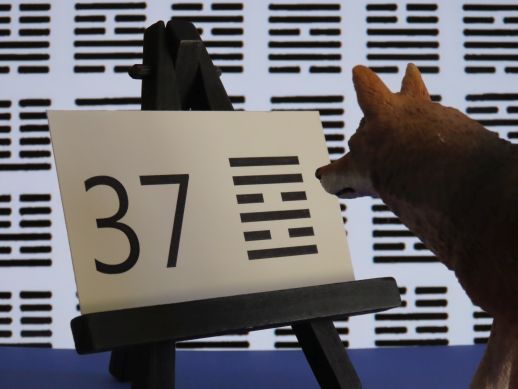
Coyote consults I Ching today: Country in harmony

37
Jia Ren • Household

The image of the gua is Wind above, Fire below. The wind springs forth from the fire. This gua symbolizes that the wind of harmony is fed by the flames of love….

The ancient sages always applied the principle of managing a household to governing a country. In their view, a country was simply a big household. With the spirit of sincerity and mutual love, one is able to create a harmonious situation anywhere, in any circumstance.

Master Alfred Huang, The Complete I Ching

I Ching Election Non-Prediction: Watching (Hexagram 20)

“There are two aspects of watching, subjective and objective. Subjective watching deals with one’s self; it is to examine one’s inner motives. Objective watching deals with others; it is to watch others’ reactions to one’s conduct. The wisdom of watching is like looking at a mirror, checking one’s original intention and outward conduct.”

The I Ching/Yijing can’t predict the election.

The pollsters can’t predict the election.

The political experts can’t predict the election.

The difference is that the I Ching embodies centuries of human affairs and history. Which makes it wise, wiser than the pollsters, the political experts, and us.

Primary is its wisdom that everything changes. One line changing to its opposite. Hexagrams changing one to another. Randomly but not randomly. People choose and change what happens. It begins with Creation (Hexagram 1). It almost ends with After Completion (Hexagram 63). But it ends with Before Completion (Hexagram 64). As if it is going to start all over again. Which it always has and will.

Q: What will be the outcome of the 2024 U.S. election?

A: Hexagram 20

Guan • Watching

NAME AND STRUCTURE

Guan means watching, observing, examining, contemplating….

Sequence of the Gua: When things become great, they require careful attention. Thus, after Approaching, Watching follows.

In China a Taoist temple is termed Tao Guan; literally it is “a place for watching the Tao.” The esoteric secret of Taoist meditation is watching—watching the breath, or the flowing of energy, or nothing. The purpose of watching is keeping alert. While chanting or reciting scriptures both Buddhist and Taoist monks beat wooden fish rhythmically. Because fish never close their eyes, the wooden fish remind one to stay alert. The Chinese name for Avalokiteshvara (an incarnation of the Buddha) is Guan-yin. Guan-yin means watching (guan) the sound (yin). To the Chinese, contemplation is watching; contemplative watching is focusing on one point and being attentive. During meditation, the sect that worships Guan-yin watches the sound either inside or outside the body. Watching the sound but not getting caught up in it, one is totally detached from the world. This gua not only sheds light on meditation but also expounds the truth that people should always keep their eyes open, watching the virtue of a leader. Thus a leader should always be sensitive to morality and justice and manifest these qualities to his people….

SIGNIFICANCE

The theme of the gua is to demonstrate the wisdom of watching. There are two aspects of watching, subjective and objective. Subjective watching deals with one’s self; it is to examine one’s inner motives. Objective watching deals with others; it is to watch others’ reactions to one’s conduct. The wisdom of watching is like looking at a mirror, checking one’s original intention and outward conduct. The ancient sages believed that inner sincerity is always revealed through one’s conduct.

The Complete I Ching: The Definitive Translation by Taoist Master Alfred Huang

Some of my tools

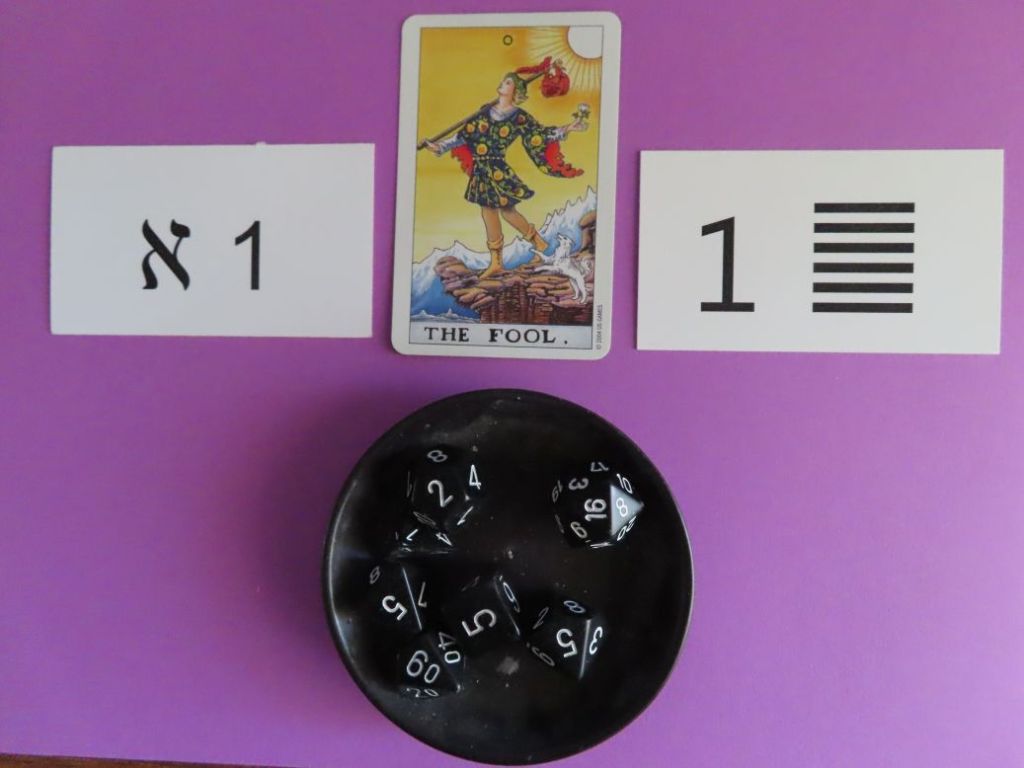
Above is a photo of some of my tools, representations of some of my tools. Tools for living.

Why tools?

Tools of all kinds are how we live. If you think of tools as enablers, everything can be thought of as a tool. (Thinking of things as tools rather than just themselves is a matter for much deeper exploration not here.)

Why just some?

Over time, I’ve discovered and used a number of tools for living, of which these represent only a few. Some are too big to include in a simple small photo. Some are not easy to picture.

Why not stick to a limited number of tools, maybe just one?

One genius item from Buddha is the idea of upaya, skillful and expedient means. Things that move us along, sideways, or up are appropriate to the moment, what things are like in the moment, who we are in the moment, all of which is changing, whether we like it or not, whether we want it or not. The tool for now is the tool for now. When we have a nail we need a hammer, when we have a screw we need a screwdriver.

What are these particular tools?

Hebrew letter cards: Hebrew letters make up not only the words of the Torah but, according to one view, all of creation. In the system of gematria, each letter is assigned a numeric and religious interpretive value.

Tarot cards: Contrary to a view that Tarot is the frivolous pastime of amateur soothsayers, it is a well-developed tool of inspection and introspection.

I Ching cards: In terms of historic and cultural influence, the I Ching (pronounced yijing) rivals the Bible. It has been my constant wisdom companion for decades.

Dice: Gregory Bateson said that inside his holy of holies he would have a random number table. We get attached—over attached—to beliefs, especially belief in our own power. One way out of this trap is to adhere to a belief in chance. Chance may be uplifting, humbling or devastating. Besides generating random numbers for use in other divinations, a dish of dice is a reminder of how things really work.

© 2024 by Bob Schwartz

I Ching Pandemic Edition: Hexagram 13 – Seeking Harmony

An ancient Chinese maxim says, “People in the same boat help each other, sharing weal and woe.”

I have been regularly consulting the I Ching during these strange days. The I Ching embodies the wisdom of thousands of years, from a civilization that has seen it all. Bright days and dark, order and chaos, wise men and fools, humility and arrogance, life and death. They have learned that we do not escape the truth of everything changes.

This is what the I Ching says today.


The Complete I Ching: The Definitive Translation by Taoist Master Alfred Huang

HEXAGRAM 13

TONG REN • SEEKING HARMONY

NAME AND STRUCTURE

Wilhelm translates Tong Ren as Fellowship with Men, and Blofeld translates it as Lovers, Beloved, Friends, Like-Minded Persons, Universal Brotherhood. In Chinese, tong means similar, alike, the same. Ren means person or people. When the two characters are put together as a unit, it means to treat people alike. In ancient China, tong ren also meant people with the same interests. Herein, Tong Ren is translated as Seeking Harmony. It has the connotation of forming alliances. To break through a tough situation, people need to work together in harmony, as in an alliance.

The ideograph of the first character, tong, consists of three parts. The first part looks like an upright rectangle without the bottom line, symbolizing a door frame or a house. Within the house, there is a single horizontal stroke representing the number one. Underneath this is a little square symbolizing a mouth. In ancient China, people were counted by mouths. For instance, if someone wanted to know how many people there were in your family, they would ask “How many mouths are there in your family?” The three parts of the ideograph come together to depict a group of people gathered together as a single unit. Here, the mouth indicates that they are thinking or speaking as one. The Chinese can feel the harmony in the group. The ideograph of the second character, ren, suggests a person standing.

SEQUENCE OF THE GUA: Events cannot remain hindered; thus, after Hindrance, Seeking Harmony follows.

The image of this gua is Heaven above, Fire below. Heaven suggests ascension. The flame of fire moves upward. Fire approaching Heaven gives an image of people with the same interests working together in harmony. There is only one yielding line, at the second place. The ancient sage saw this as a picture of harmony; the one at the second place treated the other five elements at different places equally, with the same attitude. An ancient Chinese maxim says, “People in the same boat help each other, sharing weal and woe.”

According to the I Ching, however, there is no absolute sameness. The ancient sages passed on the secret of obtaining harmony, that is, seeking common ground on major issues while reserving differences on minor ones. Tong Ren teaches that the wise classify people according to their natures, not for the purpose of treating them differently, but to seek common ground. If there is common ground, each one is able to act in harmony with the others. The ancient Chinese dreamed day and night that the world would belong to the majority and the government would serve the common interest of its countrymen. This is Seeking Harmony.

DECISION

Seeking harmony among people,
Prosperous and smooth.
Favorable to cross great rivers.
Favorable for the superior person
To be steadfast and upright.

COMMENTARY ON THE DECISON

Seeking Harmony.
The yielding obtains the proper place.
It is central
And corresponds with Qian, the Initiating.
This is Seeking Harmony.

Seeking Harmony says:
Seeking harmony among people.
Prosperous and smooth.
Favorable to cross great rivers.
It is because Qian, the Initiating,
Is progressing and advancing.

Brilliance with strength,
Central and corresponding.
This is the correct way for the superior person.
Only the superior person is able
To convey the wills of all under Heaven.

COMMENTARY ON THE SYMBOL

Heaven with Fire.
An image of Seeking Harmony.
In correspondence with this,
The superior person makes classifications of people
According to their natures
And makes distinctions of things
In terms of their categories.

SIGNIFICANCE

The Decision says, “Seeking harmony among people.” This is the main theme of the gua. Seeking harmony should be done with absolute unselfishness and among the majority. This was the ancient lofty ideal of a world of harmony. Seeking harmony among people, in Chinese, is tong ren yü ye. Tong ren means seeking harmony. Yü means at, in, or among. And ye is the place beyond the suburbs. Thus, most English translations give ye as “the open.” However, ye also means the folk or the people, as contrasted with the government. Considering the theme of this gua, it is more suitable to employ people for ye. In this way, it brings more sense to the Decision: “Seeking harmony among people. Prosperous and smooth.”

The outer gua is Qian (Heaven), symbolizing firmness and strength. With this quality, it is favorable for a person to cross great rivers, to overcome difficulties. The inner gua is Li (Fire), symbolizing a quality of inner brightness. In this situation, the host is the yielding line at the second place. It plays a leading role. It is a yin element at a yin place, central and correct. Thus, Confucius’s Commentary on the Decision explains that the yielding obtains the proper place and corresponds with Qian. This yin line in the center of the lower gua indicates that one at this place possesses a high morality and is gentle and sincere, humble and modest, and willing to seek harmony with other people. It corresponds to the solid line at the fifth place, which is also central and correct. These two lines symbolize an ideal condition where the time is auspicious, the situation is favorable, and the people are in harmony. This ideal situation results from the circumstance of overcoming hindrance.

Tong Ren reveals the truth that if people deal with each other in a spirit of equality, then peace and advancement are possible. Otherwise, there will be conflict and obstruction. The first three lines of this gua represent the fact that from sameness differences originate. The next three lines tell us that sameness derives from differences. Thus, at the fifth line, people are at first weeping and full of regret and then laughing to celebrate the victory. In ancient times, people called the piping time of peace the Great Harmony.

This gua symbolizes the historical incident in which King Wen formed alliances with neighboring clans to battle the rebellious Rong clan. King Wen proclaimed that seeking harmony with people of other clans would be prosperous and smooth. The Duke of Zhou recounts how there was no hindrance in seeking alliances with different clans, yet seeking alliances exclusively within his own clan caused isolation and brought about unfavorable results. At the very beginning, the alliance took defensive action by placing troops on a high hill and hiding fighters in the bushes. For three years there was no trouble. Later, the alliance besieged Rong’s city walls. After great struggles it was victorious. What began with weeping ended with laughing. At last, the alliance gathered in Zhou’s countryside. There was no regret about the struggles that resulted in success.
The binary and the infinite: What we learn from computers, the I Ching, the Bible and breathing.

We live today and have long lived in what seems to us, at first glance, a binary world. So it seems.

At their most basic, computers are binary machines. Countless combinations of yes/no, on/off decision circuits, adding up, as speed and the number of decisions increase exponentially, to processes that mimic (or exceed) human thought.

The I Ching begins its panoramic presentation of world with a simple binary calculation: either a solid yang line or a broken yin line, combined into eight trigrams and sixty-four hexagrams, from which the entire nature of life and time is profiled, if not actually predicted.

Traditions, such as Taoism, Zen and others, suggest non-duality. That reality exists between those choices we are so attached to. That it is not either/or, not neither/nor. Computers agree. Reduced to each of the billions of digital decisions, binary means nothing. The I Ching reduced to a single line means little. The meanings, all of them, are in the matrix of combinations.

The Bible agrees. It would seem, in its rules and lists, to promote binary behavior. The Ten Commandments are a prime example. But at the literal first moment, if we immerse ourselves in the question of what is between existence and non-existence at creation (contemplation that according to one legendary interpretation drove the Talmudist Ben Zoma crazy), the answer may be everything. The Book of Ecclesiastes, famous for saying that all is ephemeral vapor and listing the binary poles (a time to laugh, a time to weep…), is telling us we live now and ever in the changes in between. Not unlike the I Ching.

Physics has also given up on the binary. Simplistic analysis has given way to acknowledgement that as much as we would like to hold on to a concept of this or that, now or then, the physical world at a foundational level exists in simultaneous multiple states.

Not everything about our organic human lives is binary, but plenty of it is. Ten has its place (fingers, toes), but a distinct second place to two. Two arms and hands, legs and feet, eyes, ears, lungs.

Lungs bring us to breathing, the penultimate binary. Inhale, exhale. There is nothing in between. The failure of that binary leads to the ultimate: life, death. Some do posit an alternative to that binary, a third option. But if we just stick to life/death, what do we learn about either one from this discussion of binary?

Things as they are are not exactly binary, except we make them so. This doesn’t mean that one can think away breathing or death. No inhale/exhale, no life happens. But the values in between—the digital fabric, the I Ching, the space between existence and non-existence, the time between laughing and weeping, the quantum states—are where it is at.

Brightness (Li)

Hexagram 30


Li • Brightness

The structure of the gua is Fire above, Fire below. The attribute of Fire is attachment as well as brightness. When two Fire gua are combined, the Brightness is doubled. During times of darkness and danger people should cling to one another. When they do, things get brighter.

Decision

Brightness.
Favorable to be steadfast and upright.
Prosperous and smooth.

SIGNIFICANCE

The attribute of Li is brightness, which symbolizes intelligence and wisdom. Being embarrassed by unresolved problems feels like falling into darkness. Finding a solution is compared to a light that casts out the darkness. This gua, Brightness, sheds light upon the distinction between right and wrong. If one’s attitude is not sincere and wholehearted, one is not able to distinguish between what is appropriate and what is inappropriate.

Master Alfred Huang, The Complete I Ching


Li • Radiance

Inexhaustible and penetrating everywhere, radiance brings forth wild bounty. Nurture it like the docile strength of an ox, and good fortune will prevail.

Radiance is all beauty, beauty of heaven’s sun and moon, beauty of the land’s hundred grains and grasses and trees.

Sun and moon, fire and fire—using the beauty at the hinge of things, they transform and perfect all beneath heaven. And because the tender assent of this beauty is centered at the very hinge of things, it penetrates everywhere. And so: nurture it like the docile strength of an ox, and good fortune will prevail.

David Hinton, I Ching: The Book of Change


Li • Fire

Sun and Moon
Are attached to Heaven.
The Hundred Grains,
The grasses and trees,
Are attached to Earth,
To the soil.
Double Brightness
Is attached to Truth,
Truth
Which transforms and perfects
All-under-Heaven.

This Hexagram is formed by doubling the Li Trigram: Fire, Light, and Sun: also warmth, radiance, and clarity; Outer and Inner Illumination; and Attachment.

What is Illumination? It is the ability to see “with continuous clarity” the original Strength or Essence of things. This Vision itself comes from Inner Strength, from Sincerity at the Center of Being, reaching out and connecting with the outside, with “the Four Quarters.” Nothing can deceive it. It sees things as they are. It sees that everything, everywhere, to left and right, is the Tao, Connected, Attached. Illumination itself spreads like Fire. It is a chain reaction. Fire is not a substance, it is an event, an interaction.

John Minford, I Ching: The Book of Change


Li • The Clinging, Fire

What is dark clings to what is light and so enhances the brightness of the latter. A luminous thing giving out light must have within itself something that perseveres; otherwise it will in time burn itself out. Everything that gives light is dependent on something to which it clings, in order that it may continue to shine.

Thus sun and moon cling to heaven, and grain, grass, and trees cling to the earth. So too the twofold clarity of the dedicated man clings to what is right and thereby can shape the world. Human life on earth is conditioned and unfree, and when man recognizes this limitation and makes himself dependent upon the harmonious and beneficent forces of the cosmos, he achieves success. The cow is the symbol of extreme docility. By cultivating in himself an attitude of compliance and voluntary dependence, man acquires clarity without sharpness and finds his place in the world.

Each of the two trigrams represents the sun in the course of a day. The two together represent the repeated movement of the sun, the function of light with respect to time. The great man continues the work of nature in the human world. Through the clarity of his nature he causes the light to spread farther and farther and to penetrate the nature of man ever more deeply.

Wilhelm/Banes, The I Ching or Book of Changes

The I Ching on Hardship

The ancient sages experienced the hardship of climbing a mountain as well as crossing a river. They also experienced all kinds of hardship in their life journey. Some hardships were avoidable, but others were unavoidable. If one has the right attitude, no matter what kind of hardships there are, they can be overcome….If it is not the right time to overcome hardship, one should keep still. Keeping still does not mean giving up. It is just yielding to the situation and waiting for a more auspicious time.
Alfred Huang, The Complete I Ching, Hexagram 39

There are so many sincere, good-hearted and helpful messages being generated at this sad moment of some very public suicides. There is no need for me to add my own thoughts.

But I did wonder if the I Ching, that trusted well of wisdom, might have something to say. It never fails; it didn’t this time.

In answer to the question of suicide, the answer was Hexagram 39—Jian/Hardship.


39
Jian/Hardship

NAME AND STRUCTURE

Originally, Jian meant lame or a lame person. From lame, its meaning extends to encompass difficulty in walking or hardship. Wilhelm translates Jian as obstruction; Blofeld translates it as Trouble. In this book I use Hardship.

Sequence of the Gua: If there is misunderstanding and diversity in a household, surely hardship will result. Thus, after Diversity, Hardship follows.

The ideograph of the gua shows its original meaning—a lame person having difficulty walking. At the top of the ideograph is the roof of a house with a chimney. Below it there is an ideograph of a person, ren. Between the roof and the person, there are two bundles of grass, representing bedding. These images form the upper part of the ideograph: a picture of a person under the roof of a house covered with two pieces of thick bedding to resist the cold. At the bottom, there is an ideograph of a foot. On each side of the foot and underneath the person a pair of crutches is drawn. One can visualize the crutches under the armpits of the person with a lame leg. The blood circulation of a lame leg is poor, thus the image of a cold foot was used to demonstrate a lame person’s difficulty with walking.

The structure of the gua is Water above, Mountain below. It represents a situation of hardship following hardship. Climbing a mountain and crossing a river are arduous undertakings. The attribute of Water is darkness and of Mountain is keeping still. If it is not the right time to overcome hardship, one should keep still. Keeping still does not mean giving up. It is just yielding to the situation and waiting for a more auspicious time. If the proper time comes, it is favorable to seek union or to consult a noble person for constructive advice. Any premature advance will entail risk. Overcoming hardship depends on the correct time, situation, and companions—in Chinese terms Heaven, earth, and human beings, the three primary elements….

Decision

Hardship.
Favorable to the southwest.
Unfavorable to the northeast.
Favorable to see a great person. Being steadfast and upright: good fortune.

Commentary on the Decision

Jian is Hardship.
Danger in front.
Seeing the danger and knowing to stand still,
Being conscious and wise.

Hardship.
Favorable in the southwest.
Going forward obtains the central place.
Unfavorable in the northeast.
There is no way out.

Favorable to see a great person;
Going forward, there is achievement.

Proper position,
Being steadfast and upright,
Good fortune,
Rectifying the country.
Great indeed is the function and time of hardship!

Commentary on the Symbol

Water on the Mountain.
An image of Hardship.
In correspondence with this,
The superior person is introspective to cultivate his virtue.

SIGNIFICANCE

Water above Mountain is an image of hardship following hardship. There is no way to totally avoid hardship in one’s life. Hardship should be overcome; calamity can be prevented. One should not always let things take their own course and resign oneself to one’s fate. This gua tells us how to deal with hardship. The ancient sages experienced the hardship of climbing a mountain as well as crossing a river. They also experienced all kinds of hardship in their life journey. Some hardships were avoidable, but others were unavoidable. If one has the right attitude, no matter what kind of hardships there are, they can be overcome.