Koyaanisqatsi
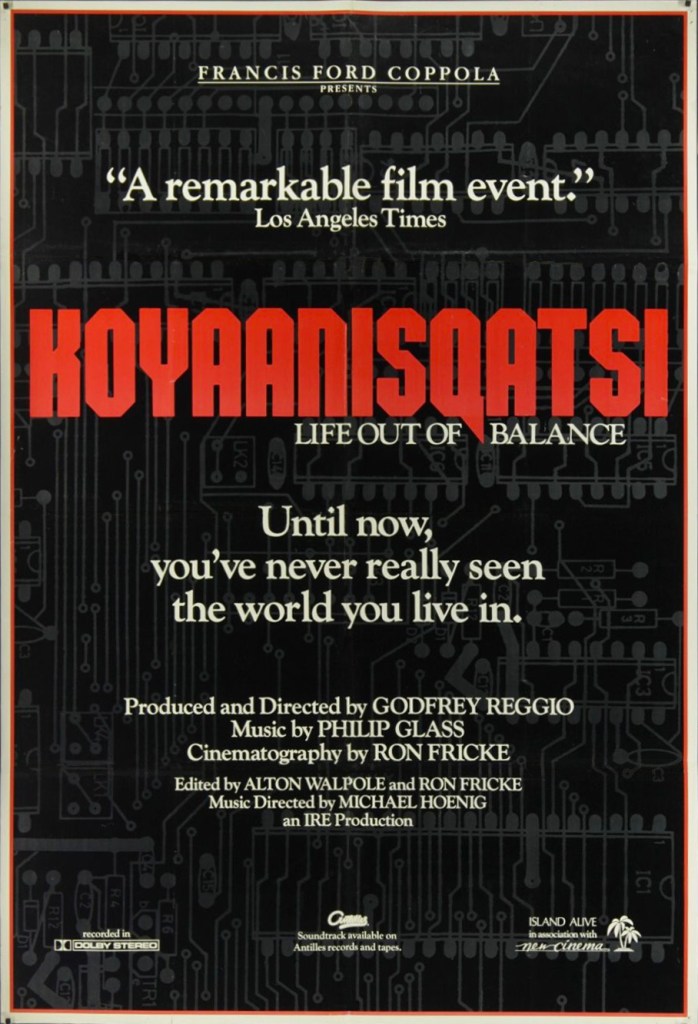
It is tempting to say that Koyaanisqatsi (1983) is THE film to envision 2026 and this modern world. To adapt the cliché “this changes everything”, this changes how you see everything. These days there is a lot to see.
You may find the people and technology pictured outdated and old school. You may find the visual and cinematic techniques unamazing, since these have advanced more than forty years. Not only is the creativity here timeless, but the Hopi, whose word for “life out of balance” gave the film its title, have been here for 2,000 years, perhaps more. The essential never ages.
Koyaanisqatsi is widely available to stream for free.
Koyaanisqatsi
An unconventional work in every way, Godfrey Reggio’s Koyaanisqatsi was nevertheless a sensation when it was released in 1983. This first work of The Qatsi Trilogy wordlessly surveys the rapidly changing environments of the Northern Hemisphere, in an astonishing collage created by the director, cinematographer Ron Fricke, and composer Philip Glass. It shuttles viewers from one jaw-dropping vision to the next, moving from images of untouched nature to others depicting human beings’ increasing dependence on technology. Koyaanisqatsi’s heterodox methods (including hypnotic time-lapse photography) make it a look at our world from a truly unique angle.
–Criterion Collection
Koyaanisqatsi
In Arizona, the wall of a canyon is adorned with artwork created by Hopi Indians. Clouds travel across a mountain range, followed by aerial views of a waterfall and a calm ocean. Elsewhere, the land is marred by strip mining, land movers, oil pipelines, electrical towers, factories, dams, oil derricks, and nuclear weapons tests. On the California coast, tourists sunbathe in the shadow of an oil refinery. Automobiles crowd freeways, and appear as if they are traveling alongside a large airliner. Fighter planes drop bombs, a missile is launched from a silo, a fleet of aircraft carriers sail the ocean, and explosions occur around various machines of war. In New York City, modern skyscrapers contrast with decaying apartment buildings, which are ultimately demolished. A cloud of polluted air covers the city. People clutter the streets, hemmed in by enormous structures and surrounded by advertising. A fighter pilot stands proudly next to his jet plane, and a group of waitresses pose in front of the Las Vegas, Nevada, casino where they are employed. Automobile and foot traffic move rapidly through cityscapes. At an Oscar Meyer processing plant, thousands of wieners roll off an assembly line. People play video games, go bowling, and file in and out of a diner. Inside an automobile assembly plant, humans work alongside machines as cars are built in rapid succession. At a department store, a mother and her two children stand in front of a display of television sets. Elsewhere, a performance artist detonates an explosive charge underneath a pile of old televisions. Dancers in a discotheque are juxtaposed with high-speed traffic. In various American cities, people go about their lives as police and firemen attend to victims of crime and disaster. In Florida, a rocket explodes shortly after lift-off, and the burning nosecone falls slowly toward earth. Back in Arizona, the Hopi artwork still adorns the canyon wall.
–American Film Institute
 Bob Schwartz