Bob Schwartz

Tag: Holidays

American Freedom Seder 2017: Where There’s a Pharaoh There’s a Wilderness

It is still a while until Passover (evening of April 10), but not too early to recommend holding or attending a Freedom Seder this year. Recommended for all people—even if you’re not Jewish, even if you’re not religious. All that’s needed is faith in freedom.

Freedom Seders are a tradition that began in the 1960s, relating the Passover journey to other struggles—race, gender, justice, war, etc. It may be a long way and a long time from Egypt to the Promised Land. But we can get there.

It’s possible you believe there are some special struggles going on right now in America. Which would make it a good time to gather with like-minded friends and family, brothers and sisters, and as a community share a meal and recall that the struggle is never easy or short (and might include some flat, dry bread), but that there is a better nation at the end of the journey. One hopeful, undiscouraged step at a time.

Only Candles Only Stars


Stars

Only Candles Only Stars

Let there be lights (מארת) in the vault of the heavens … and they shall be lights (מאורת) in the vault of the heavens (Genesis 1:14-16)

All of the lights
On the candles, trees, houses
Beneficial artifice
The best we can do.
Even the stars
Awakening guiding
Are incomplete.

The light that eludes
In the dark cold of winter
Hiding in plain sight.

Bodhi Day Riddle: Fig Newtons

Fig Newtons

Here is a riddle for Buddhists, scientists, cookie lovers or anyone else who likes a challenge:

Why should Fig Newtons be the official cookie of Bodhi Day, the day of the Buddha’s enlightenment?

(For more serious posts about Bodhi Day, see here and here.)

Bodhi Day: The Ancient Path

buddhas-of-the-celestial-gallery

“This was the third true knowledge attained by me in the last watch of the night. Ignorance was banished and true knowledge arose, darkness was banished and light arose, as happens in one who dwells diligent, ardent, and resolute.”

“Suppose, monks, a man wandering through a forest would see an ancient path, an ancient road traveled upon by people in the past. He would follow it and would see an ancient city, an ancient capital that had been inhabited by people in the past, with parks, groves, ponds, and ramparts, a delightful place. Then the man would inform the king or a royal minister: ‘Sire, know that while wandering through the forest I saw an ancient path, an ancient road traveled upon by people in the past. I followed it and saw an ancient city, an ancient capital that had been inhabited by people in the past, with parks, groves, ponds, and ramparts, a delightful place. Renovate that city, sire!’ Then the king or the royal minister would renovate the city, and some time later that city would become successful and prosperous, well populated, filled with people, attained to growth and expansion.”

“So too, monks, I saw the ancient path, the ancient road traveled by the Perfectly Enlightened Ones of the past. And what is that ancient path, that ancient road? It is just this Noble Eightfold Path; that is, right view, right intention, right speech, right action, right livelihood, right effort, right mindfulness, right concentration. I followed that path and by doing so I have directly known aging-and-death, its origin, its cessation, and the way leading to its cessation. I have directly known birth … existence … clinging … craving … feeling … contact … the six sense bases … name-and-form … consciousness … volitional formations, their origin, their cessation, and the way leading to their cessation. Having directly known them, I have explained them to the monks, the nuns, the male lay followers, and the female lay followers. This spiritual life, monks, has become successful and prosperous, extended, popular, widespread, well proclaimed among devas and humans.”

Saṃyutta Nikāya 12:65; II 104–7
In the Buddha’s Words: An Anthology of Discourses from the Pali Canon

Right Trees (Bodhi Day)

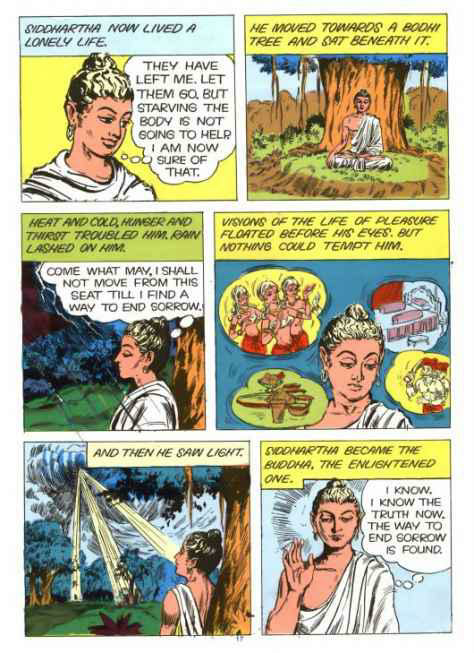
buddha-comic-enlightenment

December 8 is Bodhi Day, known in Japan as Rohatsu, the day of the Buddha’s enlightenment.  

Right Trees (Bodhi Day)

Which tree
To sit under?
Study each one
Counting branches
Inspecting leaves.
Is the ground
Too soft or wet
The shade
Too dark?
Who can deny
The forest
Yet it shrinks
To dust
On a distant shore.
The moon and
The morning star
Are just enough light
To brighten the night
Waking to find
This tree
All trees
Are right.

I wondered how the Buddha knew which tree to sit under for that consequential meditation. An easy answer is that it didn’t matter, that any tree or all trees would do. Another answer is that it didn’t have to be a tree at all. Another of the infinite answers is that there was no tree, no moon or morning star, no sitting. Just waking up.

Lincoln Proclaims Thanksgiving: “Penitence for our national perverseness”

“Thanksgiving-Day,” by Thomas Nast, Harper’s Weekly, December 5, 1863.

“Thanksgiving-Day,” by Thomas Nast, Harper’s Weekly, December 5, 1863.

The modern Thanksgiving holiday begins with Abraham Lincoln issuing a Thanksgiving Day proclamation on October 3, 1863, at the height of the Civil War.

At that point, America was a country of two cultures; in fact, of two nations at war. Even history was the subject of dispute. The North traced our national origin to the Puritans of New England, thus Thanksgiving was their American holiday. The South believed America began with the settlement of Jamestown, Virginia.

In his proclamation, Lincoln calls for healing and for “peace, harmony, tranquillity, and union.” In terms of union, however, it isn’t clear who Lincoln refers to when he asks for “humble penitence for our national perverseness and disobedience.” Exactly who has been perverse and disobedient?

One thing is clear. Even with all his divine pleas, Lincoln calls this conflict of principles and cultures inevitable—“the lamentable civil strife in which we are unavoidably engaged.”

Lincoln held a famously and understandably dark view of his American times, shaded by realities and by his own depressive personality. We can and should take a brighter view this Thanksgiving, having come so far from the America of 1863, and having much to be thankful for. But just as we repeat his call for “peace, harmony, tranquillity” we are remiss to ignore the realities of 2016. Like Lincoln, we should be big, open and wise enough to see things as they are, and to change them as needed, always being painfully aware of the cost.

From his proclamation:

It has seemed to me fit and proper that they should be solemnly, reverently, and gratefully acknowledged as with one heart and one voice by the whole American people. I do, therefore, invite my fellow-citizens in every part of the United States, and also those who are at sea, and those who are sojourning in foreign lands, to set apart and observe the last Thursday of November next as a Day of Thanksgiving and Prayer to our beneficent Father who dwelleth in the heavens. And I recommend to them that, while offering up the ascriptions justly due to Him for such singular deliverances and blessings, they do also, with humble penitence for our national perverseness and disobedience, commend to His tender care all those who have become widows, orphans, mourners, or sufferers in the lamentable civil strife in which we are unavoidably engaged, and fervently implore the interposition of the Almighty hand to heal the wounds of the nation, and to restore it, as soon as may be consistent with the Divine purposes, to the full enjoyment of peace, harmony, tranquillity, and union.

Veterans Day and Operation Unite America

veterans-day

Friday, November 11 is Veterans Day, which this year arrives during the same week as Election Day (you remember that day, don’t you?)

The great Iraq and Afghanistan Veterans of America (IAVA) has organized Operation Unite America:

Veterans Day 2016 is just 3 days after Election Day. Join IAVA’s campaign to do the impossible: bring together all Americans.

After a long, brutal and disgusting election season, everyone’s had it. It hasn’t been a good look for America. Everyone is exhausted–many are outright embarrassed. But Republican, Democrat, Independent, Other…we’re ALL sick of the bickering, the commercials, the debates, the politics, the fighting.

Here is your mission (if you choose to accept it!), JOIN US:

Tag your Veterans Day activities on social media with #veteransday

Donate $11 to IAVA to help us support veterans

Attend a #veteransday #VetTogether


tammy-duckworth

In the wake of Election Day, it is happy news to report that Rep. Tammy Duckworth of Illinois won a seat in the U.S. Senate. She is an Iraq War veteran, awarded the Purple Heart after losing both her legs. She joins a number of women warriors in Congress, which needs more women and more experienced warriors who know how to choose our wars carefully. And who will take good care of other warriors when they come home.

Yom Kippur Lesser Hits

I see that a few of my older posts about the Days of Awe/High Holy Days are being read now. This is a gratifying, considering that when I read them myself, I am not all that happy with them (the writer’s curse).

It gave me the idea that maybe instead of writing something new about this Yom Kippur, which begins this evening, I would instead include links to some of the past posts.

For those who are Jewish and fasting, may you have an easy fast. For those who are not Jewish or not fasting, no worries. The opportunity to contemplate our lives is open every day to everyone, no matter who you are, no matter what you eat, or don’t.

Yom Kippur and Job

“Whether this is a day of reflection and fasting, reciting centuries-old prayers, or an ordinary day of work or study, managing others or being managed; whether you are Job beset by unexplained misfortune, or Job’s wife, ready to kill him if he doesn’t kill himself, or Job’s friends so quick with advice; whether you are being punished by God, Satan, or whatever other forces you believe are working against you; whether you are the smartest person in the room or not; this is what we can do, even if there is seemingly no comfort in it: Be awed. Be humble.”

Yom Kippur: A Serious Day for a Serious Man

“The movie closes with a note taken straight from the Book of Job. A tornado approaches. Will it be the voice of God out of the whirlwind? Or will it just be one more inexplicable disaster, one more serious touch of uncertainty? Who knows? Yom Kippur and every day, listen to Rabbi Marshak: Be a good girl or boy.”

Yom Kippur: Beyond the Self

“The tradition says that the Book of Life is open during the Ten Days of Awe. When the holy days end with Yom Kippur, the Day of Atonement, when the shofar sounds, the book closes and our lives will have been written for the next year. But the book is always open.”

Jonah, Yom Kippur, Iran and Irony

“Last week, Iranian psychotherapist Mohsen Amir-Aslani was hanged for, among other things, insulting the prophet Jonah.”

Why I Read the Qur’an This Yom Kippur

“You may believe in many respects besides religious—historical, social, cultural—that the Bible is one of the most important books in the world. You may also have to admit that in its impact, the Qur’an is its equal.”

Days of Random Awe – Day 4: Koheleth/Ecclesiastes 11

Utter futility!—said Koheleth—
Utter futility! All is futile!
Koheleth/Ecclesiastes 1:2 (New Jewish Publication Society translation)

The random chapter of Tanakh for this Day 4 of the Days of Awe is from the Book of Ecclesiastes, known in Hebrew by the name of the sage it is attributed to, Koheleth.

This book is unique in the Tanakh and uniquely troublesome for some rabbis and biblical interpreters. The conventional system of rewards and punishments seems, to a certain extent, to have been thrown out the window. Or at least put in perspective.

Here is Chapter 11:

Send your bread forth upon the waters; for after many days you will find it. Distribute portions to seven or even to eight, for you cannot know what misfortune may occur on earth.

If the clouds are filled, they will pour down rain on the earth; and *if a tree falls to the south or to the north, the tree will stay where it falls. If one watches the wind, he will never sow; and if one observes the clouds, he will never reap. Just as you do not know how the lifebreath passes into the limbs within the womb of the pregnant woman, so you cannot foresee the actions of God, who causes all things to happen. Sow your seed in the morning, and don’t hold back your hand in the evening, since you don’t know which is going to succeed, the one or the other, or if both are equally good.

How sweet is the light, what a delight for the eyes to behold the sun! Even if a man lives many years, let him enjoy himself in all of them, remembering how many the days of darkness are going to be. The only future is nothingness!

O youth, enjoy yourself while you are young! Let your heart lead you to enjoyment in the days of your youth. Follow the desires of your heart and the glances of your eyes—but know well that God will call you to account for all such things—1and banish care from your mind, and pluck sorrow out of your flesh! For youth and black hair are fleeting.

The Jewish Study Bible explains:

His [Koheleth’s] observations are bound together by certain fundamental themes. The first is expressed by the term “futility” (hevel). For Koheleth, this is foremost the inability of humans to make sense of the world around them—to see a coherent pattern, a plan to their lives and to nature, in the sense of a movement toward lasting goals, a line of development or progress….

But the human ability to discern what these all are is frustrated, he argues, again and again, as evident by the fact that the traditional doctrine of reward and punishment for the good and the wicked does not appear to work. In this regard, Koheleth is arguing against the sort of position evident in the book of Deuteronomy or the bulk of Proverbs, for which the covenant tradition and experience provide certainty about what God demands of humans and so about His reward and punishment justice.

The one thing that is clear for Koheleth is death. It is the final point in each one’s maʿaseh, the one immutable event in life that every human, animal, and other organism must succumb to, and that cuts across, therefore, all categories of morality, class and being. If there is any survival beyond death, either physically or in terms of memory and influence, humans cannot know this, and so cannot rely on it. What is left to humans, then, as Koheleth sees it—though he does raise an occasional doubt—is principally to enjoy their toil while they are alive….

The capacity to discern all of this—to understand what can be known and what cannot—is for Koheleth the task of wisdom. Wisdom, therefore, is most effective when it is used to clarify its own limits.

This does not suggest some sort of libertine, hedonistic nihilism. In this respect, Koheleth reflects a very modern perspective that, as with the Book of Job, offers something like divine existentialism. Just because you stop trying to make sense, there is still meaning. But that meaning may be inherently hidden in the phenomena, and very different from the external order and programs others try to impose on that meaning—and on us. Compassion and generosity may be required of us, and we may seemingly be rewarded for their doing and punished for their lack, but it is ultimately the facts of life and death, and of futility, that are their source.

Days of Awesome: Day 1 (Rosh Hashanah)


I brought them out of the land of Egypt and I led them into the wilderness. I gave them My laws and taught them My rules, by the pursuit of which a man shall live. Moreover, I gave them My sabbaths to serve as a sign between Me and them, that they might know that it is I the Lord who sanctify them.
Ezekiel 20:10-12 (New Jewish Publication Society translation)

Note from The Jewish Study Bible:

The Sabbath is the foundational sign of the covenant (Exod. 20.8–11; 31.12–17). Scholars have suggested that the Sabbath became particularly significant in the exile, as holy time replaced the vacuum of holy space (the Temple); this might explain why the Sabbath plays such a significant role here. As in Exod. 31.13, 17 (from the Priestly tradition), it is viewed as a sign, namely a symbol acknowledging God as Creator.

Here we are confronted with the phenomenon at the heart of this holiday. At the heart of every holiday. At the heart of religion and reality itself. We are concerned with space. We are concerned with being. We are concerned with time too. But we may not be properly concerned, in a balanced way that accounts for time, space and being.

We can rule space, or at least pretend to. If you visit New York or other great cities, you see how people have shaped space to their liking and purposes. But where in New York or elsewhere have even the richest and most powerful ultimately shaped time? We can mark time, but do we understand? To help us understand, time is set aside. It may be by God, it may be by our society or community, it may be by and for those close to us.

The Sabbath each week, and the Days of Awe each year, are set aside to be different than the other days of the week or of the year. Different in fact than any other days of eternity. In part to remind us of present eternity.

For more, see The Sabbath by Abraham Joshua Heschel and The Time-Being by Zen Master Dogen, which can be found in Enlightenment Unfolds.

This is the first post in a very small project/experiment in random wisdom I call The Days of Awesome. In addition to the standard and traditional forms of worship and contemplation associated with the Jewish High Holy Days (also known as Days of Awe), each day of the holiday I will be studying a randomly selected chapter of the Tanakh (also known as the Jewish Bible or the Old Testament), which has 39 books containing a total of 929 chapters.

Among other things, this is inspired by the I Ching and by social theorist and philosopher Gregory Bateson, who is quoted as saying “I am going to build a church someday. It will have a holy of holies and a holy of holy of holies, and in that ultimate box will be a random number table.”