…The lights going out, he [Julius Caesar] lost his way, and wandered about a long time, until at length, by the help of a guide, whom he found towards daybreak, he proceeded on foot through some narrow paths, and again reached the road. Coming up with his troops on the banks of the Rubicon, which was the boundary of his province, he halted for a while, and, revolving in his mind the importance of the step he was on the point of taking, he turned to those about him, and said: “We may still retreat; but if we pass this little bridge, nothing is left for us but to fight it out in arms.”
XXXII.
While he was thus hesitating, the following incident occurred. A person remarkable for his noble mien and graceful aspect, appeared close at hand, sitting and playing upon a pipe. When, not only the shepherds, but a number of soldiers also flocked from their posts to listen to him, and some trumpeters among them, he snatched a trumpet from one of them, ran to the river with it, and sounding the advance with a piercing blast, crossed to the other side. Upon this, Caesar exclaimed, “Let us go whither the omens of the Gods and the iniquity of our enemies call us. The die is now cast.”
Speaker of the House Mike Johnson is taking on Pope Leo regarding a matter of biblical interpretation. Johnson says that government oppressing strangers is the biblical thing to do. Pope Leo disagrees.
One line from the Book of Exodus crystallizes the issue.
As with all biblical Hebrew, the translation is challenging and varied.
Exodus 23:9: You shall not oppress a stranger, for you know the feelings of the stranger, having yourselves been strangers in the land of Egypt. (NJPS) You shall not oppress a resident alien; you know the heart of an alien, for you were aliens in the land of Egypt. (NRSV) No sojourner shall you oppress, for you know the sojourner’s heart, since you were sojourners in the land of Egypt. (Robert Alter)
Robert Alter addresses one of the translation challenges, the Hebrew word nefesh/נֶ֣פֶשׁ: “The Hebrew is nefesh, “heart”, “life,” “inner nature,” “essential being,” “breath.””
Another word needing expansion is the Hebrew ger/גֵּ֔ר. Scholars Mark Allen Powell and Dennis R. Bratcher explain in the HarperCollins Bible Dictionary:
alien (ger): In the Bible, one who is not a member of a particular social group. Accordingly, Abraham was an alien (NRSV: “stranger”) among the Hittites at Hebron (Gen. 23:4), as were Moses in Midian (Exod. 2:22) and the Israelites in Egypt (Deut. 23:7; cf. Ruth 1:1). The Hebrew word is ger, and it has often been translated “sojourner” in English Bibles. The NRSV is inconsistent, translating it “alien” in some instances and “stranger” in others. After the settlement in Canaan, the term not only designated a temporary guest but also acquired the more specialized meaning of “resident alien,” one who lived permanently within Israel (Exod. 22:21; 23:9). No doubt because the Israelites were keenly aware of their own heritage as aliens without rights in a foreign land, they developed specific laws governing the treatment of aliens. Strangers or aliens were to be treated with kindness and generosity (Lev. 19:10, 33–34; 23:22; Deut. 14:29). The basic principle was, “You shall also love the stranger, for you were strangers in the land of Egypt” (Deut. 10:19). And, again, “You shall love the alien as yourself, for you were aliens in the land of Egypt” (Lev. 19:34)….
“Alien” or “stranger” also appears in a figurative sense, usually in appealing to the generosity and mercy of God in dealing with undeserving people (Pss. 39:12; 119:19; 1 Chron. 29:15). The idea of dwelling in a land owned by someone else is also applied theologically to the relationship of the Israelites to the land; it belonged to God and they were the strangers in it (Lev. 25:23). (emphasis added)
Pope Leo has given lots of thought to the nefesh—heart, life, inner nature, essential being, breath—of the ger—stranger, sojourner, resident alien.
Has Mike Johnson given much thought to the nefesh of the ger? Have we?
Along with the Book of Exodus, we can sing along with Randy Newman in his song have You Seen My Baby?:
I say, “Please don’t talk to strangers, baby” But she always do She say, “I’ll talk to strangers if I want to ‘Cause I’m a stranger, too”
America and the world are paying a high price for attempted distraction from three outsized issues: the Russian invasion of Ukraine, the Israeli decimation of Gaza, and the relationship of Trump to sexual predators Jeffrey Epstein and Ghislaine Maxwell.
It may be hard to tell whether Venezuela, Greenland, Iran, Minneapolis, etc. are primary evils, with distraction just a bonus, or whether those unprecedented global and national disasters are intended to distract attention.
In some ways it doesn’t matter. Venezuela, Greenland, Iran, Minneapolis, etc. are just going to be made worse and will not go away.
We need to make sure that we do not forget Ukraine, Gaza and Epstein-Trump, which should not and with our attention will not go away.
Greenland. Venezuela. Minneapolis. It is easy to forget any particular crisis. Or put another way, it is impossible to pay attention to all the crises. Not to mention all the non-critical items that crop up in our lives and our vision, some pleasant, some not.
So when one crisis gets mentioned or covered, there may be a tendency to say “well, what about…?”
So here I am saying, “What about Gaza?” That is, despite all the other headlines, don’t forget Gaza.
As I’ve implied before, in posts and conversations, Israel, including the Gaza situation, is all about theology, particularly Old Testament theology.
Walter Brueggemann (1933-2025) was one of the most prolific and influential theologians of the 20th and 21st centuries. Much of his work focused on the Old Testament, in which he found radical guidance for modern people of faith—a Bible that does not demand, justify or accept damaging political ideologies and nationalism.
In 2015 Brueggemann published Chosen?: Reading the Bible Amid the Israeli-Palestinian Conflict. He wrote:
INTRODUCTION
The seemingly insolvable conflict between the state of Israel and the Palestinian people requires our best thinking, our steadfast courage, and a deep honesty about the politically possible. The conflict is only “seemingly” beyond solution, because all historical-political problems have solutions if there is enough courage, honesty, and steadfastness.
The conflict is not a fixed, unchanging situation; rather, it is a dynamic historical reality that is dramatically changing and being redefined over time. As a result, it is imperative that our thinking not be settled in a fixed position but that it be regularly reevaluated in response to the changed and changing realities on the ground. If we should settle for a fixed solution, then we will have arrived at an ideology, which is quite unhelpful for real problems on the ground.
In my own thinking, which is much influenced by my work as a Scripture scholar, I begin with a focus on the claim of Israel as God’s chosen people. That conviction is not in doubt in the Bible. It is a theological claim, moreover, that fits with compelling persuasiveness with the reality of Jews in the wake of World War II and the Shoah. Jews were indeed a vulnerable people whose requirement of a homeland was an overriding urgency. Like many Christians, progressive and evangelical, I was grateful (and continue to be so) for the founding and prospering of the state of Israel as an embodiment of God’s chosen people. That much is expressed in my earlier book entitled The Land. I took “the holy land” to be the appropriate place for the chosen people of the Bible which anticipates the well-being of Israel that takes land and people together.
Of course, much has changed since then in the linkage between the state of Israel and the destiny of the chosen people of God.
–The state of Israel has evolved into an immense military power, presumably with a nuclear capacity. There is no doubt that such an insistence on military power has been in part evoked by a hostile environment in which the state of Israel lives, including periodic attacks by neighboring states.
–The state of Israel has escalated (and continues to escalate) its occupation of the West Bank by an aggressive development of new settlements.
–The state of Israel has exhibited a massive indifference to the human rights of Palestinians.
Thus, it seems to me that the state of Israel, in its present inclination and strategy, cannot expect much “positive play” from its identity as “God’s chosen people.” As a consequence, my own judgment is that important initiatives must be taken to secure the human rights of Palestinians. This changed stance on my part is reflected in the new edition of my book on the land. It is a change, moreover, that is featured in the thinking of many critics who have been and continue to be fully committed to the security of the state of Israel, as am I.
This rethinking is important both for political reasons and for more fundamental interpretive issues. A change in attitude and policy is important to help resolve the conflict. It is clear enough that the state of Israel will continue to show little restraint in its actions toward Palestinians as long as U.S. policy gives it a “blank check” along with commensurate financial backing. Such one-sided and unconditional support for the state of Israel is not finally in the interest of any party, for peace will come only with the legitimation of the political reality of both Israelis and Palestinians. As long as this issue remains unaddressed, destabilization will continue to be a threat to the larger region.
It will not do for Christian readers of the Bible to reduce the Bible to an ideological prop for the state of Israel, as though support for Israel were a final outcome of biblical testimony. The dynamism of the Bible, with its complex interactions of the chosen people and other peoples, is fully attested, and we do well to see what is going on in the Bible itself that is complex and cannot be reduced to a simplistic defense of chosenness. The Bible itself knows better than that!
It is my hope that the Christian community in the United States will cease to appeal to the Bible as a direct support for the state of Israel and will have the courage to deal with the political realities without being cowed by accusations of anti-Semitism.
It is my further hope that U.S. Christians will become more vigorous advocates for human rights and will urge the U.S. government to back away from a one-dimensional ideology for the sake of political realism. It seems to many of us that the so-called two-state solution is a dead possibility, as Israel in its present stance will never permit a viable Palestinian state. We are required to do fresh thinking about human rights in the face of the capacity for power coupled with indifference and cynicism in the policies of the state of Israel, which is regularly immune to any concern for human rights.
I have not changed my mind an iota about the status of Israel as God’s chosen people or about urgency for the security and well-being of the state of Israel. Certainly the Christian West continues to have much to answer for with its history of anti-Semitic attitudes and policies. None of that legacy, however, ought to cause blindness or indifference to political reality and the way in which uncriticized ideology does enormous damage to prospects for peace and for the hopes and historical possibilities of the vulnerable. The attempt to frame the Israeli-Palestinian conflict in terms of anti-Semitism is unpersuasive. More courage and honesty are required amid the realities of human domination and human suffering. As the hymn writer James Russell Lowell wrote in reference to the U.S. Civil War, “New occasions teach new duties.” The current conflict, with its escalation of cynical violence, is a new occasion. New duties are now required.
The old Hanukkah dilemma for Jews was the coincidence of the holiday with the increasingly overwhelming Christian holiday of Christmas. The dilemma isn’t entirely solved, though in general we treat them as two of the December celebrations, though they have profound distinctions. There is universal agreement that Hanukkah is a minor Jewish holiday, just as there is universal agreement that Christmas is one of the two super-major Christian holidays. But inspiring winter lights, gifts, celebrations and fun are also universally appreciated.
The new Hanukkah dilemma is not as simple or simply solved. The historical holiday is based on a small band of Jewish guerillas defying the odds in defeating an oppressive empire. The storied miracle of the oil lamp is paired with a real military victory. Unfortunately, the Jewish dynasty that took over followed the well-known path of becoming oppressors themselves. If The Who created the rock opera, meet the new boss, same as the old boss.
The war in Gaza is not the first example of Israeli aggression in the name of security. It is not the first example in world history of aggression in the name of religious hegemony. Whether Israel or any other country or religion, whether now or any other era, questions arise about how the initiatives are conducted, what suffering is inflicted, and what happens next.
In the case of Hanukkah, the approach has been to stress the story of a bright miracle, including the immediate outcome of Jewish independence, but mostly look away from the darker elements of the history. In a certain light, that is exactly how the war in Gaza is being approached. By some Jews, but not all. Not by me. It’s a dilemma.
Our menorah, a box of candles, and a box of matches stand ready for Sunday evening. Will it matter if I don’t light the candles? Like the proverbial falling tree unseen in the forest, is it a hollow protest with no effect? If I do light the candles, will my wish for peace, repair and a new Jewish and Israeli ethos mean anything?
I guess that more light is better than less or none.
It has been six months since my last post about Gaza.
I think I am weary of watching the situation daily devolve and yet seeing little change in the attitudes of many in the Jewish communities or of many Americans, including those in power. Among other things, we still hear those labeling this a humanitarian tragedy being called antisemitic, even if Jewish.
The following article in the Guardian moves me to post again.
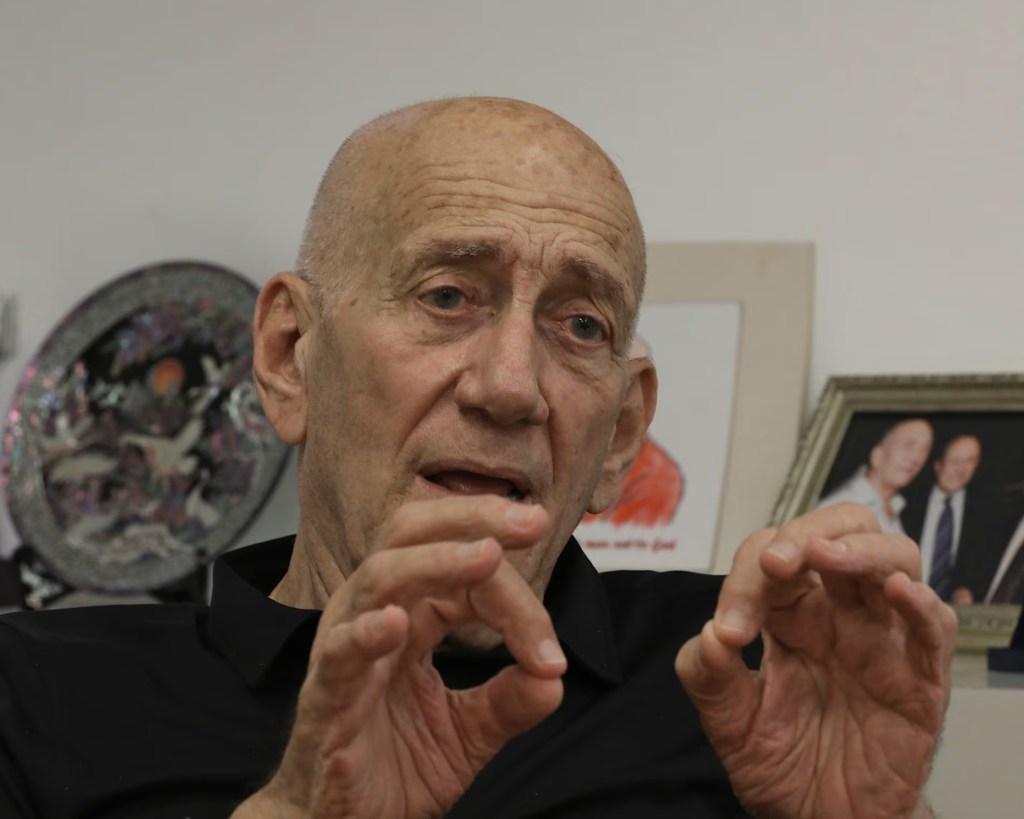
Ehud Olmert says forcing people into camp would be ethnic cleansing, and anger at Israel over Gaza war is not all down to antisemitism
“When they build a camp where they [plan to] ‘clean’ more than half of Gaza, then the inevitable understanding of the strategy of this [is that] it is not to save [Palestinians]. It is to deport them, to push them and to throw them away. There is no other understanding that I have, at least.”…
“It is a concentration camp. I am sorry,” he said, when asked about the plans laid out by Israel Katz last week. Once inside, Palestinians would not be allowed to leave, except to go to other countries, Katz said.
Katz has ordered the military to start drawing up operational plans for construction of the “humanitarian city” on the ruins of southern Gaza, to house initially 600,000 people and eventually the entire Palestinian population.
“If they [Palestinians] will be deported into the new ‘humanitarian city’, then you can say that this is part of an ethnic cleansing. It hasn’t yet happened,” Olmert said. That would be “the inevitable interpretation” of any attempt to create a camp for hundreds of thousands of people, he said.
Whoever you are and whatever communities you are in, please consider what is going on and what is planned in Gaza, please consider Olmert’s thoughts, and please consider a donation to the International Rescue Committee.
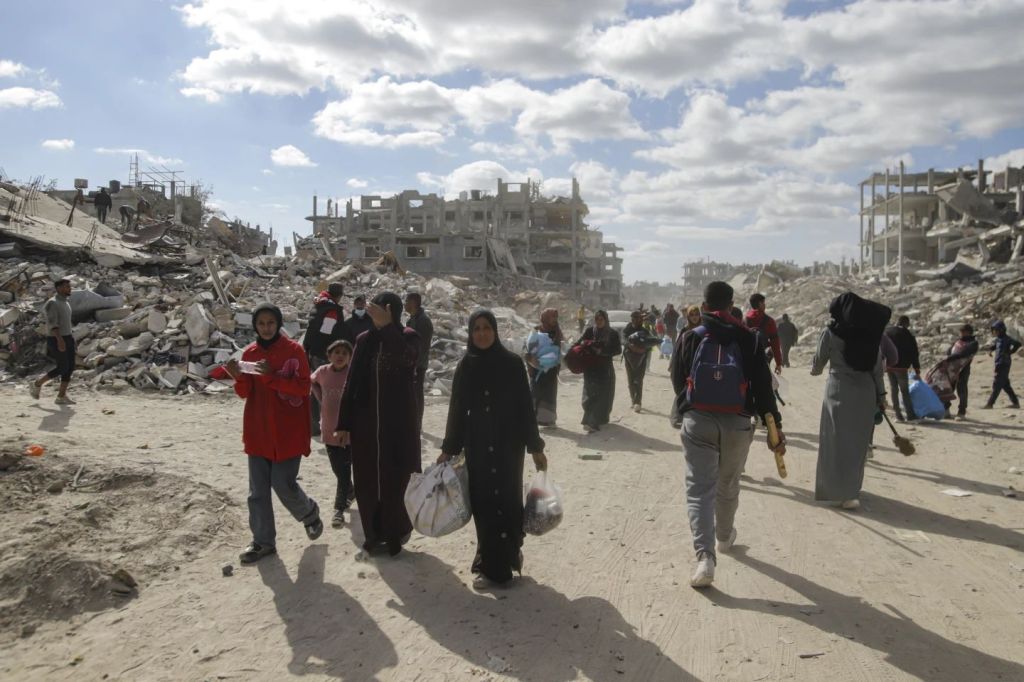
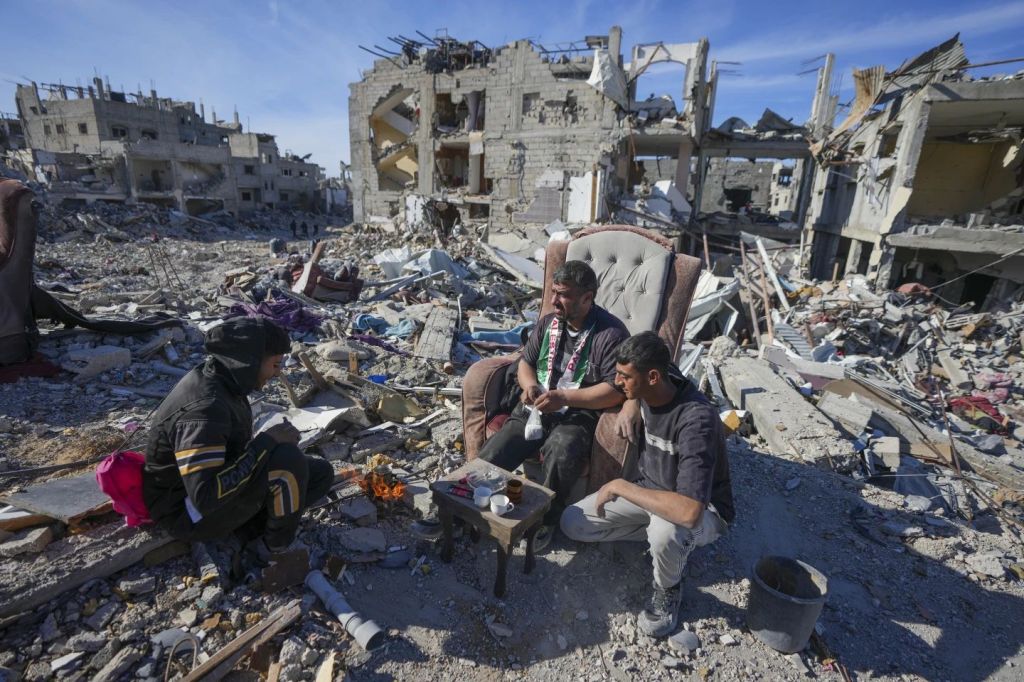
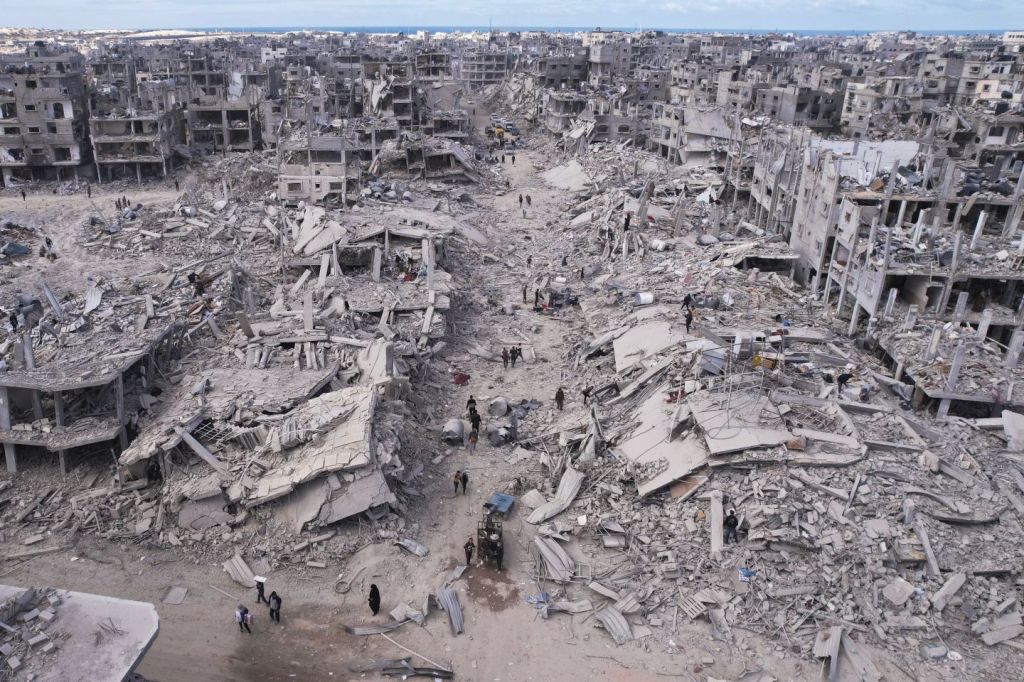
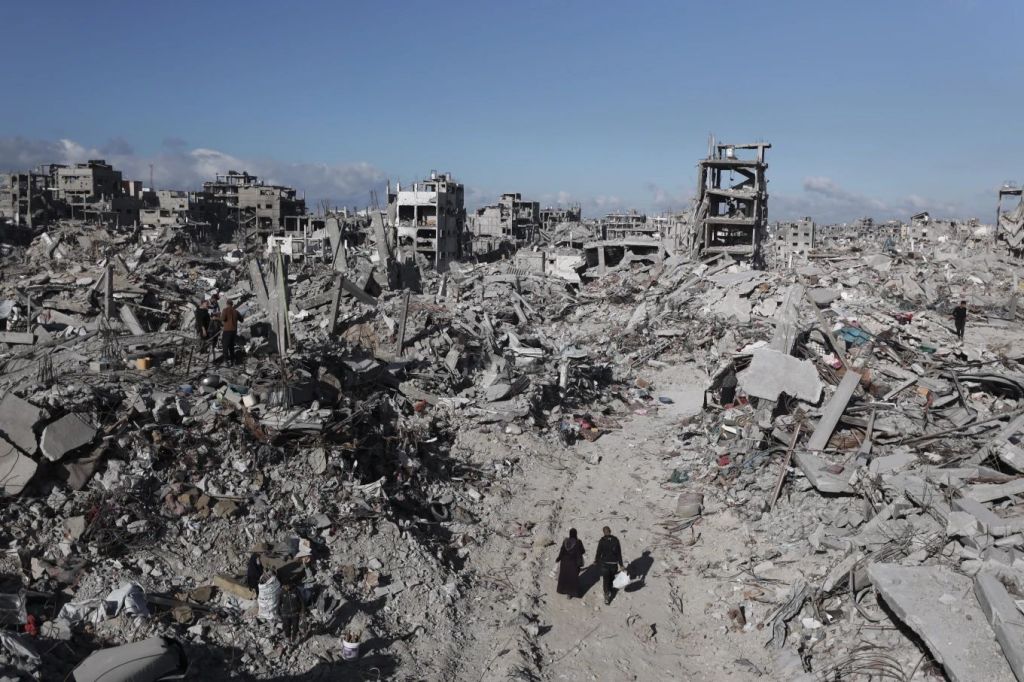
An aerial photograph taken by a drone shows displaced Palestinians returning to Rafah, a day after the ceasefire deal between Israel and Hamas came into effect, Gaza Strip, Monday, Jan. 20, 2025. (AP Photo/Mohammad Abu Samra)Palestinians walk through the rubble caused by the Israeli air and ground offensive in Rafah, southern Gaza Strip, Monday, Jan. 20, 2025. (AP Photo/Mariam Dagga)Displaced Palestinians return to Rafah, Gaza Strip, Monday, Jan. 20, 2025 a day after the ceasefire deal between Israel and Hamas went into effect. (AP Photo/Jehad Alshrafi)Hussein Barakat sits on a couch with two others, atop the rubble of his destroyed home a day after the ceasefire deal between Israel and Hamas came into effect, in Rafah, southern Gaza Strip, Monday, Jan. 20, 2025,(AP Photo/Abdel Kareem Hana)An aerial photograph taken by a drone shows displaced Palestinians returning to Rafah, a day after the ceasefire deal between Israel and Hamas came into effect, Gaza Strip, Monday, Jan. 20, 2025. (AP Photo/Mohammad Abu Samra)Palestinians walk through the destruction caused by the Israeli air and ground offensive in Jabaliya, a day after the ceasefire deal between Israel and Hamas came into effect, Monday, Jan. 20, 2025. (AP Photo/Abed Hajjar)
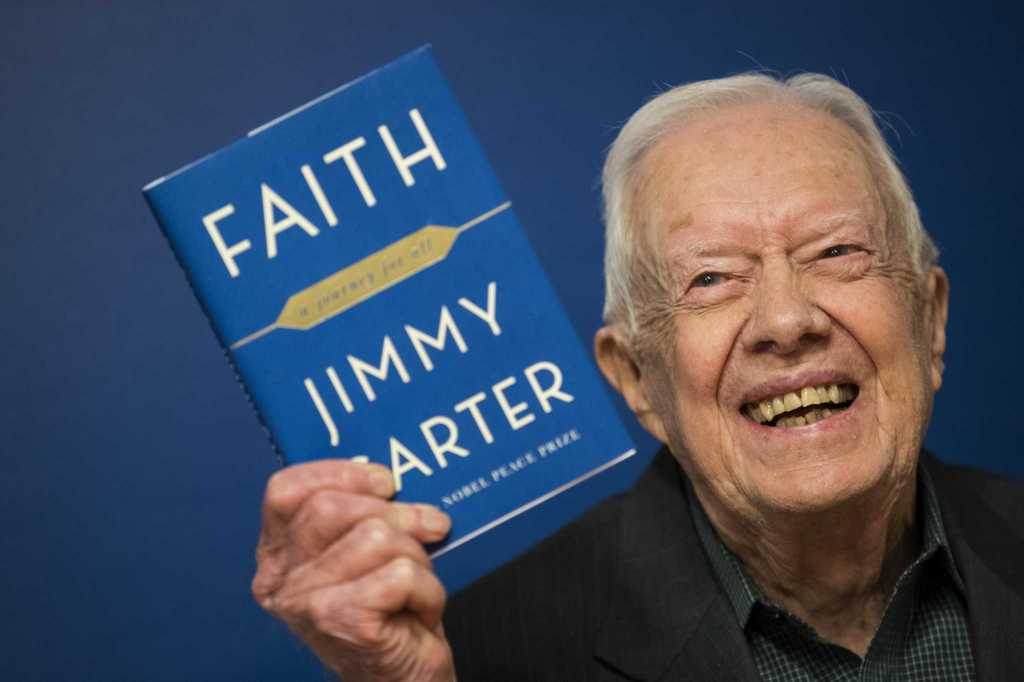
Above is Jimmy Carter. His presidency is seen by many as a mixed bag. His humanity was and is never in question. He is now 99 years old, and nobody in American history has had a more successful or shining post-presidency. As for his administration, he is a world leader who brokered a peace deal in the Middle East, a rare milestone.
Which is a segue to Benjamin Netanyahu, who spoke yesterday to Congress, at the invitation of Republican Speaker Johnson, a speech boycotted by many Democrats, a speech that resulted in a large and difficult protest by opponents of Israel’s Gaza war.
Netanyahu is a segue to Donald Trump, who Netanyahu desperately wants back in the White House, because Trump is his kind of president—corrupt, dangerously self-interested, inhumane, etc.—and because President Trump will allow, encourage and enable whatever scheme Netanyahu has to stay in office and avoid peace. Netanyahu correctly views Trump as his less smart but equally narcissistic but more powerful brother, one he can wrap around his finger.
Just as Trump has brought the worst out in many Americans, that is, the worst that was already there, Netanyahu has brought out the worst in some Jews. Nothing those Americans learn about who Trump is or what he has done or plans to do seems to bother them. Nothing those Jews learn about who Netanyahu is or what he has done or plans to do seems to bother them. Thus always with demagogues.
There are no easy answers, In America, we can elect Democrats for every office, from president on down, because Republicans who remain in the party are all in Trump’s thrall, whether or not that’s what is actually in their hearts and minds. For Jews, we can stand up for the humanity that Judaism in its best lights and moments represents, and which Netanyahu doesn’t.
While we are at it, consider Jimmy Carter as a role model. A man of genuine faith, a man whose life has been guided for 99 years by a calling of service. Those who think that either Trump or Netanyahu are people of genuine faith or are good role models can and will go on with that dangerous and devilish delusion. Some know better.
It is not easy being a creative personality, particularly one who is popular and commercially successful, and taking a position on controversial and divisive issues. The war in Gaza is such an issue.
Below is the message from Artists for Ceasefire along with the list of those who have signed on, 464 so far. Some of my favorites are there, probably some of yours too. Some of my favorites are missing, probably some of yours too.
What intrigues me is that this list of 464 includes some of the most famous and respected names in entertainment and the arts. Yet while Justin Timberlake’s DWI arrest is a top news item, this receives hardly any coverage.
Dear President Biden,
We come together as artists and advocates, but most importantly as human beings witnessing the devastating loss of lives and unfolding horrors in Israel and Palestine.
We ask that, as President of the United States, you and the US Congress call for an immediate de-escalation and ceasefire in Gaza and Israel before another life is lost. More than 36,000 people have been killed over the last 8 months, and over 83,000 injured* – numbers that any person of conscience knows are catastrophic. We believe all life is sacred, no matter faith or ethnicity and we condemn the killing of Palestinian and Israeli civilians.
We urge your administration, Congress, and all world leaders, to honor all of the lives in the Holy Land and call for and facilitate a ceasefire without delay – an end to the bombing of Gaza, and the safe release of hostages. Half of Gaza’s two million residents are children, and more than two thirds are refugees and their descendants being forced to flee their homes. Humanitarian aid must be allowed to reach them.
We believe that the United States can play a vital diplomatic role in ending the suffering and we are adding our voices to those from the US Congress, UNICEF, Doctors Without Borders, The International Committee of The Red Cross, and so many others. Saving lives is a moral imperative. To echo UNICEF, “Compassion — and international law — must prevail.”
Since Oct 7th, more than 45,000* bombs and missiles have been dropped on Gaza – resulting in one child being killed every 10 minutes.
“Children and families in Gaza have practically run out of food, water, electricity, medicine and safe access to hospitals, following days of air strikes and cuts to all supply routes. Gaza’s sole power plant ran out of fuel Wednesday afternoon, shutting down electricity, water and wastewater treatment. Most residents can no longer get drinking water from service providers or household water through pipelines…. The humanitarian situation has reached lethal lows, and yet all reports point to further attacks. Compassion — and international law — must prevail.” – UNICEF spokesperson James Elder
Beyond our pain and mourning for all of the people there and their loved ones around the world we are motivated by an unbending will to stand for our common humanity. We stand for freedom, justice, dignity and peace for all people – and a deep desire to stop more bloodshed.
We refuse to tell future generations the story of our silence, that we stood by and did nothing. As Emergency Relief Chief Martin Griffiths told UN News, “History is watching.”
*Updated as of 6/6/24
Artists
Aaron Frazer Aasif Mandvi Abbi Jacobson Adam Lambert Adam McKay Adeel Ahmed Afshan Azad Ahamed Weinberg Aida Rodriguez Aimee Lou Wood Aja Monet Alan Cumming Alana Hadid Alena Smith Alfonso Cuarón Ali Adler Alia Shawkat Allison Russell Alyssa Milano Amanda Diaz Amanda Gorman Amanda Seales Amandla Stenberg Amber Tamblyn America Ferrera Aminatou Sow Aminé Amy Herzog Anand Desai-Barochia Andrew Ahn Andrew Garfield Andrew Thomas Huang Anees Angela Dimayuga Ani DiFranco Anna Konkle Annie Lennox Anoushka Shankar Aria Mia Loberti Arian Moayed Ariana Grande Arooj Aftab ASAP Nast Ashley Lukashevsky Asim Chaudhry Atsuko Okatsuka Auliʻi Cravalho Augustus Prew Ava DuVernay Ayo Edebiri Bassam Tariq Bassem Youssef Bella Hadid Belly Ben Affleck Bilal Hasna Billy Bragg BLK ODYSSY Bobbi Salvör Menuez Bonnie Wright Boots Riley Bradley Cooper Brandon Holman Brian Cox Brian Eno Brigitte Lacombe Brittani Nichols Bruce Cohen Bryan Adams Busy Phillipps Cameron Russell Carl Clemons-Hopkins Caroline Polachek Cat Power Cate Blanchett Catherine Van-Davies Celeste Barber Celeste Yim Chani Nicholas Channing Tatum Charithra Chandran Charlotte Riley Charm La’Donna Chase Sui Wonders Chella Man Cherien Dabis Chicano Batman Chioke Nassor Christine Baranski Cindi Leive Clairo Clean Bandit Connie Britton Cora Emmanuel Cree Summer Cynthia Erivo Cynthia Nixon Dan Bucatinsky Dan Cogan Daniel Caesar Daniel Garber Daniel Goldhaber Darius Marder Dave Merheje David Clennon David Cross David Oyelowo Dawn-Lyen Gardner Deb Never Denée Benton Desi Perkins Dev Hynes Devery Jacobs Diany Rodriguez Dina Shihabi Diplo DJ Snake Dominic Cooper Dominique Fishback Dominique Thorne Drake Dua Lipa Durand Jones D.W. Moffett Dylan Mulvaney Ebon Moss-Bachrach Edie Campbell Eisa Davis Elliott Gould El-P Elsa Hosk Elvira Lind Elyanna Emily V. Gordon Emily Meade Emma Seligman Eric André Eugene Lee Yang Ewan McGregor Fai Khadra Farah Bsaiso Farah Nabulsi Farida Khelfa Fatima Farheen Mirza Fawzia Mirza Fayssal Bazzi Florence Pugh Fontaines D.C. Francesca Fiorentini Frank Ocean Fred Hechinger Fredwreck Geena Rocero Geoffrey Arend Gigi Hadid Girl Named Tom Gracie Abrams Hadar Cohen Hannah Ferguson Hari Nef Hasan Minhaj Helado Negro Hend Sabry Howard Rodman Ido Mizrahy Ilana Glazer Imaan Hammam Imad Izemrane Iman Vellani Indya Moore Ivan Jackson Jai Courtney Jalen Noble James Schamus James Wilson Jamila Woods Janelle Monáe Jared Goldstein Jas Lin Jay Hernandez Jay Shetty Jean Smart Jehane Noujaim Jena Malone Jenna Ortega Jenni Konner Jennifer Lopez Jennifer Saunders Jenny Yang Jeremy Allen White Jeremy Strong Jes Tom Jesse Peretz Jesse Williams Jessica Chastain Jessie Buckley Jim Jarmusch Joaquin Phoenix Jodi Balfour Joe Alwyn Joel Edgerton Joel Kim Booster Johan Lindeberg John Cusack John Early Jon Batiste Jon Stewart Josh Gondelman Jordan Peele Joy Sunday JP Saxe Judah Friedlander Judy Reyes Julianne Nicholson Julien Baker Juliet Stevenson Juliette Binoche Julio Torres Kaitlin Olson Kal Penn Kali Uchis Kamie Crawford Karen Sours Albisua Kathryn Grody Kathy Najimy Katie Gavin Kaytranada Kehlani Kendrick Sampson Kenza Fourati K.Flay Khalid Abdulla Kimiko Glenn Kimya Dawson Kirsten Dunst Kristen Stewart Kit Yan Kumail Nanjiani Kylie Sparks Laila Nabulsi Lauren Jauregui Lee Eddy Lena Waithe Leo Sheng Lily Gladstone Lindy West Lionel Boyce LisaGay Hamilton Livia Firth Liz Garbus Lola Kirke Lola Petticrew Lorenza Izzo Louisa Jacobson Lucy Dacus Luis Bordonada Lupita Nyong’o Macklemore Mae Martin Mahershala Ali Majid Jordan Malala Yousafzai Mandy Patinkin Manish Dayal Marcia Cross Margaret Cho Maria Cornejo Marisa Tomei Mark Ruffalo Mark Rylance Martin Starr Mary Harron Mary Elizabeth Winstead Massari Matt McGorry Matt Lieb Matt Rogers Maxwell Osborne May Calamawy Maysoon Zayid Maz Jobrani Megan Boone Mekki Leeper Melanie Martinez Melissa Barrera Mica Argañaraz Michael Cerveris Michael Dorman Michael Malarkey Michael Moore Michael Uzowuru Michael Shannon Michael Stipe Michelle Wolf Mickey Sumner Miguel MILCK Milla Jovovich Mimi Kennedy Mira Nair Miranda July Miriam Margolyes Misan Harriman Misha Collins Mishel Prada Mitra Jouhari Mo Amer Mohamed Diab Molly Bernard Mona Chalabi Monet McMichael Morgan Spector Mousa Kraish MUNA Mustafa Ahmed Nabil Elderkin Naomi Scott Natalia Cordova Natalie Merchant Naz Riahi Nelly Furtado Nia DaCosta Nicola Coughlan Nicole Ansari Cox Niki Takesh Nikoo Nooryani Nina Goodheart Noah “40” Shebib Noam Shuster-Eliassi Nori Reed Omar Apollo Omar Metwally Omar Sy Oscar Isaac Padma Lakshmi Paloma Elsesser Patti Smith Paul Elia Paul Walter Hauser Peter Berg Peter Gabriel Peter Rosenberg Phoebe Bridgers Poorna Jagannathan Poppy Delevingne Poppy Liu Priyanka Chopra Jonas Quei Tann Quinta Brunson Rachel McAdams Rachel Sennott Rachel Zegler Rain Phoenix Ramy Youssef Raveena Aurora Rianne Van Rompaey Richa Moorjani Richard Gere River L. Ramirez Riz Ahmed Roberta Colindrez Rolla Selbak Rooney Mara Rosaline Elbay Rosario Dawson Rose Abdoo Rosie O’Donnell Rowan Blanchard Run The Jewels Rupi Kaur Ruth Negga Ryan Coogler Ryan Piers Williams Saagar Shaikh Sabeen Faheem Sabine Getty Saif Mahdi Sam Gold Sam Richardson Sami Zayn Sammy Obeid Samora Pinderhughes Sandra Oh Sara Driver Sara Ramirez Sarah Bahbah Sarah Jones Sarah E. Jones Sarah Snook Sarah Sophie Flicker Sarita Choudhury Sasami Ashworth Sean Miura Sebastián Silva Selena Gomez Sepideh Moafi Shailene Woodley Shaka King Shayla Mitchell Shepard Fairey Sherry Cola Shruti Ganguly Silas Howard SimiHaze Simon Helberg Simon Rex Simone Ashley Simu Liu Sinéad Bovell Sinéad Harnett Smino Snoh Aalegra Sophia Bush Sophia Roe Stella Schnabel Stephanie Suganami Stephen Dillane Steve Way Suleika Jaouad Susan Sarandon Susan Wokoma Sydney Lemmon Tahar Rahim Tala Ashe Tanya Selvaratnam Tara Grammy Tarek Bishara Tavi Gevinson Taylour Paige Tchaiko Omawale Tessa Thompson Thursday Tien Tran Toby Haynes Tom Morello Tom Hardy Tommy Genesis Tony Kushner Tony Shalhoub Tracey Seaward Travon Free Tyler Johnson V (formerly Eve Ensler) Vic Mensa Victoria Monét Viggo Mortensen Vijay Iyer Vivek Shraya Wale Waleed Zuaiter Wallace Shawn Wanda Sykes Yara Shahidi Yasmeen Fletcher Yasmine Aker Yasmine Al Massri Yumi Sakugawa Yusuf Cat Stevens Zach Woods Zayn Malik Ziwe Zoe Chao Zoe Lister Jones 070 Shake
The primary reasons for Netenyahu pursuing his Gaza war, whatever the actual success of the strategies, are to eliminate Hamas, hide his failure in preventing October 7, stay in power, avoid going to jail, and others.
There is a secondary reason, a bonus. Bibi has made Biden look weak and ineffectual. Biden’s rhetoric has been equivocal, leaning towards Israel. His actions have been less equivocal, since his arming of Israel remains intact, whatever he says.
This is exactly what Bibi and right-wingers in his cabinet want. They want Trump. Bibi, an agile politician if not a world-class statesman, can see that all this is costing Biden support and votes, increasing the chance of a Trump victory in what will be a close election. When Trump is back in office, they believe, whatever they want, whatever they ask for, he will be on their side. Unlike Biden, who seems to be having trouble holding steady in the political winds.
So while there are reasons that Bibi has remained stubborn and needlessly brutal in Gaza, helping elect Trump would be another good outcome for him. A bonus.






 Bob Schwartz